
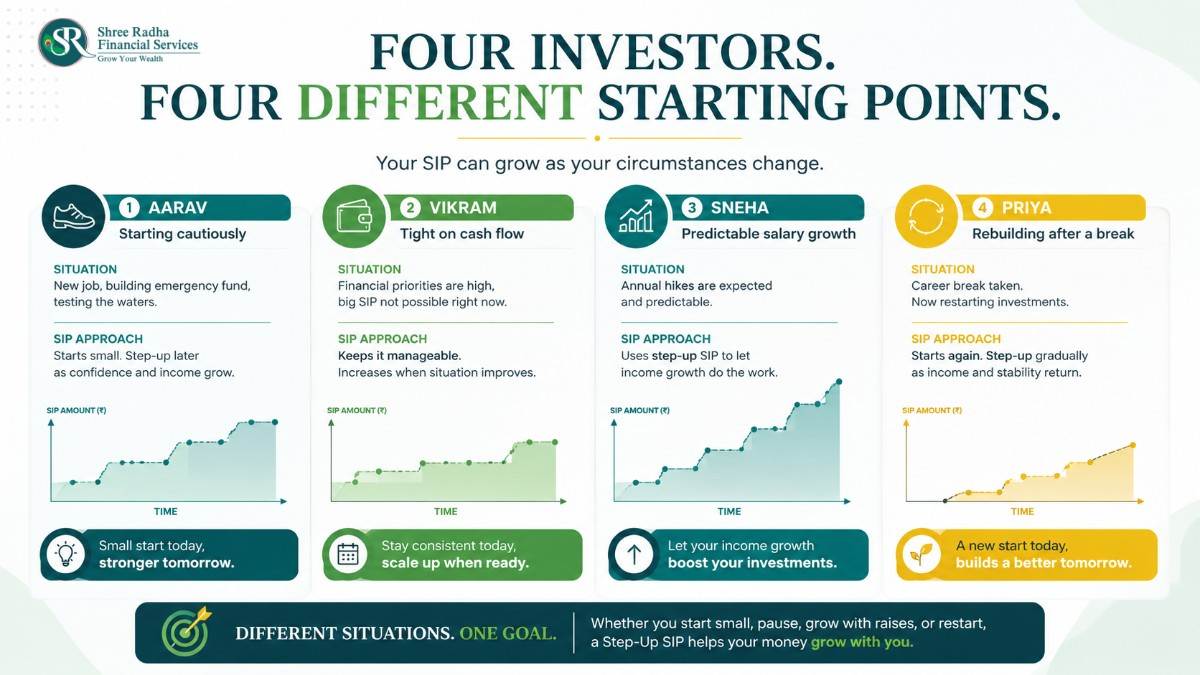
A step-up SIP is one of those ideas that sounds like a spreadsheet trick until you meet the people who actually need it. It isn’t really about percentages. It’s about the fact that nobody’s income, confidence, or life stays the same for twenty years — so why should their SIP amount? Here are four people who came to a step-up SIP (sometimes called a top-up SIP — platforms in India use both names for the same feature) from four completely different directions.
Aarav — Testing the Water Before Committing
Aarav Mehta is 26, works in IT services near City Light, and had been putting off investing for over a year — not because he didn’t have the money, but because every time he opened a mutual fund app, the market felt too unpredictable to trust with a large monthly commitment. Friends were investing ₹15,000–₹20,000 a month. Aarav didn’t feel ready for that kind of number.
What finally got him started wasn’t a bigger risk appetite. It was being shown that he didn’t need to decide his “real” SIP amount on day one. He started with a small SIP he barely noticed leaving his account, on the condition that it would increase automatically every year — a step-up SIP set to a fixed 10% annual increase. He didn’t have to keep deciding to invest more; the decision was made once, at the start, and the app did the rest.
A year in, Aarav told Paresh something telling: the fear he’d been carrying wasn’t really about the market. It was about committing to a number that felt permanent. Once the step-up SIP showed him that starting small and growing automatically was not only allowed but was actually the sensible way to do it, the fear mostly disappeared. For someone like Aarav, auto step-up works precisely because it removes the yearly re-decision — the SIP grows whether or not he feels ready that particular month.
Vikram — When the Situation Doesn’t Favour a Big SIP Right Now
Vikram runs a small textile trading unit near Ring Road, Surat. Unlike Aarav, he wasn’t nervous about markets — he’d been investing on and off for years. His problem was timing. He had recently taken on a business loan to expand capacity, and between the EMI and working capital needs, committing to a large, fixed SIP increase felt risky. Some years his business does well and cash is easy. Other years, especially right after an expansion, money is tighter.
For Vikram, a rigid auto step-up SIP that increased by a fixed 15% every single year regardless of his business cycle wasn’t the right fit — a bad year could force him to either dip into savings or pause the SIP entirely, which is worse for long-term compounding than a smaller, sustained increase. Instead, he chose a manual top-up SIP, reviewing his SIP amount once a year and deciding then, based on how the year had actually gone, whether to increase it by 20% in a strong year or hold flat in a lean one.
This is the piece people often miss about step-up SIPs: they don’t have to follow a fixed schedule. The mechanism — increasing your monthly investment over time — matters more than whether that increase is automatic or manually chosen. For someone with variable, business-linked income like Vikram, manual control isn’t a lesser version of step-up SIP. It’s the version that actually survives real business cycles without forcing a pause.
Sneha — Letting a Predictable Raise Do the Work
Sneha Joshi, 29, works in a corporate role near Vesu and has one of the more straightforward financial pictures Paresh sees: a stable salary with a fairly predictable annual increment, no major debt, and a clear goal — she wants to retire comfortably by 55 with enough to be financially independent of her children. Her situation didn’t call for complicated planning. It called for consistency.
Sneha set up an auto step-up SIP timed to her appraisal cycle — every April, when her salary revision typically comes through, her SIP increases by a fixed percentage automatically. She never has to remember to do it, never has to decide whether this is “a good year” to increase, and never sees the new, larger SIP amount as a fresh decision at all. It simply became part of how her salary revision worked, the same way a portion of every hike used to disappear into slightly higher spending before she set this up.
Sneha’s case is the textbook example of step-up SIP working exactly as intended: gradual, automatic, invisible effort, and a target that gets easier to hit every single year instead of harder.
Priya — Rebuilding After a Career Break
Priya Desai, 34, lives in Vadodara and had been investing steadily before she took a three-year career break after her second child was born. When she returned to work, her first instinct was guilt about the “lost years” — she felt behind, and wondered whether she should jump back in with an aggressive SIP to catch up quickly.
This is a pattern Paresh sees often enough with women returning to work after a career break that it’s become its own kind of conversation — women in India now hold SIP accounts that have grown dramatically in number over the past several years, and women in India now collectively hold ₹18 lakh crore in mutual funds, much of it built through exactly this kind of restart-and-grow approach rather than one dramatic catch-up move. Priya didn’t need to invest aggressively to make up for lost time. She needed a plan that respected where her income actually was right now, with room to grow as her career resumed its pace.
She restarted with a manageable SIP and chose a manual step-up for the first two years — reviewing it as her income stabilised post-return — before switching it to an automatic annual increase once her role and salary growth became predictable again. Her situation shows something important: step-up SIP isn’t only for people starting their first investment. It’s equally valuable for restarting one, without needing to punish yourself for the years in between.
What Is a Step-Up SIP (Top-Up SIP), and Auto vs Manual — Explained
Strip away the four stories above, and a step-up SIP is simple: instead of investing a fixed amount every month for the life of your SIP, you increase that amount at regular intervals — usually once a year — either by a fixed percentage (like 10%) or a fixed rupee amount (like ₹1,000 more each year). Most Indian AMCs and investment platforms offer this as a built-in feature, and you’ll see it called a step-up SIP or a top-up SIP interchangeably — they refer to the exact same mechanism.
Think of a step-up SIP like an escalator, and a manual top-up SIP like a staircase. On an escalator, you just need to step on — it carries you upward automatically, at a steady pace, without asking you to decide anything along the way. That’s auto step-up: set it once, and your SIP climbs on schedule whether or not you remember it exists. A staircase, on the other hand, still gets you up — but you decide when to take each step. That’s manual top-up: more control, better suited to a year where you’d genuinely rather pause on a landing than keep climbing at a fixed pace.
Neither is “better” in general. Auto step-up suits predictable, salary-linked income — like Sneha and, eventually, Aarav — because it removes the friction of a yearly decision. Manual top-up suits variable or recovering income — like Vikram’s business cycles and Priya’s return-to-work phase — because it lets the increase reflect what actually happened that year, not a fixed assumption made years earlier. Many investors, like Priya, use manual for a few years and switch to auto once their income settles into a predictable pattern.
What a Step-Up SIP Actually Builds — In One Table
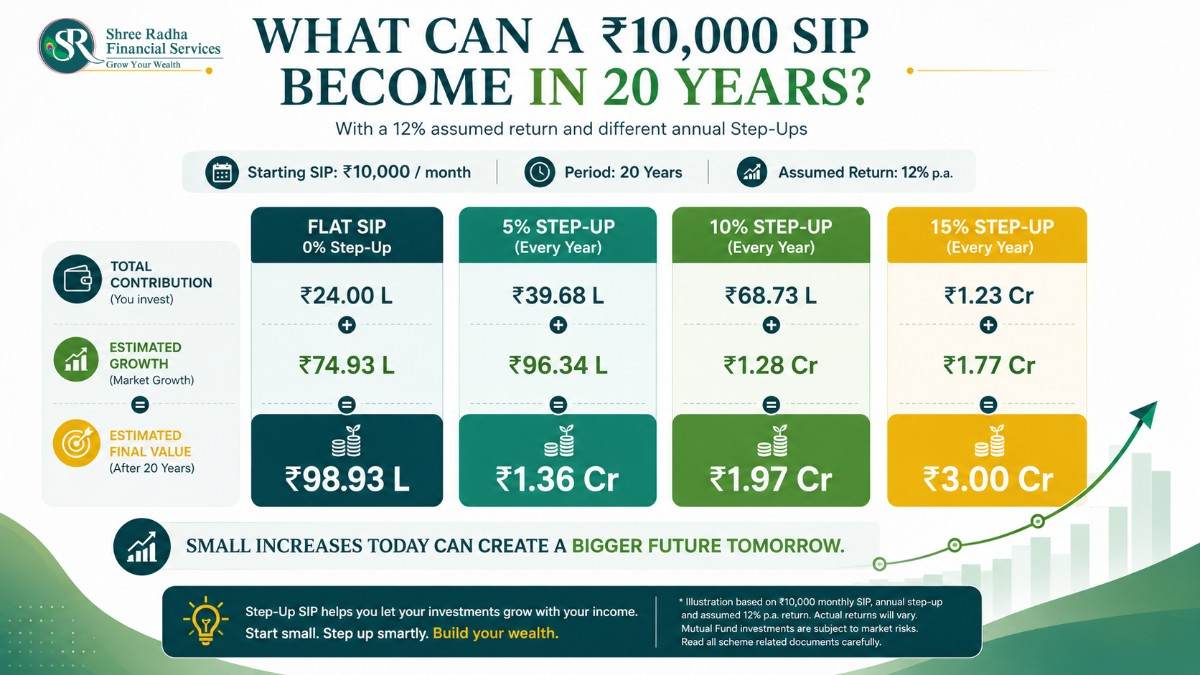
Here’s the same ₹10,000-a-month starting SIP, run for 20 years, compared at a flat rate and at three different step-up percentages — 5%, 15%, and 25% annual increase.
| SIP Type | Starting Monthly SIP | Annual Step-Up | Approx. Corpus (20 yrs) |
|---|---|---|---|
| Flat SIP | ₹10,000 | None | ~₹1.2 crore |
| Step-Up SIP | ₹10,000 | 5% | ~₹1.7 crore |
| Step-Up SIP | ₹10,000 | 15% | ~₹3.5 crore |
| Step-Up SIP | ₹10,000 | 25% | ~₹8.4 crore |
Illustrative figures based on Nifty LargeMidcap 250 TRI long-term return assumptions (~13-14% CAGR) over a 20-year tenure, for conceptual comparison only. Actual mutual fund returns are market-linked and not guaranteed. A detailed explainer on how the step-up/top-up feature works on most platforms is available from Angel One’s investor knowledge center.
Notice what doesn’t change across all four rows: the starting amount. Aarav, Vikram, Sneha, and Priya could all have started at the exact same ₹10,000 — what separated their outcomes over 20 years wasn’t willpower or income alone, it was whether the SIP was allowed to grow alongside them.
If You See Yourself in One of These Four
You don’t need to know your exact step-up percentage before you start. You need to know which situation you’re closest to right now — nervous but ready like Aarav, cash-constrained like Vikram, steady and predictable like Sneha, or rebuilding like Priya — and let that decide auto or manual for this year. You can always change it later, and most platforms let you switch between auto and manual step-up SIP (or top-up SIP) whenever your situation changes, without disturbing the SIP itself.
- Start with whatever monthly amount you can genuinely sustain today — the step-up is what does the heavy lifting later, not the starting number.
- If your income is predictable (salaried, stable business), set an auto step-up aligned to your appraisal or review cycle.
- If your income is variable (business, freelance, recent EMI/loan), choose manual top-up and review once a year, based on how the year actually went.
- Restarting after a gap? Start manual for the first 1-2 years, then switch to auto once your income stabilises — there’s no need to catch up all at once.
- Revisit your step-up percentage once a year, not more often — the whole point is that you shouldn’t need to think about it in between.
“Four people, four completely different reasons to need the same tool. That’s usually how it goes with step-up SIP — nobody needs it for the same reason twice, but almost everyone ends up needing some version of it.” — Paresh Chaudhary, Founder, Shree Radha Financial Services (SR Wealth)
Frequently Asked Questions
What is the difference between a step-up SIP and a top-up SIP?
None — they’re the same feature under two different names. Most Indian mutual fund platforms and AMCs use “step-up SIP” and “top-up SIP” interchangeably to describe a SIP that increases at regular intervals, usually annually, by a fixed percentage or a fixed rupee amount.
Should I choose auto step-up or manual top-up?
It depends on how predictable your income is. Auto step-up suits salaried investors with a regular annual increment — set it once and it runs on its own. Manual top-up suits variable or recovering income (business owners, freelancers, or anyone restarting after a gap), since you decide the increase each year based on what actually happened rather than a fixed assumption.
What percentage step-up should I choose — 5%, 15%, or 25%?
There’s no universal number. A reasonable starting point is to match your step-up percentage to your realistic annual income growth — a 5-10% step-up for steady salaried growth, higher only if your income genuinely grows faster than that, as it might for a business in an early growth phase. The table above shows how dramatically the outcome shifts even between 5% and 15%.
Can I pause or reduce a step-up SIP if my income drops?
Yes. Most platforms allow you to pause the step-up feature, reduce the SIP amount, or switch from auto to manual whenever your situation changes, without needing to cancel and restart the underlying SIP.
Is a step-up SIP only useful for people just starting to invest?
No — as Priya’s story shows, a step-up SIP is equally useful for restarting an investment journey after a gap, or for anyone whose SIP amount hasn’t kept pace with their income for years, even if they’ve been investing all along.
Not sure whether auto or manual step-up fits your situation? Shree Radha Financial Services (SR Wealth) helps clients across Surat and Gujarat build a step-up SIP plan sized to how their income actually grows — not a generic percentage.
If you’ve been putting off starting altogether, our piece on the real cost of delaying your SIP by 5 years is worth reading alongside this one.
📞 +91 98791 13255 | ✉️ shreeradha.services@gmail.com | 🌐 www.srwealth.co.in
📍 Shop 33, Mira Nagar 2, Dindoli Road, Surat 394210
This article is also avalible on Medium: https://medium.com/@shreeradha.services/step-up-sip-how-10-000-month-can-grow-into-crores-6ff3286406ac
About the Author: Paresh Chaudhary is the founder of Shree Radha Financial Services (SR Wealth), an AMFI Registered Mutual Fund and SIF Distributor (ARN: 268390) and APMI Registered PMS Distributor (APRN: 05763) based in Surat, Gujarat. He also holds an IRDAI license for insurance solutions. Before founding SR Wealth roughly 3.5 years ago, he spent over 15 years at L&T. He is a mechanical engineering graduate of SVNIT Surat.
Disclaimer: This article is for educational purposes only and does not constitute investment advice. Mutual fund investments are subject to market risks; please read all scheme-related documents carefully. Shree Radha Financial Services (SR Wealth) is a distributor, not an investment advisor. The figures used are illustrative projections based on assumed rates of return and are not guaranteed outcomes. Names and details of Aarav, Vikram, Sneha, and Priya are illustrative composites, not real client identities. Please consult a qualified professional before making investment decisions.