
https://srwealth.co.in/archives/blog/alternative-investment-funds-indiaIndia’s investment landscape just got a powerful new option. SEBI has introduced the Specialised Investment Fund (SIF) — a new asset class designed specifically for investors who have outgrown traditional mutual funds but are not yet ready for the high ticket sizes of PMS or AIF. With assets already crossing ₹9,711 crore by early 2026, this new vehicle is gaining serious traction among informed investors.As one of Surat’s early AMFI Registered SIF Distributors, we at Shree Radha Financial Services have been closely tracking this emerging asset class for investors across Gujarat and India.
In this article you will learn:
– What is Specialised Investment Fund (SIF)?
– Why SEBI introduced SIF
– Difference between MF, SIF, PMS and AIF
– Who should invest in SIF
– Tax rules for SIF
– Who should NOT invest in SIF
“In my experience working with HNI clients since 2023, I have seen many investors struggle to find the right product between mutual funds and PMS. SIF fills this gap perfectly for clients with ₹10–50 lakh surplus looking for sophisticated strategies.” — Paresh Chaudhary, Shree Radha Financial Services
What is a Specialised Investment Fund (SIF)?
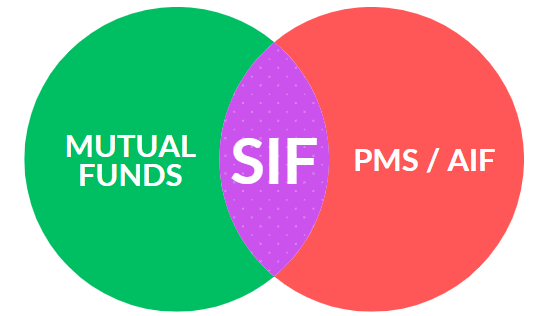
A Specialised Investment Fund is a regulated investment vehicle introduced by SEBI under the SEBI (Mutual Funds) Regulations. It sits between traditional mutual funds and premium investment products like Portfolio Management Services, offering greater flexibility while staying within a regulated framework.
SEBI introduced SIF for a clear reason. Many investors with ₹10–50 lakh to invest were moving toward unregulated, high-risk products in search of better returns and advanced strategies. SIF brings them back into a safe, regulated environment where fund managers can deploy more sophisticated approaches — without compromising investor protection.
The Specialised Investment Fund meaning is simple: more flexibility than a mutual fund, more accessibility than PMS or AIF.
Key Features and Rules of SIF Investments in India
Understanding SEBI SIF regulations is essential before you consider investing. Here are the most important rules:
Minimum Investment — The ₹10 Lakh Rule
- The SIF minimum investment amount is ₹10 Lakh at the PAN level across all SIF strategies of a single AMC
- This SIF ticket size India applies cumulatively — you can spread it across multiple strategies with the same AMC
- Systematic options like SIP, SWP, and STP are allowed — provided the total cumulative commitment reaches ₹10 Lakh
- Accredited investors are exempt from this minimum threshold
Investment Flexibility
- Fund managers can take up to 25% unhedged derivative exposure via derivatives
- This allows strategies like long-short positioning and sector rotation — not possible in traditional mutual funds
- Gross exposure cannot exceed 100% of net assets — keeping risk within defined limits
Liquidity Options
- SIFs can be structured as open-ended or interval funds
- Redemption options vary by AMC — daily liquidity or specific notice periods depending on the fund structure
- Each AMC must maintain a distinct brand identity and separate website for its SIF offerings as mandated by SEBI
SIF vs. Traditional Mutual Funds vs. PMS: Understanding the Gap
Here is a clean comparison of these three investment vehicles:
| Feature | Mutual Fund | SIF | PMS |
|---|---|---|---|
| Minimum Investment | As low as ₹500 | ₹10 Lakh | ₹50 Lakh |
| Target Audience | All retail investors | Informed HNIs | High Net Worth Individuals |
| Derivative Flexibility | Very limited | Up to 25% short exposure | High flexibility |
| Long-Short Strategies | Not allowed | Allowed | Allowed |
| Regulation | SEBI MF Regulations | SEBI SIF Regulations | SEBI PMS Regulations |
Traditional mutual funds operate under a long-only mandate — they can only buy and hold securities. They cannot short-sell or take significant derivative positions to profit from falling markets. This structural restriction is what makes SIF a genuine breakthrough for sophisticated investors.
Core SIF Investment Strategies Explained
SEBI has defined three primary subcategories under equity long short funds:
1. Equity Long-Short Funds
- Minimum 80% equity allocation
- Up to 25% short derivative exposure allowed
- Ideal for capturing both rising and falling market opportunities
- Best suited for investors who want equity growth with added downside protection
2. Equity Ex-Top 100 Long-Short Funds
- Focus on mid and small cap stocks outside the top 100 companies
- Designed to exploit market inefficiencies in the mid and small cap space
- Higher potential returns with higher volatility
- Suited for investors with a higher risk appetite and longer time horizon
3. Sector Rotation Long-Short Funds
- Concentrated bets on a maximum of 4 sectors at any given time
- Actively rotates between sectors based on macroeconomic outlook
- Captures sector-specific momentum while shorting underperforming sectors
- Requires active fund management expertise
Beyond equity, Debt Long-Short and Hybrid Long-Short strategies also exist under the SIF framework — giving investors a wider range of risk-return profiles to choose from.
How Are Specialised Investment Funds Taxed?
SIF taxation follows standard mutual fund rules — no tax is levied at the fund level itself. Tax applies only when you redeem your investment.
Equity-Oriented SIF (65%+ equity exposure)
- Short-Term Capital Gains (held under 1 year): 20%
- Long-Term Capital Gains (held over 1 year): 12.5% above ₹1.25 lakh exemption
- Same as standard equity mutual fund taxation
Non-Equity / Debt-Oriented SIF
- Gains taxed as per your income tax slab rate
- No separate indexation benefit
- Same treatment as debt mutual funds post-2023 tax changes
Who Should Invest in a Specialised Investment Fund?
SIF is not for everyone — and that is by design. Here is the ideal investor profile:
Best Suited For
- Investors with investable surplus of ₹10 Lakh or more
- HNIs who have maxed out traditional mutual fund allocations
- Investors comfortable with moderate complexity and derivative strategies
- Those seeking downside protection along with equity participation
- Business owners, senior professionals, and NRIs looking for sophisticated wealth management
Proceed With Caution If
- You are a first-time investor unfamiliar with derivatives
- Your investment horizon is under 3 years
- You need guaranteed liquidity at short notice
- You are not comfortable with market volatility
Important note on minors: Minors can participate in SIF through a guardian, provided the ₹10 Lakh PAN threshold is maintained by the guardian.
How to Start Your SIF Investment Journey
Getting started with SIF is straightforward if you follow these steps:
- Step 1 — Complete KYC: Ensure your KYC is updated and CKYC compliant. Your PAN will be the reference point for tracking the ₹10 Lakh threshold.
- Step 2 — Choose the Right AMC: Compare strategies, track record of fund managers, and fee structures across AMCs that have launched SIF products.
- Step 3 — Select Your Strategy: Choose between Equity Long-Short, Ex-Top 100, or Sector Rotation based on your risk appetite and goals.
- Step 4 — Invest Through a SEBI-Registered Distributor: Always invest through a SEBI-registered mutual fund distributor or Registered Investment Advisor.
- Step 5 — Review Regularly: Review your SIF investment at least once every 6 months with your financial advisor.
Is SIF the Right Fit For Your Portfolio?
The Specialised Investment Fund is a genuine evolution in India’s investment ecosystem. Use this simple framework to decide:
- Do you have ₹10 Lakh+ to invest? → SIF is accessible to you
- Have you maxed your MF allocations? → SIF adds a new dimension
- Do you want downside protection? → SIF’s short exposure helps
- Are you comfortable with complexity? → SIF suits your profile
- Do you have a 3+ year horizon? → SIF can create real wealth
Frequently Asked Questions About SIF
Q: What is the minimum investment in SIF? A: The minimum investment in SIF is ₹10 Lakh at the PAN level across all strategies of a single AMC.
Q: Is SIF regulated by SEBI? A: Yes. SIF is fully regulated by SEBI under the SEBI (Mutual Funds) Regulations framework.
Q: Can SIF use derivatives? A: Yes. SIF fund managers can take up to 25% unhedged short exposure via derivatives — something traditional mutual funds cannot do.
Q: Is SIF safer than PMS? A: SIF operates under stricter SEBI regulations than PMS with mandatory NAV disclosure — making it more transparent though not necessarily safer as returns depend on strategy and market conditions.
Q: Who should consider SIF? A: Investors with ₹10 Lakh+ surplus, who have already maximised mutual fund allocations and want more sophisticated strategies with downside protection.
At Shree Radha Financial Services, we help investors in Surat and across India navigate new and evolving investment opportunities like SIF with clarity and confidence. Whether you are an HNI, a business owner, or an NRI looking to optimize your portfolio — we provide personalized guidance backed by research and a client-first approach.Whether you are based in Surat, Gujarat or anywhere across India — connect with us for a personalized SIF suitability discussion.
Ready to explore if SIF belongs in your portfolio?
📞 Call us: +91 98791 13255
📧 Email: shreeradha.services@gmail.com
🌐 Visit: www.srwealth.co.in
About the Author:Paresh Chaudhary |Founder, Shree Radha Financial Services, Surat |AMFI Registered Mutual Fund & SIF Distributor — ARN: 268390 |APMI Registered PMS Distributor — APRN05763 |Investing since 2012 | BE Mechanical, SVNIT Surat | Ex-L&T (15+ Years)
This article is also available on Medium
for wider reading:https://medium.com/@shreeradha.services/what-is-sif-indias-new-sebi-investment-category-explained-for-hni-investors-7ed7eda17606
Disclaimer: This article is for educational purposes only and does not constitute investment advice. Investments in SIF are subject to market risks. Please consult your SEBI-registered financial advisor before investing.