
The SIF vs PMS question is the most important portfolio decision facing India’s HNI investors in 2026 — yet most high-earning professionals, business owners, and NRIs make this choice based on ticket size appeal rather than operational alignment with their actual financial life. This guide cuts through the confusion with a clear, compliance-accurate comparison of all three institutional instruments — Specialised Investment Funds, Portfolio Management Services, and Alternative Investment Funds — mapped to real investor profiles across India and the Gulf.
If you have outgrown standard mutual funds and are ready for the next level — this guide will show you exactly where to go and why.
“The biggest mistake I see HNI investors make is choosing an instrument based on its minimum ticket size rather than its operational fit. A ₹1 crore AIF is not better than a ₹10 lakh SIF — it is simply different. The right instrument is the one that matches your surplus, your liquidity need, and your tax situation.”
— Paresh Chaudhary, Shree Radha Financial Services, Surat
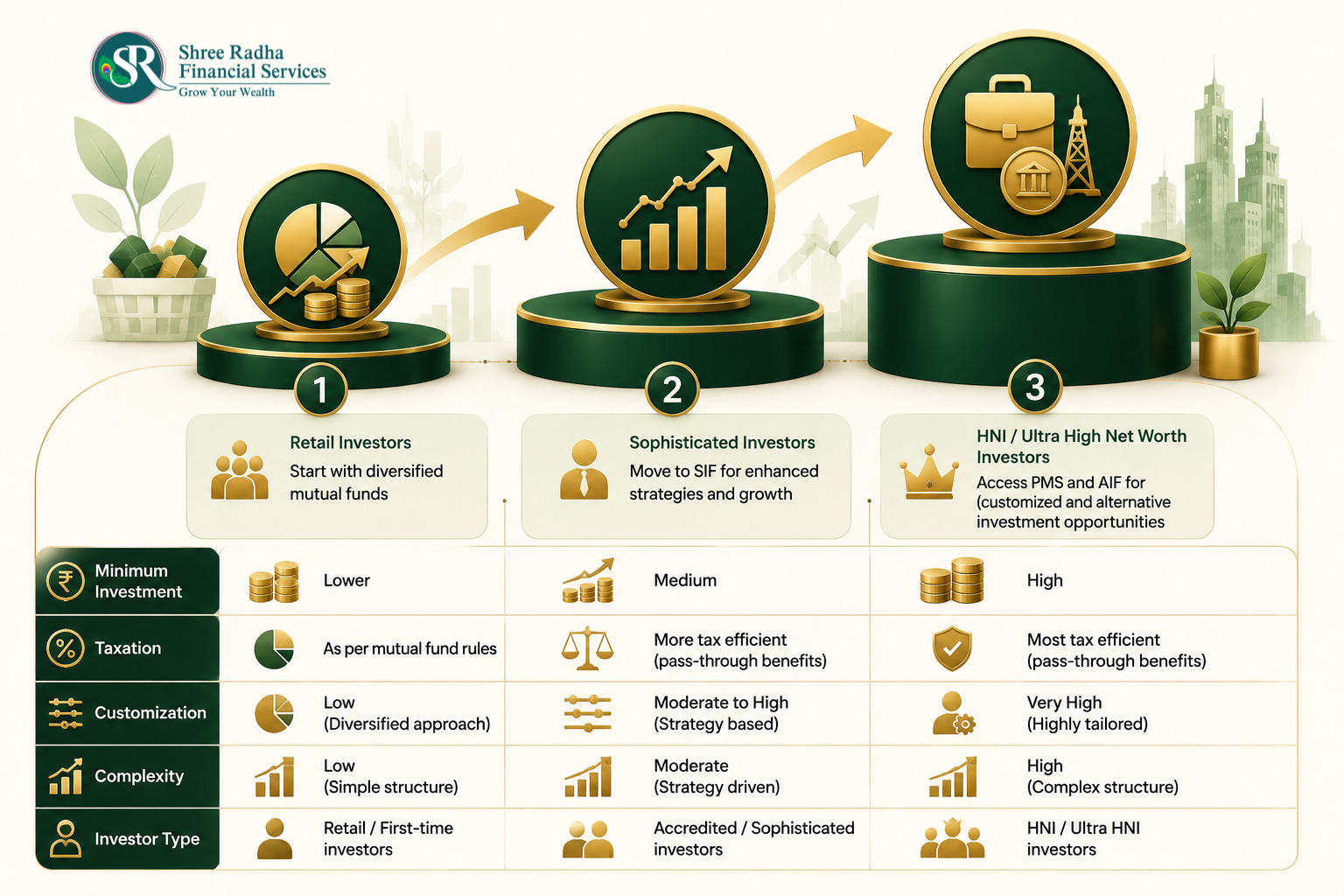
The New Wealth Spectrum: Upgrading Beyond Traditional Mutual Funds
Understanding the SIF vs PMS structural revolution
For two decades, India’s HNI investor had a simple but incomplete choice — mutual funds for accessibility or PMS for sophistication. The gap between these two was enormous. Mutual funds offered no advanced strategies. PMS required ₹50 lakhs minimum and a completely separate administrative structure. Investors with ₹10-40 lakhs of investable surplus had no institutional-grade option.
SEBI changed this permanently in April 2025 with the launch of Specialised Investment Funds. SIF fills the exact gap that sophisticated Indian investors had been waiting for — institutional-grade strategies including long-short equity, sector concentration, and multi-asset frameworks, accessible from ₹10 lakhs, regulated within the familiar mutual fund framework.
The market responded immediately. SIF AUM surged from ₹2,010 crore to ₹9,711 crore within months of launch — reflecting exactly how many investors were waiting for this middle ground. As of May 2026, over 24 distinct SIF strategies are active across 12 major AMCs, giving investors genuine choice within the category.
Why the Indian HNI strategy demands sophisticated risk engines in 2026
Standard mutual funds — excellent as they are for systematic long-term wealth building — operate under strict long-only mandates. They cannot take short positions to protect against market downturns. They cannot concentrate heavily in a single sector theme. They cannot deploy advanced derivative strategies that institutional investors use globally.
For a Gujarat diamond merchant with ₹25 lakhs of seasonal surplus, a Surat textile house owner with ₹75 lakhs of corporate investable capital, or a UAE-based NRI professional with USD-denominated savings — the need for instruments that go beyond basic long-only equity is clear. SIF, PMS, and AIF each address a specific tier of this need with distinct structures, minimums, and risk profiles.
Demystifying the Three Institutional Avenues
Specialised Investment Funds SIF: bridging the ₹10 lakh stratum
SIF is the newest and most accessible of the three institutional instruments. Regulated by SEBI within the mutual fund framework, SIF allows fund managers to deploy up to 25% of the portfolio in unhedged short derivative positions — providing genuine downside protection during market corrections that standard mutual funds cannot offer.
The pooled structure means all internal trading happens within the fund trust — tax-free at the transaction level. Investors pay capital gains tax only upon redemption of units, not on every internal rebalancing trade. This single structural advantage makes SIF significantly more tax-efficient than PMS for active strategy portfolios. For a complete understanding of how SIF works, our detailed SIF guide covers the full regulatory framework.
Consider Dr. Anand, a senior multi-specialty consultant in Ahmedabad, and his associate Vikram, who operates a manufacturing enterprise in Vadodara. They accumulated ₹25 lakhs from a clinical real estate transaction. Instead of locking it into a rigid multi-year product or leaving it in a low-yield savings account, they deployed into an equity long-short SIF strategy — achieving institutional downside protection while retaining a 15-day redemption window when needed.
Portfolio Management Services PMS: direct execution at the ₹50 lakh threshold
PMS is the instrument of choice for investors who want direct, named ownership of individual stocks in their personal demat account — not units in a pooled fund. Every stock in a PMS portfolio is registered in the investor’s own name. Every buy and sell decision is made by a dedicated portfolio manager with full transparency to the investor.
This direct ownership structure appeals strongly to business owners and executives who are comfortable with concentrated equity positions and want institutional management applied to their personal portfolio. Rajesh, an established textile house owner operating from Surat’s premium trading zones, had an investable surplus exceeding ₹75 lakhs and a clear preference for direct stock titles in the domestic infrastructure sector. His profile pointed squarely to an actively managed, high-conviction PMS framework. For a detailed PMS vs mutual fund comparison, our PMS guide covers the full framework.
The administrative reality of PMS is important to understand. Every rebalancing trade executed by the portfolio manager appears as a transaction on the investor’s personal PAN — triggering immediate short-term or long-term capital gains. For high-churn momentum strategies, this creates significant tax compliance complexity that SIF’s fund-level netting avoids entirely.
Alternative Investment Funds AIF: complex trajectories for the ₹1 crore segment
AIF represents the most sophisticated and illiquid tier of India’s alternative investment landscape. Category II AIFs cover private equity and private credit. Category III AIFs cover hedge fund strategies with complex leverage and derivative structures. The ₹1 crore minimum is deliberately enforced by SEBI to ensure these complex vehicles reach only investors with sufficient risk absorption capacity.
For most investors reading this guide — AIF is not the right immediate step. The lock-in periods, complexity, and capital requirements make AIF appropriate for ultra-HNI investors building generational wealth allocations — not for operational surplus deployment or medium-term wealth building. Our dedicated AIF guide covers Category II and III structures for those in this segment.
SIF vs PMS vs AIF: The Comprehensive Architecture at a Glance
| Parameter | Mutual Funds | SIF | PMS | AIF Cat III |
|---|---|---|---|---|
| Minimum Entry | ₹500 SIP | ₹10 Lakhs | ₹50 Lakhs | ₹1 Crore |
| Portfolio Structure | Pooled — long only | Pooled — up to 25% short allowed | Separate — direct stock ownership | Pooled — complex leverage |
| Liquidity | Daily — T+1 to T+3 | Up to 15 days notice | T+3 to T+7 typical | Lock-in — closed ended |
| Tax on Rebalancing | Fund level — tax free internally | Fund level — tax free internally | PAN level — every trade taxable | Category dependent |
| Tax on Redemption | 12.5% LTCG after 1 year | 12.5% LTCG after 1 year | Individual stock LTCG/STCG | Pass-through or fund level |
| NRI Eligible | ✅ Yes | ✅ Yes — standard KYC | ✅ Yes — NRE/NRO + PIS needed | ✅ Yes — GIFT City or domestic |
| Best For | All investors — foundation layer | ₹10-50L HNI upgrading from MF | ₹50L+ direct equity preference | ₹1Cr+ ultra HNI — illiquid tolerance |
Critical Operational Filters: Taxation Liquidity and NRI Compliance
Evaluating SIF vs PMS fiscal efficiency and capital gains structuring
The single most underappreciated difference in the SIF vs PMS debate is how taxation works during portfolio management — not just at redemption.
Inside an SIF, the fund manager can buy and sell stocks, rotate sectors, and execute short strategies completely tax-free within the fund trust. The investor pays capital gains tax only once — when they redeem their units. If held over one year, this is taxed at 12.5% LTCG — identical to standard equity mutual funds.
Inside a PMS, every single trade executed by the portfolio manager — every profit booking, every sector rotation, every rebalancing decision — registers as a transaction on the investor’s personal PAN card. A high-activity PMS strategy running 40-50 trades per year generates 40-50 individual capital gains entries on the investor’s tax return. For an investor in the 30% tax bracket, this creates both a significant tax cost and a substantial compliance burden that most investors discover only after their first year in PMS.
Liquidity matching: notice periods vs direct stock ownership
Liquidity requirements must be matched carefully to instrument choice. SIF strategies carry a notice period of up to 15 days for redemption — sufficient for most planned financial needs but not suitable for emergency same-day deployment. PMS typically allows redemption within T+3 to T+7 working days, though exit loads may apply in early exit scenarios.
AIF Category III structures often have hard lock-in periods of 1-3 years or operate as closed-ended funds with no early exit provision. For Gujarat business owners whose cash flow cycles can tighten unexpectedly — deploying operational surplus into AIF without understanding this lock-in is one of the most dangerous financial mistakes possible.
Cross-border mechanics: rules for NRI allocations from Gulf and West
NRIs across UAE, Saudi Arabia, Qatar, Kuwait, the UK, Canada, and the USA are fully eligible to invest in all three instruments — with specific operational requirements for each.
SIF follows standard mutual fund NRI onboarding — NRE or NRO account, standard KYC, and AMC-specific compliance. PMS requires a dedicated NRE or NRO banking framework and a Portfolio Investment Scheme account linked to a SEBI-registered custodian. AIF can be accessed through domestic NRI channels or increasingly through specialized structures inside GIFT City — which offers additional tax advantages for UAE-based investors specifically.
For UAE NRIs evaluating India investment options, our GIFT City guide and NRI Middle East investment guide cover the complete cross-border framework in detail.
Strategic Allocation Matrix: Mapping Your Portfolio Match
| Investable Surplus | Risk Appetite | Liquidity Need | Recommended | Why |
|---|---|---|---|---|
| Up to ₹9 Lakhs | Any | High | Mutual Funds SIP | Build foundation first — daily liquidity |
| ₹10L to ₹45L | Moderate to High | Flexible — 15 days acceptable | SIF | Advanced strategies — tax efficient — accessible |
| ₹50L to ₹1.5Cr | Aggressive | High — T+3 to T+7 acceptable | PMS | Direct ownership — concentrated equity — bespoke |
| ₹1.5Cr and above | Very Aggressive | Low — multi-year lock-in acceptable | AIF Category II or III | Private equity — pre-IPO — complex macro hedge |
Pitfalls and Real-World Scenarios in High-Ticket Investing
Three critical mistakes HNI investors make when selecting advanced instruments
Mistake 1 — The status trap allocation: HNI investors frequently commit ₹1 crore into an illiquid Category II AIF purely for the prestige of the ticket size — when a liquid SIF or concentrated PMS would have better served their actual cash flow needs. Instrument selection must be driven by financial fit, not social signaling within professional or business communities.
Mistake 2 — Underestimating PMS rebalance tax drag: Investors entering high-churn momentum PMS strategies discover only after their first year that every profit-booking trade appears individually on their PAN card. A PMS running 40 active trades per year generates 40 capital gains entries — each requiring individual tax calculation. For investors in the 30% bracket, this administrative and financial cost is significant and entirely avoidable with SIF’s fund-level netting structure.
Mistake 3 — Mismatching lock-in with business credit cycles: Gujarat business owners — diamond traders in Surat, textile manufacturers, chemical exporters from Bharuch — often deploy operational surplus into multi-year lock-in products during strong business periods. When their core trade credit cycles tighten unexpectedly, the locked capital is completely inaccessible. Always match investment liquidity to your realistic worst-case business cash flow scenario. For business-specific investment strategies, our Gujarat business owners guide and diamond merchant guide cover this framework in detail.
Starting Where You Are — The Upgrade Path
You do not need to choose between SIF, PMS, and AIF today. The most important principle in professional investment India strategy is to start where your current surplus justifies — and upgrade systematically as your investable corpus grows.
Begin with equity mutual fund SIP as your foundation. When personal investable surplus reaches ₹10 lakhs — evaluate SIF. When it reaches ₹50 lakhs — evaluate PMS. When it exceeds ₹1.5 crore — explore AIF with appropriate guidance.
This sequential upgrade path — not a sudden jump to the most complex instrument available — is what separates investors who build sustainable generational wealth from those who make expensive, illiquid mistakes chasing sophistication before their surplus justifies it.
Our Approach at Shree Radha Financial Services
Navigating the SIF vs PMS decision requires aligning instrument choice with your individual tax bracket, business cash flow cycle, liquidity requirements, and long-term family goals. Shree Radha Financial Services holds both AMFI registration as a Mutual Fund and SIF Distributor — ARN 268390 — and APMI registration as a PMS Distributor — APRN05763. This dual registration means we can guide you across the complete spectrum from mutual funds through SIF and PMS without any conflict of interest toward a single product category.
This article is also available on Medium for wider reading:
https://medium.com/@shreeradha.services/sif-vs-pms-vs-aif-which-investment-instrument-is-right-for-you-in-2026-07f0da8ca11f
Ready to architect your next-level wealth framework?
Stop relying on fragmented advice to structure high-ticket capital deployment. Connect with Shree Radha Financial Services for a confidential discussion on which instrument — SIF, PMS, or AIF — genuinely fits your surplus, tax bracket, and timeline.
Connect with us for a personalized portfolio discussion.
📞 Call/WhatsApp: +91 98791 13255
📧 Email: shreeradha.services@gmail.com
🌐 Visit: www.srwealth.co.in
📍 Shop 33, Mira Nagar 2, Dindoli Road, Surat 394210
About the Author
Paresh Chaudhary
Founder, Shree Radha Financial Services, Surat
AMFI Registered Mutual Fund & SIF Distributor — ARN: 268390
APMI Registered PMS Distributor — APRN05763
Investing since 2012 | BE Mechanical, SVNIT Surat | Ex-L&T (15+ Years)
Educational Disclaimer: This article is published by Shree Radha Financial Services — an AMFI Registered Mutual Fund & SIF Distributor (ARN: 268390) and APMI Registered PMS Distributor (APRN05763). All content is strictly for educational purposes only and does not constitute individualized investment advice. Mutual fund and market-linked investments are subject to market risks — read all scheme-related documents carefully before investing. SIF strategies may involve derivative exposures including short positions. AIF structures involve lock-in periods and liquidity restrictions. Tax treatment is based on current laws and subject to change. Please consult a qualified tax professional before investing.