
Ramesh sits on his balcony in Adajan, Surat, watching the evening lights of the textile hubs below. At 48, life feels structured and comfortable. He earns ₹1.2 lakh per month at a reputable textile firm, has ₹35 lakh saved across fixed deposits and PPF, owns his flat, and has been telling himself for years — ₹5 crore is a good enough target for retirement. He feels secure.
That security is a dangerous illusion.
Ramesh is not reckless. He is not lazy. He is simply planning with his eyes closed — looking at today’s cost of living and assuming it will hold steady for the next two decades. It will not. And by the time the gap becomes visible, it will be very difficult to close.
“I meet Ramesh every week — different name, same story. A salaried professional in Surat or Ahmedabad who has been disciplined, saved well, owns a home, and genuinely believes they are on track. The number they have in mind feels large today. What they have not calculated is what that number will actually buy them twenty years from now. That conversation — when the inflation reality lands — changes everything.”
— Paresh Chaudhary, Founder, Shree Radha Financial Services, Surat
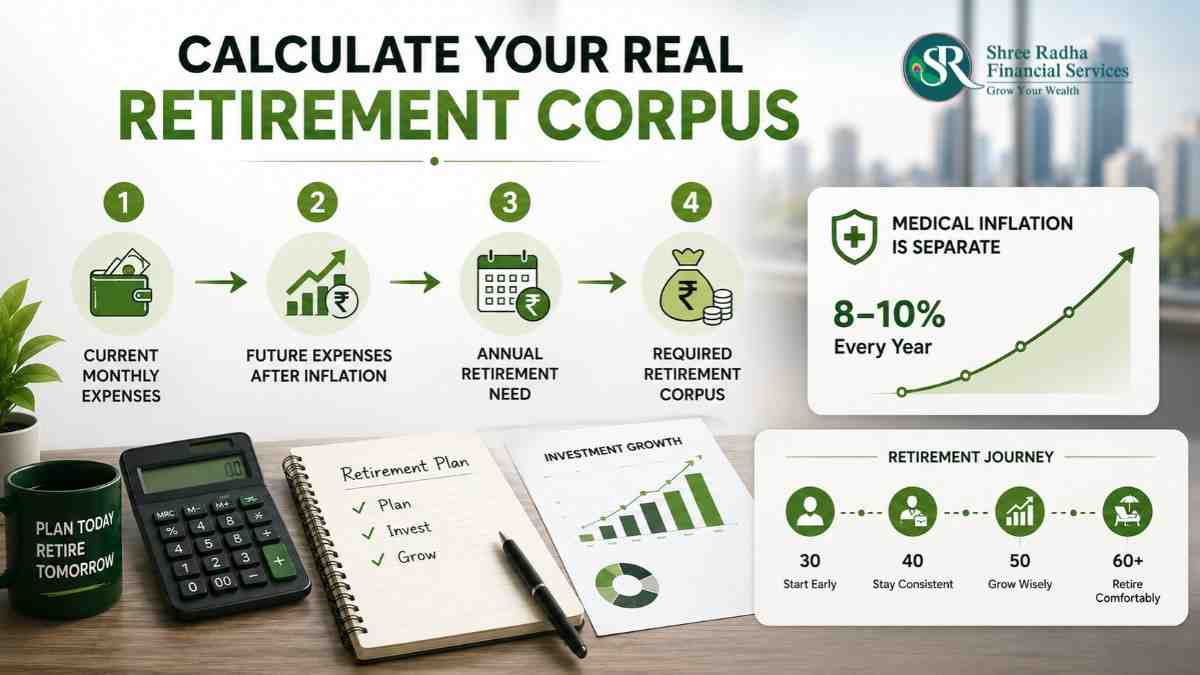
Why ₹5 Crore May Not Be Enough — Retirement Planning Surat Reality Check
₹5 crore sounds like generational wealth to most salaried professionals in Surat and Ahmedabad. But retirement planning in Surat requires looking at one number that most people completely ignore — inflation.
A monthly household expense of ₹75,000 today does not stay at ₹75,000. At a conservative 6% annual inflation rate — which India has consistently experienced — that same basket of expenses costs ₹2,40,000 per month twenty years from now. Your lifestyle has not changed. The price of living it has tripled.
A ₹5 crore corpus at a 6% withdrawal rate generates ₹2.5 lakh per month. That sounds comfortable today. But in twenty years, ₹2.5 lakh will feel like less than ₹80,000 in today’s money. The moment medical costs — which inflate at 8 to 10% per year, faster than general inflation — enter the picture, the comfortable retirement starts to crack.
Inflation Reality Check — Monthly Expenses Today vs 20 Years Later
| Monthly Expense | Today (₹) | After 20 Years at 6% Inflation (₹) |
|---|---|---|
| Household & Groceries | 30,000 | 96,214 |
| Medical Insurance Premium | 6,000 | 19,243 |
| Rent Equivalent / Maintenance | 8,000 | 25,657 |
| Utilities — Electricity, Wi-Fi, Fuel | 11,000 | 35,278 |
| Lifestyle & Dining | 10,000 | 32,071 |
| Annual Holiday (pro-rata monthly) | 10,000 | 32,071 |
| Total Monthly Need | 75,000 | 2,40,534 |
Corpus needed to generate ₹2,40,534 per month at 6% withdrawal rate: ₹4.81 crore — with almost zero buffer for emergencies, medical events, or longevity beyond 80.
So ₹5 crore is not a comfortable target. It is a bare minimum — and only if everything goes according to plan.
How to Calculate Your Actual Retirement Corpus — Retirement Planning Surat Formula
Do not pick a number from a conversation with a friend or a casual online calculator. Your retirement corpus calculation must be personal, inflation-adjusted, and built on four clear steps.
Step 1 — Identify your current annual expenses: Take your total yearly cost of living and remove items that stop at retirement — home loan EMIs, children’s school fees, commuting costs.
Step 2 — Apply inflation: Project that annual cost to your retirement year using a minimum 6% inflation rate. For medical costs, use 8 to 10% separately.
Step 3 — Apply safe withdrawal rate: Divide your inflated annual expense by your planned withdrawal rate — typically 4% to 6% depending on your asset allocation post-retirement.
Step 4 — Add separate buffers: Medical corpus, family milestone corpus, and emergency fund — these must sit outside your lifestyle retirement pool entirely.
For Ramesh — inflated annual expense of ₹28.8 lakh divided by 6% withdrawal rate gives a base corpus requirement of ₹4.8 crore. Add ₹1.2 to ₹1.5 crore for a separate medical corpus. His real target is not ₹5 crore — it is closer to ₹6.5 crore. And he has ₹35 lakh saved at 48.
Priya’s Story — The Risk of Investing Without a Destination
Priya is 34, works as a software professional in Ahmedabad, and takes home ₹95,000 per month. She reads market news, invests ₹15,000 every month in equity mutual funds through SIP, and feels proactive about her financial future.
But Priya is making the same structural error as Ramesh — just from the other end of the age spectrum.
She has no target corpus number. She does not know if ₹15,000 per month is enough or dangerously inadequate. She is building a portfolio without knowing the size of the house she needs to build. Without an inflation-adjusted retirement target, she cannot know whether her SIP amount needs to double — or triple — over the next decade.
Priya’s mistake is not laziness. It is the absence of a plan. Priya is driving at speed without a destination — and for retirement planning Surat professionals at her age, this is the most common and costly mistake.. And in retirement planning, arriving somewhere is not enough — you need to arrive at the right place with enough fuel to last thirty years.
For a full framework on how salaried professionals across Gujarat can start building a structured investment plan — read our Mutual Fund vs PMS guide which covers the right starting instruments for different income levels.
The Three Biggest Retirement Planning Mistakes Salaried Professionals Make
Mistake 1 — Treating today’s expenses as tomorrow’s baseline: Many professionals assume they will spend less after retirement because they will be older. In reality, free time increases leisure spending, medical costs rise sharply, and utility bills do not reduce. Retirement spending patterns are different — not smaller.
Mistake 2 — The linear wealth fallacy: Looking at a PPF balance or a property value and assuming it will grow linearly forever — ignoring taxation, lock-ins, liquidity constraints, and market corrections. Real wealth for retirement requires liquid, accessible, inflation-beating instruments.
Mistake 3 — Mixing heritage assets with liquid income: Holding an ancestral plot in Rajkot or a second flat in Vadodara that yields 2% rental income and assuming it will fund a dynamic monthly retirement lifestyle. Brick and mortar is illiquid. You cannot sell one room to pay your hospital bill.
Medical Inflation — The Retirement Calculation Nobody Does
This is where retirement planning Surat strategies completely break down for most families in Surat, Ahmedabad, and across Gujarat.
General consumer inflation runs at approximately 6% per year. Medical costs in India inflate at 8 to 10% per year — faster, more aggressive, and non-negotiable. A surgery that costs ₹4 lakh today costs ₹8 to 10 lakh a decade from now. Senior citizen health insurance premiums rise every renewal cycle. Post-60 diagnostic costs are entirely different from what a 40-year-old budgets for.
The standard: a 60-year-old in Surat today needs ₹1.2 to ₹1.5 crore as a separate medical corpus — completely independent from the lifestyle retirement pool. This amount must be held in liquid, accessible instruments — not locked into equity or real estate.
According to Income Tax India guidelines, senior citizens can claim deductions on health insurance premiums under Section 80D — up to ₹50,000 per year. But insurance alone is not enough. A dedicated medical corpus is non-negotiable for anyone planning retirement in urban Gujarat.
What a Realistic Retirement Plan Looks Like — By Age Group
Retirement planning Surat strategy must shift based on your distance from retirement. The approach at 28 is completely different from the approach at 48 — and both are valid starting points.
| Age Group | Monthly SIP Needed | Target Corpus | Key Focus |
|---|---|---|---|
| 25 – 35 | ₹15,000 – ₹25,000 | ₹5 – 6 Crore | Pure equity accumulation, aggressive step-up SIPs |
| 36 – 45 | ₹35,000 – ₹55,000 | ₹6 – 7 Crore | Balanced allocation, debt rebalancing, separate child milestone fund |
| 46 – 55 | ₹70,000 – ₹90,000 | ₹7 – 8 Crore | Capital protection, debt elimination, liquidity planning, bucket strategy |
The compounding reality is stark. Starting at age 30 with ₹20,000 per month at 12% compounded return builds approximately ₹7 crore by age 60. Starting the same investment at age 40 requires ₹70,000 per month to reach the same target. Waiting one decade multiplies your required monthly investment by more than three times.
Which Instruments Actually Work for Retirement Corpus Building
No single instrument does all the heavy lifting. Effective retirement planning in Surat — or anywhere in Gujarat — requires a structured mix.
Equity and Hybrid Mutual Funds serve as the primary engine for long-term inflation beating growth. Over 15 to 20 year horizons, equity has historically outperformed all traditional debt instruments in real terms. For NRI investors planning a return to Surat or Ahmedabad, our Middle East NRI Investment Guide covers how to structure India-based retirement corpus from abroad.
PPF — currently yielding 7.1% tax-free with a 15-year lock-in — provides an excellent risk-free debt foundation for the conservative portion of the retirement pool. It is not sufficient alone, but as a structural base it is hard to beat for salaried investors in the 30% tax bracket.
NPS gives you equity and debt choices in one structure — and a powerful tax incentive. The NPS tax benefit under Section 80CCD(1B) allows an additional ₹50,000 deduction over and above standard limits under the old tax regime — meaningful for high earners in Surat and Ahmedabad.
SIF — Specialised Investment Funds — for professionals and senior corporate employees with ₹10 lakh or more in surplus, SIFs offer institutional-grade active management with a tax-efficient pass-through structure. Read our complete SIF guide and SIF taxation guide for the full picture before considering this as part of your retirement mix.
Three Wrong Assumptions That Quietly Destroy Retirement Plans in Gujarat
For retirement planning Surat families and professionals across Gujarat, three wrong assumptions quietly destroy even the most disciplined savings plans.
“My flat will fund my retirement” — A home is a consumption asset. It is illiquid, expensive to maintain, and cannot generate the dynamic monthly income a retirement lifestyle requires unless you sell or rent it out entirely. For most families in Surat and Vadodara, the primary home is not a retirement instrument.
“My children will support me” — Relying on the next generation places an unfair financial burden on young careers navigating an increasingly volatile economy. True financial independence in retirement is the greatest gift a parent can give their children.
“I will work until 65” — Corporate restructuring, health slowdowns, technology disruptions, and company downsizing frequently force professionals into early retirement well before their planned timeline. Assuming active income continues at will is a plan built on an assumption you cannot control.
Frequently Asked Questions — Retirement Planning Surat and Gujarat
Can I rely entirely on EPF for retirement planning in Surat?
No. EPF is an excellent risk-free debt component — but it rarely keeps pace with real-world lifestyle and medical inflation on its own. For a comfortable urban retirement in Surat or Ahmedabad, EPF must be supplemented with equity exposure through mutual funds to ensure your corpus maintains real purchasing power over time.
How should I rebalance my portfolio as I approach 50?
In your late 40s and early 50s, begin systematically moving from pure equity funds into debt instruments or liquid options through a Systematic Transfer Plan (STP). The goal is to have at least three to five years of post-retirement expenses in safe, non-volatile instruments before you stop earning — so a market correction right before retirement does not derail your plan.
Should I clear my home loan using my retirement savings?
This depends on the interest rate differential. If your long-term investments are compounding at 12% while your home loan costs 8.5%, breaking your equity investments prematurely creates a net loss over time. Use surplus annual bonuses to prepay the loan — not your core retirement corpus.
How do I account for my children’s education and marriage separately?
These must sit in completely separate financial buckets — never clubbed with your retirement plan. If you dip into your retirement corpus to fund an expensive education or wedding, you cannot borrow for retirement later. Calculate children’s milestones independently, and build separate SIPs or lump sum allocations for each goal.
I am an NRI in Dubai planning to return to Surat or Ahmedabad for retirement. How does my calculation change?
As a returning NRI, account for currency transition, local inflation exposure, and domestic tax liabilities on your global wealth. Build an India-centric liquid portfolio in NRE or NRO accounts mapped to your planned return date. Your retirement corpus must be denominated and invested in India well before you return — not converted in a rush at the last moment. Read our detailed NRI return to India investment guide for a full framework.
Should I buy senior citizen health insurance even if I have a medical corpus?
Yes — both are needed and serve different purposes. A dedicated medical corpus of ₹1.2 to ₹1.5 crore covers expenses that insurance does not — diagnostics, home care, non-covered consumables. A solid health insurance policy protects your lifestyle corpus from being wiped out by a single major medical event. Use both together, never choose one over the other.
This article is also available on Medium for wider reading:
[Add Medium link after publishing]
Let Us Think Through This Together
Retirement planning looks different for every family in Surat, Ahmedabad, Vadodara, or Rajkot. If you want to run your numbers or simply talk through your situation — we are here. No pressure, no obligation. Just a conversation.
📞 Call/WhatsApp: +91 98791 13255
📧 Email: shreeradha.services@gmail.com
🌐 Visit: www.srwealth.co.in
📍 Shop 33, Mira Nagar 2, Dindoli Road, Surat 394210
Paresh Chaudhary
Founder, Shree Radha Financial Services, Surat
AMFI Registered Mutual Fund & SIF Distributor — ARN: 268390
APMI Registered PMS Distributor — APRN05763
Investing since 2012 | BE Mechanical, SVNIT Surat | Ex-L&T (15+ Years)
Educational Disclaimer: This article is published by Shree Radha Financial Services — an AMFI Registered Mutual Fund & SIF Distributor (ARN: 268390) and APMI Registered PMS Distributor (APRN05763). All content is strictly for educational purposes only and does not constitute individualized investment advice. Mutual fund investments are subject to market risks — read all scheme-related documents carefully before investing. Tax treatment is based on current laws and subject to change. Please consult a qualified financial and tax professional before investing. Process may vary by AMC.