
Amit is a Senior Vice President at a large manufacturing company in Ahmedabad. He has spent 22 years building something real — a career that commands respect, a compensation package that most professionals will never see, and a net worth that looks impressive on paper. Two properties in Ahmedabad, a third under construction in Gandhinagar, ESOPs vesting over the next three years, a salary above ₹1.8 crore, and annual bonuses that have been going into fixed deposits because there simply has not been time to think about anything else.
Last March, Amit exercised a portion of his vested ESOPs. He expected to feel wealthier. What arrived six weeks later was a tax demand he had not planned for — not a small adjustment, but a figure large enough to force him to break two fixed deposits and take a short-term loan against his second property. He had not known that exercising stock options triggers a perquisite tax at his full salary slab rate — 39% and above — before selling a single share. Nobody had explained it clearly. His HR had mentioned it in passing during onboarding years ago. His accountant filed returns but never modelled the cash requirement in advance.
Amit is not careless. He is not uninformed. He is exactly what most senior executives in India are — deeply skilled at managing corporate complexity, and genuinely time-poor when it comes to personal financial architecture. And that gap — between professional excellence and personal balance sheet rigour — is exactly what this article is written to address.
“In 15 years at L&T I worked alongside brilliant leaders who could read a corporate P&L in minutes and make decisions worth hundreds of crores. Most of them had never once sat down to audit their own personal balance sheet with the same discipline. That gap is not a character flaw. It is simply what happens when professional demands consume every hour of every day.”
— Paresh Chaudhary, Founder, Shree Radha Financial Services, Surat
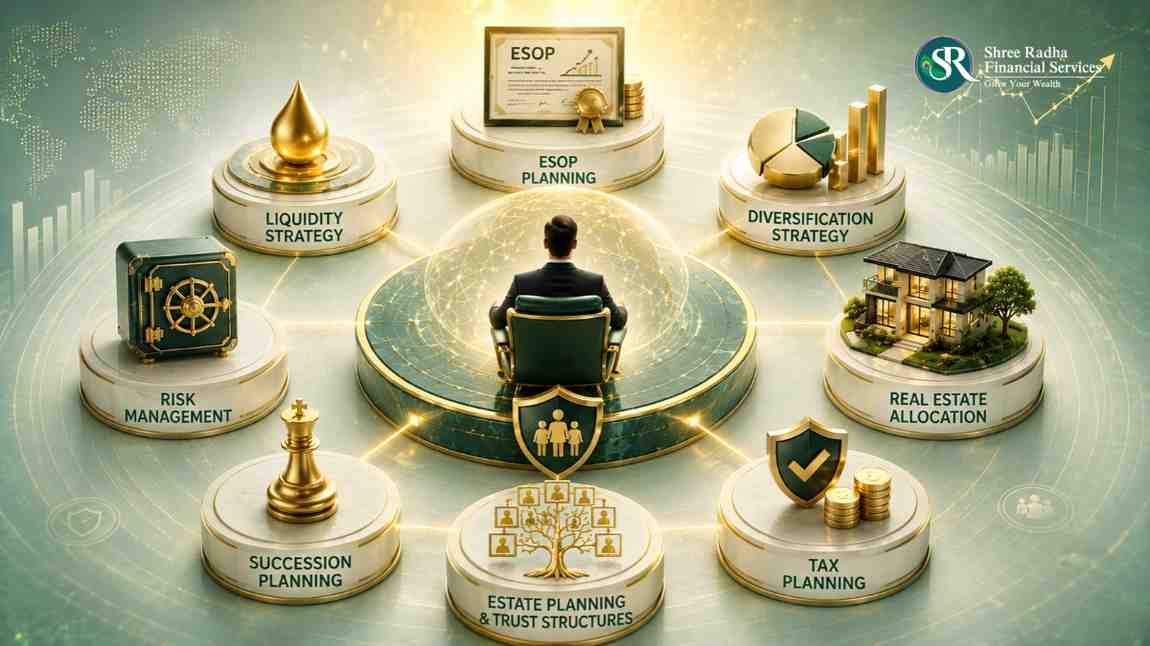
Where a CXO’s Net Worth Actually Sits Today — And Why It Looks Different Than It Feels
Most senior executives have been building wealth for fifteen to twenty years. The income is real. The assets are real. But when you map that wealth carefully — asset class by asset class — a pattern emerges that is far more concentrated and far more fragile than the total number suggests.
Executive wealth India at the CXO level typically distributes itself across five buckets. And the structural problem becomes visible the moment you look at all five together.
| Asset Class | Typical CXO Allocation | The Reality Behind the Number |
|---|---|---|
| Company Stock & ESOPs | 35% – 45% | Paper wealth — heavily taxed at exercise — cash outflow before liquidity arrives |
| Physical Real Estate | 20% – 25% | Illiquid — 2 to 3% net rental yield — cannot exit when opportunity arrives |
| Public Equities & Mutual Funds | 20% – 25% | Often scattered across 4 to 6 accounts — no consolidated view — coasting on autopilot |
| PMS / AIF / Alternatives | 5% – 10% | Significantly underutilised at this wealth level — institutional tools sitting unused |
| Fixed Income & Cash | 10% – 15% | FD taxed at 39% slab — real post-tax return near zero or negative after inflation |
Look at the first two rows alone. Company stock and real estate combined account for 55 to 70% of total net worth. Both are illiquid. Both are difficult to move quickly. And when you add the fact that salary, bonus, and ESOP are all flowing from the same single employer — career risk and wealth risk have become identical. A sector downturn, a corporate restructuring, or a sudden leadership transition hits income and net worth at exactly the same moment.
This is the structural fragility that sits quietly underneath every impressive CXO compensation package. And Amit — sitting in Ahmedabad with his fixed deposits, his three properties, and his unexercised ESOPs — is a very accurate picture of what executive wealth India actually looks like before anyone sits down to redesign it.
The Tax Bill That Arrives Before You Sell a Single Share
To understand what happened to Amit last March — you need to understand how ESOP taxation works in India. Most senior executives know ESOPs are valuable. Very few understand that the tax system treats them in two completely separate stages — and the first stage is the one that catches people completely off guard.
Amit was granted ESOPs at ₹120 per share several years ago. By the time he chose to exercise last year, the Fair Market Value of the stock had reached ₹900 per share. In Amit’s mind, that was extraordinary wealth creation — ₹780 per share in gains. What he had not fully modelled was the tax treatment at the moment of exercise.
The difference between grant price and Fair Market Value — ₹780 per share in Amit’s case — is treated entirely as salary income under Indian tax law. Not capital gains. Not a deferred liability. Salary income. Taxed at his full marginal slab rate of 39% and above, due immediately, in cash, before a single share is sold to generate the liquidity to pay for it. On a modest exercise of 10,000 shares, Amit’s tax liability was ₹30.4 lakh — arriving before he had converted any paper wealth into real money.
This is how the two stages of ESOP taxation work in India — and understanding both stages is the foundation of any serious executive wealth India strategy.
| Stage | Trigger Event | Tax Treatment | Effective Rate |
|---|---|---|---|
| Stage 1 | Exercise Date — converting options to shares | Perquisite — treated as Salary Income on the FMV minus grant price difference. Cash outflow on paper gains. | Up to 39%+ with surcharge |
| Stage 2 | Sale — Short Term under 12 months from exercise | Capital Gains on appreciation from FMV on exercise date to final sale price | 20% |
| Stage 2 | Sale — Long Term over 12 months from exercise | Capital Gains on appreciation from FMV on exercise date to final sale price | 12.5% |
The real damage in Amit’s situation was not the tax itself — it was the absence of a liquidity plan to meet it. Research on high net worth individuals in India shows that 14% maintain no structured emergency buffer at all. For a CXO with ESOPs vesting on a multi-year schedule, the absence of a dedicated liquidity tranche means every exercise event becomes a financial emergency — breaking long-term positions, taking short-term debt, or selling shares at the wrong moment in the market cycle.
Planning the cash requirement before the exercise date — not after the tax notice — is the single most important step in any executive wealth India framework. Always consult your CA before exercising options to model the exact perquisite tax liability specific to your grant structure and current FMV.
The Real Estate Trap and the Portfolio Nobody Is Watching
Priya is the COO at a technology company in Bangalore. Over twelve years of strong bonuses and disciplined saving, she has built what looks like a solid financial foundation — two premium apartments in Whitefield, a plot in the outskirts of Hyderabad purchased as an investment, SIPs running across four different mutual fund platforms, and a portfolio of direct equities spread across three demat accounts opened at different points in her career.
On paper, Priya’s net worth is impressive. In practice, it is extraordinarily difficult to manage, nearly impossible to view in one place, and built on a real estate base that is costing her more than she realises.
Her two Bangalore apartments generate a combined net rental yield of 2.4% after maintenance, property tax, and the occasional vacancy period. Her Hyderabad plot generates nothing — it simply sits, appreciating slowly in an area where liquidity is thin. When a high-conviction co-investment opportunity came to Priya last year through a former colleague — a structured private credit position requiring ₹1.5 crore liquid within 30 days — she could not participate. Not because the opportunity was wrong. Because not a single rupee of her net worth was accessible in that timeframe without triggering a distress sale.
The real estate blindspot in executive wealth India portfolios runs deeper than just rental yield. When physical property at 20 to 25% is combined with company stock at 35 to 45%, total illiquid exposure routinely crosses 60% of net worth. A net rental yield of 2 to 3% sits well below real inflation once maintenance costs, property management, and vacancy are factored in. And unlike a mutual fund unit or a listed equity — you cannot partially exit a property. You cannot sell one floor of an apartment when the market moves in your favour.
The fragmentation problem Priya carries is equally costly. Four mutual fund platforms. Three demat accounts. Investments made across different distributors over different years, with no consolidated view of what the overall allocation actually looks like today. Research on HNI investors in India shows that 40% of senior professionals are deeply dissatisfied with their personal investment returns — not because markets have failed them, but because nobody is actively watching. Investments coast on autopilot. Underperformers are never pruned. Asset allocation drifts far from what was originally intended. And a portfolio that has never been audited as a whole continues to grow in complexity without growing meaningfully in quality.
Priya is not making reckless decisions. She is making the same decision most time-poor executives make — choosing to focus on the professional role that demands her full attention, and trusting that the financial pieces will hold themselves together. Sometimes they do. Often, over ten to fifteen years, the cumulative cost of that inattention is very large indeed.
What the Data Is Telling Us — Four Blindspots Every CXO Should Know
Amit’s ESOP shock and Priya’s fragmented, illiquid portfolio are not isolated stories. They are patterns — consistent, measurable, and backed by data across India’s senior executive community. Understanding these four blindspots is the starting point for building any serious executive wealth India framework.
Concentration Risk — Career and Wealth Moving Together
For the majority of Indian CXOs, 60 to 70% of total personal net worth is anchored to a single corporate ecosystem. Salary, annual performance bonus, and unexercised stock options — all flowing from one company, one sector, one risk source. When that sector faces a cyclical contraction or a company goes through structural change, career income and personal net worth compress simultaneously. The two things a family depends on most become the same single point of failure.
The 40% Dissatisfaction Gap
Four out of ten high net worth professionals in India report genuine dissatisfaction with their personal investment returns. The reason is almost never market underperformance. It is structural — investments built up through ad-hoc decisions over many years, spread across multiple platforms, never reviewed as a unified whole, and generating returns well below what a consolidated, actively managed executive wealth India approach would deliver.
No Liquidity Buffer for Equity Events
14% of high net worth individuals in India maintain no structured emergency or liquidity buffer. For a CXO — where ESOP exercises, advance tax demands, and unexpected role transitions can each require ₹50 lakh to ₹2 crore at short notice — the absence of a dedicated liquid buffer means every large financial event becomes reactive. And reactive financial decisions at this wealth level are almost always expensive.
Tax Drag Destroying Real Returns
At an effective marginal rate of 34 to 42%, the gap between gross portfolio return and actual wealth creation is enormous. A portfolio generating 15% gross returns — structured entirely through instruments taxed at the full salary slab — can compound less real wealth than a thoughtfully structured 12% portfolio using tax-efficient instruments over the same period. Post-tax return is the only return that matters for building real executive wealth in India. Most CXO portfolios have never been evaluated through this lens.
What a Well-Structured Executive Wealth India Framework Looks Like
Moving from the concentration and fragmentation that Amit and Priya are carrying — to a portfolio that actually reflects the wealth level and the sophistication of a senior executive — is not a single transaction. It is a structural shift, done systematically over two to three years, with post-tax return and liquidity as the primary design principles throughout.
The first and most important move is building meaningful positions in liquid financial assets that are entirely uncorrelated to the employment sector. If a career is in technology — the personal portfolio should not be technology-heavy. If income is already tied to the fortunes of one company, the investment portfolio should be pulling in a different direction. This structural separation between career risk and wealth risk is the foundation that everything else is built on.
Generating liquidity from a concentrated portfolio requires a planned approach — not a forced sale. For ESOP positions, this means modelling the perquisite tax requirement ahead of the exercise date and holding a dedicated cash or liquid fund tranche specifically for that liability. For real estate, it means stopping further physical property accumulation and redirecting all new cash flows — bonuses, ESOP proceeds, salary surplus — into liquid financial instruments until the illiquid-to-liquid ratio reaches a healthier balance. Forced sales of either asset class at the wrong moment destroy years of compounding.
For portfolios with investable equity above ₹50 lakh, Portfolio Management Services offer high-conviction equity strategies held directly in a personal demat account — institutional-grade customisation that retail mutual funds cannot provide. For surplus above ₹1 crore, Alternative Investment Funds provide access to private credit and structured debt that does not correlate with public equity markets — genuine non-correlation for a portfolio already heavily exposed to listed equity through company stock. For those building from ₹10 lakh upward, the Specialised Investment Fund framework introduced by SEBI in 2025 bridges the gap between retail mutual funds and full PMS — offering institutional-grade multi-asset strategies at a significantly lower entry point. A detailed SIF vs PMS comparison helps clarify which instrument fits which stage of a CXO’s wealth journey.
The consolidation of a fragmented portfolio — six demat accounts, four platforms, three distributors — into a single unified view is not a luxury. It is a prerequisite for managing risk at this wealth level. You cannot rebalance what you cannot see. And you cannot make intelligent post-tax allocation decisions across a portfolio that exists in five different places with no common reporting.
Estate Planning — The Conversation Most CXOs Are Quietly Avoiding
Rahul is the CFO at an FMCG company in Mumbai. He is 51 years old, earns ₹2.4 crore annually, and has spent two decades building a personal net worth he estimates at ₹8 to 9 crore — spread across mutual funds, direct equities, two residential properties in Mumbai, a commercial property in Pune, and fixed deposits held across three different banks.
Everything is in his individual name. There is no Will. There is no nomination completed on two of the three bank accounts. The mutual fund folios have outdated nominees reflecting his parents — not his wife and children. The properties have no clear succession document in place. Rahul has been meaning to sort this for three years. It has simply never risen to the top of the priority list.
This is the estate planning reality for the majority of senior executives in India. The wealth is real. The succession architecture around it is largely absent. And the consequences of that absence — when they arrive — fall entirely on the family, not on the executive who postponed the conversation.
In India, when an individual passes away without a Will and with incomplete nominations, the estate enters a legal process called probate. For a complex estate — multiple properties across different cities, financial assets held with different institutions, company stock in a demat account — probate can take two to five years. During that period, family members cannot access frozen bank accounts, cannot transfer property titles, and cannot liquidate investments to meet immediate needs. The wealth that took two decades to build sits legally inaccessible while a court process runs its course.
For a CXO with an estate above ₹2 to 3 crore, three steps form the foundation of basic succession architecture. A registered Will is the non-negotiable starting point — clear, legally drafted, specifying distribution of every major asset class. Updated and consistent nominations across all financial instruments — mutual funds, demat accounts, bank accounts, insurance policies — ensure that each asset can transfer directly to the intended beneficiary without entering the estate altogether. And for estates above ₹5 crore where professional liability is a real consideration, a Private Family Trust provides a structural ring-fence — separating personal wealth from corporate exposure and enabling generation transfer with significantly reduced legal friction.
A Private Family Trust is not a tax avoidance instrument. It is an asset protection and succession tool. Assets transferred into a trust are no longer held in an individual name — meaning personal professional liabilities, legal disputes arising from corporate roles, or creditor claims cannot reach the family’s core wealth. The trust also eliminates the probate process for trust-held assets entirely — the trustee can act immediately on the terms of the trust deed without waiting for court clearance.
Rahul’s ₹8 crore estate — sitting entirely in his individual name with incomplete nominations and no succession document — is one unexpected event away from years of family hardship. That is not a planning failure. It is simply the result of professional demands consuming every hour, and succession architecture never feeling urgent until it suddenly is.
The right starting point is simple: a conversation with your CA and a qualified legal advisor. Draft the Will. Update every nomination. If the estate is above ₹5 crore and professional liability is a concern — discuss the Private Family Trust structure with your legal counsel to understand the setup process and costs specific to your situation. This is the one area of executive wealth India planning where the cost of delay is borne entirely by the people you are building the wealth for.
Who Should Build an Executive Wealth India Framework Now
A structured, institutional approach to personal wealth is specifically relevant for senior executives who recognise one or more of the following in their current situation.
This framework is directly relevant if:
- You are a CXO earning ₹1 crore or more annually with ESOPs forming a meaningful part of your compensation — and you have never modelled the perquisite tax requirement before an exercise event
- Your combined company stock and physical real estate exposure exceeds 60% of total net worth
- Your investments are spread across multiple platforms and demat accounts with no single consolidated view of total allocation and performance
- Your company is approaching a liquidity event — an IPO, a secondary promoter sale, or a senior leadership transition — that will require careful tax and allocation planning
- Your estate — Will, nominations, succession architecture — has not been reviewed or set up despite a net worth above ₹2 to 3 crore
- You have never evaluated your portfolio’s post-tax return as a primary metric — only gross yield
Proceed with caution and re-evaluate the timeline if:
- You carry significant high-cost personal debt — clearing that should come before deploying into institutional products
- Your liquidity needs require capital back within one to three years — equity and alternative instruments require a five-year minimum horizon to compound meaningfully
- You are seeking guaranteed nominal returns — all market-linked instruments carry risk and must be evaluated on a long-term post-tax basis
Frequently Asked Questions — Executive Wealth India
How is ESOP perquisite tax different from capital gains for Indian CXOs?
ESOP taxation in India operates in two completely separate stages. On the exercise date — when options are converted to shares — the difference between the grant price and the Fair Market Value is taxed as salary income at the full marginal slab rate, which can reach 39% or above with surcharges. This creates a real cash outflow before any shares are sold. When the shares are eventually sold, any appreciation from the FMV on the exercise date to the final sale price is taxed as capital gains — 12.5% for long-term holdings over 12 months, 20% for short-term. The perquisite tax at Stage 1 is the one most executives are unprepared for. Always consult your CA to calculate this liability in advance of any exercise decision.
How do I generate liquidity from an ESOP-heavy portfolio without disrupting long-term positions?
The most effective approach is to build a dedicated liquidity tranche — a separate allocation in liquid funds or short-duration debt — specifically sized to cover the projected perquisite tax on upcoming exercise events. This is planned 12 to 18 months before the exercise date, not reactively after the tax notice arrives. For executives approaching a large vesting event, partial staggered exercises across financial years can also reduce the peak perquisite tax burden in any single year. Your CA is the right person to model the exact approach for your grant structure.
What is the right approach for a CXO with heavy real estate exposure?
If physical property accounts for more than 40% of total net worth, the priority is to stop adding to it and redirect all new cash flows into liquid financial assets outside the employment sector. Forced distress sales of property are rarely necessary or advisable — the rebalancing happens gradually through directing bonuses, ESOP proceeds, and salary surplus into financial instruments until the overall ratio moves toward a healthier balance. Consult your CA on the capital gains implications of any property restructuring before making decisions.
At what stage does PMS make more sense than mutual funds for a senior executive?
SEBI mandates a minimum of ₹50 lakh for Portfolio Management Services. From a practical standpoint, the institutional benefits of PMS — direct stock ownership in a personal demat account, customised portfolio construction, and active style management — deliver their full value when total investable equity crosses ₹2 to 5 crore. Below that level, a combination of the new Specialised Investment Fund at ₹10 lakh entry and mutual funds provides institutional sophistication at a more appropriate scale. The right choice depends on corpus size, tax profile, and investment horizon — not just ticket size alone.
Why is a Private Family Trust relevant for a CXO — and when does it make sense?
A Private Family Trust is primarily an asset protection and succession tool. For a CXO whose professional role carries corporate liability exposure, a trust ring-fences personal and family wealth from any claims arising from that professional context. It also eliminates the probate process for trust-held assets — meaning family members can access and manage wealth immediately, without waiting years for court proceedings to conclude. It makes practical sense when net worth crosses ₹5 crore and when the estate includes multiple asset classes across different institutions. Setup costs and structure vary — consult your CA and a qualified legal advisor to evaluate what is appropriate for your specific situation.
How does an AIF fit into an executive wealth India portfolio?
An Alternative Investment Fund provides access to strategies that do not move in tandem with listed equity markets — private credit, structured corporate debt, and late-stage private equity. For a CXO whose salary, bonus, and company stock are all tied to equity market conditions, AIF creates genuine non-correlation in the personal portfolio. It is not about chasing higher returns — it is about building a portfolio where not everything falls at the same time. SEBI mandates a minimum investment of ₹1 crore. It is most relevant when total investable financial assets exceed ₹3 to 5 crore and when reducing public equity correlation is a specific portfolio objective.
This article is also available on Medium for wider reading:
[Add Medium link after publishing]
Executive wealth in India is built over decades of exceptional professional effort. Keeping it structured, tax-efficient, liquid where it needs to be liquid, and protected for the people it is meant for — that is a different kind of work entirely. If you want to sit down and look at your personal balance sheet with the same rigour you bring to the corporate one — we are here. No pressure. No obligation. Just a straightforward conversation.
📞 Call / WhatsApp: +91 98791 13255
📧 Email: shreeradha.services@gmail.com
🌐 Visit: www.srwealth.co.in
📍 Shop 33, Mira Nagar 2, Dindoli Road, Surat 394210
Paresh Chaudhary
Founder, Shree Radha Financial Services, Surat
AMFI Registered Mutual Fund & SIF Distributor — ARN: 268390
APMI Registered PMS Distributor — APRN05763
Investing since 2012 | BE Mechanical, SVNIT Surat | Ex-L&T (15+ Years)
Educational Disclaimer: This article is published by Shree Radha Financial Services — an AMFI Registered Mutual Fund & SIF Distributor (ARN: 268390) and APMI Registered PMS Distributor (APRN05763). Verify active credentials at amfiindia.com. All content is strictly for educational purposes only and does not constitute individualised investment, legal, or tax advice. Mutual fund investments are subject to market risks — read all scheme-related documents carefully before investing. Tax treatment is based on current laws and subject to change. Please consult a qualified CA and legal professional before making any financial or estate planning decisions.