
Introduction
Restarting SIP after stopping is a conversation we have almost every week — and it rarely starts with a fund name. It starts with a version of the same sentence: “I used to invest. Then life happened. Is it too late now?”
It isn’t. But how you go about restarting SIP after stopping matters far more than most people realise — enough that a well-meaning restart can undo itself just as easily as a poorly-timed one. This article walks through four real restart stories — different cities, different reasons for stopping, different mistakes waiting at the other end — and the framework we use to help each of them get it right, drawing on AMFI India’s own investor guidance on staying invested through market cycles.
If you’re weighing whether to put a lump sum to work or build it up gradually, our Hybrid SIF guide is a useful companion read once your SIP restart is in place.
“In just over three and a half years of building Shree Radha Financial Services, the restart conversation has come up more often than almost any other. Nobody who stopped a SIP did it lightly — and nobody restarting needs to be told what they already know. My job is to help them restart in a way that actually holds.”
— Paresh Chaudhary, Founder, Shree Radha Financial Services.
What You’re Actually Restarting For
Before any fund, any amount, any percentage — it helps to be honest about what a restart is actually for. It is rarely just “investing again.” It is a child’s higher education that’s now eight years closer than it was. It’s the retirement that no longer feels theoretical once you cross 40. It’s the ability to say yes to a daughter’s wedding without touching a fixed deposit meant for something else. It’s simply the peace of not depending entirely on a salary that stops the day you do.
A restart without a goal attached to it tends to drift — a SIP that exists but isn’t really going anywhere in the investor’s mind. A restart tied to something specific — “my daughter’s engineering fees in 2034,” “retiring with ₹80,000 a month by 58” — tends to survive the next bad market month, because there’s a reason to keep going that’s bigger than the NAV on any given day.
Rakesh, Adajan, Surat — The Guilt That Never Needed to Exist
Rakesh is 41, runs a small textile trading unit near Adajan, and until five years ago was a fairly disciplined SIP investor. Then his younger brother’s medical treatment came up — sudden, expensive, non-negotiable. Rakesh stopped his SIPs, redeemed what he had, and used every rupee toward it.
That liability is now fully cleared. Rakesh walked in not to discuss funds first, but to ask a question that had clearly been sitting with him: “Is it too late to build something for my retirement now?”
The honest answer is no — but the more useful thing to say first was that using that money for his brother wasn’t a financial failure. It was exactly what financial discipline exists for — to be there when life genuinely asks for it. The guilt he carried into the conversation was pushing him toward one specific instinct: invest aggressively, right now, to make up for the years that “went missing.” That instinct is where restarts usually go wrong.
Meera, Pune — Five Years Away, and the Trap of “Making Up for Lost Time”
Meera’s story is longer than most. A software professional in Pune, she paused her SIPs during a difficult job transition and simply never got back to it — five-plus years passed before she walked into a conversation about restarting. By then, she’d already built her own plan: take her accumulated savings and put it in as one large lump sum, “to make up for the five years I lost.”
This is the single most common misstep in restart conversations, and it comes from a completely reasonable place. If a break costs you money, the logic goes, a big lump sum should get it back faster. In practice, it’s a market-timing bet dressed up as discipline — betting an entire “catch-up” corpus on today’s valuation being a good entry point, with no averaging to protect you if it isn’t.
There’s a second, more dangerous version of this same instinct that we see often enough to flag on its own: investors trying to close a five-year gap in two years, chasing whatever product promises the highest recent return — an unregulated chit scheme, a “guaranteed” PMS pitch, a friend’s tip on a smallcap that “tripled last year.” The years lost to a SIP break are rarely recovered by finding a shortcut. They’re usually made worse by one — either through a product that quietly wasn’t what it claimed to be, or through a portfolio built entirely on the assumption that recent high returns are the market’s new normal, right before a correction resets that assumption hard.
We didn’t tell Meera not to use her savings. We restructured how. A measured portion went in as a lump sum — genuinely useful, since idle savings earning near-zero real return has its own quiet cost — but the larger share was redirected into a step-up SIP, starting modestly and rising every year. The five lost years weren’t recovered by one big bet or a hot product. They were recovered by rejoining rupee-cost averaging and giving compounding room to work again, starting now.
Sandeep, Ahmedabad — Fifteen Years, One Good Reason, and a Very Different Starting Point
Sandeep’s story is the one that most surprises people who assume a long gap means starting from nothing. A senior IT manager in Ahmedabad earning well into the ₹1.5 lakh-a-month range today, Sandeep stopped his SIPs at 32 to save aggressively for a home down payment. The home got bought. Then came school fees, a car, a parent’s medical need — and fifteen years slipped by without a single mutual fund folio being opened again.
At 47, Sandeep isn’t short on income. What he’s short on is time relative to where he wants to land — a comfortable retirement by 60, ideally with enough to help fund his daughter’s postgraduate studies abroad along the way. Thirteen years is still real runway, but it demands a different posture than someone restarting at 35 would need: a higher starting SIP relative to income, since there’s less time for compounding to do the heavy lifting, and a firmer commitment to not let the next “good reason” — and life will always offer one — become another fifteen-year gap.
Sandeep’s restart plan leaned on a strong opening SIP anchored to a specific number — not a round figure picked out of comfort, but one back-calculated from what his retirement corpus actually needs to be by 60 — with the step-up mechanism doing the rest of the work as his income continues to grow.
Arvind, Bangalore — Restarting So Cautiously It Barely Counted
Arvind’s mistake sits at the opposite end of Meera’s, and it gets far less attention because it doesn’t look like a mistake at all. After a business slowdown forced a pause in his late 30s, Arvind restarted two years later — but at nearly a quarter of his old SIP amount, entirely in a conservative hybrid fund, “just to be safe this time.”
Being cautious after a setback is a natural response. But at 42, with 16-plus years still ahead before retirement, that caution was quietly working against the one thing genuinely on his side: time. A restart that’s too small and too conservative doesn’t protect you from risk — it replaces market risk with the much larger risk of simply not building enough. Walking Arvind through what his corpus would look like at retirement under his current path versus a properly equity-heavy accumulation phase with a defined glide path later made the gap large enough that “playing it safe” stopped feeling safe at all.
What a Break Actually Costs — In Numbers, Not Guilt
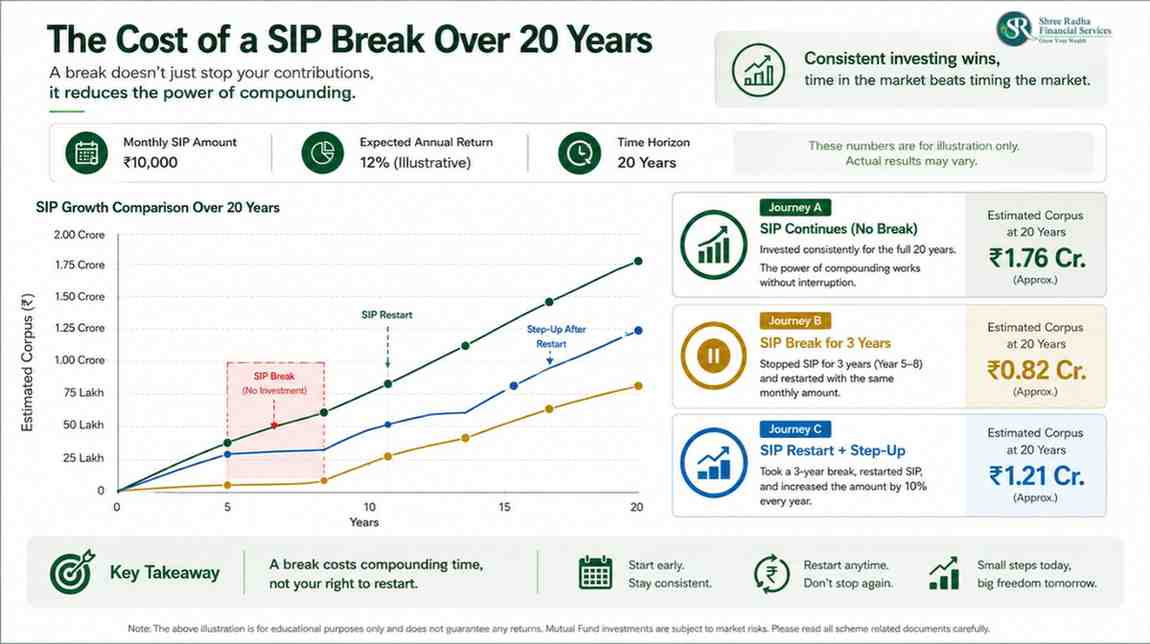
None of this is about self-blame — but a real number is far less paralysing than vague anxiety about “lost time.” Take a ₹10,000 monthly SIP running 20 years at a 12% long-term equity return, a fairly standard assumption for diversified Indian equity funds. Uninterrupted, that builds to roughly ₹96 lakh. A single multi-month pause during that period typically costs an investor somewhere in the ₹8–12 lakh range by the end — not because existing units disappear, but because of the units never bought during the pause, and the years those missed contributions never got to compound.
| Restart Approach | What It Gets Right | Where It Breaks Down |
|---|---|---|
| Large lump sum “catch-up” | Puts idle money to work immediately | Full exposure to a single entry point — no averaging cushion |
| Chasing a “high-return” product to catch up fast | Feels like it closes the gap quicker | Often unregulated or misunderstood risk; built on recent returns repeating, which they rarely do |
| Restart too small, too conservative | Feels emotionally safe | Doesn’t rebuild the corpus fast enough for the years remaining |
| Modest restart + annual step-up SIP | Rejoins rupee-cost averaging early; scales with income and confidence | Requires patience — no illusion of instantly “recovering” the gap |
The Tactical Reset — What to Actually Do Differently This Time
SEBI’s investor education material is a useful reference for understanding how SIP mandates work mechanically — but the decisions below are where most restarts are actually won or lost.
Should I continue my old SIP or start a new folio?
If the fund you were invested in earlier is still a sound, well-managed scheme in a category that fits your goal, there’s nothing stopping you from resuming the same SIP. But a restart is also a natural checkpoint to review whether that fund still belongs in your portfolio — performance, category, and your own goals may all have shifted. Don’t restart out of habit; restart out of a fresh decision.
Can I restart a paused or expired SIP online?
Yes — most fund houses and platforms let you reactivate a stopped SIP by submitting a fresh SIP registration for the same or a different scheme. If your mandate lapsed entirely after a long gap, you’ll set up a new one. The process is rarely the barrier; the decision of how much and where needs the actual care.
What happens if I stop my SIP for six months, or six years?
Your accumulated units stay fully invested and keep moving with the market regardless of how long the gap is — stopping the SIP doesn’t touch what you already own. What you lose is future contributions during that window, and the compounding those contributions would have earned from that point forward. There’s no penalty from the fund house for pausing, only the opportunity cost of time — which grows the longer the gap runs, as Sandeep’s fifteen-year story shows.
Is it better to invest a lump sum or increase my SIP after clearing debt?
Usually a blend, not an either/or. A modest, disciplined lump sum from savings that were otherwise sitting idle can genuinely help — the mistake is treating the lump sum as a shortcut to erase the entire gap in one move. A step-up SIP, rising 10% or so a year as income grows, tends to do the steadier, heavier lifting over time.
The 60-20-20 Rule — A Starting Point for How Much to Restart With
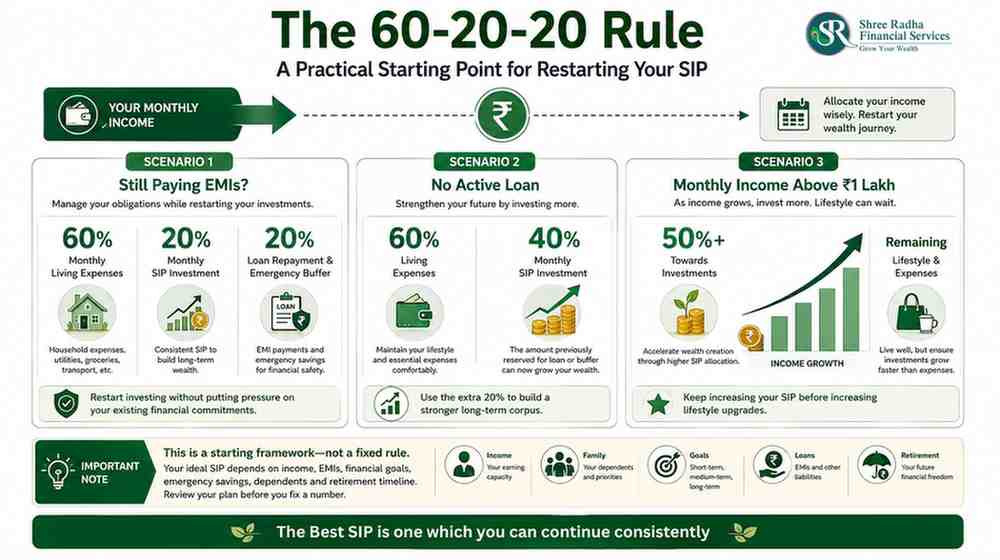
One of the most common questions in a restart conversation isn’t which fund — it’s simply, how much? A simple starting heuristic that works for most salaried and business-owner restarts:
| Your Situation | Suggested Split | Why |
|---|---|---|
| Still servicing an active loan or EMI | 60% expenses / 20% investment / 20% loan & buffer | Restart without straining the very obligations you’re trying to stay ahead of |
| No active loan | 60% expenses / 40% investment | The 20% that was going toward buffer/loan can now go straight into the SIP |
| Monthly income crosses roughly ₹1 lakh | 50% or more toward investment | Beyond this level, expenses typically stop rising at the same pace as income — the extra room should go to the SIP, not lifestyle |
This is a starting point, not a rulebook — the right split for you depends on your specific liabilities, dependents, and goals, and is worth reviewing individually before you fix a number.
The Retirement Math — What 13 to 19 Years Actually Allows For
For someone restarting SIP after stopping in their early-to-late 40s with liabilities cleared, retirement is typically 13 to 19 years away — genuinely enough runway to build a serious corpus, provided the accumulation phase is structured correctly. For broader context on retirement adequacy in India, PFRDA’s public resources are a useful starting point alongside your own SIP plan.
- The bulk of the runway: Equity-heavy accumulation. This is where time is the biggest asset in the room — the portfolio can absorb volatility because there’s no near-term need to withdraw.
- The final 4–5 years before retirement: A gradual glide path, shifting a growing portion from equity into hybrid and debt — not a sudden switch, but a planned tapering that protects the corpus from a bad market right before you need it.
- At retirement: A transition into a structured withdrawal plan, which is where a flat, single-fund SWP quietly fails a lot of otherwise well-built corpuses.
Why a Bucket-Based Withdrawal Beats a Flat, Single-Fund SWP
A common assumption is that since equity gives the best long-term returns, retirement withdrawals should simply come from an equity fund via SWP. The flaw shows up in the first bad year: if markets fall right as withdrawals begin, a flat equity SWP forces you to sell more units at depressed prices just to meet the same monthly amount — permanently denting the corpus’s ability to recover. This is sequence-of-returns risk, and it’s the biggest threat to a retirement corpus that looked perfectly sufficient on paper.
A bucket approach — a few years of expenses in liquid funds, several more years in debt, and the remainder in equity, refilled periodically from equity gains — separates money by when you’ll need it, so a bad market year never forces a sale at the worst possible time. It adds a layer of structure over a plain SWP rather than replacing the idea entirely, and it’s worth a dedicated conversation once your accumulation phase is actually approaching its final stretch.
Before you restart, a short checklist:
- ☐ Confirm liabilities are genuinely cleared — not just paused
- ☐ Attach the restart to a specific goal, not just “investing again”
- ☐ Set a starting SIP using the 60-20-20 rule as your first estimate
- ☐ Build in an annual step-up rather than one large catch-up
- ☐ Decide whether to resume old funds or restart with a fresh portfolio review
- ☐ Be wary of any product promising to “make up” your lost years quickly
Frequently Asked Questions — Restarting SIP After a Break
Does restarting a SIP after a long gap have any penalty?
No. There’s no penalty from the fund house for having stopped. You simply submit a fresh SIP mandate to begin again, regardless of how long the gap was.
How much should I restart with if I’m unsure?
Start at a level you’re confident you can sustain for at least a year without strain, using the 60-20-20 rule as a first estimate, and build in an annual step-up from day one. A smaller, sustained start consistently outperforms a large, shaky one.
Should I wait for the market to correct before restarting?
Waiting for a “good time” is itself a timing bet — the same instinct that makes lump-sum catch-ups risky. A SIP is specifically designed to remove that guesswork; restarting now and letting rupee-cost averaging do its job is generally more reliable than waiting.
I stopped my SIP more than 10 years ago. Is it too late to plan for retirement?
No — as Sandeep’s story shows, even 12 to 13 years of runway with a well-anchored SIP and consistent step-ups can build a meaningful corpus, especially once income has grown. It requires a higher starting contribution relative to someone restarting earlier, but it is very much not too late.
I want to catch up faster. Is there a mutual fund category that gives higher returns to help me catch up?
Be cautious with this framing. Products marketed on recent high returns are usually riding a specific market phase that doesn’t repeat on demand — chasing them to “catch up” is how restart money is most often lost a second time. The more reliable lever is a higher, disciplined SIP with a sensible step-up, not a higher-return bet.
Can I split my restart between an old fund and a new one?
Yes. There’s no requirement to consolidate everything into one scheme — if your old fund still fits your goal, it can continue alongside a new SIP that reflects your updated situation and risk profile.
Does my restart amount need to match what I was investing before I stopped?
Not necessarily, and often it shouldn’t. What matters more is that the amount is sustainable and grows through a step-up mechanism — a lower starting figure that survives is worth more than a high one that risks a second stoppage.
This Article is also available on Medium: https://medium.com/@shreeradha.services/restarting-sip-after-stopping-how-to-rebuild-your-investment-journey-a01d69505fbd
Ready to Restart the Right Way?
Rakesh, Meera, Sandeep, and Arvind each walked into this conversation unsure whether to catch up, hold back, or simply where to begin. Each left with a plan sized to their actual situation — not a guess, and not a shortcut.
Whether you stopped five years ago or fifteen, a portfolio review costs nothing and clears up more than you’d expect. As a SEBI/AMFI-registered Mutual Fund and SIF Distributor, we can walk through your specific numbers and timeline with you.
Grow Your Wealth — that is what we are here for.
📞 Call/WhatsApp: +91 98791 13255
📧 Email: shreeradha.services@gmail.com
🌐 Visit: www.srwealth.co.in
📍 Shop 33, Mira Nagar 2, Dindoli Road, Surat 394210
Paresh Chaudhary
Founder, Shree Radha Financial Services, Surat
AMFI Registered Mutual Fund & SIF Distributor — ARN: 268390
APMI Registered PMS Distributor — APRN05763
Building Shree Radha Financial Services since 2022 | BE Mechanical, SVNIT Surat | Ex-L&T (15+ Years)
Educational Disclaimer: This article is published by Shree Radha Financial Services — an AMFI Registered Mutual Fund & SIF Distributor (ARN: 268390) and APMI Registered PMS Distributor (APRN05763). All content is strictly for educational purposes only and does not constitute individualised investment advice. The names, cities, and figures used in this article are illustrative and fictionalised to explain general concepts; they do not represent actual client data. Mutual fund investments are subject to market risks — read all scheme-related documents carefully before investing. Past performance is not indicative of future returns. Please consult a qualified tax advisor for individual tax treatment.