
Introduction
It was a Tuesday evening in July, and Rajeshbhai Patel had a CAMS statement open on his laptop that he hadn’t looked at properly in over two years.
Rajeshbhai runs a diamond trading unit near Varachha — the kind of business where he checks the cut, colour, and clarity of every stone that passes through his hands before it’s priced. He has never once let a lot go out without weighing it himself. But his own investments?
Those he’d been adding to, one SIP at a time, for five years — a fund a cousin suggested, a fund his bank’s relationship manager pitched during a locker renewal, a fund a friend forwarded on WhatsApp with “this one is doing very well bhai.” Eight SIPs, five different apps, and — if he was honest — he could not have told you, off the top of his head, what any of them actually owned underneath.
What made him open the statement that Tuesday wasn’t a market crash or a bad return. It was a forwarded message from an old business contact, mentioning that SEBI was about to start making fund houses disclose something called “portfolio overlap” every month. Rajeshbhai didn’t fully understand what that meant yet. But something about it made him uneasy enough to finally look.
This article is written for every Surat and Gujarat investor who has felt that same low-grade unease — the sense that you’ve been “diversifying” for years without ever really checking what’s inside the boxes you’ve been ticking. Whether you’re a diamond trader in Varachha, a textile business owner on Ring Road, a homemaker managing family investments in Adajan, or a manufacturer exporting out of Vadodara
if you’re running more than four or five mutual funds and genuinely don’t know how much they overlap, this is worth twenty minutes of your evening. That’s exactly what the new mutual fund overlap SEBI 2026 rule is designed to reveal — and exactly what this guide will help you check for yourself.
“In my conversations with clients across Varachha, Adajan, and the Ring Road belt, I’ve lost count of how many portfolios come in with six, seven, sometimes eleven SIPs that are, underneath the fund names, really holding the same twenty stocks.
Nobody sat down and decided to duplicate their money. It happened one well-meaning recommendation at a time. SEBI’s new disclosure doesn’t fix that for you — it just makes it a lot harder to keep not-knowing.”
— Paresh Chaudhary, Founder, Shree Radha Financial Services
What Portfolio Overlap Actually Means — And Why It Hides So Well
Every equity mutual fund publishes a factsheet listing its top holdings. Large-cap and flexi-cap funds, in particular, tend to gravitate toward the same handful of liquid, heavily-researched companies — HDFC Bank, Reliance, ICICI Bank, Infosys — because that’s where the safest, most tradeable money in the Indian market sits. On its own, that’s completely normal.
The problem starts when you own several funds doing this at the same time, without realising it. If four of your eight funds each hold 6–9% in the same two or three stocks, your real combined exposure to those stocks can be far higher than any single fund’s factsheet would suggest.
Rather than reducing risk, this kind of overlap can actually work against you — weakening true diversification and quietly denting overall returns, even while every individual fund looks perfectly healthy on paper.
The Surat Trader’s Analogy:
Imagine building your saree inventory by visiting five different wholesalers around Ring Road — five shopfronts, five bill books, five different names. It feels like you’ve built a wide, well-spread stock. But when the goods arrive at your godown, you discover all five wholesalers sourced from the same two mills in Bhiwandi. You paid five separate margins and five separate transport charges — for what is really just two mills’ worth of variety.
A mutual fund portfolio, built one WhatsApp recommendation at a time, ends up exactly the same way — except the “godown” is your CAMS statement, and most investors never actually open it to check.
Mutual Fund Overlap SEBI 2026 Rule — Why This Is Suddenly Visible, Not Just a Feeling Anymore
Here’s what’s actually new, and why mutual fund overlap SEBI 2026 disclosure matters specifically this year. As part of a broader mutual fund overhaul effective April 1, 2026, SEBI has tightened overlap rules for sectoral and thematic equity schemes — they now can’t exceed 50% overlap with other equity schemes from the same fund house, excluding large-cap funds.
More importantly for an ordinary retail investor: AMCs are now required to publish portfolio overlap data on their SEBI-mandated disclosure format on their websites every month, calculated quarterly off the average of daily portfolio values.
| Before 2026 | Now — Under SEBI’s Rule | |
|---|---|---|
| Who could see overlap | Mainly analysts, or investors willing to manually compare five factsheets | Every investor, published monthly by the AMC itself |
| Sectoral/thematic fund limits | No defined overlap ceiling | Capped at 50% overlap with other equity schemes from the same AMC |
| Cost transparency | Single bundled Total Expense Ratio | Split into Base Expense Ratio + brokerage + statutory levies |
Most of the coverage of this rule so far explains it from the fund house’s side — what AMCs must comply with. Almost nobody has connected it to the investor’s side of the story: you are about to be handed proof of something you probably already half-suspected about your own portfolio. The rest of this article is about what to actually do with that proof.
The Solution, First: Your Portfolio Audit Checklist
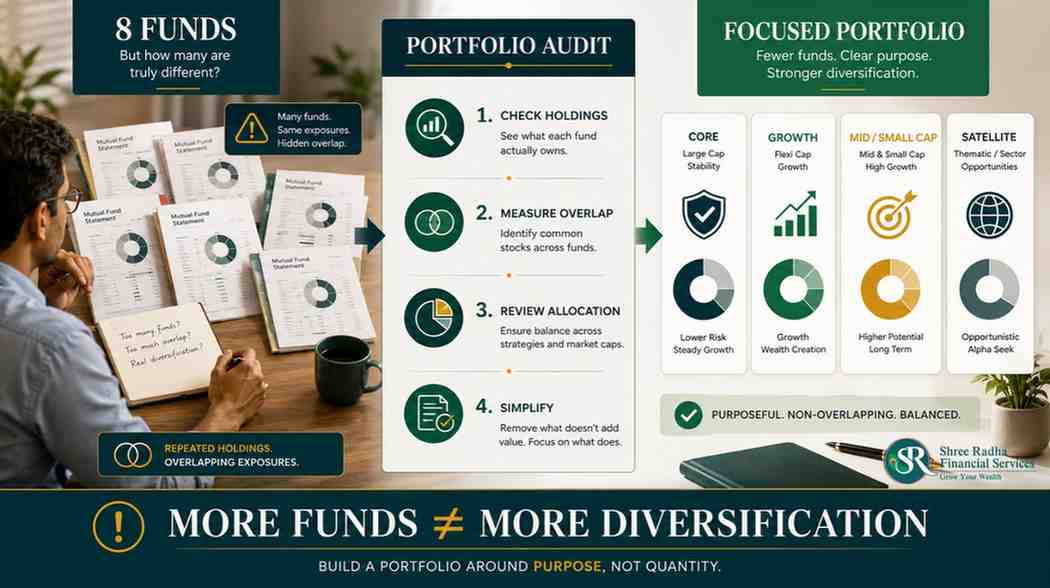
Before we get into everyone’s stories, here is the actual tool — because reading four more paragraphs won’t tell you what’s sitting inside your own SIPs. This is exactly what we walk clients through at SR Wealth as part of a full portfolio review, and you can do the first four steps yourself tonight.
- Pull one consolidated statement. Get a single CAMS/KFintech consolidated account statement across every folio and every app — not five separate screenshots from five apps.
- List every fund by category, not by app. Large-cap, flexi-cap, mid-cap, ELSS, sectoral/thematic, debt, hybrid — the app you bought it on tells you nothing about what it holds.
- Check the top-10 holdings of each equity fund once your AMC’s monthly overlap disclosure is live, or ask your distributor to pull it. Note which stocks repeat across three or more of your funds.
- Separate “genuinely different” from “same bet, different label.” A large-cap fund and a real mid-cap or international fund aren’t overlap. Two large-cap or flexi-cap funds from two different AMCs usually are.
- Check the holding period before you touch anything. Note which units have crossed 12 months (long-term capital gains) and which haven’t (short-term — taxed higher, plus a possible exit load).
- Consolidate gradually, not in one redemption. Plan exits across financial years where possible, to use your ₹1.25 lakh LTCG exemption each year instead of triggering everything at once.
Fixing overlap isn’t free — switching a fund is legally a redemption plus a fresh purchase, which means short-term gains are taxed at 20% and long-term gains at 12.5% above ₹1.25 lakh per year, and most equity funds carry a 1% exit load inside the first 12 months. That’s exactly why step 6 matters — this is a cleanup to plan, not a decision to rush.
What a Genuinely Non-Overlapping Equity Portfolio Looks Like
The question we hear most once someone realises they’re over-diversified is: “So how many funds should I actually have, and which ones?” There’s no single right answer for every investor, but here’s the simplest version of a clean, pure-equity structure — three funds, each drawing from a genuinely different part of the market, built to not compete for the same stocks.
If you’re ready to go beyond plain equity funds altogether, this is also the natural point where a Specialised Investment Fund can fit for HNI investors — but start with the basics below first.
| Fund Category | Market-Cap Universe | Role in the Portfolio |
|---|---|---|
| Flexicap | Full market — large, mid, and small-cap, manager’s choice | The core — stability and flexibility across market cycles |
| Midcap | Roughly the 101st–250th largest companies | The growth engine — a genuinely different universe of stocks |
| Smallcap | Below roughly the 250th largest company | The aggressive edge — highest growth potential, highest volatility |
Three funds built this way will typically show far less overlap than five large-cap or flexicap funds bought from five different AMCs — because the categories themselves are designed to draw from different parts of the market, not because any single scheme is “better.” This is a category-level illustration, not a recommendation of specific schemes.
Rajeshbhai’s Story — Varachha, Eight Funds, and the Statement He Stopped Opening
Rajeshbhai Patel has run his diamond trading unit near Varachha for eighteen years. He built it the way most Surat traders build a business — long hours, careful margins, trust earned lot by lot. Investing, for him, had always felt like a side activity he’d delegate to whoever seemed to know more than him.
It started with one SIP, five years ago, on a cousin’s recommendation. Then his bank’s relationship manager suggested “just one more, this one is topping the charts” during a locker renewal visit. Then a friend forwarded a fund on WhatsApp with a screenshot of its one-year return.
Rajeshbhai said yes each time — not because he’d researched it, but because saying yes felt safer than saying “let me think,” and each individual amount was small enough that it never felt like a decision worth questioning.
Two years ago, without quite deciding to, he stopped opening his consolidated statement. It had gotten long enough — eight funds across five different apps — that reading it felt like a chore with no clear reward. He knew, roughly, that the SIPs were running. That felt like enough.
What actually made him look again was almost accidental. A business contact forwarded him a message about the mutual fund overlap SEBI 2026 disclosure rule — fund houses now having to show, every month, exactly this kind of duplication. Rajeshbhai didn’t fully understand the term at first. But it made him curious enough to finally open the statement he’d been avoiding — and curious enough to call SR Wealth the next morning.
When his eight funds were laid out by category rather than by app, the pattern was hard to miss: five of them were large-cap or flexi-cap funds from five different AMCs, and more than half his equity money was sitting in the same twenty stocks. He was paying five separate expense ratios to hold, in effect, one large-cap bet five times over.
Rajeshbhai’s Portfolio — Before and After:
- Before: 8 funds across 5 apps — 5 large-cap/flexi-cap funds with heavy overlap, 2 sectoral funds he couldn’t explain the purpose of, 1 debt fund
- After: 4 funds — 1 Flexicap, 1 Midcap, 1 Smallcap, 1 Debt fund for stability — consolidated in phases across two financial years to stay within his LTCG exemption each year
- What changed: One consolidated statement, one clear picture of what he actually owns, meaningfully lower combined expense ratio
- What didn’t change: His overall monthly SIP amount stayed the same — this was never about investing less, only about investing more deliberately
That evening, Rajeshbhai did the same thing that started this for him — he forwarded the audit checklist on WhatsApp, this time to an old college friend, Hirenbhai, who runs a machine-tools export unit out of Makarpura GIDC in Vadodara. His message was short: “Check this yaar, I found this useful. You also run too many funds like me.”
What Overlap Actually Costs You — In Rupees, Over Time
Redundant funds aren’t just clutter on a statement. The cost shows up in three specific places, and the third one is the one people underestimate most.
1. You pay the fee more than once for the same stock. Actively managed equity funds in India typically carry a Base Expense Ratio in the 1.5–1.8% range, against 0.3–0.5% for a plain index fund.
If four of your funds are 70–80% overlapping, you’re effectively paying that active-fund fee three extra times for exposure you could have owned once.
2. Fixing it has its own tax cost — which is exactly why step 6 of the checklist matters. Short-term capital gains are taxed at 20%, long-term gains at 12.5% above ₹1.25 lakh per financial year, and most equity funds carry a 1% exit load inside the first 12 months.
3. The drag compounds silently over 20 years — this is the part that doesn’t show up as one bad month, only as a smaller number at the very end.
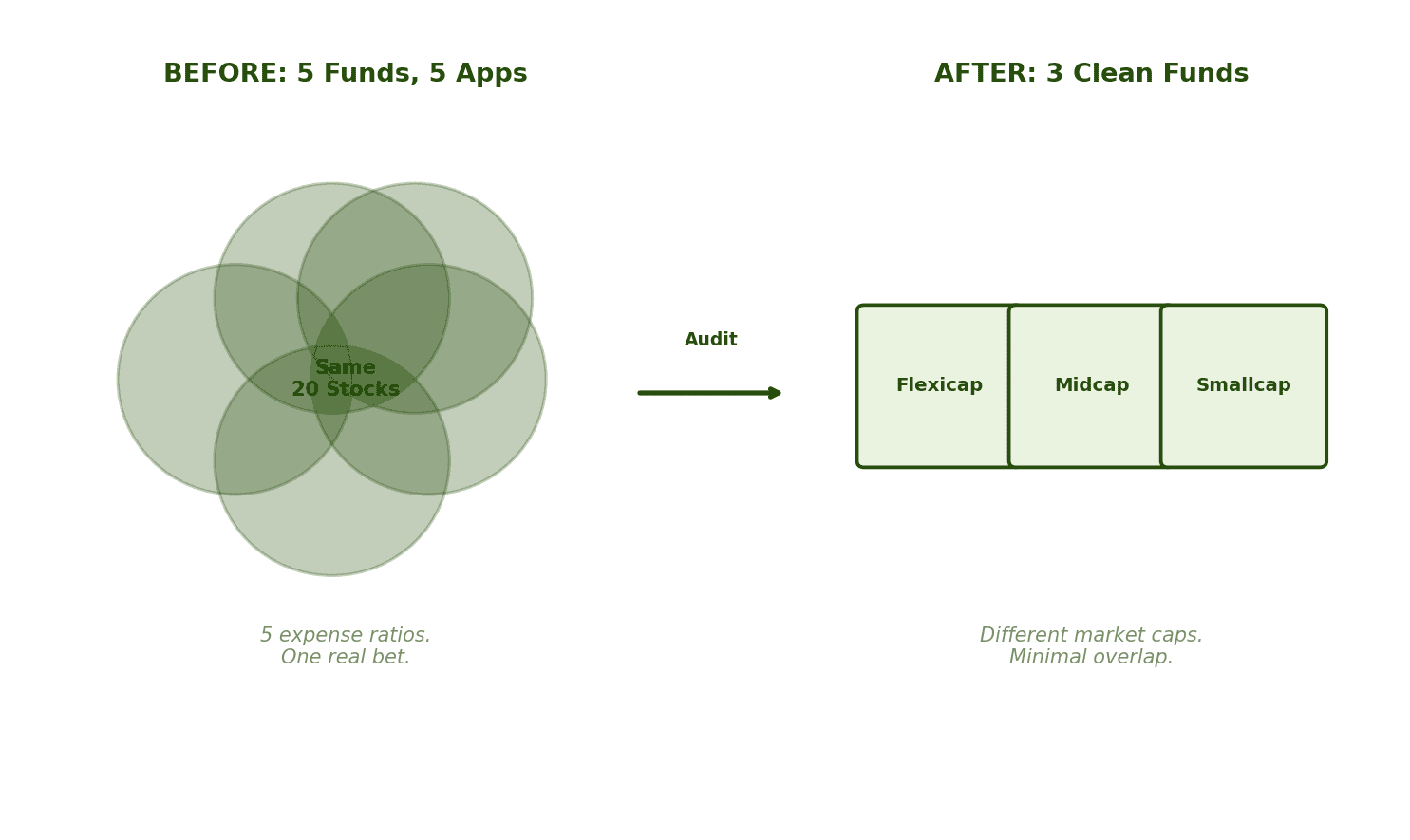
Illustration: The Cost of a 1% Drag Over 20 Years
| Monthly SIP | At 13% CAGR (lean portfolio) | At 12% CAGR (1% overlap drag) | Gap over 20 years |
|---|---|---|---|
| ₹10,000 | ≈ ₹1.15 crore | ≈ ₹99.9 lakh | ≈ ₹14.6 lakh |
| ₹50,000 | ≈ ₹5.73 crore | ≈ ₹4.99 crore | ≈ ₹73.2 lakh |
Illustrative only, assuming a 20-year SIP with no step-up. The 1% gap is a simplified stand-in for the combined effect of redundant fees and an unmonitored, overlapping portfolio — not a guaranteed or promised return. Actual outcomes depend on market performance and fund selection, and mutual fund investments are subject to market risk.
Priyaben’s Story — Adajan, Four Years of Friends’ Advice, and Three Evenings of Searching
Priyaben Shah handles export documentation for a textile trading house near Adajan, and she’s always manages her family’s investments — not because her husband isn’t involved, but because she’s the one who actually enjoys sitting with the numbers.
For four years, her approach was simple and, she thought, sensible: whenever a friend or a colleague mentioned a fund that had done well, she’d look it up, and if it seemed reasonable, she’d start a small SIP in it. It felt like due diligence. It never occurred to her that “reasonable on its own” and “not duplicating what I already own” were two different questions.
The nudge came the same way it came for Rajeshbhai — a WhatsApp forward, this one from a cousin, mentioning that SEBI was making mutual funds show their overlap now. Priyaben read it twice, then spent the next three evenings searching, in the gaps between dinner and putting the children to bed:
- “how many mutual funds should I have”
- “mutual fund overlap check free”
- “is 5 mutual funds too many”
- “SEBI portfolio overlap disclosure meaning”
Most of what she found was either written in SEBI’s technical language, or aimed at a Mumbai audience with return charts and no real explanation of what to actually do about her own five funds. She wanted something simpler: not “here’s what overlap is,” but “here’s whether I personally have a problem, and if I do, what to do about it.”
When she finally sat down with SR Wealth and had her five funds checked by category, the answer was gentler than she’d feared but still real: three of her five funds — all large-cap or flexi-cap — were carrying almost identical top-ten holdings. Her ELSS fund and her one genuine mid-cap fund were fine exactly as they were.
Priyaben’s Portfolio — Before and After:
- Before: 5 funds — 3 overlapping large-cap/flexi-cap funds, 1 ELSS, 1 midcap
- After: 3 funds — 1 Flexicap (kept, best of the three overlapping ones), 1 ELSS (kept as-is — its tax-saving purpose is separate from the overlap question), 1 Midcap (kept)
- What changed: Two redundant SIPs stopped, the freed-up monthly amount redirected into her existing Midcap fund instead of a new one
- What she said afterward: “I always felt like I was ‘collecting’ funds instead of actually owning a portfolio. This is the first time I could explain my own investments in one sentence.”
Ketanbhai’s Story — Ring Road, Three Advisors, and the Question His Son Asked
Ketanbhai Desai owns a small textile processing unit off Ring Road, and his relationship with investing has a longer, messier history than Rajeshbhai’s or Priyaben’s. Over twelve years, he’d worked with three different relationship managers — each one arriving with a fresh set of recommendations, and each one leaving without anyone ever going back to clean up what the previous one had set up. Funds simply accumulated, layer over layer, like sediment.
By this year, he held eleven funds. And if he was being honest with himself — which he mostly avoided being, on this particular topic — he’d stopped really opening his statements sometime around fund number seven. They’d become long enough, and confusing enough, that looking felt worse than not looking.
The moment that changed things wasn’t a market event. It was his son, home from college and helping prepare documents for a business loan application, asking to see “the investment portfolio” as part of the family’s net worth statement.
Ketanbhai realised, sitting across from his own son, that he genuinely could not explain what he owned or why. It wasn’t a dramatic moment. It was a quietly uncomfortable one — the kind that’s easy to keep avoiding, and easy to finally act on once someone else is watching.
He called SR Wealth that week, closer to retirement than either Rajeshbhai or Priyaben and increasingly aware his portfolio needed to reflect that.
The audit took longer — eleven funds meant eleven factsheets — but the pattern was familiar: six of his eleven funds were near-duplicates across large-cap and flexi-cap categories, two were sectoral funds from a phase he barely remembered choosing, and he had no debt allocation at all despite being so much closer to the stage a proper retirement plan would call for one.
Ketanbhai’s Portfolio — Before and After:
- Before: 11 funds — 6 overlapping large-cap/flexi-cap funds, 2 sectoral funds, 2 midcap funds, 1 smallcap fund, zero debt allocation
- After: 5 funds — 1 Flexicap, 1 Midcap, 1 Smallcap, and 2 Debt/Hybrid funds added to bring some stability closer to his retirement horizon
- What changed: Consolidation spread across two financial years to manage the capital gains tax on such a large cleanup, six redundant SIPs stopped
- What he said afterward: “For the first time in years, I could sit with my son and actually walk him through what we own. That mattered more to me than the return difference.”
Hirenbhai’s Story — Vadodara, a WhatsApp Forward, and the Same Pattern Two Cities Away
Hirenbhai Trivedi runs a machine-tools export business out of Makarpura GIDC in Vadodara, and he’s known Rajeshbhai since their college days — two engineering students from different towns who stayed in touch as their businesses grew. When Rajeshbhai’s message landed — “Check this yaar, I found this useful. You also run too many funds like me” — Hirenbhai’s first reaction was mild irritation. He was fairly confident his own investments were fine.
He ran the checklist anyway, mostly to prove his friend wrong. It took him about twenty-five minutes to pull his statement together — he was investing across six different apps, a habit that had built up the same way it had for Rajeshbhai: a fund for every platform he’d tried, without ever closing the ones from platforms he’d stopped actively using.
He wasn’t proven wrong. Of his nine funds, five were carrying near-identical large-cap and flexi-cap holdings — the same story, in a different city, in a different business, for almost exactly the same reason: recommendations added one at a time, never reviewed as a whole.
Hirenbhai called SR Wealth directly, working with the team remotely rather than in person — proof that this kind of cleanup doesn’t require sitting across a desk in Surat, only a willingness to actually look.
Hirenbhai’s Portfolio — Before and After:
- Before: 9 funds across 6 apps — 5 overlapping large-cap/flexi-cap funds, 2 midcap funds, 1 ELSS, 1 debt fund
- After: 5 funds — 1 Flexicap, 1 Midcap, 1 Smallcap (newly added, where he’d previously had none), 1 ELSS (kept), 1 Debt fund (kept)
- What changed: Four redundant SIPs closed, genuine small-cap exposure added for the first time — his portfolio actually became more diversified by owning fewer funds, not more
One WhatsApp forward. Two cities. Two portfolios that had been quietly duplicating themselves for years, cleaned up within the same month.
So How Many Funds Is “Enough”?
There’s no single official number, but the range experts converge on is narrower than most investors assume — usually 3 to 6 funds for a straightforward portfolio, often paired with a rule of thumb of keeping overlap between any two funds under 30–40%. Some advisory desks frame it in tiers — 2–3 funds for a beginner, 4–6 for an intermediate investor, 6–8 for someone with a genuinely complex, goal-segmented portfolio.
Higher ceilings exist for HNI or multi-goal portfolios — some wealth advisors go up to 13–14 schemes, often once a portfolio has grown complex enough to also include PMS alongside mutual funds — but that’s the exception for actively managed, complex wealth, not the norm for a salaried professional or a business owner’s SIPs.
What almost none of these benchmarks explain is how people end up past the limit — and it’s rarely a single bad decision. It’s Rajeshbhai’s five-years-one-recommendation-at-a-time pattern. It’s Priyaben’s four-years-of-friends’-tips pattern. It’s Ketanbhai’s three-advisors-and-no-cleanup pattern. It’s Hirenbhai’s six-apps-one-fund-each pattern. Four different causes, four different cities, the same outcome.
Frequently Asked Questions — Mutual Fund Overlap for Surat and Gujarat Investors
How do I check mutual fund overlap under SEBI’s 2026 rule without paying for a tool?
Start with the checklist earlier in this article. Once your AMC’s monthly overlap disclosure is live under this rule, it will be published on the AMC’s own website. Until then, comparing the top-10 holdings listed in each fund’s factsheet by hand — or asking an AMFI-registered distributor to do it for you — works just as well for a portfolio of five to ten funds.
Does SEBI’s new overlap rule apply to me if I only hold large-cap and flexi-cap funds, not sectoral ones?
The 50% overlap cap itself applies specifically to sectoral and thematic schemes. But the monthly disclosure requirement is broader — it’s meant to give every investor visibility into overlap across their holdings, which is exactly the information a large-cap or flexi-cap-heavy portfolio needs most, since that’s where overlap tends to be highest.
Is switching out of an overlapping fund always worth the tax cost?
Not automatically — that’s precisely why the checklist has you check the holding period before touching anything. If a fund is within 12 months of purchase, the short-term tax and possible exit load may mean it’s worth waiting a few months before consolidating that particular holding, even if it’s clearly redundant.
Should I just redeem all my overlapping funds and start over?
No — that’s the one thing every story in this article avoids doing. A planned, phased consolidation across financial years, using your ₹1.25 lakh LTCG exemption each year, keeps the cleanup itself from becoming an expensive mistake.
I don’t have time to do this audit myself — what’s the alternative?
Bring your last CAMS or KFintech consolidated statement to SR Wealth. We’ll walk through the same checklist used in every story above, at no charge, whether or not you’re already a client. Every story above started the same way — someone finally checked what the mutual fund overlap SEBI 2026 disclosure rule was about to make visible.
Not Sure How Much Overlap Is Sitting Inside Your Own SIPs?
Whether you’re a diamond trader in Varachha, a homemaker managing investments in Adajan, a manufacturer on Ring Road, or an exporter in Vadodara — bring your last CAMS/KFintech statement and we’ll walk through the audit checklist above with you. No obligation, no guesswork.
📞 Call / WhatsApp: +91 98791 13255
📧 Email: shreeradha.services@gmail.com
🌐 Visit: www.srwealth.co.in
📍 Shop 33, Mira Nagar 2, Dindoli Road, Surat 394210
Paresh Chaudhary
Founder, Shree Radha Financial Services (SR Wealth), Surat
AMFI Registered Mutual Fund & SIF Distributor — ARN: 268390
APMI Registered PMS Distributor — APRN: 05763
IRDAI Licensed Insurance Distributor
BE Mechanical, SVNIT Surat | Ex-L&T (15+ Years)
Educational Disclaimer: This article is published by Shree Radha Financial Services — an AMFI Registered Mutual Fund & SIF Distributor (ARN: 268390) and APMI Registered PMS Distributor (APRN: 05763). All content is strictly for educational purposes only and does not constitute individualised investment advice. Mutual fund investments are subject to market risks — read all scheme-related documents carefully before investing. Fund categories discussed (Flexicap, Midcap, Smallcap, Debt/Hybrid) are illustrative and not a recommendation of any specific scheme. All numbers, comparisons, and persona scenarios in this article are for educational understanding only. SEBI regulations are subject to change — verify current requirements at SEBI’s official website before acting. Past performance does not guarantee future returns.