Introduction
It was a Thursday morning in July when Devang Shah’s phone would not stop buzzing.
His college friend Ketan Solanki — a small shop owner from Katargam, just 44 years old — had died in a road accident the night before. Ketan left behind a wife, two teenage children, a small shop his father had built, and no Will.
Devang went for the condolence visit that evening, the way you do. He didn’t expect what he’d learn eight months later.
Ketan’s widow still hadn’t been able to touch some of his mutual fund investments — the ones where she was listed as nominee, which she had always assumed meant the money was simply hers now. Separately, Ketan’s younger brother had filed a claim on their late father’s shop premises — a property the two brothers had inherited jointly years earlier and never got around to formally dividing on paper. Two problems, neither of which Ketan ever imagined for his family, both traced back to the same missing document.
Devang is 42. He works as a senior manager at a textile trading firm near Sachin GIDC, and lives with his wife Priya and their two children — a nine-year-old son and a five-year-old daughter — in a flat in Citylight. Like most Indians, he had never made a Will. A 2026 survey found that nearly 85 out of every 100 Indians don’t have one, and most have no plan to change that. Devang used to be one of them.
This is what changed his mind, and what he learned along the way — because almost none of it turned out to be about being wealthy. It was about being organised for the people who’d be left sorting things out.
“In my years of practice, I’ve never met a family that regretted making a Will. I’ve met plenty who regretted waiting. A Will isn’t about assuming the worst — it’s about making sure the people you love don’t have to guess, or fight, to find out what you wanted for them.”
— Paresh Chaudhary, Founder, Shree Radha Financial Services
What Is a Will, and the Three Types Valid in India
A Will is a simpler idea than it sounds: a signed, written statement of who should get your assets after you’re gone, and who should be in charge of making sure that happens. Devang had assumed “making a Will” meant an expensive lawyer, months of paperwork, and something only very wealthy families needed. None of that turned out to be true.
Indian law — mainly the Indian Succession Act, 1925 — recognises a few different kinds of Wills, and every one of them is valid in Gujarat today. What the state’s new Uniform Civil Code changes isn’t how you make a Will. It’s what happens to your family if you don’t.
| Type | What It Is | Registration | Best For |
|---|---|---|---|
| Unregistered (typed or printed) | Signed by the testator, attested by two witnesses — fully valid without registration | Optional | Most people — valid, but easier to challenge on authenticity |
| Registered | The same document, additionally filed with the Sub-Registrar | Done voluntarily | Anyone who wants a harder-to-dispute government record — this is what Devang chose |
| Holographic | Entirely handwritten by the testator, in their own hand | Optional | Emergencies or simplicity — harder to forge since handwriting is unique, but still needs to meet the same legal conditions |
Devang chose the option most people eventually choose: type it out, sign it in front of two witnesses, then register it — not because the law demands it, but because it made the document harder for anyone to question later.
The Ledger Analogy:Devang thought about it the way he thinks about his firm’s stock ledger. An unregistered Will is like an entry in a private notebook — real, and usable in court if you can prove it’s genuine, but easy for someone to argue was altered or backdated later. A registered Will is that same entry stamped and filed with the Sub-Registrar’s office — a government record of exactly what was written and when. Nobody can quietly rewrite a government record.
The Mistake Devang Almost Made — Why “Nominee” Wasn’t Enough

Devang’s mutual funds, his fixed deposits, and his one LIC policy all had a nominee — his wife, Priya. He had always assumed that settled it: if anything happened to him, the money would simply become hers.
It doesn’t work that way — and it’s exactly the mistake Ketan’s family got caught in.
In December 2023, India’s Supreme Court settled this question for good, in Shakti Yezdani v. Jayanand Jayant Salgaonkar. A family had appointed nominees on mutual fund and fixed deposit holdings, assuming the nominees would simply inherit them outright. The Court disagreed: a nominee, it ruled, only holds the asset in trust for whoever is legally entitled to it — under a Will, or under succession law if there’s no Will. A nominee is a caretaker of the asset until it’s properly distributed, not automatically its new owner.
For Priya, that meant something very specific. Without a Will, her claim to Devang’s mutual funds would run through succession law, shared with their two children — not handed to her fully and automatically just because her name sat in the nominee field. With a Will, Devang could simply write down that Priya inherits it, and settle the question himself, in his own words, while he still could.
| Asset Type | What Nomination Does | What Decides Final Ownership |
|---|---|---|
| Bank account / FD | Nominee can claim and operate the account after death | Will, or succession law if none |
| Mutual funds / demat | Nominee receives units administratively, holds them in trust | Will, or succession law if none |
| Life insurance | Nominee receives the payout | Will (unless nominee is also a named beneficial owner under the policy) |
| Immovable property (flat, land, house) | Does not apply — no nominee concept for land or a house | Will, or succession law if none — entirely |
Movable vs Immovable — Why a Will Has to Say It Twice
There’s a second distinction that trips up almost everyone, and it’s exactly what caused the other half of Ketan’s family’s trouble.
Devang’s estate, like most people’s, holds two very different kinds of assets. His Citylight flat and his share in his late father’s house in Rander are immovable — land and buildings. His mutual funds, FDs, and insurance are movable — cash and financial instruments.
A Will governs both, but it has to say so specifically for each one. General language like “all my property to my wife” leaves room for argument about exactly which flat, which folio, which house, which share. Ketan’s shop in Katargam ran into precisely this kind of ambiguity — inherited jointly by two brothers, never formally divided on paper, and now the subject of a dispute neither brother wanted.
Five Mistakes That Undo a Will
Sitting with what had happened to Ketan’s family, Devang went through his own situation and found five gaps — the same five that come up in almost every family that skips this step.
- No Will at all. The one Devang had, until that Thursday — none. The most common mistake by far, and the one behind both of Ketan’s family’s problems.
- An outdated Will. Not Devang’s problem yet, but a common one — a Will written before children were born, before a property was bought or sold, or before a family relationship changed, can cause nearly as much confusion as no Will at all.
- Ambiguous asset descriptions. “All my property” instead of specific addresses, folio numbers, and account details — exactly the gap in Ketan’s father’s shop.
- No executor named. A Will without a named executor still works, but it leaves the family to petition a court to appoint one — an extra step and extra delay at the worst possible time.
- The ancestral-property blind spot. Devang’s father’s house in Rander had come to him and his sister Falguni jointly, years ago, and the two of them had simply left it that way — nobody living there, nobody arguing, so nobody bothered with paperwork. Since the Hindu Succession (Amendment) Act, 2005, a daughter has exactly the same coparcenary right to ancestral property as a son, by birth — so Falguni’s half was never legally in question. What was missing was documentation: a formal partition or family settlement making that share explicit on paper, the way Ketan’s father’s shop never got one.
What Happens Without a Will — Now Reshaped by Gujarat’s UCC
There are only two paths for anyone’s estate in India: testamentary succession, governed by a valid Will, or intestate succession, where the law decides because there wasn’t one.
Until this year, intestate succession in Gujarat depended heavily on religion. Hindus, Buddhists, Sikhs, and Jains followed the Hindu Succession Act; Muslims followed personal law; Christians and Parsis followed the Indian Succession Act — different rules, different shares, for families living in the same state.
The Gujarat Uniform Civil Code, passed by the state Assembly on 24 March 2026, changes that starting point. Under the UCC, intestate succession works the same way for every Gujarati resident regardless of religion — spouse, children, and parents as equal Class-I heirs, sons and daughters inheriting identically, ancestral and self-acquired property treated alike.
| Community | Pre-UCC Intestate Rule | Under Gujarat’s UCC (once notified) |
|---|---|---|
| Hindu, Buddhist, Sikh, Jain | Hindu Succession Act, 1956 (as amended 2005) | One common civil succession framework — equal shares for sons and daughters |
| Muslim | Muslim Personal Law — shares historically varied by gender and relationship | Same uniform framework as above |
| Christian, Parsi | Indian Succession Act, 1925 (community-specific chapters) | Same uniform framework as above |
One thing worth being precise about: the UCC has been passed by the Assembly, but by its own text it only takes legal effect once the state government formally notifies a date in the official gazette. Treat “passed” and “in force” as two different things until that notification lands — your CA or a lawyer can confirm current status before you rely on it for anything specific.
Either way, the direction is clear, and it’s exactly why this is the right year to stop postponing the one document that keeps the decision in your own hands rather than the law’s.
How Devang Actually Made His Will — Registration and Probate in Gujarat
Once Devang decided to act, the process itself was far less intimidating than he’d assumed.
- Listed every asset separately — the Citylight flat, his share in the Rander house, three mutual fund folios, two FDs, one LIC policy — and wrote down exactly who should get what, down to folio numbers and property descriptions.
- Named Priya as primary beneficiary and executor, with his elder brother as a backup executor.
- Named a guardian for the children (more on this below).
- Signed it in front of two witnesses who are not beneficiaries under the Will — a requirement under Section 63 of the Indian Succession Act.
- Registered it at the Sub-Registrar’s office in his jurisdiction, carrying the signed Will, his photo ID, and the witnesses’ ID proofs, for a registration fee of a few hundred rupees — not compulsory, but it means the original stays on government record and can’t quietly be disputed as altered later.
What Devang did not need to do: get court approval — called probate — in advance. Probate is compulsory in India only for Wills made in, or covering immovable property within, Mumbai, Kolkata, and Chennai. Gujarat isn’t one of them. His registered Will is enough for now. If Priya or the children ever need a court to formally confirm the Will’s validity later — for a bank or a land registry insisting on it — that’s a separate, later step, not a precondition to making the Will itself.
Naming a Guardian for the Children
One line in Devang’s Will mattered to him more than any asset description: who would raise their two children — nine and five years old — if both he and Priya were gone.
Without a named guardian, that decision goes to a court, based on whoever petitions and what the court decides is in the children’s best interest — a process that can take months and run through people the parents never envisioned, unfolding exactly when the family can least manage it. Devang named Priya’s younger sister as guardian, with his own brother as the alternate — a decision he and Priya had, in fact, never spoken out loud until they sat down to write the Will.
What If Family Is Abroad?
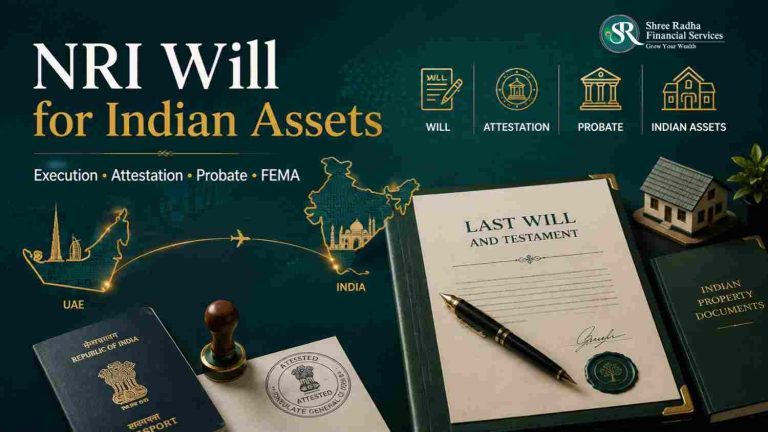
Falguni, Devang’s sister, has lived in London for eleven years. Her share of the Rander house doesn’t disappear because she lives abroad — Indian succession law still governs Indian assets regardless of where the heir resides. What changes for NRIs is more practical: executing a valid Will, from outside India, for Indian assets.
The short version: yes, an NRI can make a valid Will for Indian assets from London, Dubai, or anywhere else, following the same essential formalities — signature, two witnesses, sound mind. It’s generally advisable to keep a Will specifically for Indian assets, separate from any Will made under a foreign jurisdiction’s law, rather than assuming one document covers both. If your own NRI family situation needs a closer look, our guide on portfolio review for NRIs is a reasonable next stop.
Do You Need to Make — or Update — a Will?
Making sense right now if:
- ✅ You own a flat, land, or any immovable property, jointly or otherwise
- ✅ You hold mutual funds, FDs, or insurance with a nominee you haven’t revisited in years
- ✅ You have minor children and haven’t named a guardian anywhere
- ✅ You share ancestral or inherited property with siblings that was never formally partitioned
- ✅ You have family abroad who may one day need to deal with your Indian assets
If you already have a Will, check it for these gaps:
- ❌ Written more than three to five years ago, or before a major life event — marriage, a child, a new property, a sale
- ❌ Doesn’t name an executor
- ❌ Describes assets vaguely (“all my property”) instead of specifically
- ❌ Hasn’t accounted for coparcenary shares in ancestral property
- ❌ Nobody besides you knows where the original document actually is
Frequently Asked Questions — Making a Will in Gujarat
Is a Will compulsory in India?
No. Dying without one is entirely legal — it simply hands the decision to intestate succession law instead of to you. In Gujarat, that law is now shaped by the state’s UCC once it takes effect, rather than by religion-specific personal law as before.
Do I need a lawyer to write a Will?
Not legally required for a valid Will, but strongly recommended — Will drafting is legal work, and the more assets and family relationships involved, the more a small drafting mistake can cost later. This article is educational and does not replace legal advice.
Is a registered Will always harder to challenge in court than an unregistered one?
Registration helps, but it isn’t a guarantee. India’s courts have held that registration alone doesn’t automatically validate a Will — it still has to meet the execution requirements under Section 63 of the Indian Succession Act, and an unregistered Will that meets those requirements is just as legally enforceable.
Does the Gujarat UCC apply to me if I live outside Gujarat but own property here?
Yes. The Code has been drafted to apply to Gujarat residents living outside the state as well, in addition to everyone living within it — relevant for NRIs and other Gujaratis based elsewhere in India.
What happens to my mutual fund nominee once I have a Will?
Keep the nomination — it still matters operationally, since it’s who the AMC will process the claim through first. But your Will decides who is finally, legally entitled to that money. The two work together; neither replaces the other.
Can I include my share of ancestral coparcenary property in my Will?
Generally, a coparcener can will away their own defined or notional share of joint family property, not the whole property outright — this area has real nuance depending on whether a formal partition has happened. It’s exactly the kind of clause worth having a lawyer review specifically, rather than drafting from a template.
Can I change my Will later?
Yes, freely, any time, as long as you’re of sound mind — through a new Will or a codicil (a formal amendment). Only the most recent valid Will governs, which is exactly why an outdated one can be as risky as none at all.
Not Sure Where Your Own Will Stands?
Whether you’re starting from nothing like Devang was, or updating something written years ago, a short conversation is enough to map out what your estate actually looks like today — and what’s still missing.
We are not a legal or tax advisory firm — for Will drafting itself, you’ll need a lawyer. What we can do: review and update nominations across your mutual fund, PMS, and insurance holdings, help you list out your assets clearly, and refer you to qualified professionals for the drafting and registration itself.
📞 Call / WhatsApp: +91 98791 13255
📧 Email: shreeradha.services@gmail.com
🌐 Visit: www.srwealth.co.in
📍 Shop 33, Mira Nagar 2, Dindoli Road, Surat 394210
Paresh Chaudhary
Founder, Shree Radha Financial Services (SR Wealth), Surat
AMFI Registered Mutual Fund & SIF Distributor — ARN: 268390
APMI Registered PMS Distributor — APRN: 05763
IRDAI Licensed Insurance Distributor
BE Mechanical, SVNIT Surat | Ex-L&T (15+ Years)
Educational Disclaimer: This article is published by Shree Radha Financial Services — an AMFI Registered Mutual Fund & SIF Distributor (ARN: 268390) and APMI Registered PMS Distributor (APRN: 05763), and does not provide legal or tax advisory services. Please consult a qualified lawyer for Will drafting and registration, and a chartered accountant for tax matters specific to your situation. Regulatory provisions referenced (Income-tax Act, 2025 and Gujarat’s Uniform Civil Code, 2026) are subject to further clarification, notification, and implementation rules. All persona scenarios — Devang, Priya, Falguni, and Ketan — are illustrative composites created for educational understanding only and do not depict real individuals.