Gift Deed Gujarat: Why Kantibhai Decided Not to Wait
Every gift deed Gujarat families execute needs to get three things right: the relationship between donor and recipient, the type of property involved, and the paperwork. Kantibhai learned this firsthand while working out what to do with his shop and his daughter’s flat.
He’s run his textile shop on Ved Road for over thirty years. His elder son has been managing the day-to-day business for the last five, and everyone in the family already treats it as his. His daughter, married and settled in Surat itself, has a flat that was always meant to be hers. And his younger son has been in Dubai for eight years now, doing well, calling every Sunday.
Nothing about any of this is in dispute. So why, Kantibhai wondered, should he wait until he’s gone to make it official?
That question is exactly what a gift deed Gujarat conversation like this one is meant to answer. Not a dispute — the opposite. A desire to settle things cleanly, in your own lifetime, while everyone is still around the table and still on good terms. But “settle it now” turns out to have its own set of rules — some more expensive than people expect, some involving people they hadn’t thought to double-check (like a son in Dubai), and one involving land nobody in the family had touched in years.
This guide walks through what Kantibhai had to get right, step by step.
“I get this question a lot from Surat business families — ‘why not just leave it in the Will?’ A Will is important, but it only speaks after you’re gone, and until then nothing is settled. A gift deed lets you hand something over while you’re still here to see it used well.
The mistake I see most often isn’t the decision to gift — it’s not checking the stamp duty, the tax angle, and in a few cases, whether the land itself can even legally be gifted, before the family gets emotionally committed to the plan.”
— Paresh Chaudhary, Founder, Shree Radha Financial Services
Gift Deed Gujarat: What It Is and How It’s Different from a Will
A gift deed is a legal document under Section 122 of the Transfer of Property Act, 1882, through which a person (the donor) voluntarily transfers ownership of property to another person (the donee) without any payment or consideration in return. The donee has to accept the gift, and — for immovable property — the transfer only becomes legally valid once the deed is registered.
The distinction that matters most for families like Kantibhai’s:
- A gift deed takes effect immediately, in the donor’s lifetime. Once a registered gift deed for immovable property is executed and accepted, it’s very difficult to undo — there’s no simply “changing your mind” next year.
- A Will takes effect only after death, and can be revised or replaced any number of times before then. Nothing actually transfers while the person who made it is alive.
This is exactly why the two aren’t substitutes for each other. A gift deed is the right tool when the decision is already final and the person wants to see it through while they’re around. A Will is the right tool for everything that should stay flexible until the end. We’ve covered Wills for Gujarat families in full in our complete Will guide — most families end up needing both, not one instead of the other.
Gift Deed Gujarat: Stamp Duty and Registration Rules
For immovable property — land, a flat, a shop like Kantibhai’s — registration is not optional. Under Section 123 of the Transfer of Property Act, a gift of immovable property must be made through a registered instrument, signed by the donor and attested by at least two witnesses. An unregistered gift deed for immovable property has no legal effect — it’s treated as void.
Any gift deed Gujarat property owners execute for land, a flat, or a shop must be registered and stamped through the state’s official GARVI portal, run by the Inspector General of Registration. The stamp duty itself depends entirely on who’s receiving it:
- Blood relatives (as defined for stamp duty purposes — spouse, parents, children, siblings, and a few other close relations): a concessional 1% of the property’s value, calculated on whichever is higher — the market value or the current Jantri rate.
- Everyone else — friends, distant relatives, employees, anyone outside the defined list: the standard 4.9% (3.5% basic stamp duty plus a 1.4% surcharge).
On top of stamp duty, a registration fee of 1% of the property value applies. There’s one useful exception: if the property is gifted solely to a woman, the 1% registration fee is fully waived. Gift the same property jointly to a son and a daughter, though, and that waiver no longer applies — a detail worth checking before the deed is drafted, not after.
Once registered, the transfer also needs to be reflected in local revenue records through mutation — for Kantibhai’s shop, that means an update with the Surat Municipal Corporation records, so property tax and ownership records match the new position.
Gift Deed Gujarat: How Gifts Outside the Family Are Taxed
This is where families most often get caught out, and it’s worth a section of its own.
Under the Income Tax Act, if you receive property or money without paying for it, and the total value crosses ₹50,000 in a financial year, it’s taxable as “Income from Other Sources” — unless it comes from a defined relative. The part that surprises people: if a gift deed Gujarat family uses involves someone outside that relative list and the value crosses ₹50,000, the entire amount is taxed, not just the portion above ₹50,000. There’s no tapering — it’s a cliff, not a slope.
Who counts as a “relative” for this exemption is a fixed list: spouse, siblings (yours and your spouse’s), any lineal ascendant or descendant (parents, grandparents, children, grandchildren), and the spouse of any of these people. Gifts within this list are fully tax-exempt, at any value.
Say Kantibhai, instead of gifting the shop to his son, wanted to gift it to Ramesh — the karigar who’s worked with him for twenty years and feels like family, but isn’t. Two things change at once: the stamp duty jumps from 1% to 4.9%, and the entire stamp-duty value of the shop becomes taxable income in Ramesh’s hands that year — likely pushing him into a tax bracket he’s never been in before. None of this is a reason not to be generous with people who aren’t blood relatives. It’s a reason to know the real cost before deciding how to structure it.
A few gifts stay exempt regardless of who they’re from: gifts received on the occasion of your marriage, gifts received under a Will or by inheritance, and gifts from certain registered charitable trusts. Gifts from an employer are taxed separately, as part of salary.
Gift Deed Gujarat: Movable vs Immovable Property, Compared
Kantibhai’s situation involves immovable property — a shop and a flat. But the rules change meaningfully if the gift is cash, jewellery, shares, or mutual funds instead, and mixing up the two is one of the more common mistakes families make.
Immovable property (land, flat, shop):
- Registration is mandatory — a registered instrument under Section 123 of the Transfer of Property Act, or the gift has no legal effect.
- Stamp duty as above: 1% for blood relatives, 4.9% for everyone else, plus 1% registration fee.
- Tax exempt from relatives at any value; from non-relatives, the entire stamp-duty value is taxed once it crosses ₹50,000.
- Mutation of municipal/revenue records is required after registration.
Movable property (cash, jewellery, shares, mutual funds, vehicles):
- Registration is not mandatory. A simple gift deed on plain paper, signed and witnessed, is generally sufficient — though it’s still worth documenting properly.
- Listed shares and mutual fund units are gifted through an off-market transfer between demat accounts (via a Delivery Instruction Slip), which attracts a nominal stamp duty under the Indian Stamp Act — have this exact rate confirmed by your CA at the time, since it’s revised periodically.
- Tax treatment mirrors immovable property: exempt from relatives at any value; from non-relatives, the entire fair market value is taxed once aggregate gifts cross ₹50,000 in the year.
- Cash gifts have one extra rule worth knowing: receiving ₹2 lakh or more in cash from one person — in a single day, a single transaction, or for a single event — is barred outright, regardless of whether the giver is a relative, and carries a penalty equal to the full amount received. Any gift of that size needs to move through a bank transfer or cheque, not cash.
One rule stays the same for both, and it’s a genuinely useful one to know for any gift deed Gujarat families plan around appreciating assets: when the person who received the gift eventually sells it, the cost used to calculate capital gains isn’t reset to zero — it carries over from the original owner’s purchase price and purchase date. Kantibhai’s son, if he ever sells the shop, will calculate his gain using Kantibhai’s original cost and Kantibhai’s original ownership period, not the date of the gift.
Gift Deed Gujarat: The Agricultural Land Trap
This is the part of gift deed planning that catches out even families who’ve done everything else right. Several Surat business families hold agricultural land somewhere in the district — bought years ago, rarely visited, sitting quietly on the books.
Under Section 63 of the Gujarat Tenancy and Agricultural Lands Act, 1948, agricultural land cannot be transferred — including by gift — to someone who isn’t a registered agriculturist. If Kantibhai’s son has spent his career running a textile shop rather than farming, he legally is not an agriculturist, no matter how much farmland the family has held for generations. Gifting that land to him through a standard gift deed, without Collector permission, is barred — and that permission is genuinely difficult to obtain for a routine family transfer.
If your family holds any agricultural land, this needs to be checked with a local revenue advocate before it gets folded into a broader gifting plan — not discovered at the Sub-Registrar’s office.
Gift Deed Gujarat: Conditional Gifts and Senior Citizen Protection
A common worry we hear from parents in Kantibhai’s position: “What if I give it away, and things change?”
There’s a real answer to this, and it starts with how the gift deed is written. Under Section 126 of the Transfer of Property Act, a gift deed can include a condition — for instance, that the donor retains the right to live in the property, or to receive a share of its income, for life. This is entirely legal and commonly used.
There’s also statutory protection specifically for senior citizens. Under Section 23 of the Maintenance and Welfare of Parents and Senior Citizens Act, 2007, a senior citizen can approach a Maintenance Tribunal to have a gift deed declared void if the transfer was made on the condition that the recipient would provide basic maintenance and physical needs, and the recipient later fails to do so.
The important detail, clarified by the Supreme Court in January 2025 (Sudesh Chhikara v. Ramti Devi): this protection only applies if the deed itself states that condition in writing. A plain, unconditional gift — made “out of love and affection,” with no maintenance clause — cannot be reversed through this route later, even if the relationship sours. In other words, the protection has to be built in at the time of signing. It isn’t something a Tribunal can read into the deed afterward.
For Kantibhai, this means the difference between real protection and a false sense of security comes down to one clause his lawyer either includes or leaves out.
Gift Deed Gujarat: The FEMA Check for NRI Family Members
Kantibhai’s younger son is in Dubai — which means any gift involving him needs a second check, separate from the tax question.
The Income Tax Act’s list of “relatives” (used to decide whether a gift is tax-exempt) is not the same list FEMA uses to decide whether the transfer is even permitted. FEMA follows the narrower definition under Section 2(77) of the Companies Act, 2013 — broadly father, mother, brother, sister, son, daughter, and their spouses. It’s entirely possible for a gift to be completely tax-exempt under the Income Tax Act, and still not compliant under FEMA, because the relationship doesn’t fit FEMA’s shorter list.
For a straightforward parent-to-son gift like Kantibhai’s, residential and commercial property can be gifted to an NRI son without RBI approval. But the agricultural land restriction applies here too, and more strictly — an NRI cannot receive agricultural land, plantation property, or a farmhouse as a gift at all, only through inheritance. If any part of the family’s land holdings are agricultural, that portion simply isn’t available for lifetime gifting to the Dubai-based son, under either Gujarat’s tenancy law or FEMA.
A Quick Note on GST
One reassurance for business-owning families: gifting doesn’t involve any exchange of consideration, so it isn’t treated as a “supply” under GST law. Gifting the shop premises itself doesn’t attract GST. (Business assets like inventory or machinery can raise separate questions depending on how the business is structured — worth a quick check with your CA if the gift includes more than just the property.)
Gift Deed Gujarat: Checklist
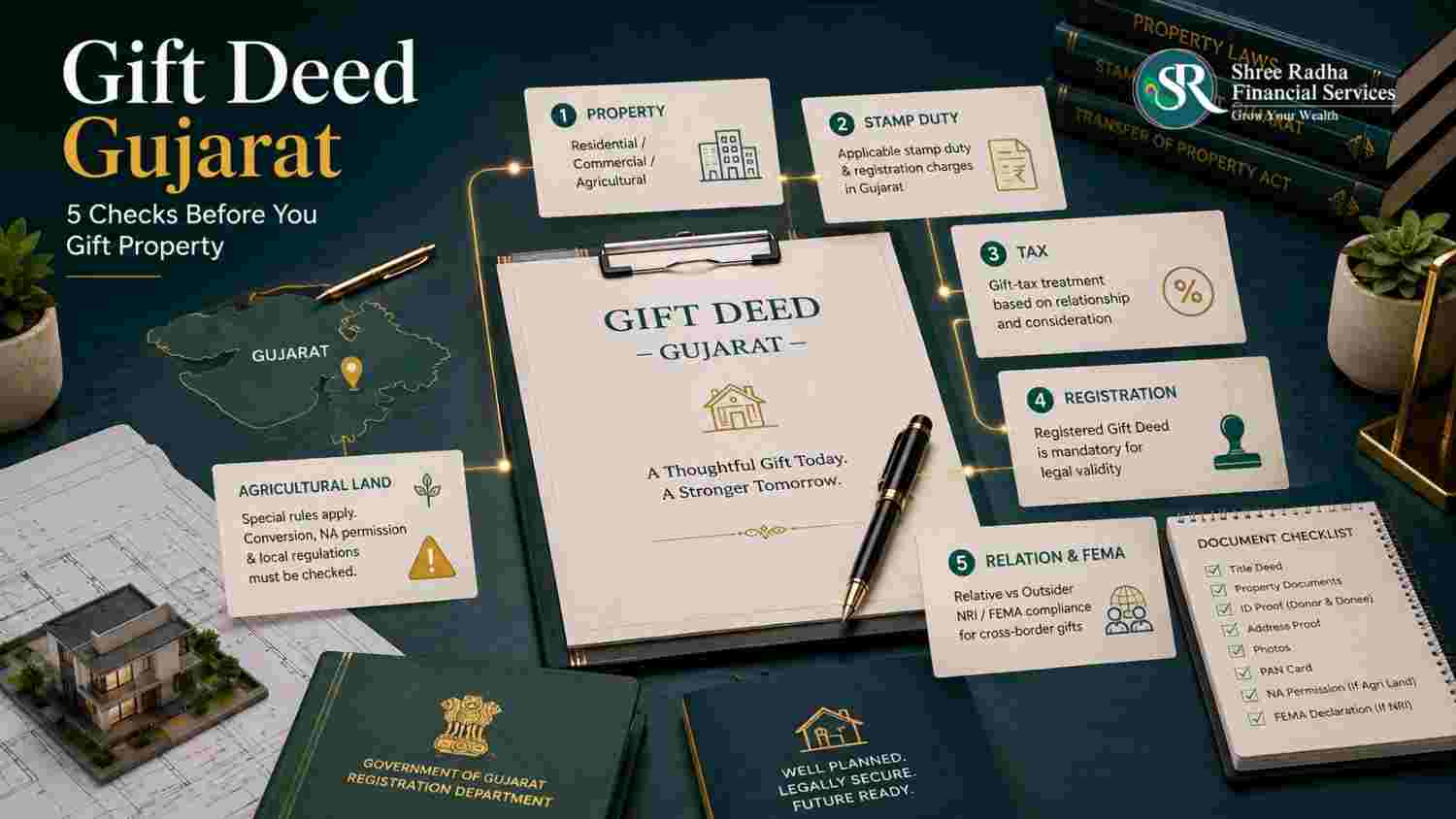
- Confirm the relationship, both ways — for tax exemption under Income Tax rules, and separately for FEMA if anyone involved is an NRI.
- Check the asset type — agricultural land needs a revenue advocate’s clearance before it goes anywhere near a gift deed.
- Calculate stamp duty properly — 1% vs 4.9% in Gujarat is a large difference; confirm which rate applies before drafting.
- Decide if you need a condition in the deed — a maintenance or life-interest clause only protects you if it’s written in at signing, not added later.
- Register immovable property gifts without exception — an unregistered gift deed for land or a flat has no legal effect.
- Complete mutation after registration — so revenue and municipal records reflect the new owner.
This checklist is a starting point, not legal advice. Gift deed drafting, FEMA compliance, and Senior Citizens Act protections all require a lawyer familiar with your specific situation.
How SR Wealth Can Help
Shree Radha Financial Services (SR Wealth) is an AMFI Registered Mutual Fund & SIF Distributor and APMI Registered PMS Distributor. We are not a legal advisory firm — for gift deed drafting, FEMA compliance, and Senior Citizens Act protections, you need a lawyer and, where FEMA or tax positions are involved, a CA. What we help with:
- Reviewing how a planned gift fits into your overall investment and estate picture
- Coordinating with your lawyer and CA when a gift involves property, securities, or an NRI family member
- Referrals to qualified lawyers for gift deed drafting and FEMA-compliant structuring
Gift Deed Gujarat: Frequently Asked Questions
Can a gift deed be cancelled once it’s registered?
Generally, no — a registered and accepted gift deed for immovable property is very difficult to reverse. The main exception is for senior citizens: a Tribunal can void it under the Senior Citizens Act, but only if the deed itself included a maintenance condition that the recipient then failed to meet.
Is stamp duty the same whether I gift to my son or to a friend?
No. For any gift deed Gujarat property owners execute, gifts to defined blood relatives attract 1% stamp duty, while gifts to anyone outside that list attract 4.9%.
Do I have to pay tax on a gift deed if it’s from my father?
No. Gifts from a parent — a defined “relative” under the Income Tax Act — are fully exempt from tax, regardless of value.
Can agricultural land in Gujarat be gifted to my children?
Only if the recipient is a registered agriculturist. If they aren’t, the transfer is barred under Section 63 of the Gujarat Tenancy and Agricultural Lands Act without Collector permission, which is difficult to obtain for routine family transfers.
Can I gift property to my NRI son?
Residential and commercial property can generally be gifted to an NRI child without RBI approval, since a son qualifies as a relative under FEMA’s narrower definition too. Agricultural land, plantation property, and farmhouses cannot be gifted to an NRI under any circumstances — only inherited.
Thinking About Gifting Property to Your Family?
Kantibhai’s decision started as a simple one — until stamp duty, tax, and a forgotten piece of farmland all turned out to matter. Worth getting the full picture before any gift deed Gujarat paperwork gets drafted.
📞 Call / WhatsApp: +91 98791 13255
📧 Email: shreeradha.services@gmail.com
🌐 Visit: www.srwealth.co.in
📍 Shop 33, Mira Nagar 2, Dindoli Road, Surat 394210
Paresh Chaudhary
Founder, Shree Radha Financial Services (SR Wealth), Surat
AMFI Registered Mutual Fund & SIF Distributor — ARN: 268390
APMI Registered PMS Distributor — APRN: 05763
IRDAI Licensed Insurance Distributor
BE Mechanical, SVNIT Surat | Ex-L&T (15+ Years)
Educational Disclaimer: This article is published by Shree Radha Financial Services — an AMFI Registered Mutual Fund & SIF Distributor (ARN: 268390) and APMI Registered PMS Distributor (APRN: 05763), and does not provide legal advisory services. Please consult a qualified lawyer and CA for gift deed drafting, FEMA compliance, and Senior Citizens Act protections specific to your situation. Regulatory and case-law positions referenced are subject to change and judicial interpretation. The persona in this article is illustrative.