
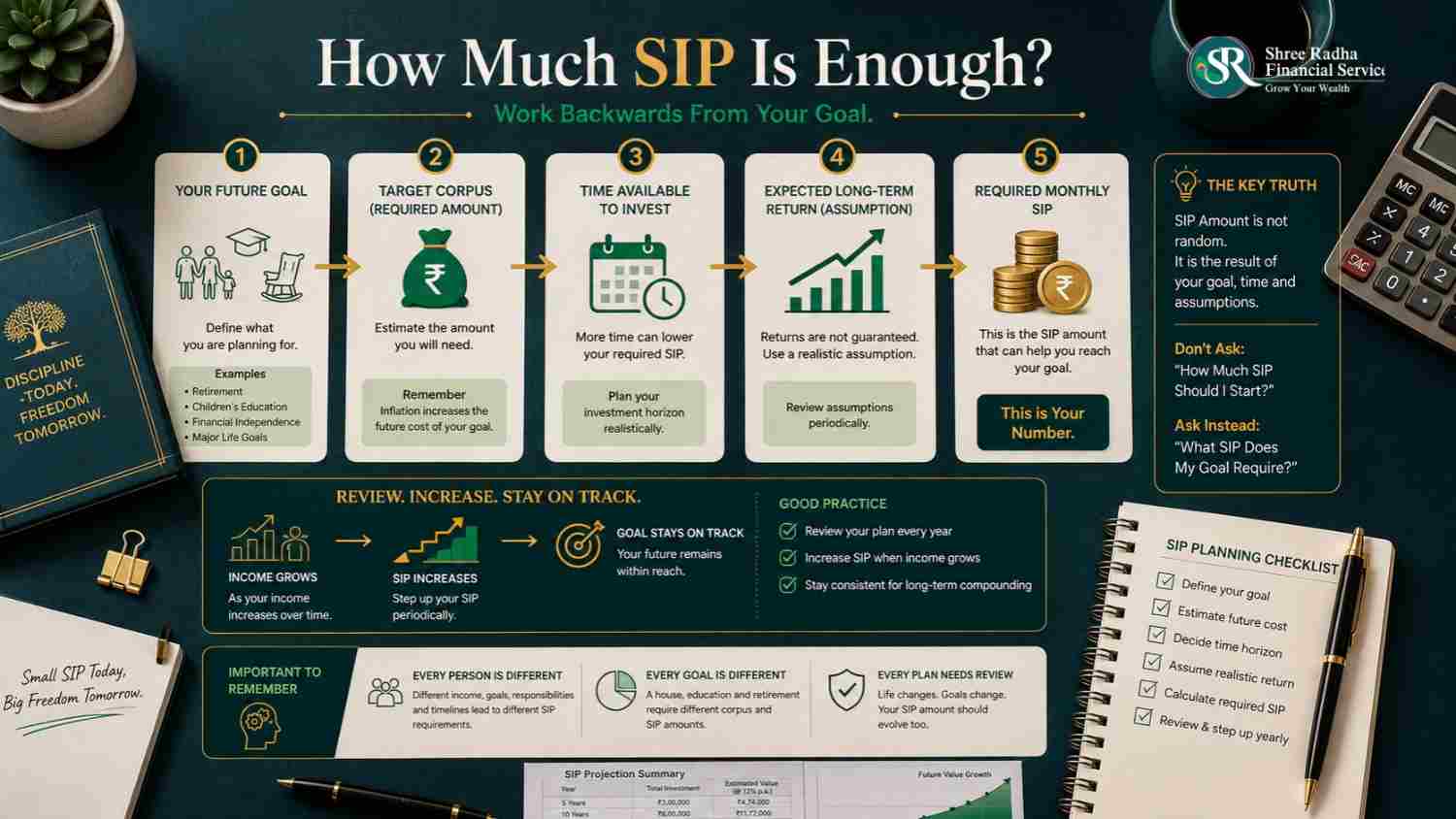
How much SIP is enough:
This guide is built for the investors who’ve done the hardest part already — starting, and sticking with it. Ramesh Bhai is one of them. So is almost everyone reading this.
Varachha: The SIP That Never Grew Up
Ramesh Bhai Sondagar has run a diamond polishing unit off Kadodara Road, on the Varachha side of Surat, for nineteen years. In 2016, when a friend at the local jewellers’ association insisted he “put something aside systematically instead of just gold,” Ramesh Bhai started a SIP of ₹5,000 a month. He remembers the exact number because it felt like a stretch back then — his unit was small, four polishing wheels, tight margins.
Nine years later, his unit runs sixteen wheels. His son has joined the business. Turnover has grown more than four times. And the SIP? Still ₹5,000 a month — the same instruction he gave his bank in 2016, sitting quietly on auto-debit, untouched.
“I thought I was doing the right thing,” he said, when he finally sat down with the question properly. “I never stopped it. I never missed a month. Isn’t that what everyone tells you to do — just don’t stop your SIP?”
He wasn’t wrong about discipline. He was wrong about the number.
“I meet investors every month who are genuinely proud of their SIP discipline — and they should be, it’s the hardest habit to build. But almost nobody checks their amount against their actual goal after the first year. The SIP keeps running. The goal keeps moving further away. Nobody notices, because nothing visibly goes wrong — until the year you actually need the money.”
— Paresh Chaudhary, Founder, Shree Radha Financial Services, Surat
The Gap Nobody Checks: What’s Actually Happening to Your SIP Amount
This isn’t just a Ramesh Bhai problem. Industry data shows the average SIP ticket size across India has stayed roughly flat around ₹2,200–2,500 per month for years — even as the number of SIP accounts has multiplied several times over. Millions of people are investing regularly. Very few have gone back and asked whether that specific number still means anything against a specific goal.
Here’s why this happens quietly, without any warning sign:
- You pick a number when you start — usually “whatever feels comfortable that month,” not a number worked backward from a goal
- The SIP keeps debiting successfully every month, so there’s no red flag, no missed payment, nothing that forces a review
- Income rises over the years — a promotion, a growing business, a second income — but the SIP amount was never linked to income, so it doesn’t rise with it
- The fund’s returns look healthy on the statement, which creates a false sense that “it’s working,” when the real question — working toward what, and is it enough — is never asked
This is the trap: a SIP can be perfectly disciplined and still be quietly insufficient. Discipline and adequacy are two different things, and only one of them shows up on your monthly statement.
The Reverse-Engineering Math: What Does ₹1 Crore Actually Require?
Instead of starting with a comfortable number, start with the goal and work backward. Assuming a long-term equity mutual fund return of 12% per annum (a commonly used planning assumption, not a guarantee — markets don’t move in a straight line), here is what a ₹1 crore goal actually requires, at different time horizons:
| Time to Goal | Monthly SIP Needed for ₹1 Crore | What ₹2,500/month Alone Gets You |
|---|---|---|
| 25 years | ~₹5,300 | ~₹47 lakh (less than half the goal) |
| 20 years | ~₹10,000 | ~₹25 lakh |
| 15 years | ~₹19,800 | ~₹12.5 lakh |
| 10 years | ~₹43,000 | ~₹5.8 lakh |
Want your own number instead of this general table? Use our free SIP goal calculator...The pattern is clear: even over a full 25-year working life, the national-average SIP amount reaches barely half of a ₹1 crore goal. This is not a criticism of anyone’s discipline — it’s simply what happens when a monthly number is chosen once, in comfort, and never revisited against math.
Hazira Belt: The Engineer Who Trusted the Wrong Habit
Kaushik Trivedi has spent eleven years as a process engineer at a petrochemical plant in the Hazira industrial belt — the kind of career, EPC-adjacent, shift-based, where financial planning tends to happen in five-minute conversations between long work stretches. In 2019, a colleague on the same shift mentioned starting a SIP. Kaushik started one too — ₹2,000 a month, in whichever fund his colleague named, with no particular goal attached beyond “saving something instead of nothing.”
His salary has grown meaningfully since — two increments, one company change within the same belt, better allowances. His SIP amount hasn’t moved once. When he finally worked out what he actually wants — his daughter’s engineering or medical education, roughly fourteen years away — the ₹2,000 figure wasn’t close. At 12% assumed returns over 14 years, that SIP was on track for roughly ₹8–9 lakh. A reasonable estimate for a professional education seat in that timeframe runs well above that.
“I didn’t do anything wrong month to month,” Kaushik said. “I just never connected the number to what it was actually for.”
The fix wasn’t a dramatic jump. Kaushik didn’t need to suddenly find an extra ₹15,000 a month — that kind of leap rarely survives contact with real life. Instead, his SIP was restructured with a step-up built in — a smaller increase each year, timed to his typical annual increment, so the amount grows toward the goal instead of sitting frozen at the number he happened to type in six years ago.
What This Math Assumes — Read Before You Act
Any responsible guide has to be honest about what these numbers do and don’t promise. A Distributor who only shows the upside isn’t giving you the full picture.
| ✅ This Framework Helps If | ❌ Be Careful If |
|---|---|
| You have a specific goal amount and a rough timeline in mind | You treat 12% as guaranteed rather than a long-term planning assumption |
| You’re comfortable reviewing and adjusting the amount every year or two | You pick a fund based only on past returns without checking category and risk fit |
| You can commit to a starting number even if it’s smaller than the “ideal” one | You ignore inflation on the goal itself — ₹1 crore in 20 years won’t buy what ₹1 crore buys today |
| You’re open to a step-up structure instead of one large jump | You expect a straight line — equity markets move in cycles, not steady slopes |
Returns are never guaranteed and equity mutual funds carry market risk — this math is a planning tool, not a promise.
Adajan: The Teacher Who Copied a Number, Not a Plan
Priya Desai teaches at a school near Adajan and started her SIP the way a lot of first-time investors do — she copied a friend’s number. Her friend invested ₹1,500 a month, so Priya set up ₹1,500 a month too, in 2021, without asking why that particular figure, or what her friend was even saving for.
Four years in, nothing had gone wrong — the SIP had grown steadily, and Priya felt good each time she checked the app. It was only when she sat down to actually name her own goal — a mix of a future home down payment in eight to ten years, plus a general long-term cushion — that the borrowed number stopped making sense. ₹1,500 a month wasn’t sized for either goal; it was sized for someone else’s life.
Priya didn’t abandon her SIP or start over from panic. She kept the existing fund running, increased the monthly amount to a figure actually worked out against her ten-year down-payment target, and added a second, smaller SIP for the longer-term goal — so each rupee now has a name attached to it, not just a habit.
Finding Your Own Number
A practical way to reverse-engineer your SIP amount, whichever life stage you’re in:
- Name the goal specifically — not “save for the future,” but an actual amount and an actual year: ₹1 crore in 20 years, ₹25 lakh in 8 years, whatever it is
- Use a realistic return assumption — 10-12% for long-term equity-oriented SIPs is a reasonable planning range, not a promise
- Work backward to the required monthly figure — using the table above as a starting reference, or a SIP goal calculator for your exact numbers
- Compare it honestly to what you’re investing today — the gap, if there is one, is the real information this exercise gives you
- Close the gap with a step-up, not a leap — a 10-15% annual increase timed to your usual increment closes most gaps within a few years without straining your monthly budget
- Revisit every 12-18 months — income changes, goals shift, and a number that was right two years ago may already be behind again
Back to Varachha, Hazira, and Adajan
Ramesh Bhai stepped his SIP up to ₹22,000 a month, phased in over two years rather than all at once, aligned to his unit’s now-larger, steadier cash flow. Kaushik’s SIP now rises each year in step with his typical increment, aimed squarely at the education goal instead of drifting on autopilot. Priya split her investing into two purpose-built SIPs instead of one borrowed number.
None of them changed their discipline — that part was already working. What changed was the number behind it.
Frequently Asked Questions — How Much SIP Is Enough
How do I know if my current SIP amount is enough?
Compare it against a goal-based figure — take your target amount and timeline, and reverse-engineer the required monthly SIP at a realistic return assumption (10-12% for equity-oriented funds). If your current amount falls well short, that’s the gap to close.
Is ₹2,500 a month a bad SIP amount?
Not inherently — it depends entirely on your goal and timeline. ₹2,500 a month can comfortably build a meaningful corpus for a goal 25+ years away, but falls well short of a ₹1 crore target within 10-15 years. The amount only means something in relation to what it’s for.
Should I increase my SIP amount every year?
For most investors with growing income, yes — a step-up SIP that rises 10-15% annually closes the gap between a starting amount and a real goal far more comfortably than one large jump later.
What return should I assume when calculating my required SIP?
10-12% per annum is a commonly used long-term planning assumption for equity-oriented mutual funds in India, based on historical index performance — but it is not guaranteed, and actual returns will vary year to year.
Does inflation affect how much SIP I need?
Yes, significantly. A goal like “₹1 crore in 20 years” should ideally be adjusted for inflation on the goal itself — what ₹1 crore buys today will buy less in 20 years, so many investors plan for a larger inflation-adjusted target rather than a flat number.
Can I fix an under-funded SIP without starting over?
Yes — the existing SIP and its accumulated units continue to grow undisturbed. You simply increase the monthly instalment going forward, or add a second SIP for a specific goal, as both Kaushik and Priya did.
Quick Checklist: Is Your SIP Amount Actually Working for You?
- Do you have a specific goal amount and year attached to your SIP — or just a comfortable habit?
- Has your income grown since you started, without your SIP amount growing alongside it?
- When did you last calculate the required SIP for your goal — ever, or only once at the start?
- Would a 10-15% annual step-up be realistic against your usual yearly increment?
- Have you adjusted your goal amount for inflation, or are you still planning against today’s price of things?
Want your actual number, not a general one?
Shree Radha Financial Services helps Surat investors — from Varachha to the Hazira belt to Adajan — work out exactly what SIP amount their real goals require, and structure a step-up plan that fits their income pattern, not someone else’s.
We also help with restarting a paused SIP, reviewing an existing portfolio, and checking if your retirement corpus is on track.
📞 Call / WhatsApp: +91 98791 13255
📧 Email: shreeradha.services@gmail.com
🌐 Visit: www.srwealth.co.in
📍 Shop 33, Mira Nagar 2, Dindoli Road, Surat 394210
About the Author
Paresh Chaudhary
Founder, Shree Radha Financial Services, Surat
AMFI Registered Mutual Fund & SIF Distributor — ARN: 268390
APMI Registered PMS Distributor — APRN: 05763
IRDAI Licensed Insurance Distributor
Investing since 2012 | BE Mechanical, SVNIT Surat | Ex-L&T (15+ Years)
Educational Disclaimer: This article is published by Shree Radha Financial Services — an AMFI Registered Mutual Fund & SIF Distributor (ARN: 268390) and APMI Registered PMS Distributor (APRN: 05763). All content is strictly for educational purposes only and does not constitute legal, tax, or investment advice. The 10-12% return assumption used in this article is illustrative and based on long-term historical trends — actual mutual fund returns are not guaranteed and are subject to market risk. Please read all scheme-related documents carefully and verify current information at SEBI or AMFI before investing. Mutual fund investments are subject to market risks.