
Introduction
The Gulf war impact NRI families are feeling isn’t what most headlines suggest. Ronakbhai didn’t lose his job. Devangbhai’s hotel didn’t close. Miteshbhai’s company is doing fine. None of the three men in this article are in danger, and none of them needed to leave the Gulf. But all three have spent the last few months with a low, background worry they can’t quite name — something about projects moving slower, about a manager’s careful choice of words, about headlines that don’t quite match daily life but don’t quite go away either.
This article looks closely at the real gulf war impact NRI households are navigating right now — not the war itself, but the quieter financial worry behind it — sector by sector, plus the one financial habit that resolves most of it whether your situation looks like Ronakbhai’s, Devangbhai’s, or Miteshbhai’s, and what history actually shows about Indian markets during moments exactly like this one.
“Almost nobody who calls me these days is scared. They’re careful. They ask about their emergency fund, about their SIP, about whether now is a normal time or not. Most of them already have the right instinct — they just haven’t checked the actual number in a while.”
— Paresh Chaudhary, Founder, Shree Radha Financial Services, Surat

Gulf War Impact NRI: What’s Really Happening — Checked, Not Assumed
The ceasefire that held from April broke down last month. The US reimposed a naval blockade on Iranian shipping, and as of this week, Oman is mediating fresh talks on reopening the Strait of Hormuz, with cautious signs of progress. That’s the honest headline: unresolved, not resolved, and not the acute danger of the earliest weeks either.
Here’s what that’s actually done to the sectors Gulf NRIs work in — checked against real reporting, not assumption:
| Sector | What Actually Happened | Current Picture |
|---|---|---|
| Real Estate & Construction | Of roughly 45,000 Dubai units due for handover in 2026, about half slipped to 2027 or later. New launches slowed noticeably from March onward. | The IMF still called the UAE economy resilient in July — this is a delay and a mood shift, not a collapse. Transactions have been recovering since April. |
| Infrastructure & Government Projects | Government spending is actually accelerating — Abu Dhabi’s Dh55 billion PPP pipeline, Dubai’s Dh34 billion Metro Gold Line. | Construction firms report continuing projects with no cancellations — the sector is pivoting toward infrastructure, not shrinking. |
| Tourism & Hospitality | Foreign visitor numbers dropped sharply in the early months; major operators like Emaar flagged “some impact” on hospitality tied to visitor flows. | Resident life and local footfall recovered faster than tourist arrivals — this is a visitor-number problem more than a resident-economy problem. |
| Oil & Core Economy | The Strait of Hormuz disruption raised near-term costs and freight risk. | The IMF expects hydrocarbon growth to actually pick up in the second half of the year as production ramps up — this is not the sector under pressure. |
Source note: Figures above are compiled from public reporting — including IMF Article IV consultation updates, Dubai Land Department transaction data, and public company disclosures (including Emaar) — current as of publication. Conditions vary by company, project, and location, and can change as the situation develops.
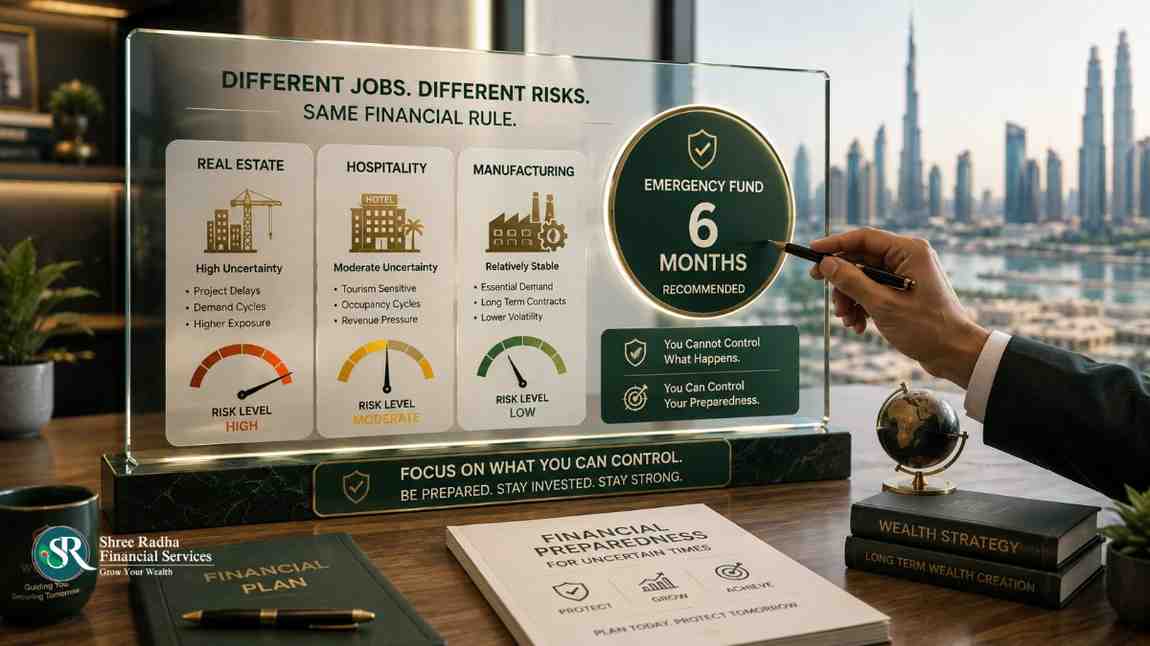
The honest summary of the gulf war impact NRI professionals are actually facing: if you work in or around real estate, construction sales, or hospitality, your caution has a real basis. If you work in most other sectors, the economy around you has been more resilient than the headlines suggest — but the general uncertainty still gets under everyone’s skin a little, because it’s genuinely unresolved. For the broader mechanics of how a conflict like this moves through an economy, see our detailed look at the effect of war on the economy.
Ronakbhai’s Story — Dubai, Real Estate Sales, and the Handover That Kept Moving
Ronakbhai Trivedi has sold off-plan apartments for a mid-sized Dubai developer for six years. Originally from Rajkot, he built his income around commissions tied to project milestones and handovers. Early this year, launches that used to sell out within hours started moving noticeably slower. Then two of his own projects — originally slated for handover this year — got pushed into 2027.
Nothing about his job disappeared. His company hasn’t cut anyone. But his income has become lumpier and less predictable than it’s been in years, and he genuinely doesn’t know how long that lasts. Ronakbhai’s story is one of the clearest, most concrete examples of gulf war impact NRI sales professionals in Dubai’s property market are actually living through — not panic, a real, specific financial planning problem that deserves a real answer.
Devangbhai’s Story — Doha, Hotel Operations, and a Manager’s Careful Sentence
Devangbhai Shah has managed front-office operations at a five-star hotel in Doha for nine years. Originally from Vadodara. Occupancy at his hotel has been visibly softer since the conflict began; conference bookings that used to fill a full quarter are now confirmed a few weeks out at a time.
His manager hasn’t said anything alarming. What he said was: “let’s keep a close eye on costs this year.” That single, careful sentence is doing more to Devangbhai’s peace of mind than any dramatic headline would — because it’s vague enough to worry about and specific enough to be real.
Miteshbhai’s Story — Kuwait, Manufacturing, and the Worry With No Actual Cause
Miteshbhai Gohil works in process engineering at a manufacturing plant in Kuwait — a sector that, per the data above, hasn’t been meaningfully disrupted by the conflict at all. Originally from Surat, his job is secure and his company’s order book is unaffected. By every actual measure, nothing about his situation has changed.
And yet he’s checked his company’s news page more times this year than in the previous five combined. That’s not irrational — when the region you live in is in every headline, a baseline hum of unease is a completely normal human response, even when your own circumstances are fine. Miteshbhai’s story matters because he’s probably the most common version of this — not actually at risk, just tired of not knowing for certain.
The One Number That Answers All Three Stories — Your 6-Month Emergency Fund
Ronakbhai’s income is genuinely uncertain. Devangbhai’s is softening quietly. Miteshbhai’s isn’t affected at all but the worry persists anyway. All three get the same answer, because the fix isn’t about predicting the war — it’s about making sure a few uncertain months, whenever and if they come, can’t actually hurt you. This is the single most practical response to the gulf war impact NRI households across the region can take today, regardless of which of the three stories above sounds most like their own.
How to check your number, honestly:
- Add up your committed monthly outflow — Gulf rent or accommodation, EMIs, school fees, and whatever you regularly send home for family expenses
- Multiply that by six
- Compare it to what you actually have sitting in something you could access within a day or two, without penalty
- If the number sitting there is short of six months — that gap, not the war, is the thing actually worth fixing this month
Where that money sits matters almost as much as how much of it there is. A savings account is easy to access but earns next to nothing and loses real value to inflation every year it sits there. A liquid mutual fund — the same category of fund we walk through in our mutual fund investment guide — gives you the same one-to-two-day access with a meaningfully better return and more efficient taxation on the gains. NRE and NRO account rules for NRIs are governed by RBI’s remittance and deposit guidelines, so whichever account this cushion sits in, it stays fully compliant.
| Feature | Savings Account | Liquid Fund |
|---|---|---|
| Access Time | Instant | Usually within 1 business day |
| Typical Return | Low — rarely keeps pace with inflation | Meaningfully higher — money market instruments, actively managed |
| Safety | High | High — short-duration, low-volatility instruments |
| Best For | The portion you may need same-day | The bulk of your 6-month cushion |
This single step — checking the number and moving idle cash into something that actually works while staying accessible — is what turns a vague, background worry into a completed task. It doesn’t require predicting when the Strait talks conclude or whether the next quarter is quiet or noisy. It just removes the question “what if” from having a scary answer.

This Isn’t India’s First Time — What Happened to Markets During Past Conflicts
Once your near-term cushion is sorted, the next fear is usually about the bigger investments — the SIP, the mutual funds, the money meant for five and ten years from now. Here, the most useful thing isn’t a prediction. It’s a look at what actually happened the last few times India faced something like this — useful context for understanding today’s gulf war impact NRI investors are trying to make sense of.
| Event | Initial Market Reaction | What Followed |
|---|---|---|
| Kargil War (1999) | Brief early dip | Sensex gained 39.1% over the course of the conflict; the economy grew 6.5%, matching the prior year’s pace |
| Post-Balakot Strikes (2019) | Sensex dipped under 1% | Markets moved on within days |
| Russia-Ukraine War (2022) | Nifty fell roughly 16% from its peak | Recovered over the following months |
Source note: Historical index movements are illustrative, compiled from public market data and financial news reporting on the events listed. Past performance does not indicate or guarantee how markets will behave in any future situation, including the present one.
The pattern across nearly every geopolitical shock India has faced: an initial dip, a recovery window typically ranging from a few weeks to under two years, and markets that have shown increasing resilience over time — not less. That’s not a guarantee about this specific conflict. It’s context that’s genuinely missing from most of the headlines driving the worry in the first place.
Whether You’re Already Invested, Still Investing, or Thinking of Starting
If you’re already invested and it’s been doing well
The instinct to protect gains by pulling out during uncertainty is natural — and, going by the pattern above, it usually costs more than it protects. The precaution here isn’t to exit. It’s to check whether your allocation has quietly drifted more aggressive than you’re comfortable with, and rebalance if needed — a review, not a retreat.
If you’re actively investing — SIPs running, staying disciplined
This is exactly the wrong moment to pause. A SIP works by buying more units when prices dip and fewer when they’re high — a volatile period does that job for you automatically, provided you don’t interrupt it. The precaution here is simply continuity, not a new decision.
If you haven’t started yet, and this is what’s pushing you to finally look at it
Uncertainty-driven dips are historically when disciplined money gets deployed at better prices, not worse ones. The precaution for a first-time investor is different from the other two — start with an amount you’re genuinely comfortable not touching for three to five years, and don’t let “the market feels scary right now” become a reason to wait indefinitely. There’s always a headline; there’s rarely a perfect entry point.
Three Costly Habits Worth Avoiding Right Now:
- ❌ Stopping a SIP mid-cycle — historically this means missing the recovery, not avoiding the dip
- ❌ Buying gold after it’s already spiked — the fear is already priced in; a steady, small allocation works better than a panic purchase
- ❌ Moving your full portfolio to cash “until things settle” — cash steadily loses value to inflation, and “settled” rarely arrives on a predictable date
Two Smaller Things Worth Knowing While You’re At It
If your income is stable — closer to Miteshbhai’s situation — the rupee’s slide to around 95 to the dollar this year is actually working in your favour every time you remit, not against you. Money going into productive, India-based investments through your NRE account converts to meaningfully more rupees than it did a year ago.
And if the specific thing bothering you is watching the exchange rate itself — not your job, just the currency — that’s a narrower problem with its own fix. Instruments like GIFT City funds are dollar-denominated, which means rupee movement stops being something you need to track at all for that portion of your money.
Frequently Asked Questions on Gulf War Impact NRI and Financial Planning
Is my job actually at risk if I’m not in real estate, construction, or hospitality in the Gulf?
Based on current reporting, most other sectors — manufacturing, healthcare, government-linked roles, core oil and gas — have been notably resilient through the conflict, and the IMF described the UAE economy overall as resilient as of July 2026. The sectors showing genuine, measurable strain are real estate, construction handovers, and tourism-dependent hospitality.
How much should my emergency fund actually be?
Six months of your committed monthly outflow — rent or accommodation, EMIs, school fees, and regular family remittances — is the standard, sensible benchmark, and a reasonable one to hold to regardless of whether the current situation resolves quickly or drags on.
Should I move my emergency fund out of my savings account?
Keep a small buffer for same-day needs in savings, and move the bulk of the six-month cushion into a liquid mutual fund, which offers similar access within a day or two with a meaningfully better return and no loss of safety.
Is it safe to invest in India during the Iran-Gulf conflict?
India’s stock market has a long history of absorbing geopolitical shocks without lasting damage — the Kargil War, Balakot, and the Russia-Ukraine war all saw initial dips followed by recovery within months, not years. The war affects sentiment and specific sectors more than the underlying strength of Indian companies or the regulatory protection around your investments. Past patterns are not a guarantee for this specific situation, but they are useful context.
Should I stop my SIP because of the war?
Historically, no — a SIP is specifically designed to benefit from volatility by buying more units when prices are lower. Pausing during a dip usually means missing the recovery that has followed nearly every past geopolitical shock to Indian markets, including Kargil and Russia-Ukraine.
Gold or mutual funds — which is better to invest in during a war?
Gold tends to spike early as a fear response, which often means buying it mid-conflict means buying near its peak. Mutual funds tied to the broader economy have historically recovered and grown well beyond their pre-conflict levels within a year or two of past shocks. A small, steady gold allocation (5-10% of a portfolio) makes sense as a permanent diversification choice — not as a panic switch mid-crisis.
Is now a bad time to keep investing given everything going on?
The conflict affects sentiment and specific sectors, not the regulatory protections or fundamentals behind mutual fund investing. For a stable income, continuing your SIP and using the current rupee level to your advantage tends to work out better than pausing and waiting for certainty that may not arrive on any predictable schedule. This is, in the end, the calmest way to respond to gulf war impact NRI households will keep feeling in the months ahead, whichever way the Oman talks go.
This article is also available on Medium: https://medium.com/@shreeradha.services/gulf-war-2026-what-it-actually-means-for-nri-jobs-and-money-0d2f4bbb5d78
Not Sure Where Your Emergency Fund or Portfolio Actually Stands?
Whether you’re watching project handovers slip in Dubai, a quieter season in Doha, or you’re simply tired of the background noise in Kuwait or Abu Dhabi — a short conversation is enough to check your number and tell you honestly whether you’re covered.
No obligation. No pressure. A clear answer, from a Surat-based advisor who already works with NRI families across the Gulf. You can browse the fund options we work with on our investment options page, and verify our registration directly on AMFI’s official website under ARN 268390.
📞 Call / WhatsApp: +91 98791 13255
📧 Email: shreeradha.services@gmail.com
🌐 Visit: www.srwealth.co.in
📍 Shop 33, Mira Nagar 2, Dindoli Road, Surat 394210
Paresh Chaudhary
Founder, Shree Radha Financial Services, Surat
AMFI Registered Mutual Fund & SIF Distributor — ARN: 268390
APMI Registered PMS Distributor — APRN05763
Investing since 2012 | BE Mechanical, SVNIT Surat | Ex-L&T (15+ Years)
Educational Disclaimer: This article is published by Shree Radha Financial Services — an AMFI Registered Mutual Fund & SIF Distributor (ARN: 268390) and APMI Registered PMS Distributor (APRN05763). It is for educational purposes only and does not constitute investment advice, employment guidance, or a recommendation about travel or residency decisions. Sector, market, and historical data referenced are drawn from public reporting and public market data current as of publication and may change; past performance does not guarantee future results. Mutual fund investments are subject to market risks — read all scheme-related documents carefully before investing. Please consult a qualified professional for decisions specific to your situation.