Nirav’s WhatsApp Problem
Nirav Kapadia works in operations at a private firm near Adajan, Surat. Thirty-six, married, a daughter in the third grade. When his annual bonus landed this March, he did what a lot of people his age do — he opened Google and typed the exact phrase a lot of Surat investors end up searching: mutual fund advisor vs distributor. He just wanted to know who to trust with the money.
Within two days, four people had messaged him on WhatsApp. Each one called himself a “mutual fund advisor.” One sent a PDF of a fund that had “given 34% last year.” Another asked for ₹2 lakh upfront to “start the advisory relationship.” A third simply said, “Sir trust me, I am doing this for 8 years, no need to worry about paperwork.”
Nirav didn’t invest with any of them. Something felt off, and he couldn’t name what — until his brother-in-law asked one question: “Are you sure any of them are actually SEBI Registered Investment Advisers, or are they AMFI Registered Distributors? Those aren’t the same thing, and the second one isn’t even supposed to call himself an advisor.”
Nirav had never heard that in his life. Neither had any of the four men in his WhatsApp.
“Almost every investor who calls me asking for ‘advice’ has never been told there’s a legal difference between an advisor and a distributor. That’s not their fault — nobody explains it to them. My job the first time I speak to someone isn’t to sell. It’s to tell them plainly which one I am, so they know exactly what they’re getting before they decide anything.”
— Paresh Chaudhary, Founder, Shree Radha Financial Services (SR Wealth)
Bhavesh Bhai Had Been Investing for Five Years — And Never Once Asked
Bhavesh Sarvaiya runs a textile trading business in Katargam. He’s been investing through the same local contact, Rakesh, for five years — a referral from a cousin, no complaints, decent returns. Rakesh’s visiting card reads “Senior Wealth Advisor.” Bhavesh never gave that title a second thought.
Then his son, home from college, mentioned something he’d read online — that SEBI doesn’t actually allow a mutual fund distributor to call himself an “advisor” unless he’s separately registered for it. Bhavesh checked Rakesh’s card again. Below the title, in smaller print: ARN-154XXX.
Rakesh wasn’t running a scam. He held a genuine, active AMFI registration — the ARN was real. What he’d gotten wrong was the title on his own card, something distributors slip into casually because it sounds more impressive than “distributor.” But that slip had a real cost for Bhavesh: he’d spent five years assuming Rakesh was formally guiding his full financial picture — the business surplus, the gold, a plot near Sarthana he’d been meaning to do something with — when, by regulation, Rakesh could only formally guide him on the mutual funds themselves.
Bhavesh didn’t stop working with Rakesh. He had a direct, un-awkward conversation with him about it, and for the first time understood exactly where Rakesh’s role started and stopped.
Why This Mix-Up Happens So Often in Surat
There are two separate roles here, and SEBI drew the line deliberately.
A Mutual Fund Distributor (MFD) holds an AMFI Registration Number — an ARN — earned by clearing the NISM Series V-A certification exam and completing AMFI’s KYD process. Their job is to help investors select, invest in, and service mutual fund schemes.
A SEBI Registered Investment Adviser (RIA) operates under an entirely different framework — the SEBI (Investment Advisers) Regulations, 2013 — and is registered to give personalised, fee-based investment advice across an investor’s full financial picture.
Because the two carry different duties and different compensation models, SEBI has specifically directed that distributors should not describe themselves using titles like advisor, wealth manager, planner, consultant, or coach unless they hold that separate registration — which is exactly why the mutual fund advisor vs distributor Surat question keeps coming up. It isn’t a technicality — it exists so an investor can tell, from the title alone, what kind of relationship they’re actually entering. In practice, plenty of genuine, well-meaning distributors use these titles anyway, simply because nobody ever corrected them — which is exactly what happened with Rakesh.
Mutual Fund Advisor vs Distributor Surat: The Real Difference In One Table
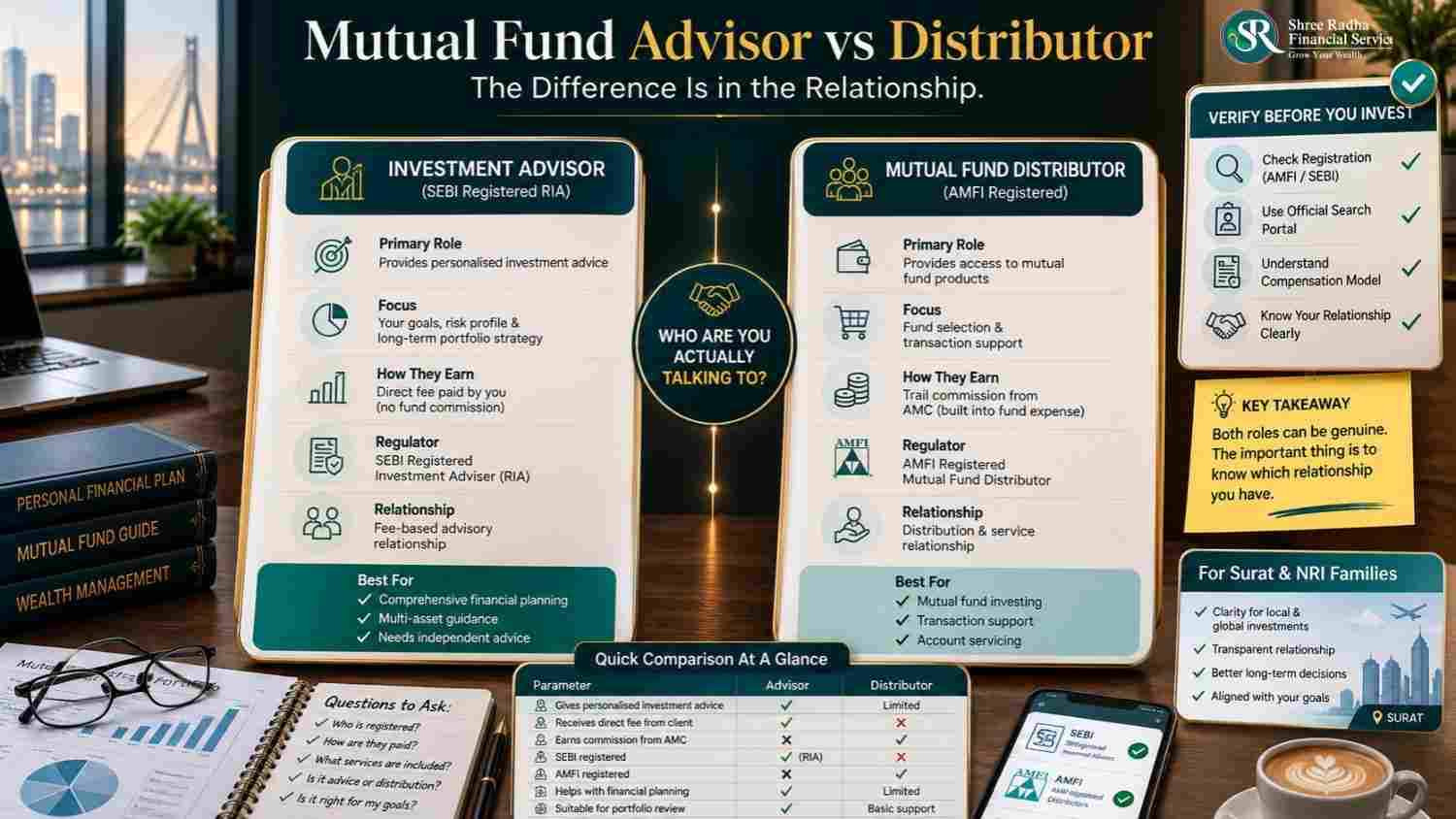
| Aspect | SEBI Registered Investment Adviser (RIA) | AMFI Registered Distributor (MFD) |
|---|---|---|
| Registered with | SEBI directly | AMFI |
| Scope | Full financial picture — goals, assets, planning | Mutual fund selection, investment, and servicing |
| Duty owed to you | Fiduciary — legally bound to your best interest | Honest dealing, not a fiduciary standard |
| Can use the title “advisor”? | Yes — that’s the registration itself | No, per SEBI’s direction — though it happens anyway, as with Rakesh |
Neither is “the better one” — they solve different problems. Bhavesh didn’t need to leave Rakesh. He needed to know Rakesh’s actual scope, so the rest of his wealth gets planned somewhere it’s actually covered — the kind of gap our Investment Guide for Gujarat Business Owners walks through in more detail.
The Commission Question Nobody Explains
A distributor’s income comes from a portion of the trail commission a fund house pays out on a Regular Plan — not the full gap between what a Direct Plan and a Regular Plan charge. Part of that gap is retained by the fund house itself, and wherever a platform or sub-distribution arrangement sits in between, a further share goes there too. What actually reaches someone like Rakesh is smaller than the headline expense-ratio difference investors often assume.
Nirav and Bhavesh don’t write a separate cheque for this — it’s built into the Regular Plan’s expense ratio and appears on every Consolidated Account Statement. It’s a real cost, worth weighing the same way you’d weigh paying a mechanic instead of servicing your own car — the question isn’t whether there’s a cost, it’s whether you’re getting a person who picks up the phone when it matters.
How to Verify Who You’re Actually Talking To
This takes about sixty seconds using AMFI’s official Locate a Mutual Fund Distributor tool — free, no login required.
Before you invest through anyone, check:
- ✅ Ask directly for their ARN — a genuine distributor gives it without hesitation
- ✅ Search that ARN on AMFI’s official locator and confirm the status reads “Active”
- ✅ If it shows Expired, Suspended, or nothing at all — don’t invest through them
- ✅ If they call themselves advisor, wealth manager, or planner, ask to see a separate SEBI RIA registration — an ARN alone doesn’t cover that title
- ✅ Confirm commissions are visible on your CAS — if someone discourages you from reading your own statement, that’s a red flag on its own
Nirav ran this check on all four WhatsApp contacts. Two ARNs came back Expired. One number wasn’t found at all. Worth doing the same check on funds you already hold, too — our Portfolio Review guide walks through what else to look for.
A Note for NRI Families From Surat
Kiran bhai has lived in Sharjah for eleven years, originally from Surat. He gets the same kind of WhatsApp forwards Nirav did — often from people claiming special expertise in “NRI investment advisory.” The verification step doesn’t change because he’s abroad: the same AMFI locator, the same ARN check, works from anywhere. He ran it before agreeing to anything, and it took him under a minute from Sharjah — the same instinct that saved him a KYC headache later, covered in our NRI KYC guide.
Where They Are Today
Nirav verified all four contacts, found one legitimate distributor among them, and started a ₹15,000 monthly SIP knowing exactly what he was paying for. Bhavesh still works with Rakesh — now with a clear understanding of what Rakesh can and can’t formally advise on, and a separate conversation started about who should look at the rest of his assets. Kiran bhai checked his contact’s ARN from Sharjah before sending a single rupee.
Who Should Care About This
If any of this sounds familiar, our Mutual Fund Investment in Surat guide is a good next read before you go further.
- Anyone who searched “mutual fund advisor near me” and got flooded with WhatsApp replies
- Business owners already investing through a local contact for years, without ever checking their registration
- NRI families receiving investment pitches from Surat-based contacts over WhatsApp or calls
- Anyone who’s been told “trust me” instead of shown an ARN
Which One Do You Actually Need?
An AMFI Registered Distributor is likely the right fit if:
- ✅ You mainly want help choosing, investing in, and servicing mutual funds
- ✅ You’re comfortable with a disclosed commission built into the fund, rather than a separate advisory fee
- ✅ You want a local, reachable person for KYC issues, SIP changes, or transmission after a death in the family
You should be looking for a SEBI RIA instead if:
- ❌ You want one fee-based plan covering everything you own — not just mutual funds
- ❌ You specifically want fiduciary advice with zero product commission anywhere in the mix
- ❌ You need ongoing advice across stocks, property, and insurance together, not funds alone
If you’re already comfortable with mutual funds and exploring what’s next, our PMS for Surat Investors guide covers the natural next step.
Frequently Asked Questions — Mutual Fund Advisor vs Distributor
Mutual fund advisor vs distributor Surat — can a distributor legally call themselves a “financial advisor”?
No. SEBI has directed that distributors should not use titles like advisor, wealth manager, planner, or consultant unless separately SEBI-registered as an Investment Adviser. As Bhavesh’s case shows, this happens anyway — often without any intent to mislead — so it’s worth asking directly.
How do I check if someone is a genuine AMFI-registered distributor?
Ask for their ARN and search it on AMFI’s official Locate a Mutual Fund Distributor tool. Confirm the status shows “Active” before investing.
How much of my mutual fund’s cost actually goes to my distributor?
A portion of the trail commission built into the Regular Plan’s expense ratio — not the entire gap between Direct and Regular plan costs. The fund house, and any platform in between, retain a share as well.
Do I pay a distributor directly, the way I’d pay an RIA?
No. A distributor earns commission from the fund house, visible on your CAS. An RIA charges you a fee directly and cannot earn product commission from the same client.
Can the same person be both a distributor and a SEBI RIA?
The two roles carry different obligations and aren’t meant to be mixed for the same client relationship. If someone claims both for you at once, ask which role applies to your specific relationship with them.
Mutual Fund Advisor vs Distributor Surat — Know Exactly Who You’re Talking To
Before you invest a single rupee with anyone, it takes sixty seconds to verify their registration. We’d rather you check us out first than take our word for it.
No obligation. No pressure. Just a clear look at your specific numbers.
📞 Call / WhatsApp: +91 98791 13255
📧 Email: shreeradha.services@gmail.com
🌐 Visit: www.srwealth.co.in
📍 Shop 33, Mira Nagar 2, Dindoli Road, Surat 394210
This artice is also available on Medium: https://medium.com/@shreeradha.services/why-your-mutual-fund-advisor-in-surat-might-not-legally-be-one-4d2ecd3cbc09
About the Author
Paresh Chaudhary
Founder, Shree Radha Financial Services (SR Wealth)
AMFI Registered Mutual Fund & SIF Distributor — ARN: 268390
APMI Registered PMS Distributor — APRN: 05763
IRDAI Licensed Insurance Distributor
BE Mechanical, SVNIT Surat | Ex-L&T (15+ Years)
Educational Disclaimer: This article is published by Shree Radha Financial Services — an AMFI Registered Mutual Fund & SIF Distributor (ARN: 268390) and APMI Registered PMS Distributor (APRN: 05763). Shree Radha Financial Services is not a SEBI Registered Investment Adviser and does not provide personalised investment advice. All content is strictly for educational purposes. Mutual fund investments are subject to market risks — read all scheme-related documents carefully before investing. Regulatory positions referenced are based on prevailing SEBI and AMFI rules as of the time of writing and are subject to change. The persons and events in this article are illustrative.