SIP vs STP vs SWP vs Switch: Four Words, One Common Confusion
SIP vs STP vs SWP vs Switch — four terms that sound almost identical, get used almost interchangeably by well-meaning relatives and half the finance content online, and yet each one does something completely different with your money.
Get the wrong one for the wrong goal, and it isn’t a small mistake — it can mean paying tax you didn’t need to pay, taking on risk right when you should be reducing it, or simply never building the habit that was supposed to change your financial life.As AMFI’s investor education portal explains, SIP and STP work on the same disciplined principle but move money in different directions.
Here’s the four full forms and what each one really means, in one place, before we get into the stories:
| Term | Full Form | In one line |
|---|---|---|
| SIP | Systematic Investment Plan | Money going IN, regularly, to build a corpus |
| STP | Systematic Transfer Plan | Money moving BETWEEN two funds, gradually, in either direction |
| SWP | Systematic Withdrawal Plan | Money coming OUT, regularly, as income |
| Switch | One-time fund-to-fund or plan-to-plan move | Your whole investment moving at once — and yes, it’s usually taxed |
Now let’s meet the five people who’ll make this real.
Pune — Why Ananya’s SIP Almost Failed Her (Not Because She Started Wrong, But Because She Stopped)
Ananya, 29, works with an IT services firm on Pune’s Hinjawadi stretch. She started a Systematic Investment Plan (SIP) — ₹50,000 a month into an equity fund — right after her first big appraisal, at 28. Disciplined, automated, exactly what every article tells you to do.
Then came a rough eight months for the market. Her portfolio, which had been quietly climbing, suddenly showed red. Ananya did what feels completely natural in that moment: she paused her SIP “until things settle down.”
Here’s what most people in Ananya’s position don’t realise — the SIP mistake almost never happens at the start. It happens exactly at the moment the market falls, because that’s precisely when a paused SIP costs the most. Every unit an SIP buys during a fall is bought cheaper. Stopping during a dip doesn’t protect you from volatility — it removes you from the recovery.For a deeper look at what stopping costs over time, see The Real Cost of Delaying Your SIP by 5 Years.
Illustrative numbers (assuming a 13% CAGR, close to long-term Nifty LargeMidcap 250 TRI averages, over a 20-year SIP horizon):
| Scenario | Approx. corpus after 20 years |
|---|---|
| ₹50,000/month SIP, never paused | ≈ ₹5.7 crore |
| Same SIP, paused for 18–20 months during two market dips over the period | ≈ ₹4.4–4.6 crore |
That’s roughly ₹1.1–1.3 crore given up — not through a bad fund choice, but through stopping at the wrong time. Ananya’s advisor conversation (with a SR Wealth team member, over a phone call, since she found us through a referral, not a Pune office visit) was simple: reduce the amount if you must, in a tight month, but don’t stop the habit. A ₹50,000 SIP dropped to ₹25,000 for six months still keeps you invested.
A paused SIP keeps you out.If you’ve already stopped and restarted is on your mind, our guide on Restarting SIP After Stopping walks through exactly how to come back.
Mumbai — Rohan’s ₹1 Crore, and the STP That Saved Him From Himself
Rohan, 34, works in Mumbai’s financial services sector. Between a strong bonus year and the sale of a small ancestral flat in Thane, he suddenly had ₹1 crore sitting in his savings account — real money, but idle money, earning close to nothing.
He had two instincts, both wrong. The first: put it all into equity funds immediately, because “I’m already late.” The second, after a friend spooked him with market-crash talk: leave it in the savings account “until things look safer.” Both instincts are versions of trying to time the market — one by rushing in, one by waiting forever.
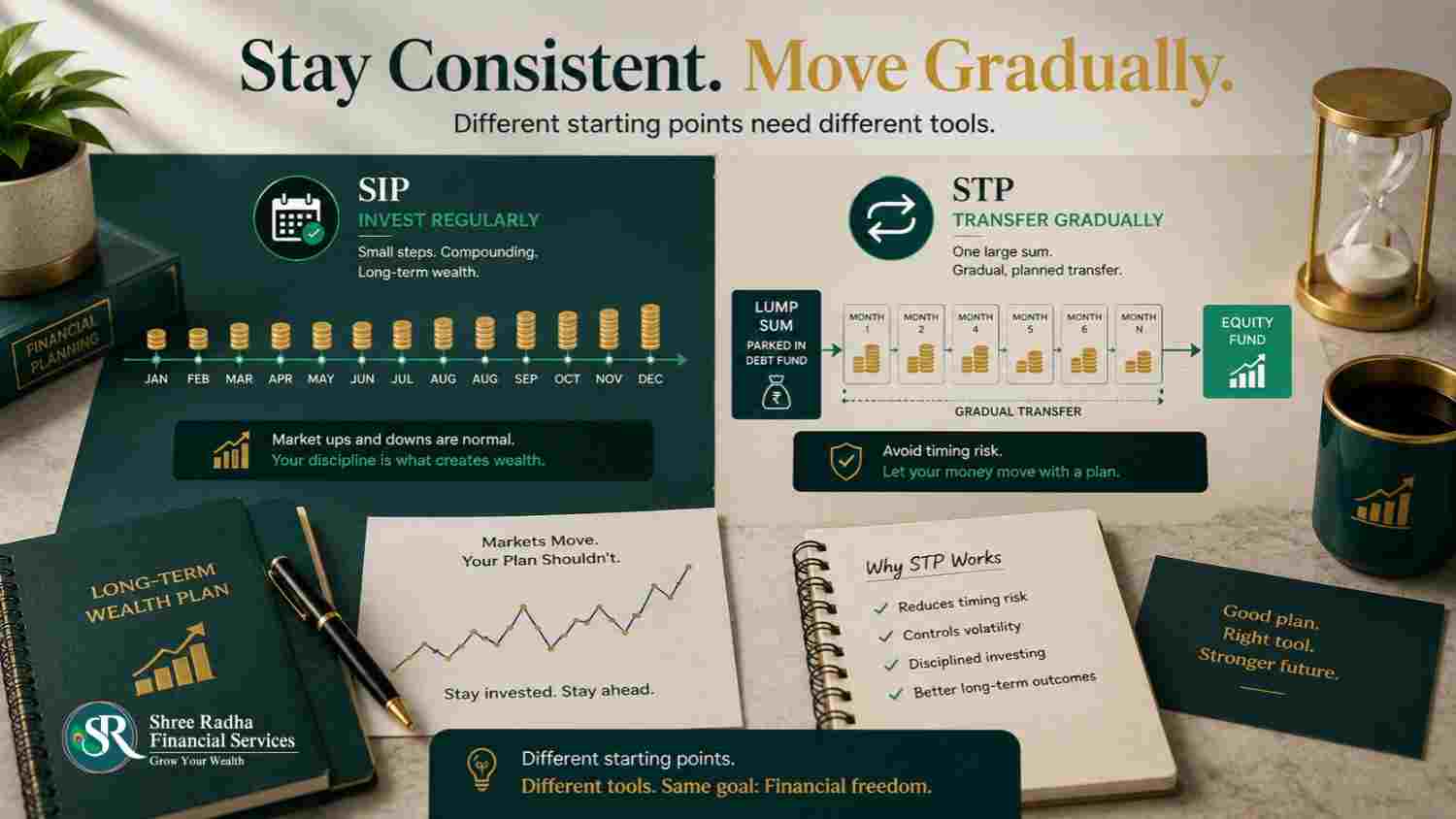
The tool that actually solves this is a Systematic Transfer Plan (STP): park the full ₹1 crore in a liquid fund first (where it earns a modest, stable return instead of sitting idle), then set up an STP to move a fixed amount — say ₹10 lakh — into an equity fund every month for 10 months.
The tax catch most people miss: every single STP transfer counts as a redemption from the liquid fund. That’s 10 separate redemption events, each one a capital gains transaction (liquid fund gains are taxed at your income slab rate if the units are held under 3 years, since debt-oriented funds lost indexation benefit after the 2023 rule change).
It’s a small, manageable tax — usually much smaller than the cost of bad market timing — but it should be planned for, not discovered later.
Illustrative comparison, ₹1 crore deployed over a period that included one sharp 15% market correction partway through:
| Approach | Illustrative outcome |
|---|---|
| Full ₹1 crore lump sum, day one | Full exposure to the correction; recovery depends entirely on timing luck |
| ₹1 crore via 10-month STP | Only the portion already transferred was exposed; remaining amount kept buying at lower, post-correction prices |
Bengaluru — The ₹3.6 Lakh Tax Bill Vikram Didn’t See Coming

Vikram, 38, is a product manager in Bengaluru who reads a lot — enough to know that regular mutual fund plans carry a distributor commission built into the expense ratio, and that direct plans don’t. So when his ₹75 lakh regular-plan portfolio (built over nine years) had grown nicely, he decided to switch the whole thing to direct plans of the same schemes, expecting only to save on future expense ratio.
What he didn’t expect: the switch itself is taxed. A switch — even between the regular and direct version of the exact same scheme, at the exact same AMC — is treated by the tax department as a full redemption of the regular-plan units, followed by a fresh purchase of direct-plan units. It is not a “housekeeping” move. It is a sale.
Vikram’s ₹75 lakh portfolio had roughly ₹30 lakh of embedded long-term gains. After the ₹1.25 lakh annual LTCG exemption, that left about ₹28.75 lakh taxable at the current 12.5% equity LTCG rate — a tax bill of roughly ₹3.59 lakh, due in the same financial year, on a move he thought was free.
| Item | Amount |
|---|---|
| Regular-plan portfolio value | ₹75,00,000 |
| Embedded long-term gain | ₹30,00,000 |
| Less: annual LTCG exemption | ₹1,25,000 |
| Taxable gain | ₹28,75,000 |
| Tax at 12.5% | ≈ ₹3,59,375 |
This is governed by Section 112A of the Income Tax Act, which sets the 12.5% LTCG rate above the ₹1.25 lakh annual exemption.
Before deciding, it’s worth understanding what the Direct vs Regular price difference actually buys you — the switch may still be worth it, just planned properly.
This doesn’t mean don’t switch to direct — over the long run, the saved expense ratio can be worth far more than this one-time tax. It means switch with a plan: consider spreading a large regular-to-direct move across two or three financial years to use multiple years’ exemption, or route new money into direct plans going forward while leaving old regular-plan units to mature, rather than a single big-bang switch.
Delhi NCR — How Ramesh Uncle Turned ₹5 Crore Into a Tax-Smart Monthly Salary
Ramesh Uncle, 61, retired from a senior corporate role in Gurugram with a ₹5 crore mutual fund corpus, built over three decades. His question was simple: how do I turn this into a monthly income without either running out of money or handing over a third of it in tax?
His first instinct — like many retirees — was to redeem lump sums every few months as expenses came up. That works, but it’s inefficient: each large redemption bunches up gains in one go, and there’s no discipline to it. The right tool is a Systematic Withdrawal Plan (SWP): a fixed amount, say ₹2,00,000 a month, withdrawn automatically, while the rest of the corpus stays invested and keeps growing.
Here’s the part that actually changes the math: every SWP withdrawal is a blend of two things — a return of your own original capital, and a portion of gains. Only the gains portion is taxable, not the whole withdrawal. Early in retirement, when the corpus hasn’t grown much relative to what was invested, most of each withdrawal is capital (not taxed at all). Later, as the fund has compounded further, a larger share becomes gain.
Illustrative numbers, five years into Ramesh Uncle’s SWP, once roughly 65% of each withdrawal has become gain:
| Item | Amount |
|---|---|
| Monthly SWP withdrawal | ₹2,00,000 |
| Portion that is return of capital (not taxed) | ≈ ₹70,000/month |
| Portion that is gain (taxable) | ≈ ₹1,30,000/month → ₹15,60,000/year |
| Less: annual LTCG exemption | ₹1,25,000 |
| Taxable gain | ₹14,35,000 |
| Tax at 12.5% | ≈ ₹1,79,375/year |
Now compare that to generating the same ₹24 lakh a year from a Fixed Deposit instead. FD interest gets no capital/gain split — the entire amount is added to income and taxed at slab rate. For a retiree in the 30% bracket, that’s roughly ₹7,20,000 a year in tax — over ₹5.4 lakh more than the SWP route, every single year. Over a 20-year retirement, that gap alone is worth well over a crore.
If you’re still working out whether your own corpus is big enough to retire on, our guide Is ₹2 Crore Enough to Retire? walks through the exact math.
This is the number that changes how people think about SWP — it isn’t just “an income tool,” it’s a structurally more tax-efficient one than the fixed-income products most retirees default to.
Jaipur — The Malhotra Family, Two Goals, Two Tools, and the One Thing They Never Mix
The Malhotras run a gems and jewellery export business in Jaipur — three generations under one roof. Two financial goals are running at the same time in this family, and this is where the decision-tree logic really shows itself.
Goal 1 — Ananya (no relation to our Pune Ananya) and Vikas’s daughter’s engineering education, seven years away. They’ve been running a SIP toward a ₹1.2 crore target since she was 11. Now, with two years left before the fees actually fall due, they don’t touch the SIP — they start a reverse STP: gradually moving that specific corpus out of the equity fund and into a debt fund over the next 12–18 months. A market fall two months before college fees are due would be a disaster if the money were still fully in equity; a reverse STP removes that risk gradually, not with one panicked lump-sum redemption.
Goal 2 — The grandparents’ retirement, already underway. A separate ₹10 crore corpus, built over their working years, now running a pure SWP at roughly ₹4,00,000 a month for the household’s living expenses. This money has nothing to do with the education goal — different corpus, different purpose, different tool.
This exact situation — mixing or separating a child’s education fund from retirement — is common enough that we’ve covered it in detail: Child Education and Retirement Fund: 5 Costly Mistakes to Avoid.
This is deliberate, and it’s the single most important lesson in this article: never run STP and SWP on the same pool of money for two different goals. If the Malhotras tried to fund both the reverse STP de-risking and the grandparents’ SWP from one mixed corpus, they’d have one process constantly feeding money in while another drains it out — impossible to track, impossible to plan around, and it defeats the purpose of either tool.
Each goal gets its own dedicated corpus and its own dedicated tool. That’s not a technicality — it’s the difference between a plan you can actually follow and one that quietly falls apart.
And to be clear — reverse STP isn’t only for education. The same logic applies to any goal with a fixed date: a house down payment 18 months away, a child’s wedding, even a planned sabbatical. Any time equity money needs to become “safe” money before a specific date, a reverse STP is the tool, not a single lump-sum exit.
SIP vs STP vs SWP vs Switch — The Decision Tree: Which One, When
| Your situation | Tool |
|---|---|
| You want to build wealth from regular income, over years | SIP |
| You have a lump sum and want to enter equity without full market-timing risk | STP (debt → equity) |
| A specific goal is 1–2 years away and the money is currently in equity | Reverse STP (equity → debt) |
| You need regular income from an existing corpus (retirement or otherwise) | SWP |
| You want to move your whole holding to a cheaper plan or a different scheme | Switch — but check the tax first |
Quick checklist before you act:
- Know which goal this specific money is for — never let one corpus serve two goals with two different tools
- Before any STP or Switch, check what tax event it triggers — liquid fund gains, equity LTCG/STCG, or slab-rate debt taxation
- If your goal is under 2 years away and the money is in equity, plan a reverse STP now — don’t wait for a market fall to force your hand
- For retirement income, calculate your SWP’s capital-vs-gain split before assuming a tax number — it’s rarely the full withdrawal amount
- A large Regular-to-Direct switch is often better spread across financial years than done in one go
“In over 3.5 years of running SR Wealth, the costliest mistakes I’ve seen investors make were never about picking the wrong fund. They were about using the right tool at the wrong time, or the wrong tool altogether — stopping a SIP right when it mattered most, or switching plans without knowing it’s a taxable event. Understanding SIP, STP, SWP and Switch isn’t optional financial trivia. It’s the difference between a plan that survives real life and one that quietly falls apart.” — Paresh Chaudhary, Founder, SR Wealth
Frequently Asked Questions
Is STP taxed the same way as SIP?
No. An SIP installment is a fresh purchase — no tax at the time of investing. An STP transfer is a redemption from the source fund (usually liquid or debt) followed by a purchase in the destination fund — so each transfer can trigger a tax event on the source fund’s gains.
Can I do SWP directly from an equity fund, or does it have to be debt?
SWP can be run from any fund type, including equity. Many retirees deliberately keep a portion in equity-oriented funds for an SWP because of the more favourable LTCG treatment compared to debt funds, which are taxed at slab rate regardless of holding period under current rules.
What’s the real difference between a Switch and an STP?
A Switch moves your entire investment at once, in a single transaction. An STP moves a fixed amount gradually, over several transactions across several months. Both are taxable events, but STP spreads the tax impact (and the market-timing risk) over time; a Switch concentrates it in one go.
Does switching from Regular to Direct always trigger tax?
Yes, unless your gains are below the annual exemption threshold. It’s treated as a redemption of the regular-plan units and a fresh purchase of direct-plan units — there’s no special exemption for moving within the same scheme.
Is there a way to avoid tax when moving from Regular to Direct?
There’s no way to avoid it entirely if there are gains, but you can manage it — spreading a large switch across financial years to use multiple years’ LTCG exemption, or simply directing new investments to direct plans while letting older regular-plan units continue as-is.
Can I use SIP, STP and SWP all at the same time?
Yes, but for different goals and different pools of money — not the same corpus serving two purposes at once. That’s exactly what the Malhotra family in this article does: one SIP building toward education, a separate corpus running SWP for retirement.
Is SIP better than SWP, or are they opposites?
They’re not competitors — they’re opposite ends of the same journey. SIP builds a corpus during your working years; SWP draws income from that same corpus once a goal, usually retirement, has arrived. Asking “SIP vs SWP” is really asking whether you’re still building or now spending.
What is a safe withdrawal rate for SWP in India?
Most planners suggest 3–4% of the corpus per year for Indian retirees — more conservative than the commonly quoted US “4% rule,” since India has no social security cushion and healthcare inflation runs higher. A ₹5 crore corpus at a 4% safe withdrawal rate supports roughly ₹20 lakh a year, before adjusting for the corpus’s own growth.
SIP vs STP vs SWP vs Switch — Why Getting This Right Alone Is Harder Than It Looks
Every story above looks obvious in hindsight — Ananya should’ve kept her SIP running, Vikram should’ve checked the tax before switching, Ramesh Uncle needed a structured SWP instead of ad-hoc withdrawals. In the moment, with your own money and your own deadlines, none of it feels that clear. It depends on your tax slab, how many years are actually left to your goal, and what portion of your corpus is capital versus gain — details a generic calculator can’t see.
This is exactly where working with a distributor changes outcomes — not by predicting the market, but by mapping which tool fits which of your goals, checking the tax impact before you act instead of after, and catching the two costliest habits self-directed investors fall into: stopping at the wrong moment, and combining tools without realizing one is quietly undoing the other.As AMFI’s own investor education material notes, SIP and STP share the same disciplined principle but move money in opposite directions — which is exactly the kind of distinction worth getting a second opinion on.
At SR Wealth, this mapping — goal by goal, tool by tool — is exactly the conversation we have before a rupee moves.
Talk Through Your Own Situation
Every family’s goals sit at different distances — some years away, some already here. If you’d like help mapping which of these tools fits which of your goals, reach out to SR Wealth:
📞 +91 98791 13255
✉️ shreeradha.services@gmail.com
🌐 www.srwealth.co.in
📍 Shop 33, Mira Nagar 2, Dindoli Road, Surat 394210
About the Author: Paresh Chaudhary is the founder of Shree Radha Financial Services (SR Wealth), an AMFI Registered Mutual Fund and SIF Distributor (ARN: 268390) and APMI Registered PMS Distributor (APRN: 05763), based in Surat. He holds an IRDAI license and works with clients across India and the Gulf on mutual funds, SIF, PMS, AIF, GIFT City and insurance solutions.
Disclaimer: This article is for educational purposes only and does not constitute investment advice. Mutual fund investments are subject to market risks. Please read all scheme-related documents carefully. Tax rates and rules mentioned are as applicable at the time of writing and are subject to change; please consult a qualified tax professional for advice specific to your situation.