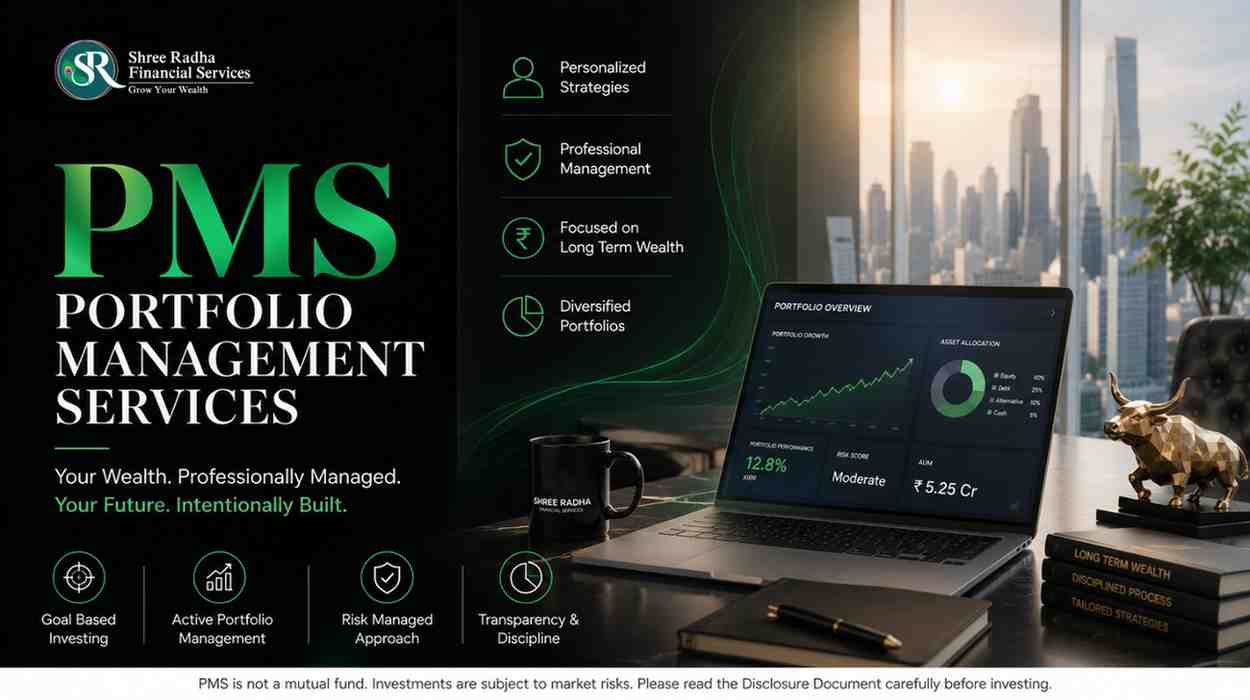
For investors who've outgrown mutual funds and are looking for something more tailored, Portfolio Management Services (PMS) offer a way to build wealth through a personalised portfolio — owned directly in your name, and managed by a professional aligned to your specific goals and risk appetite.
Looking for a trusted PMS Distributor Surat investors can rely on? Portfolio Management Services (PMS) offer customized, direct-equity portfolios for HNIs.Looking for a trusted PMS Distributor Surat investors can rely on? Portfolio Management Services (PMS) offer customized, direct-equity portfolios for HNIs.As a PMS distributor in Surat, SR Wealth works with high-net-worth individuals and NRI clients across the Gulf to evaluate PMS strategies suited to their portfolio size and long-term goals.
What is Portfolio Management Services (PMS)?
Portfolio Management Services (PMS) is a SEBI-regulated investment service where a professional portfolio manager builds and manages a dedicated, customised portfolio of equities, debt, and other securities directly in the investor's own name and demat account — unlike mutual funds, where money is pooled together with thousands of other investors.
For official guidance on Portfolio Management Services regulations, visit
SEBI's investor education portal.
Key Features of PMS
- Direct Ownership — Securities are held in your own demat account, not in a pooled structure.
- Customised Strategy — Portfolios are built around your specific goals, risk profile, and constraints.
- SEBI Regulated — Governed under the SEBI (Portfolio Managers) Regulations, 2020, with mandatory registration, audits, and an independent custodian for asset safety.
- Professional Management — Managed by experienced portfolio managers with a fiduciary duty to act in the client's best interest.
Types of PMS
- Discretionary PMS — The portfolio manager takes all investment decisions on the client's behalf, within the agreed mandate.
- Non-Discretionary PMS — The manager recommends investments, but the client takes the final call before execution.
- Advisory PMS — The manager only provides advice; the client independently executes the trades.
Who Can Invest in PMS?
As per SEBI regulations, the minimum investment required for PMS is
₹50 lakh per investor, per strategy. This threshold is designed to ensure PMS remains suited to investors with the financial capacity to handle concentrated, higher-risk portfolios. PMS is generally suited for:
- High-Net-Worth Individuals (HNIs) seeking portfolio customisation beyond mutual funds
- Investors with an existing equity portfolio of ₹2.5 crore or more, looking for focused, actively managed exposure
- NRIs looking to build a professionally managed Indian equity portfolio
Can NRIs Invest in PMS?
Yes.
NRIs from the UAE, Saudi Arabia, Qatar, Oman, Kuwait, and Bahrain can invest in PMS through NRO or NRE accounts, subject to SEBI and RBI/FEMA guidelines. Tax treatment for NRIs may vary depending on the applicable Double Taxation Avoidance Agreement (DTAA) — please consult your CA for guidance specific to your country of residence.
PMS vs Mutual Funds
Mutual funds pool investor money into a shared scheme, allowing investment from as little as ₹500.
PMS, by contrast, requires a significantly higher minimum investment and builds a dedicated, non-pooled portfolio in the investor's own name — offering greater customisation, but with a higher entry threshold and concentration risk.
How PMS Works — The Process
- Onboarding & Risk Profiling — Understanding your goals, liquidity needs, and risk appetite.
- Documentation — Completing KYC and signing the Portfolio Management Agreement.
- Funding the Account — Meeting the ₹50 lakh minimum threshold, via cash, securities, or both.
- Portfolio Construction — The manager builds the portfolio as per the agreed strategy.
- Ongoing Management & Reporting — Regular performance, fee, and risk disclosures as mandated by SEBI.
Taxation on PMS Investments
Unlike pooled AIF structures, PMS taxation applies directly in the investor's own hands, similar to direct equity or debt holdings — capital gains and other applicable taxes are computed based on individual holding periods and instruments. Please consult your CA for guidance specific to your situation.
Risk Disclosure
PMS investments are subject to market risk. Portfolio performance depends on market conditions and the manager's strategy, and returns are not guaranteed. Please read all scheme-related and disclosure documents carefully before investing.
Why Choose SR Wealth as Your PMS Distributor Surat?
With over 15 years of experience across financial markets and a strong understanding of HNI and NRI client needs, SR Wealth helps you evaluate PMS strategies that align with your goals — with full transparency on fees, structure, and risk, and no return promises.
Explore Our Other Investment Solutions
Portfolio Management Services works well alongside other strategies depending on your goals. Explore our
Specialised Investment Fund (SIF) for niche alternative strategies, our
Alternative Investment Fund (AIF) for private market exposure, our
Mutual Funds for diversified, lower-entry investing, or our
Gift City AIF for GIFT City tax-efficient NRI investing. For a broader financial roadmap, see our
Goal-Based Financial Planning and
NRI Investment Solutions pages.
Frequently Asked Questions About PMS
What is the minimum investment required for PMS?
As per SEBI regulations, the minimum investment for PMS is ₹50 lakh per investor, per strategy.
Is PMS the same as a mutual fund?
No. Mutual funds pool money from many investors into a shared scheme, while PMS builds a dedicated, customised portfolio directly in the investor's own demat account.
Can NRIs invest in PMS?
Yes, NRIs can invest in PMS through NRO or NRE accounts, subject to SEBI and RBI/FEMA guidelines.
Are PMS returns guaranteed?
No. PMS investments are market-linked and subject to risk. Returns depend on market conditions and are never guaranteed.
What is the difference between Discretionary and Non-Discretionary PMS?
In Discretionary PMS, the manager makes all investment decisions independently. In Non-Discretionary PMS, the manager recommends but the investor approves each transaction.
How is PMS taxed?
PMS taxation applies directly to the investor, similar to direct equity or debt holdings, based on individual holding periods. Consult your CA for specifics.
How do I choose the right PMS Distributor Surat?
Look for APMI registration, transparent fee disclosure, and a distributor who understands your specific portfolio goals.
About the Author
Paresh Chaudhary
Founder, Shree Radha Financial Services, Surat
AMFI Registered Mutual Fund & SIF Distributor — ARN: 268390
APMI Registered PMS Distributor — APRN: 05763
IRDAI Licensed Insurance Distributor
Investing since 2012 | BE Mechanical, SVNIT Surat | Ex-L&T (15+ Years)
Portfolio Management Services offer a professionally managed, customised route for investors ready to go beyond mutual funds. With SEBI-mandated safeguards, transparent reporting, and a dedicated portfolio structure, PMS suits HNI and NRI investors seeking focused, long-term wealth building — guided by the right distributor to match strategy with goals.