
Introduction

Rohit Vaghela had done this before. Ten years in Doha, a steady engineering job, and a habit of moving spare dirhams into Indian mutual funds every quarter through his NRE account. So when his relationship manager in Bengaluru mentioned a new product — a Specialised Investment Fund, or SIF, needing just ₹10 lakh instead of the ₹50 lakh PMS ticket he’d always assumed was the entry point for anything “beyond mutual funds” — he didn’t think twice. He wired the money the same way he always had.
It worked. But it worked because Rohit got lucky on the details, not because he understood them. He didn’t know that NRI investment in SIF PMS AIF India follows three different eligibility ladders, three different funding rules, and three completely different tax treatments on exit. Getting any one of them wrong doesn’t just cost you paperwork — it can lock up your own money for months, or hand a chunk of your return to TDS you never needed to pay.
This guide walks through all three tiers the way Gulf NRIs are actually approaching them in 2026 — as a ladder, not three separate decisions.
The Three Tiers: NRI Investment in SIF PMS AIF India
Until SIF arrived, an NRI wanting something more active than a mutual fund had exactly two doors: PMS at ₹50 lakh, or AIF at ₹1 crore. SIF now sits underneath both, at a ₹10 lakh minimum per PAN (₹1 lakh if you qualify as an accredited investor). Because it runs under the SEBI mutual fund regulatory framework, it inherits mutual fund KYC, mutual fund taxation, and mutual fund-style redemption. That’s the part Rohit’s relationship manager was right about.
What nobody told him is that “NRI-friendly by default” isn’t automatically true for the next two tiers. If you’re weighing which tier fits your situation, our SIF vs PMS comparison breaks down the strategy and flexibility differences before you get to the NRI-specific rules covered here.
Getting the Money In: NRE vs NRO for SIF, PMS and AIF
Priya Solanki, a Pune-origin brand manager based in Dubai, ran into this at the PMS stage. She had ₹65 lakh sitting in her NRO account — rental income from a flat she still owns in Pune, accumulated over six years.
When her portfolio manager onboarded her, the funding instruction assumed NRE. Priya didn’t correct it because she didn’t know there was anything to correct. The PMS agreement got signed against an NRO mandate instead. Six months later, when she wanted to redeem and send the proceeds to Dubai, her portfolio manager needed a fresh CA certificate before a single rupee could move — because NRO-sourced repatriation isn’t automatic the way NRE is. (This is the same category of mismatch we’ve seen trip up NRIs on the banking side too — see our guide on avoiding NRI account FEMA violations.)
| Account Type | Repatriation | Best Fit For |
|---|---|---|
| NRE | Fully and freely repatriable — principal and returns, no annual cap | Foreign-earned income you plan to move in and out of India |
| NRO | Repatriable only up to USD 1 million per financial year, per the RBI Master Direction on Remittance of Assets, and only after tax is certified via Form 15CA/15CB | India-sourced income (rent, dividends, sale proceeds already in India) |
The rule holds across all three products: SIF, PMS, and AIF can each be funded through either an NRE or NRO account, but the account you choose decides how easily — and how quickly — you get your money back out. Priya’s proceeds weren’t blocked forever; they were blocked by a paperwork step she hadn’t budgeted time for, during a quarter when she needed the funds for a down payment back in Dubai.
Tier 1: SIF — The ₹10 Lakh Entry Point for NRIs
For an NRI, SIF eligibility and funding mirror what you already know from mutual funds: completed KYC, an NRE or NRO account, and ₹10 lakh minimum per PAN across strategies (or ₹1 lakh if accredited). Taxation follows mutual fund rules too — equity-oriented SIFs attract 20% STCG and 12.5% LTCG after 12 months, debt-oriented SIFs are taxed at your slab rate.
This is precisely why Rohit’s instinct to “just wire it like an MF” worked out fine at this tier. The mistake would only have surfaced one rung higher — which is exactly where Priya’s story picks up.
Tier 2: PMS — ₹50 Lakh, and Taxation That Follows the Underlying Asset
PMS doesn’t have its own separate tax regime. Capital gains are taxed based on whatever the portfolio manager is actually holding on your behalf — listed equity gets listed-equity treatment (20% STCG, 12.5% LTCG), while debt instruments follow slab-rate rules instead.
For an NRI, the practical friction isn’t the tax rate — it’s TDS. Portfolio managers are required to deduct tax at the non-resident rate unless you’ve submitted a Tax Residency Certificate and Form 10F on the Income Tax e-filing portal to claim a lower DTAA rate. Priya hadn’t done this either. By the time she filed for it, her PMS exit had already been taxed at the higher domestic non-resident rate, with the excess sitting in a refund claim she’d have to chase during the next filing season. For the full treaty mechanics, see our DTAA guide for NRIs.
Tier 3: AIF — ₹1 Crore, and Two Very Different Tax Realities
Vikram Oswal, a Hyderabad-origin supply chain manager working in Riyadh, moved ₹1.2 crore into a Category II AIF investing in private credit — the kind of fund that lends to mid-sized companies the public markets don’t reach.
Category I and II AIFs are pass-through vehicles. The fund itself pays no tax; income flows straight to the investor. TDS is deducted under Section 194LBB — 10% for a resident, but “at the rate in force” for an NRI, meaning your applicable non-resident rate or your DTAA rate if you’ve filed the paperwork.
Here’s what caught Vikram off guard: pass-through doesn’t mean tax-free, and it doesn’t even mean the income has to reach your bank account before it’s taxable. Category I and II AIFs report income to investors annually whether or not it’s actually distributed in cash. Vikram received a statement showing taxable income he hadn’t received a single rupee of yet — the fund had reinvested it rather than distributing it — and he owed tax on paper income for a return he hadn’t touched.
His cousin Naina, Jaipur-origin and based in Kuwait, hit the opposite trap one tier over. She put ₹1.5 crore into a Category III AIF — a long-short equity strategy her relationship manager had quoted at a gross 22% return.
Category III AIFs are taxed differently: the fund itself pays tax at the maximum marginal rate — currently running above 42% with surcharge and cess — before a single rupee reaches the investor. What Naina received wasn’t 22% minus some deductible TDS. It was already net of fund-level tax, so her real post-tax number looked nothing like the number she’d been sold on. There was no further TDS left for her to manage or reclaim — it had already happened, invisibly, inside the fund. For NRIs weighing this tier specifically, our AIF investor guide covers the category-by-category mechanics in more depth.
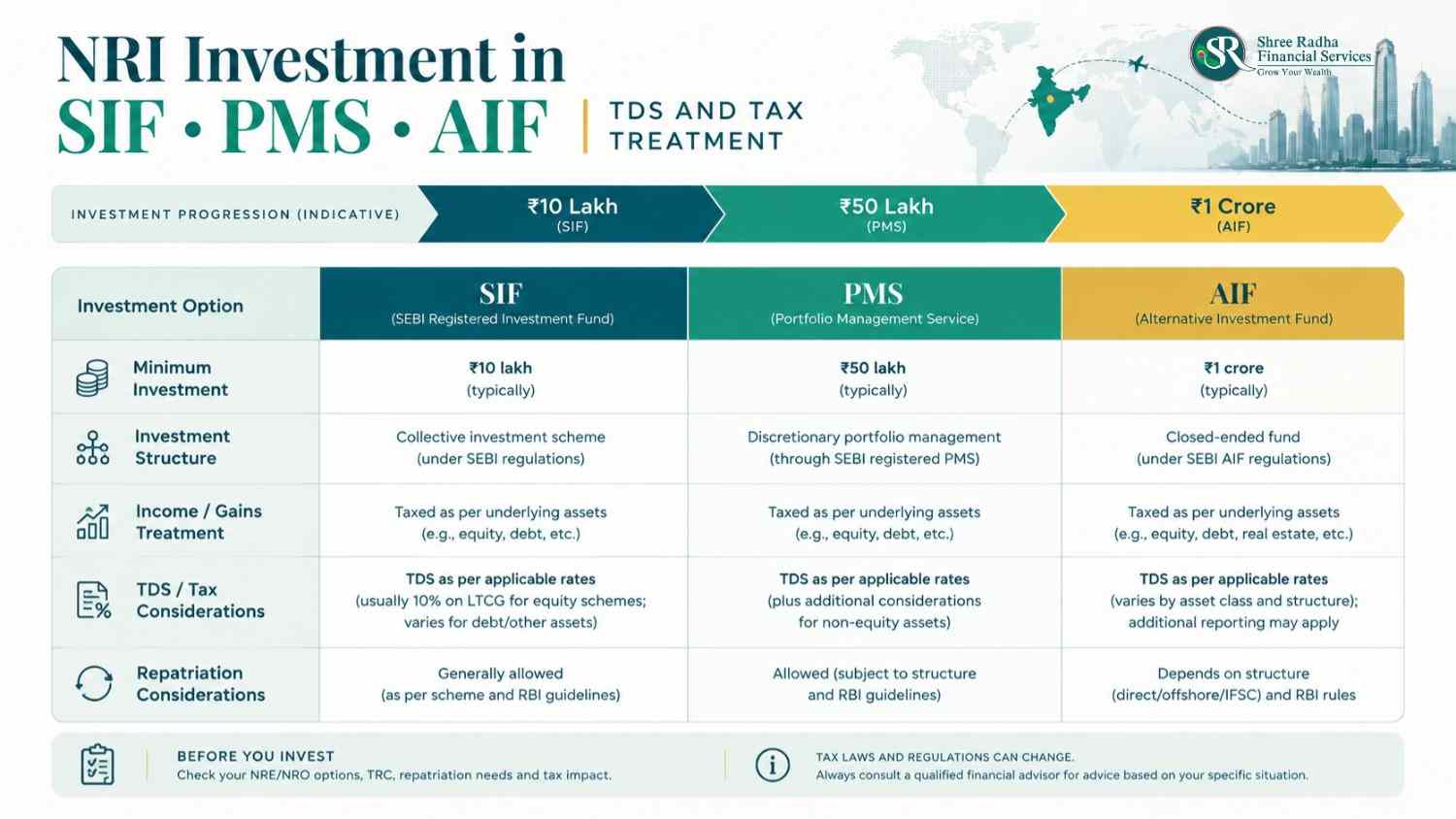
TDS and Tax Treatment for NRI Investment in SIF PMS AIF India: At a Glance

| Product | Minimum (NRI) | Tax Point | NRI TDS Reality |
|---|---|---|---|
| SIF | ₹10 lakh (₹1 lakh accredited) | On redemption, MF-style | Equity: 20% STCG / 12.5% LTCG. Debt: slab rate |
| PMS | ₹50 lakh | On redemption, follows underlying asset | Non-resident rate unless TRC + Form 10F filed for DTAA relief |
| AIF Cat I & II | ₹1 crore | Pass-through — taxed to investor annually, even if undistributed | Sec 194LBB “at rate in force” — non-resident rate or DTAA |
| AIF Cat III | ₹1 crore | At fund level, before distribution | Investor receives net-of-tax proceeds; no separate TDS event |
Before You Fund an NRI Investment in SIF PMS AIF India: Checklist
- Confirm which account — NRE or NRO — the money is actually sitting in before instructing your distributor or portfolio manager
- If funding from NRO, ask upfront whether the product needs Form 15CA/15CB at the time of investment, redemption, or both
- File your Tax Residency Certificate and Form 10F before your first transaction, not after, to avoid a higher default TDS deduction on exit
- For AIF Category I/II, ask specifically whether income will be distributed in cash or reinvested — and confirm you’ll be taxed on it either way
- For AIF Category III, ask for the expected post-tax (not gross) return, since fund-level tax is already priced into what you’ll receive
- Keep your NRE/NRO account mapping consistent across the entire investment lifecycle — funding, any interim cash flows, and final redemption
“Every NRI client I’ve onboarded into SIF, PMS or AIF in the last year has asked me the same underlying question in different words — will I actually get my money back the way I expect to? The honest answer is: only if the funding route and the tax paperwork are sorted before the first rupee moves, not after. In three and a half years of doing this from Surat for clients across the Gulf, that one sequencing mistake causes more frustration than any market movement ever does.” — Paresh Chaudhary, Founder, SR Wealth
Frequently Asked Questions on NRI Investment in SIF PMS AIF India
Can NRIs invest in SIF in India?
Yes. NRIs can invest in SIF the same way they invest in mutual funds — through an NRE or NRO account, subject to the ₹10 lakh minimum (or ₹1 lakh for accredited investors), with standard mutual fund KYC and taxation rules applying.
Is the SEBI accredited investor route available to NRIs for a lower SIF ticket size?
Accredited investor status depends on income and net worth criteria under SEBI’s accreditation framework. NRIs can apply, but should confirm current documentation requirements with their AMC, as processes can differ slightly for non-resident applicants.
Do NRIs need a Tax Residency Certificate for PMS and AIF investments?
Not to invest, but yes to avoid over-deduction of TDS at exit. Without a TRC and Form 10F on file, portfolio managers and AIF trustees will typically default to the higher non-resident TDS rate rather than your DTAA-eligible rate.
Why did I get taxed on AIF income I never received in cash?
Category I and II AIFs are pass-through vehicles — income is taxable to investors in the year it’s earned by the fund, regardless of whether it’s distributed in cash or reinvested. This is standard treatment, not an error, but it surprises investors who assume “no cash in hand” means “no tax due.”
Is repatriation from PMS or AIF automatic for NRIs?
Only if the original investment was funded through an NRE account. NRO-funded investments are repatriable only up to USD 1 million per financial year and require Form 15CA/15CB certification confirming applicable taxes have been paid.
Which is better for a Gulf NRI — SIF, PMS, or AIF?
It depends on ticket size and how actively you want to be involved, not on which is “better” in isolation. SIF suits NRIs testing sophisticated strategies below the PMS threshold; PMS suits those wanting direct, visible stock ownership; AIF suits larger, longer-horizon commitments. A distributor who can map your specific NRE/NRO funding situation against all three is more useful than a generic comparison.
Considering NRI investment in SIF, PMS or AIF from the Gulf?
SR Wealth helps NRI clients map eligibility, funding route, and tax paperwork before the first rupee moves — not after. See our PMS for Surat investors guide for the resident-side comparison.
📞 +91 98791 13255
✉️ shreeradha.services@gmail.com
🌐 www.srwealth.co.in
📍 Shop 33, Mira Nagar 2, Dindoli Road, Surat 394210
SR Wealth helps NRI clients map eligibility, funding route, and tax paperwork before the first rupee moves — not after. See our PMS for Surat investors guide for the resident-side comparison.
📞 +91 98791 13255
✉️ shreeradha.services@gmail.com
🌐 www.srwealth.co.in
📍 Shop 33, Mira Nagar 2, Dindoli Road, Surat 394210
About the Author:
Paresh Chaudhary
Founder, Shree Radha Financial Services (SR Wealth), Surat
AMFI Registered Mutual Fund & SIF Distributor — ARN: 268390
APMI Registered PMS Distributor — APRN: 05763
IRDAI Licensed Insurance Distributor
BE Mechanical, SVNIT Surat | Ex-L&T (15+ Years)
This Article is also availble on Medium: https://medium.com/@shreeradha.services/the-1-5-crore-return-that-wasnt-what-it-looked-like-57141d105bf9
Disclaimer: This article is for educational purposes only and does not constitute investment advice. Mutual fund investments are subject to market risks. Please read all scheme-related documents carefully. Data and figures cited are as available at the time of writing and are subject to change; please consult a qualified professional for advice specific to your situation