
NRI Account FEMA Violation: Three Stories, Zero Bad Intentions
Nobody moves abroad thinking about their old savings account. There’s a job to start, a flat to find, a new SIM card to sort out. The account back home just sits there, doing what it’s always done, until the day it doesn’t.
An NRI account FEMA violation almost never starts with someone trying to break a rule. It starts with an account nobody got around to converting — and it usually surfaces at the worst possible moment, not the most convenient one. These are three of those moments.
Arjun’s Down Payment, Frozen Mid-Sale
Arjun Kulkarni had been in Dubai for four years, and by most measures, he’d figured it out. Senior role at a good firm, an apartment he liked in JVC, and a spreadsheet — because of course there was a spreadsheet — tracking exactly how much more he needed for a down payment on a place of his own.
The last piece of that number was sitting in his old Zerodha account back in Bengaluru: some index funds, a few individual stocks, and a small pile of RSU shares from his last job that had finally vested past their lock-in. He’d decided to sell a chunk of it that week and wire the proceeds to Dubai.
He logged in on a Tuesday night, picked the shares, and hit sell. Nothing happened. Not an error message — just a spinning wheel, then a banner: *account under review, please contact support*. He assumed it was a glitch and tried again the next morning. Same thing.
Three days of app chats and hold music later, someone finally gave him a straight answer: his account was flagged for a residential-status mismatch. His KYC still listed a Bengaluru address; his last several logins had all pinged from Dubai.
The account, technically, should have stopped being a resident demat account the day he moved — the same day his old resident savings account, the one his parents used for utility bills, should have stopped being a resident savings account too. Both were still exactly as they’d been in 2022.
Arjun didn’t feel like someone who’d broken a rule. He felt like someone who’d been reasonably busy for four years and never had anyone tell him what actually changes on the day you become an NRI. He also asked, a little sheepishly, whether this had anything to do with his RSUs being taxed differently — he was told, kindly, that was a separate question entirely; this was about what kind of account was even allowed to hold his money now, not about what was inside it.
The fix took a week and a half: the savings account converted to NRO, the demat re-opened under the NRI PIS route, his existing holdings carried across without disturbing his purchase history. He closed on the apartment twelve days later than planned. Later than he wanted — but not the disaster it felt like at 1am on day three, refreshing a support chat that wasn’t replying.
“Nobody wakes up one day and decides to violate FEMA. They just never got a clear answer on what changes the day their residency status does. That’s the gap I try to close before it becomes an actual notice.”
— Paresh Chaudhary, Founder, Shree Radha Financial Services (SR Wealth)
Rohan’s Rally, Watched From the Sidelines
Rohan Mehta had bought into a mid-cap manufacturing stock three years before he ever thought about Sharjah, back when it was trading at a third of its current price. He’d almost sold twice — once out of boredom, once out of nerves — and was glad both times he hadn’t.
The plan was simple: use the eventual gains toward his sister’s wedding, still a year out but already looming large in every family WhatsApp group. He tracked the stock most evenings after work, India time slipping later and later into his Sharjah night.
On a Thursday, it finally broke out — up 9% by the time he checked, still climbing. He opened the app to book at least half the position before the euphoria wore off. The order screen wouldn’t load. Then the login itself failed. Then, an hour later, an email: his account had been placed under review as part of a compliance sweep on resident accounts showing repeated logins from foreign IP addresses.
He spent the next four days doing the thing everyone does in that situation — refreshing the stock’s price obsessively, doing math on what he was “losing” every time it ticked up another rupee, and getting nowhere with a support queue that kept resetting his case number. By the time his account was converted to an NRO-linked demat and unfrozen, the stock had given back almost half its rally. Rohan didn’t lose his money. He lost the exit he’d actually wanted, at the exact moment he’d finally earned it.
What stung more than the missed gain was how avoidable the whole four-day scramble had been. The account itself — a resident demat account still running two years after he’d become an NRI — was the entire problem, and it had been sitting there, quietly non-compliant, the whole time he’d been checking the price every evening.
It’s the same underlying issue our NRI KYC guide covers on the mutual fund side — a residency mismatch that nobody flags until it’s inconvenient to fix. Trading-segment rules for NRIs have also shifted more than once in recent years, so Rohan’s other takeaway was simpler than any FEMA clause: check with your specific broker before assuming last year’s setup still holds.
Manish’s Father, in a Hospital Corridor
Manish Tiwari had thought about this one carefully before he left for Riyadh. His father was in his late sixties, managed the family’s Lucknow logistics office day-to-day, and wasn’t especially comfortable with net banking. So before Manish flew out, he added his father as a joint holder on his NRE account — access to funds, no fuss, problem solved. It felt like one of the more responsible things he’d done that month.
Two years passed without incident. Then his father had a fall, needed a procedure booked within days, and the family needed a larger sum moved out of that account than they’d ever touched before. His father went to the branch in person — something he almost never did — and the transaction got held for review.
Manish found out over a crackling call from a hospital corridor, his mother’s voice tight in the background, the bank officer on hold on his other line. The account had been flagged during a routine audit: an NRE account, which under FEMA can only carry a resident relative as a joint holder on a “former or survivor” basis, had a resident actively transacting on it — his father, doing exactly what Manish had set the account up for him to do.
There wasn’t time for Manish to feel foolish about it, not with his father waiting on a hospital bed and the transfer stuck. The branch manager, to her credit, moved fast: opened a proper NRO joint account the same afternoon, routed the funds through it, and had the money in his father’s hands before evening.
The NRE account went back to being NRI-only, exactly as it should have been from day one — the same distinction our NRO Repatriation guide walks through for NRIs managing money across both account types.
Manish still thinks about how close it came. Not to a FEMA penalty — to his father sitting in a hospital waiting room without the money that was already, technically, his.
What Actually Happens Next — In Plain Terms
It’s worth being straightforward about what all three of these families were technically exposed to. Under Section 13 of FEMA, a violation like this can be penalized up to three times the amount involved, or up to ₹2,00,000 where that amount isn’t easy to pin down — plus ₹5,000 for every day it continues.
Here’s the part that gets lost in most explanations of this rule: there’s a real difference between an account that’s quietly non-compliant because nobody noticed, and one where someone is actively hiding assets or income. FEMA treats these very differently in practice, even though the same section technically covers both.
Think of it like an expired vehicle registration you didn’t know had lapsed, versus driving without ever registering the vehicle at all. The first is something you fix the moment you’re told, and the system is built to let you do exactly that. The second is a different conversation altogether.
For the first kind — the kind Arjun, Rohan, and Manish all had — the RBI’s own Master Direction on Compounding of Contraventions under FEMA (updated April 2025) provides a formal path to resolve it: a compounding application, a fee of ₹10,000 plus GST, and a decision within 180 days. For minor, first-time, promptly-corrected mismatches like these three, the RBI has discretion — not a guarantee, but real discretion — to settle the matter for well below the theoretical maximum.
None of that is a reason to leave an account unconverted. It’s a reason not to spiral if you discover, like these three did, that you already have one — and a reason to fix it the day you find out, not the day it costs you an apartment, a stock rally, or a hospital transfer.
NRI Account FEMA Violation — Quick Reference
| Account Type | Rule Once You’re an NRI | Joint Holder Allowed? |
|---|---|---|
| Resident savings account | Must be converted to NRO or closed | N/A — not permitted to continue as-is |
| NRE account | For foreign income; fully repatriable | Only another NRI, or a resident relative on “former or survivor” basis |
| NRO account | For Indian income; capped repatriation | A resident relative can be a genuine joint holder |
| Resident demat/trading account | Must be converted to NRI PIS/Non-PIS demat account | Depends on broker; check trading-segment restrictions too |
Who Should Care About an NRI Account FEMA Violation
- Any NRI who moved abroad and hasn’t formally converted their old resident savings account
- Active investors and traders who kept using the same demat/broker account after relocating
- Anyone who’s added a resident parent or spouse as a joint holder on an NRE account for convenience
- Anyone who’s discovered a gap like this and isn’t sure how serious it actually is
Related reading if property is also part of your situation: our NRI Land Property Rules India guide covers the FEMA side of buying and inheriting property, and our Portfolio Review guide is worth a look if a frozen or lapsed account has left your investments unreviewed for a while.
Fixing an NRI Account FEMA Violation — Do This, Not That
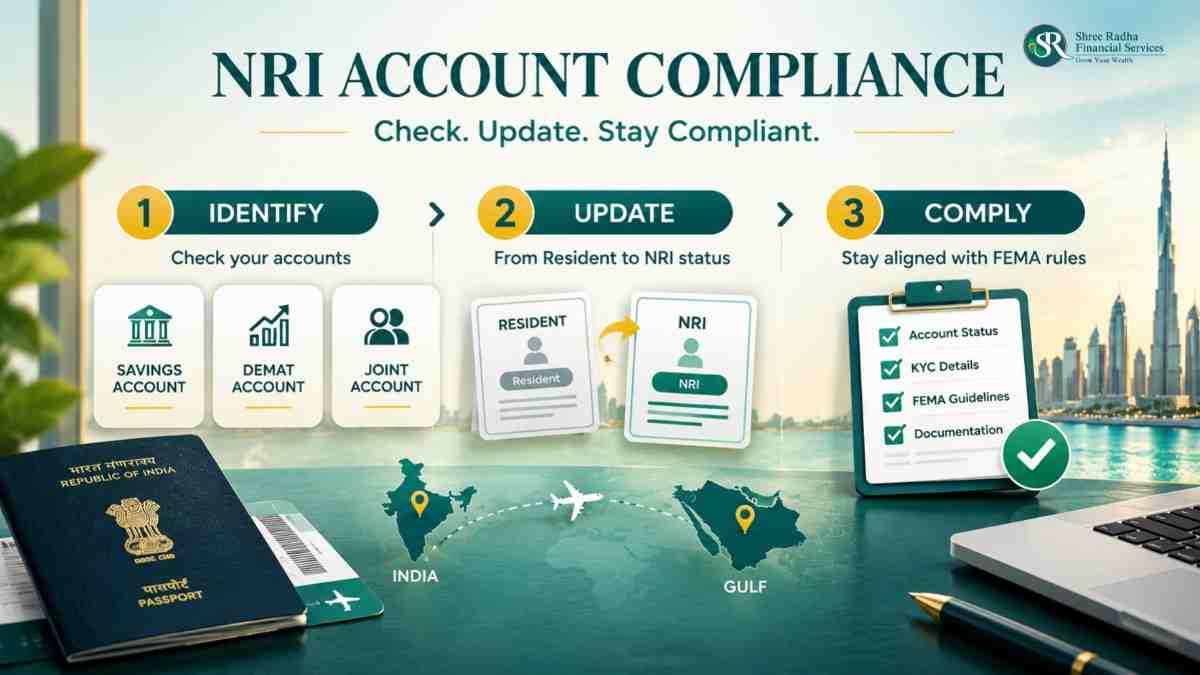
- The moment your residency status changes, notify your bank and broker in writing — don’t wait for them to catch it during a routine review.
- Convert your resident savings account to NRO, or close it — don’t leave it running “for convenience.”
- Convert your resident demat/trading account to an NRI PIS or Non-PIS account before your next trade, not after a freeze forces the issue.
- Never add a resident relative as an active joint holder on an NRE account — route family household needs through a separate NRO account instead.
- If you discover a gap that’s already happened, don’t ignore it — a prompt, voluntary compounding application is treated very differently from one prompted by an enforcement notice.
Frequently Asked Questions — NRI Account FEMA Violation
What exactly counts as an NRI account FEMA violation?
Continuing to operate a resident savings account, resident demat/trading account, or an NRE account with an active resident joint holder after your residency status has changed to NRI — regardless of whether it was intentional.
What’s the actual penalty for not converting a resident account after becoming an NRI?
Under Section 13 of FEMA, up to three times the amount involved where it can be quantified, up to ₹2,00,000 where it can’t, and a further ₹5,000 for every day the violation continues.
Can I still fix it if I’ve already been operating a non-compliant account for a while?
Yes. Convert or close the account as soon as you identify the issue, and consider a voluntary compounding application to RBI — a prompt, good-faith correction is treated differently from a continuing, undisclosed violation.
Can a resident parent be a joint holder on my NRE account?
Only on a “former or survivor” basis, meaning they can only operate it after your death — not as an active co-holder for day-to-day transactions. For that purpose, use a separate NRO account instead.
Do I need to convert my demat account too, or just my bank account?
Both. A resident demat/trading account is a separate FEMA compliance point from your bank account, and needs its own conversion to an NRI PIS or Non-PIS demat account.
Not Sure If Your Accounts Are Actually Compliant?
Whether it’s a savings account you never got around to converting, a demat account you’re still trading through, or a joint account set up for a parent — get it checked against your specific situation before it becomes a bigger problem.
No obligation. No pressure. Just a clear look at your specific numbers.
📞 Call / WhatsApp: +91 98791 13255
📧 Email: shreeradha.services@gmail.com
🌐 Visit: www.srwealth.co.in
📍 Shop 33, Mira Nagar 2, Dindoli Road, Surat 394210
About the Author
Paresh Chaudhary
Founder, Shree Radha Financial Services (SR Wealth)
AMFI Registered Mutual Fund & SIF Distributor — ARN: 268390
APMI Registered PMS Distributor — APRN: 05763
IRDAI Licensed Insurance Distributor
BE Mechanical, SVNIT Surat | Ex-L&T (15+ Years)
This article is also avialble on Medium: https://medium.com/@shreeradha.services/six-hours-in-a-hospital-corridor-over-an-account-nobody-thought-twice-about-3050772a1e41
Educational Disclaimer: This article is published by Shree Radha Financial Services — an AMFI Registered Mutual Fund & SIF Distributor (ARN: 268390) and APMI Registered PMS Distributor (APRN: 05763). All content is strictly for educational purposes only and does not constitute individualised legal, tax, or investment advice. FEMA rules, penalty structures, and compounding procedures are subject to change and involve regulatory discretion; consult a qualified legal or compliance professional and verify current rules before acting. Mutual fund and PMS investments are subject to market risks — read all scheme-related documents carefully before investing. All characters, cities, and scenarios described in this article — including Arjun, Rohan, and Manish — are entirely fictional and used solely for illustrative purposes; any resemblance to actual persons, living or dead, or to any real transaction, is purely coincidental.