
Introduction
It was a Tuesday evening in Dubai, and Rakesh Solanki was not supposed to be thinking about banking at all.
Eleven years running a trading business out of Jebel Ali had taught him to keep his finances simple. His NRE fixed deposit, opened back in 2019, had renewed itself automatically every few years without him giving it a second thought. Click renew. Move on.
Then a WhatsApp forward from a cousin in Vadodara landed in the family group. It said the rupee had slipped nearly 12% against the dollar over the past year — and that money sitting in NRE deposits had quietly been losing value the whole time, simply because it was held in rupees.
Rakesh typed four words into Google that night: FCNR deposit vs NRE FD.
Forty minutes later, he had his answer about the best FCNR deposit for NRIs like him— and a decision that would change how he split his savings between three different accounts he had never really thought to compare.
This blog is written for every NRI who has had that same evening moment — a WhatsApp forward, a nagging doubt, a Google search at 11 PM. Whether you are in Dubai, Abu Dhabi, London, Toronto, or the US — if you have money sitting in an NRE FD, an NRO savings account, or idle NRE savings, read this fully before your next renewal notice arrives.
“Every year I meet NRI families who have been renewing the same NRE FD for a decade without ever asking whether it is still the right place for that money. RBI’s FCNR(B) window closing on 30 September is not just a rate story — it is a reason to actually look at how your NRE, NRO, and FCNR money is split, and whether idle savings are quietly losing value to the rupee.”
— Paresh Chaudhary, Founder, Shree Radha Financial Services, Surat
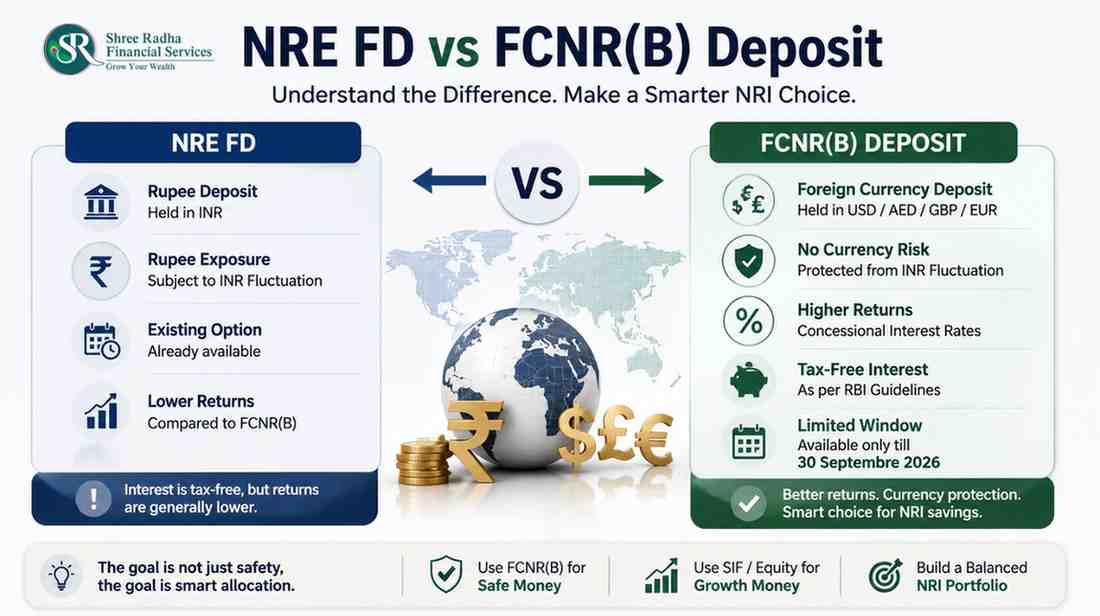
What Is an FCNR Deposit — And Why Is RBI’s 2026 Window Different
Most NRIs are familiar with three types of accounts — NRE, NRO, and FCNR(B) — but very few understand what actually separates them when it comes to currency risk. In early June 2026, with the rupee under sustained pressure — down close to 12% year-on-year against the dollar, and foreign portfolio outflows running above ₹2.87 lakh crore between January and early June — the Reserve Bank of India opened a concessional swap window to pull stable, long-term foreign currency into the banking system.
For a complete foundational understanding of NRI investment routes into India, read our detailed explainer: NRI Investment Guide 2026 — How to Invest in India from UAE.
| Feature | NRE Account | NRO Account | FCNR(B) Deposit |
|---|---|---|---|
| Currency Held | Rupees — converted on deposit | Rupees — converted on deposit | Foreign currency — USD, GBP, EUR, AUD, CAD, JPY |
| Rupee Depreciation Risk | Full exposure | Full exposure | None — value stays in original currency |
| Typical Source | Foreign income remitted to India | India-sourced income — rent, dividends, pension | Foreign income remitted to India |
| Taxation in India | Interest tax-free | TDS applies on interest | Interest tax-free |
| Repatriability | Fully repatriable | Limited — subject to conditions | Fully repatriable |
The Suitcase Analogy:
Think of NRE and NRO money as cash you handed over at the airport counter to be exchanged into rupees the moment you landed — from that point on, its value moves with the rupee, whether you like it or not. FCNR(B) is like a suitcase you never opened. The dollars, pounds, or dirhams stay exactly as they are, earning interest in that same currency, untouched by whatever the rupee does while you were away.
RBI’s 2026 window is simply offering an unusually good rate — 6% to 7% — to keep that suitcase in an Indian bank instead of a foreign one.
RBI’s FCNR(B) Concessional Swap Window — The Details
Through an operational circular effective 8 June 2026 (RBI/2026-27/99), the Reserve Bank of India opened a special swap facility for fresh and renewed FCNR(B) deposits:
- Applies to fresh or renewed FCNR(B) deposits with tenures of 3 to 5 years
- Deposits must be mobilised by 30 September 2026 to qualify for the concessional swap
- RBI absorbs the full currency hedging cost banks would otherwise pass on — historically 280 to 350 basis points — which is why banks are advertising 6% to 7%+ interest on USD deposits, with some lenders quoting up to 7.1%
- Interest is tax-free in India; principal and interest are fully repatriable
- Minimum lock-in is 1 year; the advertised 6-7% range applies specifically to the 3-5 year tenures RBI is targeting
- After 30 September 2026, RBI stops absorbing the hedging cost and the earlier interest rate ceiling returns — rates on fresh FCNR(B) deposits are expected to fall meaningfully once the window shuts
Within the first six weeks of the window opening, RBI data showed FCNR(B) deposits alone had pulled in over $17 billion in fresh inflows — NRIs across the Gulf, US, UK, Canada and Australia are already acting on this, even where the reasoning was never explained to them in plain language.
Rakesh’s Story — Dubai, an NRE FD Renewal Notice, and What Changed His Mind
Rakesh Solanki has lived in Dubai for eleven years, running his trading business out of Jebel Ali. He tracks his shipments and his margins carefully, but his personal savings had run on autopilot — an NRE FD that renewed itself every three years without question.
That night, after the WhatsApp forward, he called Shree Radha Financial Services in Surat the next morning. The conversation was straightforward: his NRE FD money — because it sat in rupees — had lost real, dollar-equivalent value every time the rupee weakened, even though the FD balance itself never dropped a single rupee. He had never thought of a fixed deposit as something that could quietly shrink.
Rakesh’s Decision — The Numbers That Changed His Mind:
- NRE FD renewing at a standard rupee FD rate — fully exposed to rupee depreciation, running near 12% year-on-year
- FCNR(B) 3-year deposit locking a 6-7% USD rate before the 30 September window closes — zero currency risk
- Two-thirds of the maturing NRE FD moved into a 3-year FCNR(B) deposit
- The remaining third redirected into an SIF allocation he had been considering for over a year
- Working capital and near-term business liquidity left untouched — this was surplus savings only
NRE FD vs FCNR Deposit — The Numbers Every NRI Needs to See
| Comparison Point | NRE FD | FCNR(B) Deposit (2026 Window) |
|---|---|---|
| Currency | Rupees | USD / GBP / EUR / AUD / CAD / JPY |
| Rupee Depreciation Impact | Real dollar-equivalent value falls as rupee weakens | None — value stays in the deposit currency |
| Advertised Rate (2026) | 6.5% to 7.25% in rupees | 6% to 7%+ in USD — no conversion drag |
| Taxation | Interest tax-free in India | Interest tax-free in India |
| Best Suited For | Money you plan to eventually spend in rupees in India | Money you want protected in the currency you earn it in |
| Time-Bound Opportunity | No deadline | Best rates available only until 30 September 2026 |
Important: Moving money out of an NRE FD before maturity may involve a premature closure cost — this needs to be weighed against the rate difference and the time remaining in the window. This is a calculation worth doing properly rather than guessing.
Meenal’s Story — London, an Idle NRO Balance, and a Saturday Morning Question
Meenal Desai moved to London nine years ago and works as a project manager for a construction consultancy. Rental income from a flat she still owns in Ahmedabad, along with some consulting fees and dividends, had quietly built up to nearly ₹42 lakh sitting in her NRO savings account — earning standard savings interest, doing nothing.
When her brother mentioned the FCNR(B) window during a video call, her first reaction was confusion: “Isn’t that just another FD? Why does it matter which one I use?” It is a fair question, and it is exactly the question this blog exists to answer.
Her ₹42 lakh, sitting in NRO, was fully exposed to rupee depreciation and earning a rate that came nowhere close to compensating for that risk. Once she understood that FCNR(B) would hold the equivalent value in pounds — not rupees — the decision became clear.
(For NRO funds specifically, remittance limits and tax clearance — Form 15CA/15CB — apply before conversion and transfer into an FCNR(B) deposit. This is a documentation step, not a blocker, but it needs to be planned ahead of the 30 September cut-off rather than attempted in the last week.)
Meenal converted a portion of her NRO balance into a GBP-denominated FCNR(B) deposit after completing the documentation with her bank’s NRI desk, and kept the remainder liquid for a flat renovation she is planning next year.
FCNR(B) vs SIF — Why “Safe Money” and “Growth Money” Are Two Different Conversations
Here is where Rakesh and Meenal both eventually landed on the same realization: FCNR(B) is a parking solution, not a growth solution.
| Comparison Point | FCNR(B) Deposit | SIF (Specialised Investment Fund) |
|---|---|---|
| Currency Exposure | None — held in foreign currency | Rupee-denominated — rupee movement affects returns |
| Return Type | Fixed, known in advance (6-7% currently) | Market-linked, no ceiling, no guarantee |
| Purpose | Capital protection + currency hedge | Long-term wealth growth |
| Liquidity | Locked for tenure — min. 1 year, best rate on 3-5 years | Category-dependent, generally more flexible |
| Minimum Investment | Bank-dependent, no SEBI minimum | ₹10 lakh per SIF strategy |
| Best Suited For | Money you don’t want exposed to markets or rupee swings | Surplus with a 3 to 5 year horizon, ready to work harder |
FCNR(B) and SIF are not competing for the same money — they answer two different questions. “Where do I keep money safe from the rupee and the market?” is answered by FCNR(B). “Where do I grow wealth over the next 5-10 years?” is answered by SIF and mutual funds. An NRI portfolio that only has FCNR(B) is playing entirely defensive. A portfolio with no currency-protected base at all is carrying rupee risk on money that might be needed sooner than expected.
For more on how SIF works for NRI investors specifically, read: SIF Investment Guide — Surat HNI and NRI Investors.
The Cousin in Toronto — How One WhatsApp Forward Became Two Restructured Portfolios
Three days after Rakesh split his NRE FD between FCNR(B) and SIF, he forwarded the same explanation to his cousin Deval in Toronto — a software engineer who had ₹22 lakh sitting across an NRE savings account and an ageing FD, never actively managed since he emigrated seven years ago.
Deval called Shree Radha Financial Services the same week. His situation mirrored Rakesh’s almost exactly — money that had been “safe” only in the sense that nobody had looked at it recently. He locked a 5-year FCNR(B) deposit in USD-equivalent Canadian dollar remittances before the September deadline, and moved a smaller portion into an SIF Hybrid allocation for the first time.
One WhatsApp forward. One family group. Two portfolios restructured across two continents. That is how NRI financial decisions actually spread — through trusted family conversation, not advertising — and why explaining these ideas clearly, once, matters more than any single sales pitch.
Who Should Move Money Into FCNR(B) Before 30 September — A Simple Honest Checklist
Moving money into FCNR(B) is likely right for you if:
- ✅ You have an NRE FD maturing (or renewing) in the next few months
- ✅ You have NRE or NRO savings sitting idle, earning minimal interest
- ✅ You don’t expect to need this specific money in India within the next 1-3 years
- ✅ You want protection from further rupee depreciation on money you plan to keep in foreign currency
- ✅ You are comfortable locking funds for 3-5 years to get the full advertised rate
FCNR(B) may not be the right move right now if:
- ❌ You will need this money in India within the next 12 months
- ❌ Your NRE FD has a long time left before maturity and premature closure costs outweigh the benefit
- ❌ You have no rupee-risk money at all left over once your emergency and near-term needs are set aside — in which case the conversation may be entirely about SIF/growth instead
The Practical Steps: Moving NRE FD or Idle Savings Into FCNR(B)
- Check maturity dates on existing NRE FDs. Premature closure to move into FCNR(B) may involve a penalty — compare that cost against the rate differential and remaining window time.
- Review idle NRE/NRO savings balances. Money sitting in a savings account earning minimal interest is the easiest, lowest-friction money to move first.
- For NRO funds, plan tax documentation early. Form 15CA/15CB and repatriation limits need lead time — don’t leave this to the last week of September.
- Choose the tenure deliberately. The advertised 6-7% range is tied to 3-5 year FCNR(B) deposits specifically — shorter tenures won’t get the same rate.
- Decide the split, not just the move. Work out how much is “safe money” for FCNR(B) versus how much should be working toward growth via SIF or mutual funds.
- Act before 30 September 2026. Once the concessional swap window closes, banks lose RBI’s hedging support and rates on fresh FCNR(B) deposits are expected to fall.
Frequently Asked Questions — FCNR(B), NRE FD and SIF for NRI Investors
Can I move my existing NRE FD into an FCNR(B) deposit?
Yes, subject to your bank’s premature closure terms on the existing NRE FD. The proceeds, once in foreign currency, can be placed into a fresh FCNR(B) deposit within the window, provided it is mobilised by 30 September 2026.
Is FCNR(B) interest really tax-free?
Interest is exempt from Indian income tax for NRIs. It may still be taxable in your country of residence, depending on local rules and any applicable DTAA — this is worth checking with a tax professional in your country of residence.
Can I move idle NRO savings into FCNR(B)?
Yes, but NRO funds require tax clearance — Form 15CA/15CB — and are subject to applicable remittance limits before conversion into foreign currency for an FCNR(B) deposit. This documentation should be started well ahead of the 30 September deadline.
What happens to my FCNR(B) deposit if I return to India permanently?
It can continue until maturity even after you resettle in India, and is typically converted to a Resident Foreign Currency (RFC) account at that point.
Should I put all my NRI savings into FCNR(B) before the deadline?
Not necessarily. FCNR(B) is well suited for the portion of your money that needs currency protection and capital safety. Long-term growth is better served through SIF or mutual funds, which don’t carry the same rate ceiling.
Can NRIs invest in SIF alongside an FCNR(B) deposit?
Yes. NRI investors can invest in SEBI-regulated SIF through the NRI investment route using their NRE or NRO accounts, alongside an FCNR(B) deposit. The two serve different purposes — currency-protected safety versus long-term growth — and are commonly held together rather than as alternatives to each other.
This artical is also available on Medium : https://medium.com/@shreeradha.services/rbis-7-dollar-deposit-window-closes-sept-30-2026-what-nris-need-to-know-2b7f063691fc
Planning to Move NRE FD or Idle Savings Into FCNR(B) Before September 30?
Whether you are in Dubai, London, Toronto, or anywhere else — a short conversation will tell you clearly how to split your money between currency-protected FCNR(B) deposits and growth-oriented SIF or mutual fund investments.
No obligation. No pressure. Just honest, clear information — from Surat, for NRI families everywhere.
📞 Call / WhatsApp: +91 98791 13255
📧 Email: shreeradha.services@gmail.com
🌐 Visit: www.srwealth.co.in
📍 Shop 33, Mira Nagar 2, Dindoli Road, Surat 394210
Paresh Chaudhary
Founder, Shree Radha Financial Services, Surat
AMFI Registered Mutual Fund & SIF Distributor — ARN: 268390
APMI Registered PMS Distributor — APRN05763
IRDAI Licensed Insurance Distributor
Investing since 2012 | BE Mechanical, SVNIT Surat | Ex-L&T (15+ Years)
Educational Disclaimer: This article is published by Shree Radha Financial Services — an AMFI Registered Mutual Fund & SIF Distributor (ARN: 268390) and APMI Registered PMS Distributor (APRN05763). All content is strictly for educational purposes only and does not constitute individualised investment advice. Mutual fund and SIF investments are subject to market risks — read all scheme-related documents carefully before investing. FCNR(B) deposit rates, RBI window dates, and tax treatment are subject to change per RBI/bank circulars and applicable law — please verify current terms with your bank before transacting. All numbers and scenarios in this article are for educational understanding only — actual outcomes will vary based on market conditions, bank terms, and individual circumstances. Verify current RBI guidelines at RBI’s official website before acting. Past performance of any investment category does not guarantee future returns.