Introduction
Is ₹2 crore enough to retire? It’s a question that carries a particular kind of financial anxiety — one that almost never gets said out loud. It isn’t the stress of debt, or the panic of a market crash.
It’s quieter than that — the feeling of having done everything more or less right, and still not being sure if it’s enough.
This is a conversation for people who never stopped investing. Anand Mehta has never missed a SIP instalment in twelve years.
He has ₹2 crore in mutual funds, a monthly SIP of ₹1.7 lakh, no debt, and a job he’s good at. And he still walked into a conversation with one question sitting under everything else: “Am I actually going to be okay?”
This article is for Anand, and for the many people quietly asking themselves whether ₹2 crore is enough to retire on.
“In just over three and a half years of building Shree Radha Financial Services, the clients who worry me least are usually the ones who worry most about themselves. Discipline isn’t the problem for people like Anand. The problem is that nobody ever sits down and actually runs the number for them — so the anxiety just sits there, unresolved, next to a portfolio that’s probably doing fine.”
— Paresh Chaudhary, Founder, Shree Radha Financial Services, Surat
Anand, Pune — Doing Everything Right, and Still Unsure
Anand is 45, a VP at a mid-sized manufacturing firm in Pune, married with one teenager — the same senior-professional profile we cover in our Executive Wealth guide for high-income professionals. His numbers, on the surface, look enviable: ₹2 crore already built in mutual funds, ₹1.7 lakh going into SIPs every month, a fully paid-off flat he lives in, and an EPF balance growing quietly in the background.
He isn’t chasing hot funds or checking his portfolio daily. He just wants one honest answer: is this enough, or does something need to change?
The mistake most people make at this point — including a lot of otherwise sound financial content online — is answering with a single reassuring number pulled from a rule of thumb. The more useful answer starts with a framework Anand can actually apply to his own numbers.
The Honest Framework — How Much Do You Actually Need?
Four steps, applied in order:
- Start with today’s monthly expense — not income, not lifestyle aspiration, the actual number your household spends today.
- Inflate it to your retirement year — using a realistic long-term inflation assumption, typically 6% for general expenses in India.
- Apply a safe withdrawal rate (SWR) — the percentage of your corpus you can withdraw annually without running out of money over a 25-30+ year retirement.
- Divide to get your required corpus — inflated annual expense ÷ SWR = the number you’re actually working toward
Step 3 is where almost every online calculator quietly gets it wrong for Indian readers. The famous “4% rule” comes from American research, built on US inflation of 2-3% and US market history. India’s inflation has structurally run higher — 6-7% on average, sometimes more — which means a withdrawal rate that’s “safe” in the US isn’t safe here. Indian retirement research consistently points to a lower, more conservative range instead.
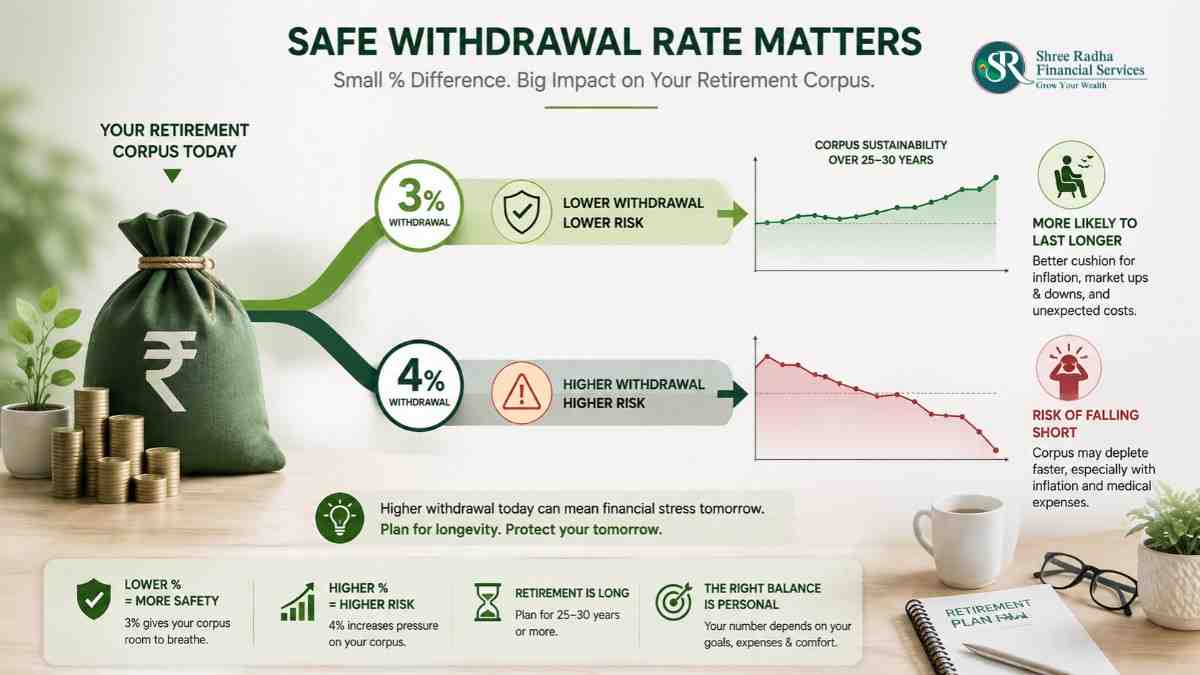
| Withdrawal Rate | Rule of Thumb | Corpus Needed for ₹1 Lakh/Month | Fit for India |
|---|---|---|---|
| 4% | 25X annual expense | ₹3 crore | US-built assumption — risky here |
| 3.5% | ~28.5X annual expense | ₹3.43 crore | Reasonable middle ground |
| 3% | 33X annual expense | ₹4 crore | Conservative — better margin of safety |
There’s no social security cushion waiting in India the way there is in the West — PFRDA’s own resources are a useful reference here — and, as the next section covers, healthcare costs alone are reason enough to lean conservative. A 3–3.5% withdrawal rate, not 4%, is the more honest starting point for this kind of planning. If ₹2 crore isn’t your number, our companion piece on whether ₹5 crore is enough to retire walks through the same framework at a higher corpus.
The Cost Nobody Builds In — Medical Inflation
General inflation is the number everyone plans around. Medical inflation is the number that quietly wrecks the plan. In India, healthcare costs have been rising at roughly 11-14% a year — nearly three times general inflation, a trend IRDAI’s own health insurance data reflects year over year. A knee surgery costing ₹3 lakh today runs to roughly ₹7 lakh in ten years, and close to ₹16 lakh in twenty.
Retirement is exactly the period when medical expenses tend to rise fastest, which is the entire reason a conservative withdrawal rate and a dedicated health buffer both matter more in India than the average US-origin retirement calculator assumes.
Projecting Anand’s Actual Numbers Forward
With the required-corpus side of the equation settled, the second half is projecting what Anand’s ₹2 crore plus his ₹1.7 lakh monthly SIP will realistically become by the time he retires — using a realistic long-term equity CAGR, not an optimistic best-case number, since overstating the return is just as dangerous as understating the required corpus.
Run conservatively, most disciplined investors in Anand’s position land somewhere close to their number, sometimes ahead of it, sometimes with a moderate gap — and knowing which of those three it is changes what he does next, from nothing at all to a modest step-up in his SIP.
This is the actual point of the exercise — not a yes/no verdict pulled from a generic calculator, but a real comparison between two numbers that were previously just a vague feeling. AMFI India’s own investor resources echo the same principle: plan against your actual numbers, not an average. A portfolio review is usually the fastest way to get there.
Dr. Kavita Iyer, Coimbatore — When “Other Assets” Aren’t Worth What You Think
Kavita runs her own clinic in Coimbatore, 47, self-employed rather than salaried — a different financial shape from Anand entirely, closer to the profile in our SIF vs PMS comparison for surplus-holding professionals. Her mutual fund portfolio is smaller, and her monthly SIP more modest, but she’s been mentally counting two rental flats as roughly half her retirement plan.
On paper, her numbers look similar to Anand’s. In practice, they aren’t — and the gap is exactly the kind that’s easy to miss until someone runs it through honestly.
Why Real Estate Doesn’t Count at Face Value
The instinct to count a property’s market value toward a retirement number is understandable — and it’s also where a lot of otherwise solid retirement plans quietly overstate themselves. Two problems, both real:
- Illiquidity. Selling a property takes months, sometimes longer, and carries 7-10% in transaction costs — stamp duty, registration, brokerage. That’s not money you can access on a Tuesday if you need it.
- Weak actual yield. Residential rental yields in India typically run 2-4% net, sometimes lower after maintenance and taxes. A flat “worth” ₹1 crore might genuinely generate only ₹2-3 lakh a year in usable income — a fraction of what its sale-value number implies.
Kavita’s two flats look like ₹1.5 crore of retirement security on paper. As an actual income stream, in the years she’d need it most, they’re worth considerably less than that number suggests — and that gap is exactly the kind of thing that should be corrected before retirement, not discovered during it.
What Genuinely Does Count — PF and Gratuity

Set against this, Kavita’s accumulated Provident Fund balance and the gratuity built up over her years of running the clinic with staff genuinely do belong in the corpus number. These are liquid (or become liquid) at retirement, don’t carry a sale-market risk, and can be counted at close to their stated value. The distinction isn’t “assets vs no assets” — it’s liquid, bankable value versus an illiquid asset wearing a large number.
Frequently Asked Questions — Is My Retirement Corpus Enough?
Is ₹2 crore enough to retire in India?
It depends entirely on your monthly expenses, years to retirement, and the withdrawal rate you plan around — there’s no single answer that applies to everyone. Someone with modest expenses and 15+ years of further SIP growth ahead may be well covered; someone closer to retirement with higher expenses may have a real gap. The honest framework above is how to find your specific answer rather than borrowing someone else’s.
Why shouldn’t I use the 4% rule like everyone talks about online?
The 4% rule was built on US inflation and US market history, both structurally different from India’s. Indian inflation has historically run higher, which means a 4% withdrawal rate carries more risk of running out of money over a long retirement here than it does in the US. A 3-3.5% rate is the more realistic Indian equivalent.
Should I count my spouse’s assets and income in this calculation?
If you’re planning jointly, yes — a joint retirement plan should reflect joint resources and joint expenses. If you’re each planning somewhat independently, it’s worth running the numbers both ways so you understand what you’re each individually covered for.
What if the numbers show I’m short?
A gap identified now, with real years of compounding still ahead, is a solvable problem — usually through a moderate step-up in SIP contributions rather than a drastic lifestyle change. A gap discovered at 58 with two years to retirement is a much harder conversation. The value of running this exercise early is entirely in the runway it leaves you.
Does rental income change this if I plan to keep the property through retirement?
Yes, partially — if you intend to hold and rent the property through retirement rather than sell it, its rental income (not its sale value) becomes a genuine, ongoing income stream you can factor in, typically at that realistic 2-4% net yield rather than the property’s market price.
How often should I re-check whether I’m on track?
Roughly once a year, or after any major change — a job move, a large expense, a market swing that meaningfully shifts your corpus. The framework doesn’t change; the inputs do, and it’s worth re-running the numbers rather than assuming last year’s answer still holds.
This article is also available on Medium: https://medium.com/@shreeradha.services/is-2-crore-enough-to-retire-the-honest-answer-dce8b1746189
Want Your Own Number, Not Someone Else’s Rule of Thumb?
Anand and Kavita both walked away with an actual answer instead of a lingering feeling — one a clear “you’re closer than you think,” the other a specific, fixable correction. Both took less than an hour to work through.
If this quiet “am I on track” question has been sitting with you too, a portfolio and retirement-readiness review costs nothing to start. If you’re instead sitting on the other side of this — SIPs paused rather than steady — our piece on restarting SIP after stopping is the better starting point. As a SEBI/AMFI-registered Mutual Fund and SIF Distributor, we can run your actual numbers with you.
Grow Your Wealth — that is what we are here for.
📞 Call/WhatsApp: +91 98791 13255
📧 Email: shreeradha.services@gmail.com
🌐 Visit: www.srwealth.co.in
📍 Shop 33, Mira Nagar 2, Dindoli Road, Surat 394210
Paresh Chaudhary
Founder, Shree Radha Financial Services, Surat
AMFI Registered Mutual Fund & SIF Distributor — ARN: 268390
APMI Registered PMS Distributor — APRN05763
Building Shree Radha Financial Services since 2022 | BE Mechanical, SVNIT Surat | Ex-L&T (15+ Years)
Educational Disclaimer: This article is published by Shree Radha Financial Services — an AMFI Registered Mutual Fund & SIF Distributor (ARN: 268390) and APMI Registered PMS Distributor (APRN05763). All content is strictly for educational purposes only and does not constitute individualised investment advice. The names, cities, and figures used in this article are illustrative and fictionalised to explain general concepts; they do not represent actual client data. Mutual fund investments are subject to market risks — read all scheme-related documents carefully before investing. Inflation, withdrawal rate, and return figures are general estimates based on publicly available research as of mid-2026 and will vary by individual circumstance. Past performance is not indicative of future returns. Please consult a qualified tax advisor for individual tax treatment.