
When it comes to Hybrid SIF vs Fixed Deposit, most investors have never actually run the tax math — Rohan Deshpande hadn’t either, until one Wednesday night
It was 10:47 PM on a Wednesday, and Rohan Deshpande was doing something he rarely did on a weeknight — going through his own bank statements line by line.
Rohan, 38, is an engineering manager at a product company in Pune. For ten years, his system had been simple and, in his mind, smart: every bonus, every insurance maturity, every bit of surplus went straight into a fixed deposit. By this Wednesday night, he had close to ₹20 lakh sitting across three FDs at a large private bank. Safe. Predictable. Untouched by market noise.
Earlier that evening, a colleague from the finance team had said something in passing over coffee: “You know your FD interest is basically taxed at your full salary slab, every single year, right? Even if you never touch the money.”
Rohan laughed it off in the moment. Then he went home and actually did the math. He didn’t laugh the second time.
“I meet professionals like Rohan every week — across cities, not just Surat. Their FDs feel safe because the number on the certificate never moves. Nobody shows them the number that actually reaches their bank account after tax. That gap is exactly what the Hybrid SIF category was built to close — without asking them to take on the kind of risk they’re not comfortable with.”
— Paresh Chaudhary, Founder, Shree Radha Financial Services (SR Wealth)
The Tax Math Nobody Shows You
Here’s what Rohan found when he pulled out his last Form 26AS and ran the numbers properly.
His FDs were earning roughly 7% per annum — a fair, competitive rate from a large private bank. But Rohan sits in the 30% income tax slab, and once cess is added, his effective tax rate on that interest income comes to just over 31%. And this tax applies every single year, on interest that’s added to his taxable income whether he withdraws it or not — his bank deducts TDS automatically.
Run the numbers, and his real, post-tax return on that “safe” 7% FD works out to roughly 4.8% per annum. With retail inflation running close to that number in many recent years, Rohan wasn’t really growing his money — he was treading water and paying tax for the privilege.
This is the quiet trap that catches most salaried professionals in the higher tax brackets. FDs feel safe because the number on the certificate never moves. But the number that actually reaches your account, after tax, tells a very different story.
Hybrid SIF vs Fixed Deposit — What Actually Makes the Category Different”
In 2025, SEBI introduced a new investment category called the Specialised Investment Fund (SIF) — designed to sit between traditional mutual funds and the more exclusive world of PMS and AIF.
It requires a minimum investment of ₹10 lakh, operates under the same tight AMC-managed regulatory framework as mutual funds, but gives fund managers meaningfully more flexibility — including limited short exposure through derivatives, something a regular mutual fund simply cannot use.
Within SIF, there are equity-oriented, debt-oriented, and hybrid strategy categories. For someone like Rohan — sitting on FD money he wants to keep low-risk but tax-efficient — the relevant one is the Hybrid Long-Short SIF category, often described in the industry as an “FD-Plus” or “Bond-Plus” strategy.
The Simple Analogy:
Think of your options on a ladder. A Fixed Deposit sits at the bottom rung — guaranteed, but taxed hard and going nowhere fast after tax. A Balanced Advantage Fund or diversified equity fund sits several rungs up — real growth potential, but real volatility too. Hybrid SIF sits on the rung just above FD — built with a core allocation to arbitrage and fixed-income instruments for stability, with a smaller derivative and special-situations layer for a bit of extra return. It doesn’t ask you to jump straight to the top of the ladder. It asks you to take one step up from where you already are.
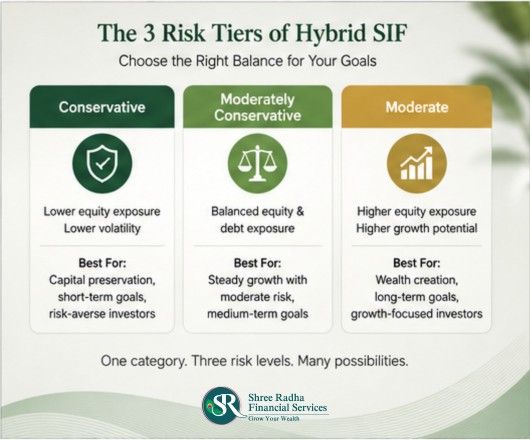
The 3 Risk Tiers Inside Hybrid SIF — And Exactly Who Each One Is For
This is the part most articles skip entirely — they treat “Hybrid SIF” as one single product. It isn’t. AMCs have structured their Hybrid SIF offerings into three distinct risk tiers, each with a different investment horizon, a different expected return band, and a different type of investor in mind. Knowing which tier you actually belong in matters more than knowing the category exists.
| Tier | Ideal For | Horizon | Positioning | Expected Return Range* |
|---|---|---|---|---|
| Tier 1 — Conservative (FD/Bond Alternate) |
Investors seeking higher post-tax returns than FD, with relatively low volatility | 2 years & above | Between Arbitrage Funds and Equity Savings Funds | FD +1% to +3% alpha (~8–10% p.a. pre-tax) |
| Tier 2 — Moderately Conservative | Investors willing to accept slightly higher risk in pursuit of better risk-adjusted returns | 3 years & above | Between Equity Savings Funds and Balanced Advantage Funds | FD +2% to +4% alpha (~9–11% p.a. pre-tax) |
| Tier 3 — Moderate (BAF Alternative) |
Investors with a longer horizon seeking higher wealth-creation potential | 5 years & above | Balanced Advantage Fund (BAF) alternative | BAF +2% potential alpha over the long term |
*Return ranges are illustrative, based on respective AMCs’ back-tested category analysis as disclosed in fund literature. They are not guaranteed and will vary with market conditions and the specific fund chosen.
All three tiers share one common thread that matters enormously for a 30%-bracket investor: once held beyond the applicable period, gains are taxed as long-term capital gains at 12.5% — not at your income slab rate. The difference between the tiers is how much of the portfolio sits in pure arbitrage/debt versus how much moves into equity-linked derivative strategies to chase extra return.
For most FD-heavy investors taking their first step into SIF, Tier 1 (Conservative) is the natural starting point — it’s built to feel closest to what an FD investor is already used to, just with a smarter tax structure underneath it.
Tier 2 suits someone who’s already comfortable with some market-linked exposure. Tier 3 is a genuine alternative to a Balanced Advantage Fund, not an FD replacement — worth knowing so nobody moves emergency-fund money into it by mistake.
The Taxation Difference — Where the Real Gap Opens Up
This is the part that made Rohan sit up straighter. FD interest is taxed at your income slab rate, every year, as it accrues — whether you touch the money or not. Hybrid SIF strategies, by contrast, are taxed as capital gains — short-term at slab rate or a flat rate if redeemed early, along-term at a flat 12.5% once held beyond 12 months. Two things stack up in your favour:
| Comparison Point | Fixed Deposit | Hybrid SIF (Conservative Tier) |
|---|---|---|
| Returns | 6.5% to 7.5% fixed | ~8–10% p.a. pre-tax (illustrative, back-tested) |
| Taxation | Slab rate (~31% incl. cess for 30% bracket), charged annually on accrued interest | 12.5% LTCG, charged only at redemption after 1 year |
| Post-Tax Yield | ≈ 4.8% p.a. | ≈ 7.1% p.a. (illustrative) |
| Inflation Protection | Near zero real return once inflation is accounted for | Modest equity/derivative component targets real return above inflation |
| Downside Protection | Principal guaranteed | Arbitrage/debt core limits downside — not guaranteed |
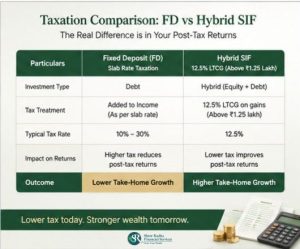
Two things stack up in the SIF investor’s favour: a lower effective tax rate (12.5% instead of 30%+ for someone in the highest slab), and tax deferral — you’re taxed once, at redemption, not every year on interest you haven’t even spent. Compounding works a lot harder when the taxman isn’t taking a bite out of it every twelve months.
What ₹50 Lakh Actually Looks Like, Over 5 Years
Rohan’s numbers were closer to ₹20 lakh, but let’s take a rounder figure that a lot of dual-income professional households will recognise: ₹50 lakh, sitting in FDs, for a 30%-tax-bracket investor.
| Particulars | Fixed Deposit | Hybrid SIF (Conservative) |
|---|---|---|
| Assumed pre-tax return | 7% p.a. | 8% p.a. (illustrative) |
| Value after 5 years | ≈ ₹63.3 lakh | ≈ ₹70.5 lakh |
| Effective post-tax CAGR | ≈ 4.8% p.a. | ≈ 7.1% p.a. |
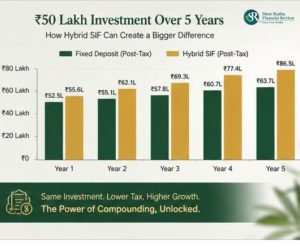
That’s a difference of roughly ₹7.25 lakh in the investor’s pocket over five years, on the same ₹50 lakh — from a more tax-efficient structure alone, with the underlying risk still positioned conservatively, in the “FD-plus” zone rather than full equity market risk.
Note: These figures are illustrative, based on assumed rates and each fund’s own back-tested category performance as disclosed by respective AMCs. They are not guaranteed returns, and actual outcomes will vary based on market conditions, the specific fund chosen, and the investor’s holding period. Please read all scheme-related documents carefully before investing.
Meera’s Story — A Different Tier, A Different Life Stage
Not every professional’s version of this problem looks like Rohan’s. Meera Iyer, a 44-year-old VP at a Bengaluru SaaS company, wasn’t purely an FD person — she already had exposure to a Balanced Advantage Fund and a couple of equity SIPs.
Her issue was different: she wanted better risk-adjusted returns without taking on more volatility than she already carried, especially with two years left until her daughter’s undergraduate fees came due.
For an investor like Meera — already comfortable with market-linked products, wanting more than FD-level safety but still cautious about pure equity — Tier 2 (Moderately Conservative) is the natural fit. It’s positioned between an Equity Savings Fund and a Balanced Advantage Fund, targeting a slightly higher return band with a 3-year-plus horizon.
It’s a different entry point into the same broad Hybrid SIF category, built around a different risk appetite and a different life stage than Rohan’s.
This is really the point of thinking in tiers rather than one product: the right entry point depends on how much risk you’re genuinely comfortable carrying, and for how long — not on picking whichever fund happens to be trending on social media.
Who Should Actually Consider Hybrid SIF — A Simple Honest Checklist
Hybrid SIF is likely right for you if:
- ✅ You’re a salaried professional in the 30% tax bracket sitting on FD balances “for safety”
- ✅ You have a 2-year-plus horizon on this specific portion of your money — you won’t need it urgently
- ✅ You’ve never been fully comfortable with pure equity volatility, but you’re tired of watching tax and inflation quietly erode FD returns
- ✅ You can meet the ₹10 lakh minimum threshold (per SIF strategy)
- ✅ You want a step-up from FD, not a leap into equity
Hybrid SIF may not be right for you right now if:
- ❌ This is your emergency fund or money you may need within 12 months
- ❌ You’re not comfortable with any short-term NAV fluctuation, even a modest one
- ❌ You haven’t yet built a foundation of equity mutual fund investing and want to understand market-linked products first
Frequently Asked Questions — Hybrid SIF vs Fixed Deposit
Is Hybrid SIF guaranteed to beat FD returns?
No. Hybrid SIF is a market-linked, actively managed strategy — returns are not guaranteed and will fluctuate with market conditions, unlike a fixed deposit’s contractually guaranteed rate. The return figures discussed in this article are illustrative, based on each AMC’s disclosed back-tested category performance, not a promise of future results.
What’s the minimum investment for Hybrid SIF?
SEBI has set the minimum at ₹10 lakh per SIF strategy. You can invest as a lump sum, or via SIP/STP provided the cumulative commitment reaches and maintains the ₹10 lakh threshold.
How is Hybrid SIF different from a Balanced Advantage Fund (BAF)?
A BAF is a mutual fund with limited flexibility in portfolio allocation and largely long-only exposure. Hybrid SIF — particularly the Moderate tier — targets similar territory but with greater flexibility, including income-generating derivative strategies like covered calls and collar strategies, and the ability to use limited short exposure, which a standard BAF cannot.
Which Hybrid SIF tier should a first-time SIF investor choose?
For most investors moving out of FD for the first time, the Conservative tier is the natural starting point — it’s built to feel closest to FD-level stability while improving tax efficiency. Investors already comfortable with market-linked products can consider the Moderately Conservative or Moderate tiers, depending on horizon and risk appetite.
Does the 12.5% LTCG rate apply to all Hybrid SIF strategies equally?
Tax treatment depends on the specific fund’s underlying strategy and holding period — some strategies attract slab-rate taxation on short-term gains before the qualifying holding period, transitioning to the 12.5% LTCG rate after. It’s worth confirming the specific tax treatment of the fund you’re considering before investing, since asset allocation differs across AMCs even within the same tier.
A Category, Not a Single Fund
It’s worth saying this plainly: there is no single “best” Hybrid SIF fund. Multiple AMCs — from established mutual fund houses to newer entrants — have launched Hybrid Long-Short SIF strategies across all three tiers, each with slightly different asset allocation ranges, fund managers, and risk positioning.
The right one for you depends on your specific risk profile, horizon, and existing portfolio — which is exactly the kind of fit assessment worth having a proper conversation about, rather than picking a name off a factsheet.
If you’re curious about where Hybrid SIF sits within the broader SIF category — including the Equity Long-Short and Ex-Top 100 strategies for investors with a higher risk appetite — take a look at our earlier deep-dive on SIF Categories in India (2026).
And if you’re a Surat-based HNI weighing SIF against your existing portfolio, our SIF Investment Guide for Surat HNIs covers the local context in more depth.
Following Article is also aviable on Medium.com: https://medium.com/@shreeradha.services/the-30-tax-trap-why-high-earning-professionals-are-outgrowing-fixed-deposits-eaf936d7c23b
Hybrid SIF vs Fixed Deposit — Which One Fits Your Portfolio?
Every investor’s tax situation, horizon, and comfort with risk is different. Before you move any portion of your FD holdings, it’s worth having someone look at your specific numbers — and tell you plainly which tier, if any, actually fits.
No obligation. No pressure. Just a clear, honest conversation.
📞 Call / WhatsApp: +91 98791 13255
📧 Email: shreeradha.services@gmail.com
🌐 Visit: www.srwealth.co.in
About the Author
Paresh Chaudhary
Founder, Shree Radha Financial Services (SR Wealth)
AMFI Registered Mutual Fund & SIF Distributor — ARN: 268390
APMI Registered PMS Distributor — APRN: 05763
IRDAI Licensed Insurance Distributor
BE Mechanical, SVNIT Surat | Ex-L&T (15+ Years)
Educational Disclaimer: This article is published by Shree Radha Financial Services — an AMFI Registered Mutual Fund & SIF Distributor (ARN: 268390) and APMI Registered PMS Distributor (APRN: 05763). All content is strictly for educational purposes only and does not constitute individualised investment advice. Mutual fund and SIF investments are subject to market risks — read all scheme-related documents carefully before investing. All numbers, comparisons, and illustrative scenarios in this article are for educational understanding only — actual returns will vary based on market conditions, fund performance, and individual circumstances. SIF is a new asset class — investors should understand all terms, risks, and conditions before investing. Tax rates and rules are subject to change as per prevailing Income Tax laws; consult your tax advisor for guidance specific to your situation. Past performance of any investment category does not guarantee future returns.