SWP Taxation: Four Families, Four Different Tax Bills
SWP taxation worries almost everyone the first time. You take Rs 50,000 a month from a mutual fund. Is the whole Rs 50,000 taxed? Or none of it?
The answer is neither. Only the gain inside each withdrawal is taxed. And the rate depends on the type of fund you hold.
Four families, four cities, four different bills. Read the stories first. The rules and tables come after.
Note: The families and numbers in these stories are illustrative, to explain the rules. They are not real clients. We assume the NAV stays the same through the year, to keep the sums simple.
“SWP taxation looks hard only because people mix up two things: the money they put in, and the gain on it. Split them, and the picture becomes clear.”
— Paresh Chaudhary, Founder, Shree Radha Financial Services
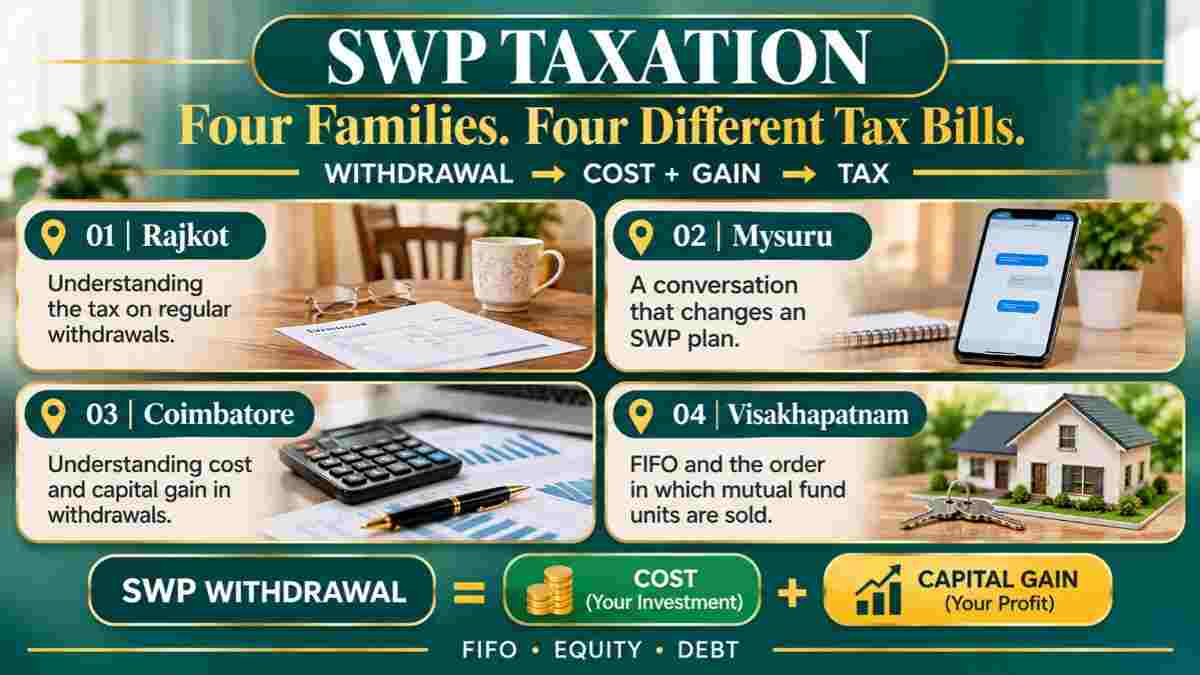
Story 1: Rajkot, the Question at the Dinner Table
It was Sunday night in Rajkot. The thali was on the table, the TV was on low, and nine-year-old Dev was racing through his dal.
His grandfather, Ramesh bhai, 67, was quiet. A friend at the club had told him that morning, “Arre, SWP is fully taxable. Half your income will go in tax.” Ramesh bhai had not slept well since.
His son Hardik noticed. “Papa, what is bothering you?”
“Every month Rs 60,000 comes from my equity fund,” said Ramesh bhai. “They say the income tax people will take half of it.”
Hardik smiled and opened the fund statement on his phone. “Papa, look. You bought your units at Rs 100 each. Today the price is Rs 150. When the fund sends you Rs 60,000, it sells 400 units. Those 400 units cost you Rs 40,000. That part is your own money coming back. Only the other Rs 20,000 is gain.”
Over the year, the gain comes to Rs 2,40,000. The first Rs 1,25,000 of long-term gain from equity funds is not taxed. Tax is worked out on the remaining Rs 1,15,000. The bill comes to Rs 14,950, with cess. That is about 2% of the Rs 7,20,000 he withdrew.
Ramesh bhai put down his spoon and laughed. “Then my friend was only guessing.” SWP taxation looked scary only until the numbers were split.
What to remember: in an SWP, you are first getting your own money back. Only the gain part is taxed.
Useful to know about SWP taxation:
- When the price rises, a bigger part of each payout becomes gain. At Rs 100 cost, a payout at NAV Rs 150 is one-third gain. At NAV Rs 200, it is half gain.
- The Rs 1,25,000 limit covers all your equity fund and share sales in the year, not just this SWP.
- Keep the CAS statement. It shows the date and price of every purchase.
The same SWP taxation calculation in formula form:
| Step | Formula | Numbers | Result |
|---|---|---|---|
| 1. Units sold in a month | Withdrawal ÷ NAV | 60,000 ÷ 150 | 400 units |
| 2. Cost of those units | Units sold × buying NAV | 400 × 100 | Rs 40,000 |
| 3. Gain in each payout | Withdrawal − cost | 60,000 − 40,000 | Rs 20,000 |
| 4. Gain in the year | Monthly gain × 12 | 20,000 × 12 | Rs 2,40,000 |
| 5. Gain that is taxed | Yearly gain − Rs 1,25,000 | 2,40,000 − 1,25,000 | Rs 1,15,000 |
| 6. Tax at 12.5% | Taxed gain × 12.5% | 1,15,000 × 12.5% | Rs 14,375 |
| 7. Cess at 4% | Tax × 4% | 14,375 × 4% | Rs 575 |
| 8. Total tax | Tax + cess | 14,375 + 575 | Rs 14,950 |
| 9. Share of total withdrawal | Total tax ÷ yearly withdrawal | 14,950 ÷ 7,20,000 | About 2.08% |
Story 2: Mysuru, the Chat That Changed a Plan
Ananya, 42, is a software architect in Mysuru. Her daughter’s university fees were due in September. She planned an SWP of Rs 10 lakh a year from her balanced fund. At 9:40 pm she messaged her friend Divya, who is a CA.
Ananya: I am setting up an SWP for Veda’s fees. Equity tax is low, so I should be fine, right?
Divya: What does the fund hold?
Ananya: My colleague said it is “equity-like and safe”. About 45% shares, 35% bonds, 20% gold.
Divya: Then for tax it is not an equity fund. Equity tax needs 65% or more in Indian company shares.
Ananya: Oh. So what happens?
Divya: You bought at Rs 50 and the price is Rs 100 now. So half of each payout is gain, Rs 5 lakh a year. Held more than 24 months, the gain is long-term at 12.5%. But you do not get the Rs 1,25,000 relief. Tax is Rs 62,500, plus cess. About Rs 65,000.
Ananya: And in an equity fund?
Divya: On the same Rs 5 lakh gain, Rs 48,750. Check the fund’s asset allocation page, not its name.
Ananya stared at her phone. The difference was Rs 16,250 a year. She had picked the fund for its name and her colleague’s advice. She had never opened its holdings.
What to remember: the fund’s name does not decide the tax. The fund’s actual holdings do.
Useful to know before you start an SWP taxation plan:
- The fund’s factsheet shows how much is in shares, bonds and gold. Look at it before you start an SWP.
- Funds that mix shares, bonds and gold are often neither equity oriented nor debt specified for tax. Their tax rule is the 24-month rule.
- Holdings can change over time. Check the factsheet again every year.
The same calculation in formula form:
| Step | Formula | Numbers | Result |
|---|---|---|---|
| 1. Gain share of each payout | (Selling NAV − buying NAV) ÷ selling NAV | (100 − 50) ÷ 100 | 50% |
| 2. Gain in the year | Yearly withdrawal × gain share | 10,00,000 × 50% | Rs 5,00,000 |
| 3. Tax at 12.5% (no Rs 1,25,000 relief) | Gain × 12.5% | 5,00,000 × 12.5% | Rs 62,500 |
| 4. Cess at 4% | Tax × 4% | 62,500 × 4% | Rs 2,500 |
| 5. Total tax | Tax + cess | 62,500 + 2,500 | Rs 65,000 |
| For comparison: equity fund, same gain | (Gain − 1,25,000) × 12.5%, plus 4% | (5,00,000 − 1,25,000) × 12.5% = 46,875; plus 1,875 | Rs 48,750 |
Story 3: Coimbatore, the Letter to the CA
Mr. Iyer, 51, runs an auto-parts unit in Coimbatore. After Diwali sales in 2022 he had spare money. In May 2023 he put it into a debt fund. “Safe, steady, and the interest will not be taxed like an FD,” a friend had said.
Now he takes Rs 1.5 lakh a month from it to pay suppliers and the staff bonus. One evening, with his tea going cold, he wrote to his CA.
“Dear Sir, I take Rs 18 lakh a year from my debt fund. About Rs 15 lakh is my own money. About Rs 3 lakh is gain. I have held the fund for more than three years. Surely the long-term rate applies?”
His CA wrote back the next morning.
“Dear Mr. Iyer, no. For debt funds bought on or after 1 April 2023, the law treats the gain as short-term, however long you hold. It is added to your income and taxed at your slab rate. If you are in the 30% slab, tax on Rs 3 lakh is Rs 90,000. With cess, Rs 93,600. Surcharge may also apply. Only the Rs 3 lakh gain is taxed, not the Rs 15 lakh of your own money. Since this is a large amount, please also check advance tax.”
Mr. Iyer read it twice. He had expected one rate. He got another. But he also noticed what the CA did not say: the Rs 15 lakh was safe from tax.
What to remember: a debt fund bought on or after 1 April 2023 has no long-term rate. Gains go at your slab rate.
Useful to know about SWP taxation on debt funds:
- If your total tax for the year, after TDS, is Rs 10,000 or more, advance tax may apply (Section 404). The instalment dates are 15 June, 15 September, 15 December and 15 March (Section 408). Ask your CA how this works for capital gains.
- A debt fund bought before 1 April 2023 follows a different rule: long-term gain after 24 months at 12.5%.
- Your fund’s own tax reckoner and your CA can confirm which group your fund belongs to.
The same SWP taxation calculation in formula form:
| Step | Formula | Numbers | Result |
|---|---|---|---|
| 1. Gain in the year | Yearly withdrawal − your own money returned | 18,00,000 − 15,00,000 | Rs 3,00,000 |
| 2. Tax at slab rate (assume 30%) | Gain × slab rate | 3,00,000 × 30% | Rs 90,000 |
| 3. Cess at 4% | Tax × 4% | 90,000 × 4% | Rs 3,600 |
| 4. Total tax | Tax + cess | 90,000 + 3,600 | Rs 93,600 |
| 5. Part that is not taxed | Own money returned | Not taxed | Rs 15,00,000 |
Story 4: Visakhapatnam, the Two Lots
Suresh, 53, gave his farewell speech at the office on a Friday. By Monday, he was at his desk at home, filling in an SWP form for Rs 50,000 a month. He had invested in one equity fund, in two lots. His wife Padma asked, “Which one will they sell first?”
Three years ago: Suresh bought 5,000 units at Rs 50. Call this Lot A.
Eight months ago: he bought 5,000 more units at Rs 80. Call this Lot B.
Today: the NAV is Rs 100. The SWP asks the fund to sell 500 units a month.
Months 1 to 10: the oldest units go first. That is Lot A, cost Rs 50 a unit. This is the first-in-first-out rule.
Months 11 and 12: Lot A is finished. Units from Lot B are sold, at a cost of Rs 80. By then Lot B is more than 12 months old, so these gains are also long-term.
End of year: total gain is Rs 2,70,000. After the Rs 1,25,000 limit, tax is on Rs 1,45,000 at 12.5%, which is Rs 18,125. With cess, Rs 18,850.
“So we did not need to do anything?” asked Padma. “Right,” said Suresh. “The rule decided it for us.”
What to remember: you do not choose which units are sold. The oldest go first, and their cost sets your gain.
Useful to know about SWP taxation and lots:
- Had Suresh sold Lot B units in the first few months, they would have been under 12 months old, and the 20% short-term rate would apply.
- Your CAS statement shows the date and cost of each lot. Our CAS download guide explains how to get it.
- For folio units, please confirm the FIFO method with your CA or the fund house.
The same calculation in formula form:
| Step | Formula | Numbers | Result |
|---|---|---|---|
| 1. Units sold in the year | Monthly units × 12 | 500 × 12 | 6,000 units |
| 2. Units from Lot A | Lot A size (sold first) | 5,000 units (months 1 to 10) | 5,000 |
| 3. Units from Lot B | Total units − Lot A units | 6,000 − 5,000 | 1,000 |
| 4. Gain on Lot A | Units × (NAV − cost) | 5,000 × (100 − 50) | Rs 2,50,000 |
| 5. Gain on Lot B | Units × (NAV − cost) | 1,000 × (100 − 80) | Rs 20,000 |
| 6. Total gain | Lot A gain + Lot B gain | 2,50,000 + 20,000 | Rs 2,70,000 |
| 7. Gain that is taxed | Total gain − Rs 1,25,000 | 2,70,000 − 1,25,000 | Rs 1,45,000 |
| 8. Tax at 12.5% | Taxed gain × 12.5% | 1,45,000 × 12.5% | Rs 18,125 |
| 9. Cess at 4% | Tax × 4% | 18,125 × 4% | Rs 725 |
| 10. Total tax | Tax + cess | 18,125 + 725 | Rs 18,850 |
How SWP Taxation Works: Cost and Gain in Every Payout
Every SWP payout is a sale of units. Each sale has two parts: the cost of the units sold, and the gain. Only the gain is taxed. Here are the formulas used in all four stories, in one place.
| What you want to find | Formula |
|---|---|
| Units sold | Withdrawal ÷ NAV on the day |
| Cost of units sold | Units sold × buying NAV (oldest units first) |
| Gain in each payout | Withdrawal − cost of units sold |
| Equity fund, sold within 12 months | Gain × 20% |
| Equity fund, sold after 12 months | (Total gain in the year − Rs 1,25,000) × 12.5%, if the answer is positive |
| Debt fund bought on or after 1 April 2023 | Gain × your slab rate |
| Other funds held more than 24 months | Gain × 12.5% |
| Cess | Tax × 4% (surcharge may apply at higher incomes) |
The Rs 1,25,000 limit is for the whole tax year, across all your equity fund and share sales. It is not applied month by month. This table shows when Ramesh bhai’s gain crosses it.
| Month of SWP | Gain so far | Gain above Rs 1,25,000 |
|---|---|---|
| Month 6 | Rs 1,20,000 | Nil |
| Month 7 | Rs 1,40,000 | Rs 15,000 |
| Month 12 | Rs 2,40,000 | Rs 1,15,000 |
Under the Act, a resident individual whose other income is below the tax-free limit can have the gain reduced by the shortfall. The rebate under Section 156 cannot be used against tax on these equity long-term gains. Ask your CA how this applies to you.
SWP Taxation by Fund Type
SWP taxation falls into three groups under the Income-tax Act 2025.
| Type of fund | Sold within | Sold after | Section |
|---|---|---|---|
| Equity oriented fund (65% or more in listed Indian company shares, STT paid) | 12 months: 20% (short-term) | 12 months: 12.5% on gains above Rs 1,25,000 in the year | 2(101), 196, 198 |
| Debt fund that invests more than 65% in debt and money market instruments, bought on or after 1 April 2023 | Always short-term, whatever the holding period: slab rate | Same: slab rate, no indexation | 76 |
| Other funds, such as multi-asset or balanced funds, and debt funds bought before 1 April 2023 | 24 months: slab rate (short-term) | 24 months: 12.5%, no Rs 1,25,000 relief, no indexation | 2(101), 197 |
The same Rs 5 lakh of gain gives very different tax bills, depending on the fund type.
| On a gain of Rs 5 lakh | Tax at the rate | Plus 4% cess | How it works |
|---|---|---|---|
| Equity oriented fund, long-term | Rs 46,875 | Rs 48,750 | 12.5% on Rs 3,75,000 (after Rs 1,25,000) |
| Multi-asset fund, long-term | Rs 62,500 | Rs 65,000 | 12.5% on the full Rs 5,00,000 |
| Debt fund bought after 1 April 2023, taxed at 30% slab | Rs 1,50,000 | Rs 1,56,000 | Slab rate on the full gain |
These are examples, not advice. Surcharge may apply at higher incomes. Rules and rates change from time to time. Please confirm with your tax consultant / CA.
FIFO: Which Units Are Sold First
When you hold units bought at different times, the oldest units are treated as sold first (Section 67(7)(c)). Suresh’s story shows how this decides the cost of each payout.
The Act text speaks of securities held in a demat account. For mutual fund units held in a folio, please confirm the method with your CA or the fund house.
Five Points to Remember About SWP Taxation
- Only the gain inside each payout is taxed. Your own money coming back is not.
- The fund’s actual holdings decide the group: equity oriented, debt specified, or other.
- Equity funds get the Rs 1,25,000 yearly relief on long-term gains. Other funds do not.
- Debt funds bought on or after 1 April 2023 are taxed at slab rate, whatever the holding period.
- The oldest units are sold first, and their cost sets the gain.
Check Your Own Case: Five Questions
- What does my fund actually hold: 65% or more in Indian company shares, more than 65% in debt, or something in between?
- When did I buy each lot of units?
- Have I already used the Rs 1,25,000 limit this year with other sales?
- Is my other income below the tax-free limit?
- Which slab rate applies to my gain, if it is taxed as short-term?
Good SWP taxation planning starts with these answers. Mutual fund investments are subject to market risks. Read all scheme-related documents carefully. SWP does not guarantee income. For a comparison with SIP, STP and switch, see our SIP vs STP vs SWP vs Switch guide. For retirement income planning, read our SIP and SWP retirement guide.
| Subject | 1961 Act | 2025 Act |
|---|---|---|
| Short-term gain on equity funds (20%) | Section 111A | Section 196 |
| Long-term gain at 12.5% | Section 112 | Section 197 |
| Long-term gain on equity funds above Rs 1,25,000 | Section 112A | Section 198 |
| Debt funds taxed as short-term | Section 50AA | Section 76 |
| Holding periods | Section 2(42A) | Section 2(101) |
| Cost for units bought before 1 February 2018 | Section 55(2)(ac) | Section 90(7) |
| First-in-first-out | Section 45 (read with rules) | Section 67(7)(c) |
Official Sources to Read
- Income Tax Department: the Income-tax Act page, Sections 76, 196, 197 and 198.
- e-Filing portal: incometax.gov.in for your AIS and return forms.
- AMFI: amfiindia.com for scheme categories and fund information.
Read these with our mutual fund taxation guide, carry forward of losses guide and old vs new tax regime guide. SWP taxation is easier to plan once you know your fund type and your total income.
How SR Wealth Can Help
Shree Radha Financial Services is an AMFI Registered Mutual Fund and SIF Distributor and an APMI Registered PMS Distributor. We are not tax consultants. What we do:
- Explain the funds and withdrawal options you hold or are considering, including SWP taxation basics
- Help you get your consolidated account statement and lot details in order, so your CA can compute gains
- Connect you with a competent CA or tax consultant if you need one for your salary tax, return or notice
SWP Taxation: Frequently Asked Questions
1. Is the whole SWP payout taxable?
No. Each payout is a sale of units, so SWP taxation applies only to the gain part. The rest is your own money coming back.
2. How is SWP from an equity fund taxed?
For SWP taxation on equity funds, units sold within 12 months give short-term gain at 20%. After 12 months, gain is long-term at 12.5% on the part above Rs 1,25,000 in the year (Sections 196 and 198).
3. How is SWP from a debt fund taxed?
For SWP taxation on debt funds, if the fund invests more than 65% in debt and money market instruments and was bought on or after 1 April 2023, the gain is short-term and taxed at your slab rate (Section 76).
4. Do debt funds get indexation?
No. Indexation is available only for land and buildings in the Act text.
5. How are multi-asset and balanced funds taxed?
If they are not equity oriented and not specified debt funds, units held more than 24 months give long-term gain at 12.5%, without the Rs 1,25,000 relief.
6. What is FIFO in SWP?
First-in-first-out means the oldest units are treated as sold first, and their cost decides your gain.
7. Does the Rs 1,25,000 limit apply to each withdrawal?
No. It applies to your total long-term gains on equity oriented funds and shares in the tax year.
8. Is SWP better than IDCW (dividend) for tax?
They are taxed differently. IDCW payouts are dividend income, added to total income at slab rate. In an SWP, only the gain part is taxed. Our income from other sources guide explains dividend.
9. Can a rebate under Section 156 reduce equity LTCG tax?
No. Section 198(7) says the rebate is allowed only on the tax on the rest of the income.
10. Do losses help in an SWP?
A loss from selling units can be set off against gains under the loss rules. Our carry forward of losses guide explains how. Please confirm with your CA.
This article is also available on Medium for wider reading: https://medium.com/@shreeradha.services/is-your-whole-swp-payout-taxed-a-rajkot-dinner-table-answer-e01a01e1bcbe
Planning Your Monthly Income?
If you want to talk about SWP, SIP, mutual funds, SIF or retirement income planning, connect with Shree Radha Financial Services for a personalized discussion.
📞 Call/WhatsApp: +91 98791 13255
📧 Email: shreeradha.services@gmail.com
🌐 Visit: www.srwealth.co.in
📍 Shop 33, Mira Nagar 2, Dindoli Road, Surat 394210
Paresh Chaudhary
Founder, Shree Radha Financial Services, Surat
AMFI Registered Mutual Fund & SIF Distributor — ARN: 268390
APMI Registered PMS Distributor — APRN05763
IRDAI Licensed Insurance Distributor
Investing since 2012 | BE Mechanical, SVNIT Surat | Ex-L&T (15+ Years)
Educational Disclaimer: This article is published by Shree Radha Financial Services — an AMFI Registered Mutual Fund & SIF Distributor (ARN: 268390) and APMI Registered PMS Distributor (APRN05763). All content is strictly for educational purposes only and does not constitute individualized investment or tax advice. The characters in this article are fictional. Mutual fund investments are subject to market risks — read all scheme-related documents carefully before investing. Rules and rates change from time to time. Please confirm with your tax consultant / CA. Tax treatment is based on current laws and subject to change.