
Ex-Top 100 SIF vs PMS — Where This Question Actually Comes From
Dr. Kavitha Subramaniam runs a busy clinic in Chennai. She built her ₹55 lakh PMS portfolio over six years, deliberately choosing a concentrated, growth-focused mandate with a manager she trusted. What she hadn’t fully accounted for was what tax season would look like once that portfolio started actively trading.
Every March, her CA would sit her down with a statement listing every single buy and sell her portfolio manager had executed that year — sometimes forty, sometimes over a hundred transactions. Each one was a separate taxable event, in her name, on her return. “I understood I’d be taxed on my gains,” she said. “I didn’t understand I’d be taxed on every trade my manager made, whether I ever saw that money or not.”
That frustration is what eventually led her to a very specific question: was there a way to get similar growth-focused, actively managed exposure — without the tax paperwork multiplying every year her manager traded actively?
“Investors who already have a PMS or an AIF aren’t asking whether to invest in growth stocks — they’re already doing that. What they’re actually asking, once they understand how their existing structure is taxed, is whether there’s a way to get similar exposure without paying for complexity they never asked for. That’s the honest starting point for this conversation.”
— Paresh Chaudhary, Founder, Shree Radha Financial Services (SR Wealth)
What Is Ex-Top 100 SIF
Under SEBI’s Specialised Investment Fund framework, the equity-oriented category includes three strategies — Equity Long-Short, Sector Rotation, and Equity Ex-Top 100 Long-Short, the focus of this article. As the name suggests, these funds invest at least 65% of the portfolio in companies outside India’s top 100 by market capitalisation — primarily mid and small-cap businesses — with the remainder in cash, debt, or other permitted instruments.
Like the standard Equity Long-Short SIF category, Ex-Top 100 funds are permitted limited short exposure (up to 25% unhedged, via derivatives) — but in practice, most fund houses in this category run predominantly long portfolios, using short exposure sparingly rather than as a core strategy. The primary story here isn’t downside protection; it’s structural access to a segment of the market that regular mutual funds and even many PMS mandates approach very differently.
For where this fits within the full SIF category — including the Hybrid and Equity Long-Short strategies covered earlier in this series — read SIF Categories in India (2026).
One quick note on mutual funds: regular mutual funds don’t have an “Ex-Top 100” category — SEBI’s mandate splits this territory into separate midcap (ranks 101–250) and smallcap (251+) funds, each required to hold roughly 65% within its specific band. Ex-Top 100 SIF isn’t boxed into that split — it just needs 65%+ anywhere outside the top 100, letting the fund manager shift weight between mid and small-cap based on where the actual opportunity is, rather than a fixed proportion of each. It’s a structural difference worth knowing, even if it’s not the main reason most investors end up here.
Ex-Top 100 SIF vs PMS — The Real Difference
Most content comparing SIF and PMS focuses on strategy sophistication. The bigger practical difference, for anyone who’s actually held a PMS, is taxation timing.
| Aspect | PMS | Ex-Top 100 SIF |
|---|---|---|
| Ownership structure | Direct — stocks held in your own demat account | Pooled — you hold units with a NAV, like a mutual fund |
| When you’re taxed | Every single buy/sell the manager executes is a taxable event for you, that year | Only when you redeem your units — the fund can trade internally without triggering your personal tax liability |
| Annual tax paperwork | Can run into dozens or hundreds of transactions, depending on how actively the manager trades | A single capital gains entry at redemption |
| Minimum investment | ₹50 lakh | ₹10 lakh |
| Customisation | Fully personalised to you | Pooled — same portfolio as other investors in the fund |
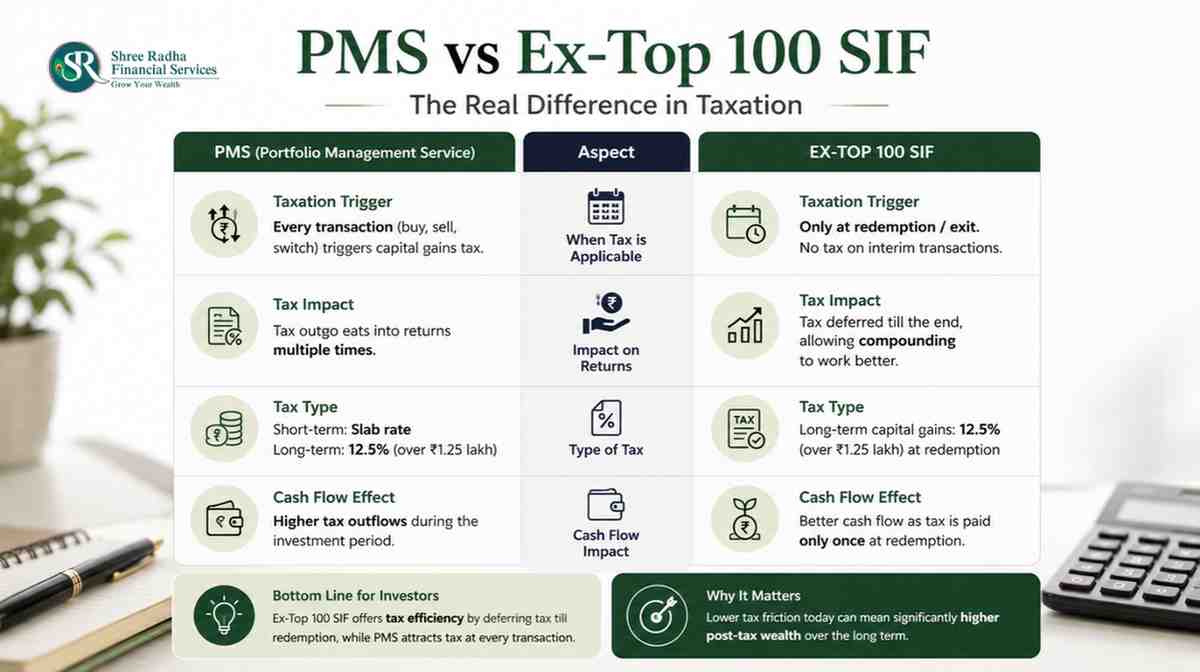
Neither structure is objectively “better” — a PMS gives Dr. Kavitha something a pooled fund can’t: a portfolio built specifically around her preferences, with the option to time her own exits for tax planning. What SIF offers instead is simplicity — the fund manager can trade as actively as the strategy requires, without that activity showing up as a taxable event in her name every single year.
For someone already comfortable with PMS-style active management but tired of the paperwork, that’s a meaningful trade-off to weigh.
Ex-Top 100 SIF vs Category III AIF
Arjun Mehta, 39, works in consulting in Gurugram. Two years ago, he put ₹1 crore into a Category III AIF chasing an aggressive, alpha-focused strategy — the kind of sophisticated, hedge-fund-style vehicle that felt like the natural next step after outgrowing mutual funds.
The strategy performed reasonably well. His post-tax number, when he finally sat down and worked through it with his CA, was noticeably lower than he’d expected.
The reason: Category III AIFs are taxed at the fund level, at the maximum marginal rate — roughly 42.7% including surcharge and cess — before any income is distributed to investors. That’s a structural feature of how Cat III AIFs are regulated, not a hidden fee, but it’s also not something every investor fully internalises before committing capital.
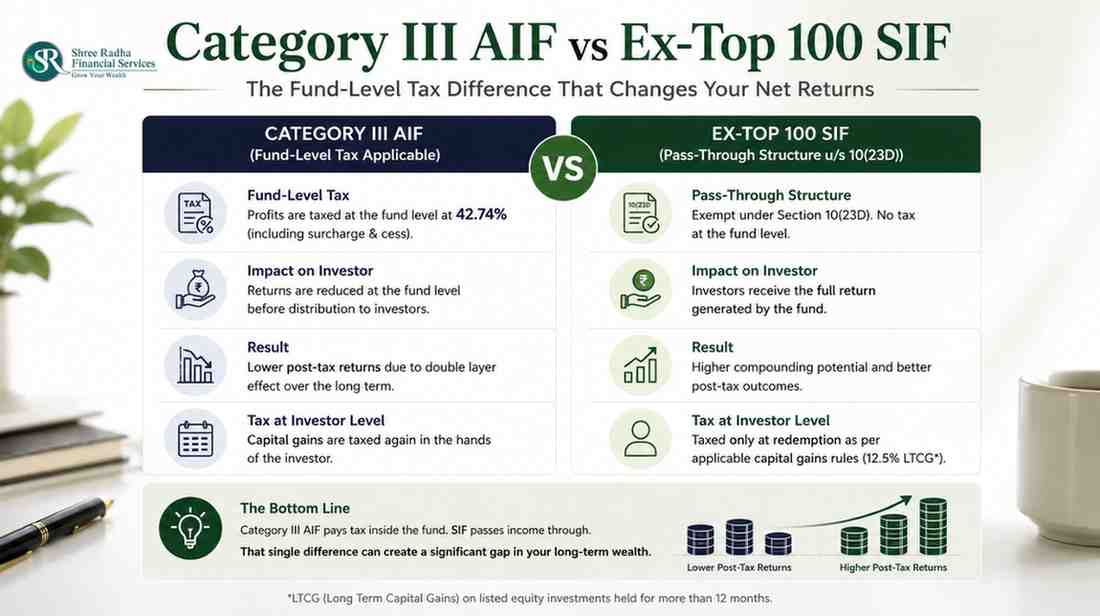
SIFs work differently. Under Section 10(23D) of the Income Tax Act, income at the fund level is exempt — the same pass-through treatment mutual funds get. Tax applies only once, when the investor redeems units, at standard capital gains rates (20% STCG, 12.5% LTCG for equity-oriented strategies).
For an investor like Arjun, comparing a Cat III AIF against an Ex-Top 100 SIF isn’t really “which one performs better” — it’s “how much of that performance actually reaches me after tax.”
Worth noting too: SIF’s ₹10 lakh minimum sits well below both PMS (₹50 lakh) and Category III AIF (typically ₹1 crore) — making it a meaningfully more accessible entry point into sophisticated, actively managed growth strategies, even for investors who eventually want to scale into PMS or AIF territory.
Note: These are structural, illustrative comparisons based on prevailing tax rules and typical fund structures as of the time of writing. Tax rates, surcharge, and cess are subject to change; individual PMS and AIF fee/tax outcomes vary by manager and structure. Please consult your tax advisor and read all scheme-related documents before investing.
Who Should Actually Consider This — A Simple Honest Checklist
Ex-Top 100 SIF is likely worth exploring if:
- ✅ You already hold a PMS or AIF and want to understand whether a simpler tax structure exists for similar growth exposure
- ✅ You want mid and small-cap growth exposure without running multiple separate mutual fund SIPs to get there
- ✅ You’re comfortable with a pooled, NAV-based structure rather than direct stock ownership
- ✅ You can meet the ₹10 lakh minimum and have a genuine 5-year-plus horizon — this is a high-risk, high-return category by design
- ✅ You understand this is not principal-protected, and mid/small-cap exposure carries real volatility
It’s probably not right for you if:
- ❌ You specifically want a portfolio customised to your individual preferences — that’s what PMS is built for, and SIF can’t replicate it
- ❌ You need liquidity within the next 1-2 years
- ❌ You haven’t yet built comfort with market-linked, higher-volatility investing through mid/small-cap mutual funds first
Frequently Asked Questions — Ex-Top 100 SIF vs PMS
Is Ex-Top 100 SIF less risky than a PMS with similar mid/small-cap exposure?
Not necessarily — both carry real mid/small-cap volatility. The difference discussed in this article is primarily about taxation structure and minimum investment, not risk level. Both require investors comfortable with higher volatility than large-cap-oriented strategies.
Can I hold both a PMS and an Ex-Top 100 SIF?
Yes — many investors use SIF as a complement to existing PMS or AIF holdings rather than a replacement, particularly for the lower entry threshold and simpler tax reporting on that specific allocation.
How is Ex-Top 100 SIF taxed?
As an equity-oriented strategy, it follows equity mutual fund taxation: 20% STCG for units held under 12 months, and 12.5% LTCG on gains above ₹1.25 lakh per year for units held beyond 12 months — taxed only at redemption, not on internal fund trades.
What’s the minimum investment for Ex-Top 100 SIF?
₹10 lakh per SIF strategy, as per SEBI’s SIF framework — lump sum or via SIP/STP structured to reach that cumulative threshold.
Is Ex-Top 100 SIF the same as investing in a midcap and smallcap mutual fund together?
Similar in spirit — both give exposure beyond the top 100 companies — but structurally different. Regular midcap and smallcap funds are bound to fixed SEBI market-cap bands and require separate SIPs; Ex-Top 100 SIF combines that universe into a single strategy with more flexibility in how the manager allocates between mid and small-cap.
A Category, Not a Single Fund
As with every SIF category in this series, there’s no single “best” Ex-Top 100 fund — several AMCs have launched strategies here with different fund managers and research approaches within the same broad mandate. The right fit depends on your existing portfolio, particularly whether you already carry PMS or AIF exposure and how much of that complexity you’re looking to simplify.
This completes our three-part SIF series — if you haven’t yet, catch up on Hybrid SIF vs Fixed Deposit and Equity Long-Short SIF vs Flexicap Fund — together, the three cover the full range of where SIF might or might not fit into a portfolio, from FD-alternative to PMS-complement.
This Article is also available on Medium: https://medium.com/@shreeradha.services/ex-top-100-sif-vs-pms-the-tax-difference-investors-miss-3115ef9d92a0
Ex-Top 100 SIF vs PMS — What Actually Fits Your Portfolio?
Whether Ex-Top 100 SIF simplifies or complements what you already hold depends entirely on your existing portfolio and tax situation. That’s worth an honest conversation, not a generic pitch.
No obligation. No pressure. Just a clear look at your specific numbers.
📞 Call / WhatsApp: +91 98791 13255
📧 Email: shreeradha.services@gmail.com
🌐 Visit: www.srwealth.co.in
About the Author
Paresh Chaudhary
Founder, Shree Radha Financial Services (SR Wealth)
AMFI Registered Mutual Fund & SIF Distributor — ARN: 268390
APMI Registered PMS Distributor — APRN: 05763
IRDAI Licensed Insurance Distributor
BE Mechanical, SVNIT Surat | Ex-L&T (15+ Years)
Educational Disclaimer: This article is published by Shree Radha Financial Services — an AMFI Registered Mutual Fund & SIF Distributor (ARN: 268390) and APMI Registered PMS Distributor (APRN: 05763). All content is strictly for educational purposes only and does not constitute individualised investment advice. Mutual fund, PMS, AIF, and SIF investments are subject to market risks — read all scheme-related documents carefully before investing. Ex-Top 100 SIF strategies carry high risk due to mid and small-cap concentration. Tax structures and rates described are based on prevailing rules as of the time of writing and are subject to change; individual PMS and AIF outcomes vary by manager and structure. This article does not recommend any specific fund, PMS, or AIF. Consult your tax advisor for guidance specific to your situation.