Introduction
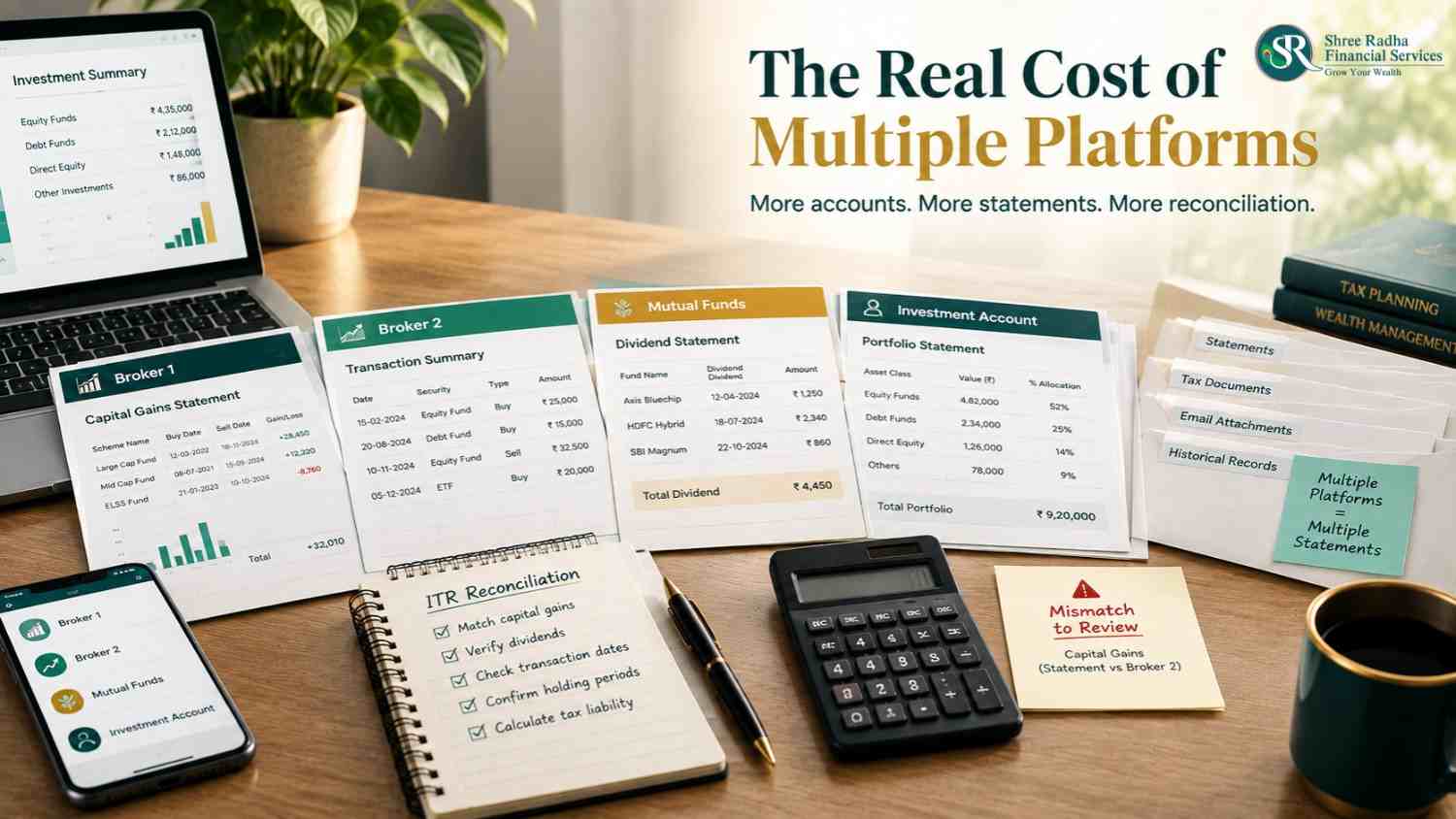
Every investor who has spread their money across four or five apps and brokers has had the same moment. It usually happens in the first week of July. You sit down to file your ITR, open your first broker app for the capital gains statement, and realise this is going to take a while. Then you open the second app. Then the third.
If you have optimised your investing life — the zero-brokerage broker for stocks, the clean-UI app for SIPs, the direct plan app because someone on YouTube said it saves on commission, and a fourth account you opened two years ago and forgot about — ITR filing multiple platforms isn’t really a tax problem. It’s the bill finally arriving for a choice you made without realising you were making it.
Paresh Chaudhary, who has guided dozens of clients through exactly this every filing season, puts it simply:
“
Every client I’ve helped move from five apps to one relationship has said the same thing afterward — not that they saved money, but that they got a weekend back in July. That’s the actual value, and I’d rather say that plainly than pretend we file tax returns, because we don’t.
— Paresh Chaudhary
FOUNDER, Shree Radha Fianancial Services
These four stories are composites built from patterns we see every filing season across our client base and prospect conversations in Surat, Ahmedabad, Vadodara, and among Gulf NRIs. The names are illustrative, but the mistakes — and the ITR filing multiple platforms problem behind them — are not.
Kalpesh Bhai, Surat — Three Brokers, One Missed Loss
Kalpesh Bhai runs a diamond trading unit in Varachha — a pattern of scattered accounts we’ve seen often among Surat’s diamond trading community. Over the years, he opened trading accounts with three different brokers — one because a friend got him a better brokerage slab, one because his bank pushed it during an account opening drive, and one that he’d used since his college days and never bothered closing. His mutual fund SIPs sit in two direct apps, opened separately because each was running a signup offer at the time. This kind of spread is common among Gujarat’s business owners, who often run multiple accounts for reasons that made sense at the time but stop making sense by July.
When his CA asked for a consolidated capital gains figure this year, Kalpesh Bhai assumed it would be simple. It wasn’t. Each broker’s capital gains report used a different format — one grouped by ISIN, one by transaction date, one gave a combined figure with no break-up at all. He spent the better part of a week piecing them together manually.
The real cost showed up later. One of his older, dormant broker accounts had a short-term capital loss of about ₹42,000 from a bad trade three years ago. Because that account never made it into any year’s filing — he’d genuinely forgotten it existed — the loss was never reported, and the right to carry it forward and set it off against future gains had already lapsed. That was money he could have legitimately saved on this year’s tax bill, gone because of an account he wasn’t even actively using.
He mentioned this in his trade association’s WhatsApp group, half as a complaint. His nephew, who works in IT in Ahmedabad, read it and felt an uncomfortable sense of recognition — because ITR filing multiple platforms doesn’t spare salaried professionals either.
Before: 3 brokers, 2 direct MF apps, one forgotten dormant account, a full week spent reconciling, and a ₹42,000 capital loss that lapsed unclaimed.
After: Closed the dormant account (after transferring its holdings out), consolidated active trading into two brokers via an off-market transfer, and now maintains one tracker updated quarterly instead of once a year in a panic.
“I wasn’t losing money on brokerage. I was losing it on not knowing what I owned, where.” — Kalpesh Bhai
Rohan, Ahmedabad — Four Apps, Four Email IDs
Rohan is a salaried IT professional in Ahmedabad who built his mutual fund portfolio the way most of his generation does — by following advice from finance YouTube and Reddit threads. Over four years, he opened SIPs on Groww, on Kuvera, on a direct-plan platform recommended in a comment thread, and one folio held directly with an AMC because it wasn’t available elsewhere at the time. Each platform asked for an email ID at signup, and Rohan, like most people, didn’t think twice about which one he used — his personal Gmail for one, his old college email for another, his work email for a third.
This year, he tried to use the combined capital gains statement that CAMS and KFintech jointly generate — the one document that, in theory, should cover every AMC he has invested in, regardless of which app he used to invest. He requested it against his primary email. Two of his four folios didn’t show up.
Not because the statement doesn’t work — it genuinely does consolidate across AMCs — but because it can only pull the folios registered against the exact email or PAN combination you request it with. His college-email folio and his AMC-direct folio simply weren’t linked to that email. He nearly filed his return with an LTCG figure about ₹1.1 lakh lower than his actual gains. It was only after cross-checking against his AIS on the income tax portal — which flagged a redemption he hadn’t accounted for — that he caught the gap.
Before: 4 mutual fund folios registered under 3 different email IDs, an incomplete “combined” statement, and a nearly-underreported LTCG of ₹1.1 lakh.
After: Updated KYC to link all folios to one email and one mobile number, re-pulled a genuinely complete CAMS-KFintech statement, and now checks it against AIS every year before filing, not after.
“I assumed the government’s own numbers would just be right. They’re a starting point, not the final answer.” — Rohan
Rohan mentioned this to a colleague, whose wife, Sonal Ben in Vadodara, handles the investing for her entire household — including her mother’s. Her version of ITR filing multiple platforms looked different again.
Sonal Ben, Vadodara — Managing Money For Two Generations, Across Three Platforms
Sonal Ben’s husband runs a small chemical trading agency supplying to units in the Vadodara-Nandesari belt. She manages the family’s investments and, after her father passed away, took over her mother’s mutual fund and FD portfolio as well — six folios in total, spread across three different platforms because her mother’s investments had been made through an old agent years ago and never consolidated with Sonal Ben’s own accounts.
This year, the income tax portal’s AIS showed a redemption entry Sonal Ben didn’t recognise at first glance. It took her a worried afternoon and a call to her CA to realise what had happened: she had switched her mother’s money from one debt fund to another within the same fund house, thinking of it as simply moving money around.
A switch, tax-wise, is treated exactly like a redemption followed by a fresh purchase — it is a taxable event, even though no money ever left the mutual fund ecosystem. This is one of the most common blind spots for investors managing multiple family folios, and having accounts spread across platforms makes it far easier to miss. Once she understood what had actually triggered the entry, reconciling it was straightforward — but the scare was real, and entirely avoidable with the right documentation habits from the start.
Before: 6 folios across 3 platforms for two generations, one unexplained AIS entry, and a genuinely frightening afternoon assuming the worst.
After: Learned that switches are taxable events, used the AIS feedback option to confirm the entry was accurate rather than disputing it blindly, and now keeps a single family-level transaction log updated after every switch or redemption.
“Nobody tells you a switch counts as a sale. I found that out from a scare, not from a form.” — Sonal Ben
Sonal Ben called her younger brother Chirag in Dubai that same week, half to vent and half to check whether his accounts back home were in any better shape. They weren’t — his version of the same problem just had an extra layer.
Chirag, Dubai — An NRI’s Version of the Same Problem, With Extra Steps
Chirag is a structural engineer who has worked in the UAE for over a decade. He holds an NRE-linked demat account with one broker for direct equity, and invests in mutual funds through a separate app that isn’t always built with NRI-specific reporting in mind — a gap we’ve flagged before for Gulf-based NRIs and their mutual fund KYC. Every filing season, he pulls together statements from both, converts himself into “resident” mode mentally because that’s the form he’s more familiar with, and files.
That habit nearly caused a real problem. ITR-2 has separate columns for resident and non-resident capital gains reporting, and NRIs are also subject to TDS on capital gains in a way that differs from resident investors. Chirag had been entering his figures in the resident section for two years running — the return still went through because the portal doesn’t always block it, but it left him exposed to a wrong tax computation that could easily have surfaced in scrutiny. His sister’s call was the trigger to actually get it reviewed properly rather than assume “it’s worked so far.”
Before: NRE demat and a separate MF app, two years of capital gains entered in the wrong resident/non-resident column, correctly filed only by accident.
After: Got the last two years’ computations reviewed and corrected the reporting fields going forward; moved to a single relationship that understands NRI-specific reporting rather than a generic direct app.
“I’d been getting away with it, not getting it right. Those aren’t the same thing.” — Chirag
You’ve probably recognised a piece of yourself in at least one of these four. That’s not a coincidence — it’s what happens when the same underlying structure repeats itself across four very different lives.
Why ITR Filing Multiple Platforms Actually Gets Messy
Here’s the part that most ITR-filing guides skip: mutual funds and stocks are not the same problem. Treating them as though a single fix covers both is exactly what makes ITR filing multiple platforms feel harder than it should.
| Asset Type | Is There a Single Combined Statement? | What Still Needs Manual Work |
|---|---|---|
| Mutual Funds | Yes — CAMS and KFintech jointly issue one capital gains statement covering every AMC | Only complete if every folio shares the same registered email/PAN. Scattered emails across apps create silent gaps. |
| Stocks / Equity via Brokers | No industry-wide equivalent exists | Each broker’s capital gains report is a separate format. Must be downloaded and reconciled ISIN-by-ISIN, broker by broker. |
| AIS / TIS (Income Tax Dept. pre-fill) | Attempts to auto-populate everything from reported data | Frequently mismatches actual acquisition cost or misses transactions. Must be reconciled, never trusted as final. |
Once you see it laid out this way, the pattern in all four stories becomes obvious. Mutual funds have a genuine, if fragile, single-source fix. Stocks across multiple brokers do not — and never will, until SEBI or the depositories build one.
AIS is a cross-check, not a source of truth. Platform-hopping doesn’t just make each of these harder individually; it compounds them, because every extra app is one more place your data lives, one more login in July, and one more chance for a folio, a switch, or a resident/non-resident field to slip through. That’s the real anatomy of the ITR filing multiple platforms problem — not one big obstacle, but three small ones stacking on top of each other.

The Practical Fix for ITR Filing Multiple Platforms — And the Trade-Off Nobody Mentions
This is the part where most articles either oversimplify (“just use one app!”) or oversell (“our software solves everything!”). Neither is honest. Here’s what actually works, in order.
- Pull your CAMS-KFintech combined statement and check it against your own list of folios. If something’s missing, it’s almost always an email or PAN mismatch — fixable through a KYC update, not a reason to distrust the document itself. If you haven’t done a full portfolio review across platforms in a while, this is a good place to start.
- Download each broker’s capital gains report separately for stocks. There is no shortcut here today. Reduce the number of active brokers going forward — that’s the only lever that actually shrinks this part of ITR filing multiple platforms next year.
- Reconcile against AIS and TIS before you file, not after a notice arrives. Use the “information is incorrect” feedback option on the AIS portal if an entry looks wrong — don’t just override it in your own filing and hope.
- If you want to consolidate going forward, know the two ways to do it without a tax event. Moving an existing mutual fund folio’s servicing to a new distributor is a change-of-broker-code request submitted to the AMC or RTA — your units, purchase date, and cost of acquisition are untouched, because you are not redeeming anything. Moving shares between two demat accounts you own is generally an off-market transfer, not a sale, so it typically does not trigger capital gains either — though DP transfer charges apply and you should confirm the specifics with your CA before initiating either move.
Now, the part we won’t soften: consolidating has a real cost, and it isn’t for everyone.
If you’ve spent years proudly running four or five apps to save a few hundred rupees in brokerage or a fraction of a percent in expense ratio, this is the uncomfortable bit. That habit — not the tax department, not the ITR form — is what’s costing you a week every July and exposing you to the kind of error that Rohan and Chirag nearly made. Simplifying usually means accepting a slightly higher cost somewhere: a regular plan’s trail, a marginally higher brokerage, or simply the discipline to stop opening a new app every time one offers a better deal.
If your portfolio is genuinely complex — multiple brokers, multiple family members’ folios, NRI status, or all three — that trade is almost always worth it. If you run two SIPs and hold no stocks, it probably isn’t. Don’t manufacture a problem you don’t have. And one more honest point: none of this fixes the past. If you, like Kalpesh Bhai, have a lapsed carry-forward loss sitting in a forgotten account, that loss is gone. The value here is in not repeating it, not in undoing it.
Frequently Asked Questions
1. Can I change my mutual fund distributor without selling my units and triggering capital gains?
Yes. This is done through a change-of-broker/distributor-code request submitted to the AMC or the RTA (CAMS/KFintech) for your existing folio. You aren’t redeeming anything, so your units, purchase date, and cost of acquisition remain unchanged, and no capital gains event is triggered.
2. Does transferring shares between my own two demat accounts count as a sale for tax purposes?
Generally no — an off-market transfer between demat accounts held in your own name is treated as a transfer, not a sale, so it typically does not attract capital gains tax. DP transfer charges may apply. Confirm the specifics with your CA or DP before initiating.
3. Why didn’t all my mutual fund folios show up in my combined CAMS/KFintech statement?
Almost always a registered-email or PAN mismatch across folios opened through different apps at different times. Updating your KYC to a single consistent email and mobile number usually resolves it.
4. Is it worth consolidating if I only invest in two or three mutual funds and don’t trade stocks?
Honestly, probably not. The ITR filing multiple platforms problem scales with complexity — multiple brokers, multiple family members’ portfolios, or NRI status. A simple, small portfolio doesn’t need this fix.
5. What should I gather every year, regardless of how many platforms I use?
Capital gains statements from every broker you hold, the combined CAMS/KFintech statement for mutual funds, and your AIS, TIS, and Form 26AS — reconciled against each other before you file, not after.
If ITR filing multiple platforms has turned into your July headache and you’d rather your investments lived in one relationship you can actually call, get in touch with SR Wealth.
📞 Call / WhatsApp: +91 98791 13255
📧 Email: shreeradha.services@gmail.com
🌐 Visit: www.srwealth.co.in
📍 Shop 33, Mira Nagar 2, Dindoli Road, Surat 394210
Paresh Chaudhary
Founder, Shree Radha Financial Services (SR Wealth), Surat
AMFI Registered Mutual Fund & SIF Distributor (ARN: 268390) | APMI Registered PMS Distributor (APRN: 05763)
IRDAI Licensed Insurance Distributor
BE Mechanical, SVNIT Surat | Ex-L&T (15+ Years)
This article is also availlable on Medium: https://medium.com/@shreeradha.services/why-itr-filing-gets-so-messy-when-you-invest-across-multiple-platforms-3a4c84dfd6b5
Disclaimer: Paresh Chaudhary is an AMFI Registered Mutual Fund & SIF Distributor (ARN: 268390), APMI Registered PMS Distributor (APRN: 05763), IRDAI-registered POSP, and SEBI Authorized Person under Nuvama Wealth and Investment Limited. This article is for informational and educational purposes only and does not constitute tax, legal, or investment advice. Please consult a qualified Chartered Accountant before filing your return and a SEBI-registered investment adviser for personalised investment advice. The persons and situations described are illustrative composites, not real individuals.