
Mutual Funds for Business Owners in Surat: Why the Business Doesn’t Protect the Wealth
This is a guide to mutual funds for business owners in Surat — not a list of fund names, but four real stories about what actually happens to money once a family business starts throwing off more of it than the business itself needs.
Nikhil Bhai grades diamonds for a living. Every stone that crosses his desk in Varachha gets checked against four things — carat, cut, colour, clarity — because judging it on weight alone would be reckless, and he’d never let a lot go out the door on a single number.
His own wealth, until this year, got exactly one check: how much of it there was. Nobody — not him, not his CA, not the bank relationship manager who’d sold him his last FD — had ever graded it for cut, colour, or clarity. For how well it was actually spread across risks that don’t move together.
That gap is what this guide to mutual funds for business owners in Surat is really about. Not because Surat’s diamond and textile business owners are careless with money — most are sharper with numbers than the professionals advising them. It’s because the discipline they apply inside the business rarely gets applied to the wealth sitting outside it.
This year gave that gap a harder edge than usual. Rough diamond supply got disrupted when the Russia-Ukraine war hit sanctions on one of the world’s largest sources. Tariff hikes on Indian gem exports to the US — India’s single largest buyer market — added a fresh layer of uncertainty exporters had never priced in before. Textile units have lived their own version of it: cotton price swings, GST refund timelines that don’t line up with when the next input payment is due.
None of this means the business is in trouble. It means the FDs, the gold, and the current account balance nobody has touched since last Diwali are often carrying the same risk as the business itself — just quietly, and unexamined.
“When I sit down with diamond and textile families in Surat, I rarely need to ask if the business is doing well — that part they can tell me in a sentence. What takes longer to surface is that their personal wealth is built exactly like their business: concentrated, illiquid, and moving on the same clock as the trade. Nobody decided that on purpose. It just happened, one FD renewal at a time.”
— Paresh Chaudhary, Founder, Shree Radha Financial Services
This is the story of four people who share a trade association meeting, a family dinner table, and — as it turned out — the same blind spot. Whether you’re a diamond manufacturer in Varachha, a powerloom owner in Pandesara, someone just starting out in a family business, or the person quietly managing the household’s money while the business runs — one of these four is probably closer to your situation than you’d expect.
Nikhil Bhai’s Story — Varachha, ₹25 Lakh, and a Tariff Conversation That Changed the Question
Nikhil Bhai runs a diamond manufacturing unit in Varachha — three generations in the trade, a client base spread across Antwerp and Hong Kong buyers, and a business that has weathered enough cycles that he doesn’t rattle easily. What actually unsettled him this year wasn’t the tariff hike itself — it was a conversation at a trade association meeting, where a fellow exporter mentioned, almost in passing, that his family’s entire net worth outside the business was diamond-adjacent too: gold, and FDs funded by diamond profits.
Nikhil Bhai went home and did the same audit on himself. The business held the diamond risk. The FDs held cash that came from diamonds. The gold held more diamond-adjacent risk, dressed differently. Nothing in the family’s wealth moved independently of the trade — which meant a bad year for diamonds wasn’t just a bad year for the business. It was a bad year for everything, all at once.
Sitting alongside that realisation was a more immediate, practical problem: roughly ₹25 lakh of festive-season profit had been sitting untouched in his current account for nine months while he decided whether it was capital for a new cutting machine or capital for the family’s future. Two separate goals — which is exactly the kind of decision goal-based investing is built to answer, not a single fund recommendation.
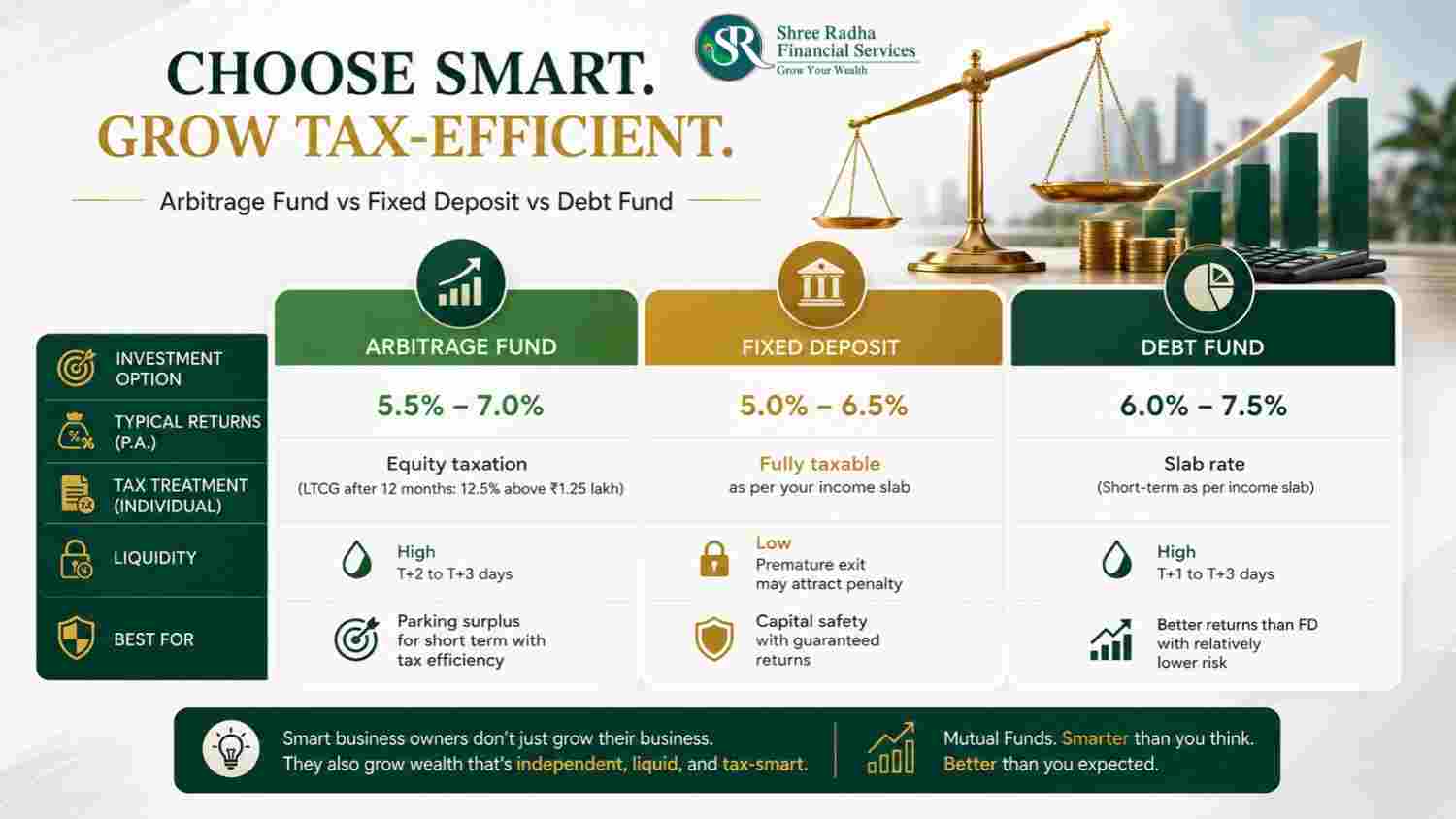
| Where the ₹25 lakh sat | Gross return (9 months) | Tax (30% bracket) | Net, post-tax |
|---|---|---|---|
| Fixed Deposit (~7% p.a.) | ₹1,31,250 | ₹39,375 (slab rate) | ₹91,875 (~4.9% effective) |
| Debt Mutual Fund (~7.3% p.a.) | ₹1,36,875 | ₹41,063 (slab rate) | ₹95,812 (~5.1% effective) |
| Arbitrage Fund (~7% p.a.) | ₹1,31,250 | ₹26,250 (20% STCG) | ₹1,05,000 (~5.6% effective) |
The gross returns of the debt fund and the arbitrage fund are nearly identical. The entire difference comes from how each is taxed. Debt funds bought after April 2023 are taxed exactly like a fixed deposit — at your income slab rate, however long you hold them. Arbitrage funds, despite behaving like a low-volatility cash-parking product, legally qualify as equity-oriented schemes — taxed at 20% short-term, and a more favourable 12.5% (with a ₹1.25 lakh annual exemption) beyond 12 months. For a business owner in the 30% bracket, that’s real money, not a rounding error. Our guide on why high-earning professionals are outgrowing fixed deposits goes deeper into this same gap for larger corpuses.
Nikhil Bhai’s Portfolio — Before and After:
- Before: ₹25 lakh idle in a current account for 9 months; ~₹1.1 crore of total family wealth split almost entirely between diamond-funded FDs and gold
- After: Half the ₹25 lakh moved into a liquid fund as an instantly-accessible buffer; the other half routed into a flexicap equity fund through a 6-month Systematic Transfer Plan (STP), so a bad week in the markets wouldn’t decide a decision he’d taken months to make
- The bigger move: A separate ₹30 lakh, carved out from the FD-and-gold pile as genuinely spare, reallocated into diversified equity funds — projected, at an assumed 12% p.a. (not guaranteed), to be worth roughly ₹1.64 crore in 15 years, growing on a clock that has nothing to do with rough diamond prices
- What he said afterward: “I check my stones for four things before I trust them. I’d never once checked my own money that way.”
For a broader look at protecting family wealth from trade volatility specifically — not just Nikhil Bhai’s situation but the wider pattern across Varachha’s diamond families — our dedicated guide on wealth diversification for Surat diamond merchants covers it in more depth.
It was at that same trade association meeting, a few weeks later, that Nikhil Bhai mentioned all this to Rajesh Bhai — a textile trader he’d known for years through mutual business contacts in Pandesara. Rajesh Bhai’s reaction was less “my wealth is too concentrated” and more “I don’t even know where half my money actually is.”
Rajesh Bhai’s Story — Pandesara, the GST Refund Gap, and ₹45,000 He Didn’t Know He Was Losing
Rajesh Bhai owns a powerloom and processing unit in Pandesara. His cash flow doesn’t arrive evenly — it comes in bursts around export dispatch cycles, with GST refunds that sometimes take months to land and input payments that don’t wait for them. For years, the “solution” was a current account balance padded high enough to survive the gap, plus a rolling set of short-tenure FDs that got broken more often than they matured.
When he actually sat down and traced where his roughly ₹18 lakh of working-capital buffer was sitting, the picture wasn’t what he expected. Close to half of it sat in a current account earning effectively nothing. The rest moved between FDs that got broken early whenever a payment came due sooner than planned — each early break costing roughly a percentage point in penalty interest. Blended across the year, that ₹18 lakh was realistically earning under 3%.
The mistake wasn’t a bad investment choice. It was never separating “money the business needs next month” from “money the business won’t need for a year or more.” Once that line was drawn, the fix was almost mechanical:
- Money needed within weeks (GST payment reserve, next salary cycle) — moved into a liquid fund. Same-day to T+1 redemption, and a real improvement over an idle current account.
- Money genuinely not needed for 3–12 months (surplus between export cycles) — moved into an arbitrage fund, for the same tax-efficiency shown in Nikhil Bhai’s table above.
- Money earmarked for a goal 5+ years out — left for equity mutual funds, where short-term volatility stops mattering and long-term compounding starts to.
Rajesh Bhai’s Working Capital — Before and After:
- Before: ₹18 lakh split between a near-zero-interest current account and short FDs broken early — a blended return under 3% after penalties
- After: ₹8 lakh in a liquid fund (instant access), ₹10 lakh in an arbitrage fund (3–9 month horizon) — a blended post-tax return closer to 5.5%
- What changed in rupees: Roughly ₹45,000 more per year — without adding a single rupee of new capital, and without taking on meaningfully more risk than the current account he’d been using
- What he said afterward: “I was so busy tracking GST refunds and dispatch dates that I never once tracked my own money the same way.”
Our broader investment guide for Gujarat business owners on optimising idle cash walks through this same working-capital-versus-investment split for other business structures beyond textiles.
The Business Owner’s Tax Playbook: What Most CAs Won’t Bring Up Unless You Ask
Your Chartered Accountant is, rightly, focused on your business’s GST filings, TDS compliance, and income tax return. Mutual fund taxation on personal investments is a separate conversation that often just doesn’t come up — until redemption day, when it’s too late to plan around it. Here’s the current picture for FY 2026-27:
| Fund type | Short-term (under 12 months) | Long-term (12+ months) |
|---|---|---|
| Equity funds & ELSS (65%+ equity) | 20% | 12.5% above ₹1.25 lakh/year |
| Arbitrage funds | 20% (equity-taxed) | 12.5% above ₹1.25 lakh/year |
| Debt funds (bought after Apr 2023) | Slab rate | Slab rate (no holding-period benefit) |
Two things surprise most business owners here. First, debt funds lost their old tax advantage in April 2023 — for someone in the 30% bracket, a debt fund today offers essentially no tax edge over a plain FD, while carrying interest-rate risk the FD doesn’t. Second, ELSS funds still offer a deduction of up to ₹1.5 lakh under Section 80C with just a 3-year lock-in — but only if you’re filing under the old tax regime. Many business owners have moved to the new regime by default in recent years, where 80C deductions, including ELSS, no longer apply. Before assuming ELSS will save you tax, it’s worth a five-minute check with your CA on which regime you’re actually filing under this year.
None of the above is tax advice specific to your situation — capital gains treatment can shift with surcharge, cess, and your overall income mix, and your CA is the right person to confirm the exact number on your return. This is meant to help you ask the right questions, not replace that conversation.
It was Rajesh Bhai, working through this exact table with his son one evening, who first got Dhruv curious about the difference between what the business does with its money and what he could be doing with his own.
Dhruv’s Story — His First SIP, and What It’s Independent Of
Dhruv is 29, Rajesh Bhai’s son, an engineering graduate who joined the family textile business three years ago. Growing up, “investment” in his household meant expanding the business, gold, or land — never a mutual fund. His father built real wealth this way, and Dhruv doesn’t dispute that it worked. But watching his father restructure that ₹18 lakh working-capital buffer made him notice something he hadn’t before: every rupee of the family’s wealth was tied to either the textile trade or Surat real estate. Nothing was liquid, tradeable in fifteen minutes, or independent of both those bets.
Dhruv started with a modest SIP — ₹10,000 a month into a flexicap fund — not because it was a large amount for a textile trading family, but because starting early mattered more to him than starting big. He also opened an ELSS SIP to use his Section 80C limit, since he continues to file under the old regime for now given other deductions he claims. At his 30% slab, the full ₹1.5 lakh ELSS deduction saves him roughly ₹46,800 in tax each year — before the fund has even had a chance to grow.
Here’s what disciplined, long-term SIP investing can realistically build over 20 years, at an assumed (not guaranteed) 12% annual return — the kind of number that matters for someone in his late 20s with three decades of working life still ahead:
| Monthly SIP | Total invested (20 yrs) | Estimated corpus @ 12% p.a. |
|---|---|---|
| ₹10,000 | ₹24,00,000 | ~₹99.9 lakh |
| ₹50,000 | ₹1,20,00,000 | ~₹4.99 crore |
| ₹1,00,000 (typical for an established business surplus) | ₹2,40,00,000 | ~₹9.99 crore |
Figures are illustrative only, assuming a 12% annual return compounded monthly. Mutual fund returns are market-linked and not guaranteed; actual outcomes will differ.
The ₹1,00,000/month row isn’t a standard illustration — most guides stop at ₹50,000. It’s included here because it reflects what an established diamond or textile business owner’s monthly surplus can realistically look like once the working-capital confusion Rajesh Bhai untangled is out of the way. The gap between investing ₹50,000 and ₹1,00,000 a month, sustained for 20 years, is roughly ₹5 crore — the kind of number that a “we’ll get to it after this season” delay quietly costs.
Dhruv’s Starting Point — Before and After:
- Before: No personal investments; all family wealth held jointly in business assets, gold, and property
- After: ₹10,000/month flexicap SIP + ELSS SIP using his full ₹1.5 lakh 80C limit — roughly ₹46,800 saved in tax this year alone, on top of the SIP itself
- What he said afterward: “It’s not about the ₹10,000. It’s the first rupee I’ve ever owned that has nothing to do with the loom or the factory.”
What Dhruv is really building isn’t just a number on a statement — it’s a pool of wealth that answers to nothing in Pandesara. If the textile trade has a rough five years, his SIP corpus doesn’t know or care. His aunt Falguni Ben — Nikhil Bhai’s wife, who handles the back-office accounts for his diamond unit — asked him about all this over a family dinner a few weeks later.
Falguni Ben’s Story — Money That’s Hers, Not the Business’s
Falguni Ben handles the back-office accounts for Nikhil Bhai’s diamond unit — she knows the business’s cash flow better than almost anyone in the family. What she didn’t have, until she heard Dhruv talk about his SIP, was a financial plan of her own that existed independently of the business’s fortunes. If the unit had a difficult year, every rupee of household wealth felt exposed to it, herself included.
Her goals were specific, not vague: a fund for her younger daughter’s college years, seven years out, and a personal safety net she controlled directly rather than one that ran through the business’s books. For the college goal, a flexicap SIP with a clear seven-year horizon made sense — long enough for equity to smooth out its own volatility, short enough that a purely aggressive fund wasn’t the right fit.
Falguni Ben’s Education Fund — Before and After:
- Before: No dedicated fund for her daughter’s education — the assumption had always been “the business will cover it when the time comes”
- After: A ₹15,000/month SIP earmarked specifically for the goal — projected, at an assumed 12% p.a., to reach roughly ₹19.8 lakh in 7 years against ₹12.6 lakh invested
- The safety net: A separate emergency allocation split between a liquid fund (instant access) and a short-term debt fund, deliberately held apart from any business account
- What she said afterward: “For the first time, I have money that’s mine to explain, not the business’s to explain for me.”
One tool worth mentioning here that doesn’t come up often enough for family businesses: a Systematic Withdrawal Plan (SWP). For a family member approaching a stage where they want a small, steady monthly income from an existing corpus — without redeeming the whole investment or disturbing the growth of the rest — an SWP lets you draw a fixed amount each month while the remainder stays invested. It’s a useful bridge during a slow business season, without touching the core corpus underneath it.
There’s a wider point sitting underneath all four of these stories, one worth naming directly: a family’s wealth and a family’s business are not the same asset, even when they’re managed by the same people around the same dinner table. Keeping some of that wealth genuinely separate — in the person’s own name, structured for their own goals — is also a basic form of protection if the business ever hits a difficult stretch. Our guide on how business owners protect family wealth from business risk goes deeper into that specific angle, beyond mutual funds alone.
Where Do You Start? A Goal-First Checklist for Mutual Funds for Business Owners in Surat
Across all four stories above, the sequence that actually worked was never “pick the top-performing fund first.” It was this:
- Separate business cash flow from personal wealth — even a simple line, mental or actual, between “working capital” and “my money” changes every decision after it.
- Build the buffer before the ambition — a liquid fund covering a few months of near-term needs, before anything longer-term.
- Name the goal, not the amount — “retirement at 55,” “my daughter’s college fund,” “capital for the next unit” each point to a different time horizon and a different fund category. “Grow my money” doesn’t.
- Match the product to the tax bracket and the time horizon, not to last year’s return chart — the tax playbook above is the fastest way to check this.
- Deploy lump sums gradually when the goal allows it — an STP through a liquid fund, rather than one large transaction on one uncertain day.
- Review on your business calendar, not a generic quarterly reminder — after Diwali, after the financial year closes, and whenever a global event moves your industry meaningfully.
For those sitting on a larger surplus once this basic structure is in place, our guide to Specialised Investment Funds for Surat’s HNI investors covers what comes next above the mutual fund layer.
Frequently Asked Questions — Mutual Funds for Business Owners in Surat
What are the best mutual funds for business owners in Surat?
There’s no single “best fund” that fits every diamond or textile business owner — it depends on your time horizon, tax bracket, and how much of your wealth is already tied up in the business. As the four stories above show, the right starting point is usually a mix: a liquid fund for near-term working capital, an arbitrage fund for 3–12 month surplus, and a flexicap or ELSS fund for long-term, goal-based wealth — not one scheme picked off a “top 10” list.
Should I invest business surplus in mutual funds, or keep reinvesting it in the business?
This isn’t an either-or choice for most of the business owners we work with — it’s a split. Capital the business can genuinely deploy at a strong return usually stays in the business. Surplus beyond that — profit that would otherwise sit idle, as it did for both Nikhil Bhai and Rajesh Bhai — is exactly what this article is about.
Is ELSS still useful for business owners under the new tax regime?
Only if you’re filing under the old regime, where Section 80C deductions still apply. Under the new regime, the ELSS tax benefit doesn’t apply, though the fund still behaves like a normal equity fund. Check with your CA which regime you’re actually filing under before assuming the deduction applies to you.
What’s the real difference between a liquid fund and an arbitrage fund for parking surplus?
Liquidity and tax treatment. Liquid funds offer same-day to T+1 access and are taxed at your slab rate. Arbitrage funds take T+2/T+3 to redeem but are taxed under equity capital gains rules — usually more favourable for business owners in higher tax brackets, as shown in Nikhil Bhai’s table above.
How much of my business surplus should go into equity mutual funds?
There’s no single percentage that fits every business — it depends on your near-term working capital needs, your existing concentration in the business and real estate, and your goals’ time horizons. This is exactly what a goal-mapping conversation is for, rather than a rule of thumb applied blindly.
Can I invest through my business’s PAN, or does it have to be personal?
Mutual fund folios can be opened under a proprietorship, partnership, or company PAN as well as an individual’s — the KYC and documentation requirements differ slightly by entity type. Most of the personal wealth-building discussed in this article, though, is best held in an individual’s own name, separate from the business entity.
Further Reading
If your surplus is large enough to look beyond mutual funds, or if you’d like to go deeper on any single thread from this guide to mutual funds for business owners in Surat, these guides pick up where this one leaves off:
- Wealth Diversification for Surat Diamond Merchants
- Investment Guide for Gujarat Business Owners: Optimizing Idle Cash
- The 30% Tax Trap: Why High Earners Are Outgrowing Fixed Deposits
- How Business Owners Protect Family Wealth From Business Risk
- Specialised Investment Funds (SIF) for Surat’s HNI Investors
Your Business Already Runs on Discipline. Does Your Personal Wealth?
Whether you’re sitting on idle festive-season profit like Nikhil Bhai, an unsorted working-capital buffer like Rajesh Bhai, ready for your first SIP like Dhruv, or building a plan that’s genuinely yours like Falguni Ben — bring your numbers and we’ll map them against your actual goals. No product pitch, no obligation.
📞 Call / WhatsApp: +91 98791 13255
📧 Email: shreeradha.services@gmail.com
🌐 Visit: www.srwealth.co.in
📍 Shop 33, Mira Nagar 2, Dindoli Road, Surat 394210
Paresh Chaudhary
Founder, Shree Radha Financial Services (SR Wealth), Surat
AMFI Registered Mutual Fund & SIF Distributor — ARN: 268390
APMI Registered PMS Distributor — APRN: 05763
IRDAI Licensed Insurance Distributor
BE Mechanical, SVNIT Surat | Ex-L&T (15+ Years)
Educational Disclaimer: This article is published by Shree Radha Financial Services — an AMFI Registered Mutual Fund & SIF Distributor (ARN: 268390) and APMI Registered PMS Distributor (APRN: 05763). All content is strictly for educational purposes only and does not constitute individualised investment advice. The names, cities, and figures used in the persona stories are illustrative and fictionalised composites based on patterns observed across client conversations; they do not represent actual client data. Mutual fund investments are subject to market risks — read all scheme-related documents carefully before investing. Tax rates cited are as applicable for FY 2026-27 and are subject to change; please consult your Chartered Accountant for advice specific to your situation. Past performance does not guarantee future returns.