Tax computation (often searched as income tax computation) is the step-by-step method that turns your income from different sources into the final tax you pay. From 1 April 2026 the Income-tax Act 2025 sets the rules for income earned in Tax Year 2026-27, and it replaces the 1961 Act for that income. The good news is that the Act restructures the law and does not introduce a new tax. The slabs you may already know still work, but the section numbers and some words have changed.
This guide is for salaried families, business owners and retired couples in Surat, Gujarat and across India. We use the new section numbers first. Where it helps, we also show the old 1961 Act section, so you can follow older notes, old Form 16s and your CA’s earlier advice.
“I meet many Surat families who plan their investments with great care, and then find the tax effect only after they redeem, sell a property or retire. By then the timing cannot be changed. When you understand how tax is built up, you can plan when to invest, when to withdraw and what to discuss with your CA before the money moves, not after.”
— Paresh Chaudhary, Founder, Shree Radha Financial Services
Tax Computation Starts With One Question: Which Act Applies?
Neha is a freelance designer in Pune. She was reading about the new Act while planning her mutual fund investments for the year.
Her question was simple: “Is my tax computation this year under the new Act?” Her CA gave a short answer: it depends on which year’s income you are talking about.
Income earned up to 31 March 2026 stays under the Income-tax Act 1961. Its return is filed for Assessment Year 2026-27. Income earned from 1 April 2026 falls under the Income-tax Act 2025 as Tax Year 2026-27. The first return under the new Act comes after 31 March 2027.
| Income earned in | Which Act applies | How it is named |
|---|---|---|
| 1 April 2025 to 31 March 2026 (FY 2025-26) | Income-tax Act, 1961 | Previous year; return filed for Assessment Year 2026-27 |
| 1 April 2026 to 31 March 2027 | Income-tax Act, 2025 | Tax Year 2026-27; first return under the new Act |
Many websites mix the two Acts in one calculation. Do not do that. Use the 1961 Act for FY 2025-26 and the 2025 Act for Tax Year 2026-27. The Income Tax Department explains this in its own FAQs on the transition.
For Neha, this meant two things. Her FY 2025-26 return follows the old rules. Her advance tax and records for FY 2026-27 follow the new Act. Advance tax applies when the tax payable for the year is ₹10,000 or more (Section 404, earlier Section 208).
Tax Computation Under the Income-tax Act 2025: What Changed and What Did Not
The Income-tax Act 2025 on the Income Tax Department website has 536 sections and 16 schedules. The 1961 Act had 819 sections and 14 schedules. The Act is shorter and uses simpler wording, but the idea of tax computation is the same.
Here is what changed in plain words:
- Tax year: The words “previous year” and “assessment year” are replaced by one term, “tax year” (Section 3).
- Section numbers: Most sections moved. Section 80C is now Section 123. The rebate under Section 87A is now Section 156.
- New regime: It is the default regime under Section 202. The old regime is still available as an option.
- Exemptions: The long list in the old Section 10 now sits in Schedules II to VII.
What did not change: the five heads of income, the slabs for Tax Year 2026-27, the standard deduction amounts and the ₹12 lakh rebate limit in the new regime. Use this table to match the numbers you know with their new homes.
| Topic | Old reference (1961 Act) | New reference (2025 Act) |
|---|---|---|
| Tax year | Previous year / Assessment year | Section 3 |
| Salary income and deductions | Sections 15 to 17 (standard deduction in Section 16) | Sections 15 to 19 (standard deduction in Section 19) |
| Income from house property | Sections 22 to 24 | Sections 20 to 22 |
| Business or profession | Section 28 | Section 26 |
| Presumptive taxation | Sections 44AD and 44ADA | Section 58 |
| Capital gains | Section 45 | Section 67 |
| Income from other sources | Section 56 | Section 92 |
| Clubbing of income | Section 64 | Section 99 |
| Set-off of losses | Sections 70 and 71 | Sections 108 and 109 |
| Life insurance, PPF, EPF, ELSS deduction | Section 80C | Section 123 (with Schedule XV) |
| Health insurance deduction | Section 80D | Section 126 |
| Rebate for lower incomes | Section 87A | Section 156 |
| New tax regime | Section 115BAC | Section 202 |
| TDS on salary | Section 192 | Section 392 |
| Return of income | Section 139 | Section 263 |
| Advance tax conditions | Section 208 | Section 404 |
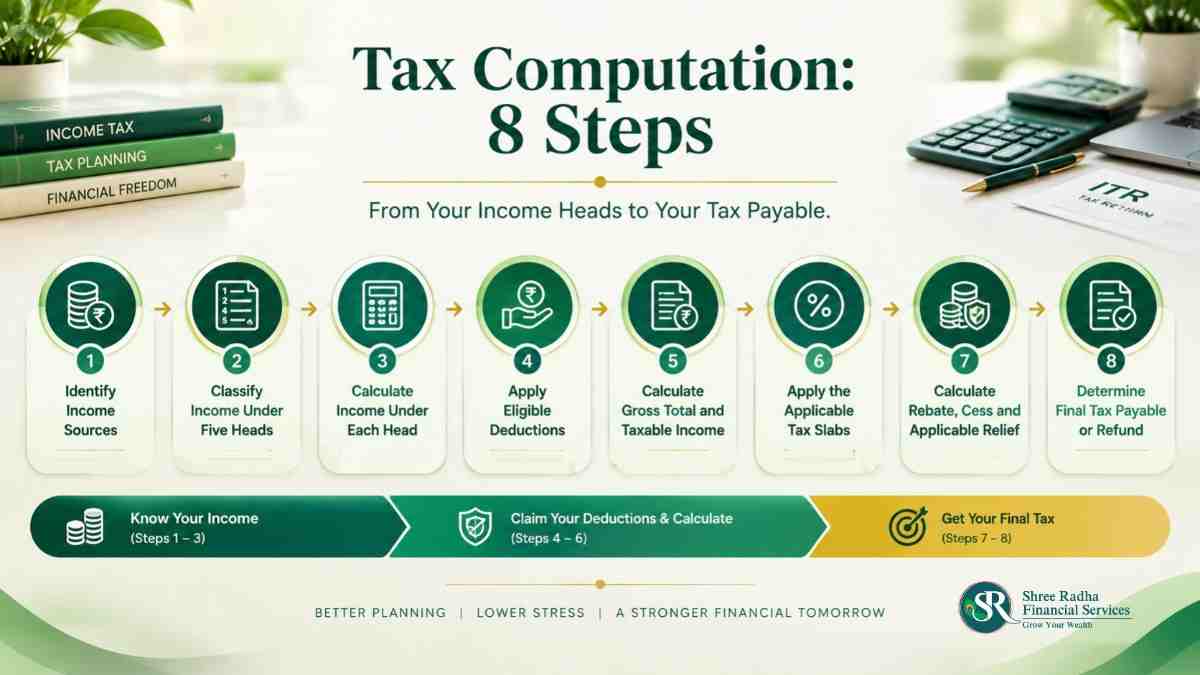
Tax Computation Step by Step: The 8-Step Flow
Whether you are a salaried manager or a business owner, tax computation follows the same road. Walk through these steps in order.
- Check your residential status (Section 6). It decides whether your foreign income is taxed in India.
- Sort your income into the five heads. Salary, house property, business or profession, capital gains and other sources.
- Apply clubbing and set-off. Income of a spouse or minor child may be added to yours (Section 99). Losses can be set off as per Sections 108 and 109.
- Add the heads to get gross total income.
- Subtract deductions. In the new regime, most deductions are not allowed. In the old regime, you can use Sections 123, 126 and others.
- Arrive at total income, then apply the slab rates. Special-rate income such as capital gains is taxed separately.
- Subtract the rebate, then add cess. The rebate is in Section 156. Cess is 4% on the tax.
- Subtract TDS and advance tax already paid. What remains is the tax to pay, or the refund you can claim.
Keep this flow beside you when you read any tax computation. It stops you from skipping a step.
The Five Heads of Income Under the Income-tax Act 2025
Every rupee you earn falls in one of five heads. Each head has its own rules for what you can deduct. That is why a tax computation always starts by sorting your income.
| Head of income | What it covers | New section | Old section |
|---|---|---|---|
| Salary | Salary, pension, allowances, perquisites | Sections 15 to 19 | Sections 15 to 17 |
| House property | Rent from a let-out property, or deemed rent | Sections 20 to 22 | Sections 22 to 24 |
| Business or profession | Trading, manufacturing, professional fees | Section 26 (presumptive: Section 58) | Section 28 (presumptive: 44AD, 44ADA) |
| Capital gains | Profit on selling property, shares, mutual funds | Section 67 | Section 45 |
| Other sources | Interest, dividends, gifts above the limit | Section 92 | Section 56 |
We will explain each head in a separate guide. This article gives you the full picture first. If you have capital gains or a retirement benefit coming up, our retirement planning guide for Surat is a good next read.
Tax Computation for Salaried Families: Mehul’s ₹18 Lakh Salary
Mehul is a 38-year-old manager at a chemical company in Vadodara. His gross salary is ₹18 lakh. His payslip showed TDS, but his own calculation gave a different number.
He had used old-regime numbers from a friend. His employer had used the new regime, which is the default. Neither was wrong. They were using two different regimes.
We ran his tax computation on the same salary in both regimes. We assumed ₹1.8 lakh as HRA exemption, ₹1.5 lakh under Section 123 and ₹25,000 under Section 126 for the old regime.
| Step (Mehul, ₹18 lakh salary) | New regime (Section 202) | Old regime (optional) |
|---|---|---|
| Gross salary | ₹18,00,000 | ₹18,00,000 |
| Standard deduction | ₹75,000 | ₹50,000 |
| HRA exemption (assumed) | Not allowed | ₹1,80,000 |
| Section 123 deduction (earlier 80C) | Not allowed | ₹1,50,000 |
| Section 126 deduction (earlier 80D) | Not allowed | ₹25,000 |
| Taxable income | ₹17,25,000 | ₹13,95,000 |
| Tax on slabs | ₹1,45,000 | ₹2,31,000 |
| Rebate under Section 156 | Nil (income above ₹12 lakh) | Nil (income above ₹5 lakh) |
| Health and education cess (4%) | ₹5,800 | ₹9,240 |
| Total tax | ₹1,50,800 | ₹2,40,240 |
On these numbers the new regime saves Mehul about ₹89,000. The old regime would need much larger deductions to win. For more on this, we plan a separate guide on which regime suits which kind of person.
Two points to remember from this table. The standard deduction is ₹75,000 in the new regime and ₹50,000 otherwise (Section 19). And a salaried person without business income can generally pick a regime when filing the return, but business owners have stricter rules, which we cover below.
Income Tax Slabs for Tax Year 2026-27
The new regime slabs are set in Section 202 of the Income-tax Act 2025. They apply to individuals and HUFs who stay in the default regime.
| Taxable income (new regime) | Tax rate |
|---|---|
| Up to ₹4,00,000 | Nil |
| ₹4,00,001 to ₹8,00,000 | 5% |
| ₹8,00,001 to ₹12,00,000 | 10% |
| ₹12,00,001 to ₹16,00,000 | 15% |
| ₹16,00,001 to ₹20,00,000 | 20% |
| ₹20,00,001 to ₹24,00,000 | 25% |
| Above ₹24,00,000 | 30% |
The rebate under Section 156 makes income up to ₹12 lakh effectively tax-free for a resident individual in the new regime. The rebate is ₹60,000, or the tax payable if that is less. Above ₹12 lakh, marginal relief limits the tax to the amount by which income crosses ₹12 lakh.
The old regime slabs (₹2.5 lakh basic exemption, then 5%, 20% and 30%) are not written in the Act. They come from the Finance Act of the year. The old-regime rebate is ₹12,500 for income up to ₹5 lakh.
Tax Computation for Business Families: Hitesh bhai’s Story From Surat
Hitesh bhai runs a textile trading business near Ring Road, Surat. He earns from four places: business profit, rent from a small shop, fixed deposit interest and a mutual fund sale.
His total income is ₹11 lakh. So he told his CA, “Income is under ₹12 lakh, so my tax should be zero.”
It was not zero. Here is the tax computation.
| Item (Hitesh bhai, Surat) | Head of income | Amount |
|---|---|---|
| Business profit from the textile trade | Business (Section 26) | ₹6,35,000 |
| Rent from a let-out shop ₹3,00,000 less 30% (₹90,000) | House property (Sections 20 to 22) | ₹2,10,000 |
| Interest on fixed deposits | Other sources (Section 92) | ₹1,05,000 |
| Income taxed at slab rates | ₹9,50,000 | |
| Mutual fund gain ₹2,75,000 less ₹1,25,000 exempt | Capital gains (Sections 67, 198) | ₹1,50,000 taxed at 12.5% |
| Slab tax on ₹9,50,000 (₹20,000 + ₹15,000) | ₹35,000 | |
| Rebate under Section 156 (limited to slab tax) | – ₹35,000 | |
| Tax on the mutual fund gain at 12.5% | ₹18,750 | |
| Cess at 4% | ₹750 | |
| Total tax payable | ₹19,500 |
The rebate in Section 156 cannot be more than the tax at slab rates (Section 156(3)). Section 198(7) also says the rebate is given against the slab tax, not the tax on the mutual fund gain. So the ₹18,750 on the gain stays payable, even though the total income is under ₹12 lakh.
Listed equity mutual fund gains above ₹1.25 lakh are taxed at 12.5% under Section 198 (see the official Act text). The rate and exemption come from the Finance Act, so check them each year.
Hitesh bhai must also remember one more rule. A person with business income who wants the old regime must opt for it by the due date of the return (Section 202(4)(a)). The option continues in later years. It can be withdrawn only once. After that withdrawal, it cannot be taken again unless the business income stops.
Business families with property and gifts to plan should also read our guide on a Will in Gujarat, since planning ahead can reduce surprises later.
Tax Computation for Retired Couples: Ramanbhai and Savita ben’s Story
Ramanbhai, 68, retired from a private firm in Rajkot. He and his wife Savita ben live on pension, fixed deposit interest and rent from one small shop.
Their taxable pension is ₹3 lakh. Their FD interest is ₹5 lakh. Rent from the shop is ₹1.8 lakh, and after the 30% deduction under Section 22 the taxable rent is ₹1,26,000. Total income is ₹9,26,000.
Banks had deducted ₹38,000 as TDS on the FD interest. Ramanbhai believed that this was “their tax” and the matter was closed. In fact, TDS is only an advance payment of tax, not the final bill.
Here is the actual tax computation. Slab tax on ₹9,26,000 is ₹20,000 plus ₹12,600, which is ₹32,600. The Section 156 rebate of up to ₹60,000 wipes out the full ₹32,600. The tax payable is nil.
That means the whole ₹38,000 TDS should come back as a refund. They only get it by filing a return. If they had given their banks Form 121 (earlier Forms 15G and 15H) under Section 393(6) at the start of the year, banks would not have deducted TDS at all. The Income Tax Department explains the new form names in its transition FAQs.
The lesson is simple. TDS is not the same as tax liability. Do the tax computation first, then decide on Form 121, advance tax and the return. Our guide on SIF taxation shows how other investment income is taxed, and our retirement SIP and SWP guide explains how retirees can plan regular income.
5 Common Mistakes in Tax Computation
- Mixing the two Acts. Using Tax Year words for FY 2025-26 income, or old sections for FY 2026-27 income.
- Thinking “under ₹12 lakh means no tax”. The rebate does not cover tax on special-rate gains like Hitesh’s.
- Treating TDS as the final tax. TDS is an advance. Your return decides what you owe or get back.
- Claiming old-regime deductions in the new regime. Sections 123 and 126 do not work there. Only employer NPS under Section 124 and a few others are allowed.
- Ignoring AIS. The Annual Information Statement (Form 168) may show income you forgot. A mismatch can lead to a notice.
Tax Computation Checklist Before You File
- Confirm which Act applies to the income year you are filing.
- Collect Form 130 (earlier Form 16), Form 168 (AIS) and bank interest certificates. You can view your AIS on the e-Filing portal.
- Write down all income under the five heads.
- Check your residential status.
- Decide the regime. Business owners must watch the Section 202(4)(a) rule.
- Apply deductions only if you are in the old regime.
- Check the Section 156 rebate and remember it applies only to slab-rate tax.
- Match TDS and advance tax with your own tax computation.
- File on time. For most individuals, the due date is 31 July. For business owners with no audit, it is 31 August (Section 263).
- Keep proofs for at least the period your CA advises.
Who Can Use This Guide, and Who Should Take Extra Help
This guide works well for:
- Salaried people who want to understand their Form 16 and regime choice
- Small business owners and traders who have rent, interest and gains alongside business income
- Retired couples who want to check TDS against actual tax
- Freelancers who are confused about the old and new Acts
You should take extra help from a CA if:
- You have foreign income, NRI status or a complex capital gains position
- You have a business with audit requirements or loss carry-forwards
- You have received a tax notice
- You are planning a large property sale or a gift of property
How SR Wealth Can Help
Shree Radha Financial Services (SR Wealth) is an AMFI Registered Mutual Fund and SIF Distributor and an APMI Registered PMS Distributor. We are distributors, not tax consultants. Your final tax computation and your return should always be confirmed by a CA or tax consultant.
What we can do for you:
- Explain, in general terms, how mutual fund gains and other investment income are taxed
- Help you plan the timing of investments and redemptions, so you can discuss the tax effect with your CA first
- Connect you with a competent CA or tax consultant if you need one for your tax computation, return or notice
Our executive wealth guide covers tax efficiency for high-income earners.
Tax Computation FAQ
How do I do the tax computation step by step under the new regime?
Add your income under the five heads, subtract the standard deduction and any allowed items, apply the Section 202 slabs, subtract the Section 156 rebate if you qualify, and add 4% cess. Then subtract TDS and advance tax.
What are the five heads of income?
Salary, income from house property, profits and gains of business or profession, capital gains, and income from other sources.
What is Section 80C called in the Income-tax Act 2025?
It is Section 123, read with Schedule XV. The limit is still ₹1,50,000. It works only if you choose the old regime.
Which section covers TDS on salary now?
Section 392 (earlier Section 192). Other TDS provisions are consolidated in Section 393.
Is the rebate under Section 156 available in both regimes?
Yes, with different limits. The old regime gives up to ₹12,500 if income is up to ₹5 lakh. The new regime gives up to ₹60,000 if income is up to ₹12 lakh, with marginal relief just above it.
Can I still file under the 1961 Act?
Yes, for income earned up to 31 March 2026. The return for FY 2025-26 (Assessment Year 2026-27) follows the 1961 Act. Income from 1 April 2026 follows the 2025 Act.
How is taxable income worked out from gross salary?
Start with gross salary. Subtract the standard deduction (₹75,000 in the new regime). In the old regime, subtract HRA exemption and deductions such as Sections 123 and 126 as well. The result is your taxable salary.
This article is also available on Medium for wider reading: https://medium.com/@shreeradha.services/how-tax-computation-works-under-indias-new-income-tax-act-2025-a-simple-8-step-guide-acce63bc2c9b
About to Sell, Redeem or Retire? Plan the Tax Effect First
Most tax surprises happen after the money moves: a mutual fund redemption, a property sale or the first month of retirement. A short conversation before you act can help you see the likely tax effect and the right timing, so you can take it to your CA with clear questions.
No CA yet? We can connect you with a competent one.
📞 Call / WhatsApp: +91 98791 13255
📧 Email: shreeradha.services@gmail.com
🌐 Visit: www.srwealth.co.in
📍 Shop 33, Mira Nagar 2, Dindoli Road, Surat 394210
Paresh Chaudhary
Founder, Shree Radha Financial Services (SR Wealth), Surat
AMFI Registered Mutual Fund & SIF Distributor — ARN: 268390
APMI Registered PMS Distributor — APRN: 05763
IRDAI Licensed Insurance Distributor
BE Mechanical, SVNIT Surat | Ex-L&T (15+ Years)
Last verified on 26 October 2026 against the Income-tax Act 2025 (as amended by Finance Act 2026) and the CBDT FAQs on transition. The old 1961 Act references come from the Income-tax Act 1961 as amended up to Finance Act 2026. Official sources: Income Tax Department and the e-Filing portal.
Educational Disclaimer: This article is published by Shree Radha Financial Services — an AMFI Registered Mutual Fund & SIF Distributor (ARN: 268390) and APMI Registered PMS Distributor (APRN: 05763). It is for education only and is not tax, legal or investment advice. Tax rules, rates and section numbers change from time to time. Please connect with your tax consultant or CA for details specific to your situation. The people in the stories are fictional and the numbers are illustrations only. Mutual fund investments are subject to market risks. Please read all scheme-related documents carefully.