Salary Income Under the New Income-tax Act: The Quick Answer
Salary income, also called income from salary, is every rupee your employer pays or gives you for your work, and most of it is taxable. Only a few parts, such as employer PF within a limit, meal vouchers within a limit and small gifts, are left out. The Income-tax Act 2025 covers salary in Sections 15 to 19, and it applies to income earned from 1 April 2026.
Here is the quick answer. Your CTC is not your taxable salary, and your taxable salary is not your take-home pay. The new regime taxes most allowances, while the old regime still lets you claim some, such as HRA and LTA. Tax rules change from time to time, so please check your own case with your CA.
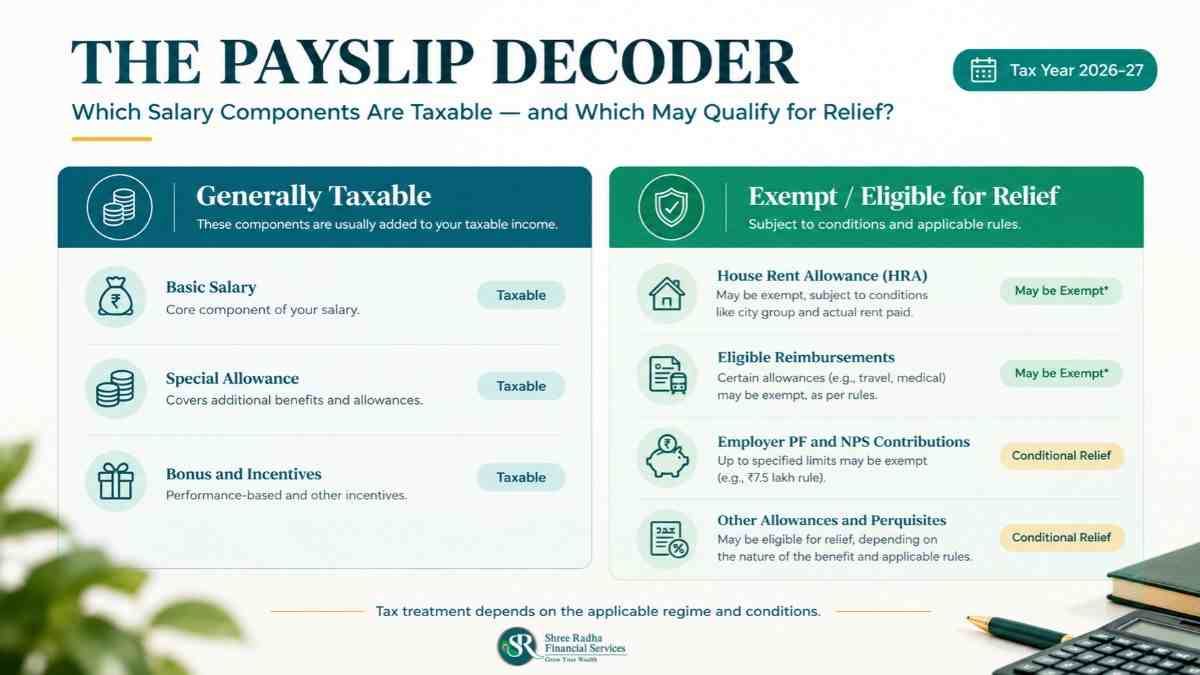
- Fully taxable: basic salary, dearness allowance, bonus, commission, most special allowances
- Taxable in the new regime, partly exempt in the old: HRA, LTA, children education and hostel allowance
- Left out within limits: employer PF, NPS and superannuation up to ₹7.5 lakh a year, meals up to ₹200 a meal, gifts below ₹15,000 a year
- Deduction: standard deduction of ₹75,000 in the new regime and ₹50,000 in the old
“Many young professionals plan their monthly SIP on their CTC, and then find that the money in their account is far lower. Once you know which parts of your pay are taxable, you can plan what you can actually invest each month, and not what you wished you could.”
— Paresh Chaudhary, Founder, Shree Radha Financial Services

Salary Income: Which Act Applies to Your Pay?
The question: “My payslip still shows old section numbers. Which law is it?”
The answer: Salary earned up to 31 March 2026 stays under the Income-tax Act 1961, filed as Assessment Year 2026-27. Salary from 1 April 2026 falls under the Income-tax Act 2025 as Tax Year 2026-27. The Income Tax Department explains this in its FAQs on the transition. Our income tax computation guide shows how the two Acts fit together.
The section numbers moved, and the table below helps you match them.
| Item | 1961 Act | 2025 Act |
|---|---|---|
| Salary charging section | Section 15 | Section 15 |
| Meaning of salary | Section 17(1) | Section 16 |
| Perquisites | Section 17(2) | Section 17 |
| Profits in lieu of salary | Section 17(3) | Section 18 |
| Deductions from salary | Section 16 | Section 19 |
| Allowance exemptions | Section 10(5), 10(13A), 10(14) | Schedule III, Sl. 8, 11, 12, 13 |
| TDS on salary | Section 192 | Section 392 |
| TDS certificate (Form 16) | Form 16 | Form 130 |
| Employee claims statement (Form 12BB) | Form 12BB | Form 124 |
| Statement of perquisites (Form 12BA) | Form 12BA | Form 123 |
What Counts as Salary Income (Income From Salary): Sections 15 and 16
Section 15 taxes salary when it is due or when it is paid, whichever comes first. It also covers advance salary and arrears. Section 16 lists what is included: wages, pension, gratuity, fees, commission, perquisites, leave encashment, and the employer’s NPS contribution.
Two points surprise many people. A partner’s share from a firm is not salary (Section 15(4)), and a bonus is taxed when it becomes due, not when you spend it.
The Income Tax Department’s own page on income from salary gives the 1961 Act view for FY 2025-26, which is useful if you are still filing for that year.
Taxable Salary Components: Kunal’s Payslip Decoded
Kunal is a software engineer in Pune. His CTC is ₹14 lakh. He told his friends, “My taxable income is ₹14 lakh.” That is the most common mistake we see.
The mistake: counting the whole CTC as taxable income.
The way forward: go line by line through the payslip. Here is Kunal’s yearly payslip, with what is taxable in each regime. He pays rent of ₹25,000 a month in Pune.
| Payslip line (Kunal, Pune) | Yearly amount | Taxable in new regime | Taxable in old regime |
|---|---|---|---|
| Basic salary | ₹5,60,000 | ₹5,60,000 | ₹5,60,000 |
| HRA (rent paid ₹25,000 a month) | ₹2,80,000 | ₹2,80,000 | ₹36,000 (₹2,44,000 exempt) |
| Special allowance | ₹3,63,200 | ₹3,63,200 | ₹3,63,200 |
| Variable pay | ₹1,03,200 | ₹1,03,200 | ₹1,03,200 |
| Meal card (₹2,200 a month, within ₹200 a meal) | ₹26,400 | Nil | Nil |
| Employer PF (12% of basic) | ₹67,200 | Nil (within ₹7.5 lakh cap) | Nil (within ₹7.5 lakh cap) |
| Total CTC | ₹14,00,000 | ||
| Taxable salary before standard deduction | ₹13,06,400 | ₹10,62,400 | |
| Standard deduction | ₹75,000 | ₹50,000 | |
| Salary income after standard deduction | ₹12,31,400 | ₹10,12,400 (before Sections 123 and 126) |
Look at the two ends of this table. The CTC is ₹14,00,000, but the taxable salary in the new regime is ₹13,06,400, and the salary income after the ₹75,000 standard deduction is ₹12,31,400. His employer’s PF and the meal card are not taxed, because they stay within the limits.
In the new regime, Kunal’s tax comes to about ₹32,656, because his income is only a little above ₹12 lakh and marginal relief applies. In the old regime, he can reduce his salary income further with Sections 123 and 126. Which regime wins depends on his deductions, and our old vs new tax regime guide explains how to check.
Salary Income Decoder: Taxable or Not, Component by Component
Use this table when you read your own payslip. It shows how each common component is treated in the new and old regime, with the new Act reference and the old one.
| Component | New regime | Old regime | New Act reference | 1961 Act reference |
|---|---|---|---|---|
| Basic salary, dearness allowance | Taxable | Taxable | Sections 15 and 16 | Sections 15 and 17(1) |
| Bonus, commission, variable pay | Taxable | Taxable | Section 15 | Section 15 |
| House rent allowance (HRA) | Taxable | Partly exempt (Rule 279) | Schedule III, Sl. 11 | Section 10(13A) |
| Leave travel allowance (LTA) | Taxable | Exempt for actual travel (Rule 278) | Schedule III, Sl. 8 | Section 10(5) |
| Children education allowance | Taxable | Exempt up to ₹3,000 a month per child, two children (Rule 280) | Schedule III, Sl. 13 | Section 10(14) |
| Hostel allowance | Taxable | Exempt up to ₹9,000 a month per child, two children (Rule 280) | Schedule III, Sl. 13 | Section 10(14) |
| Special allowance (general) | Taxable | Taxable, unless it fits the Rule 280 list | Schedule III, Sl. 12 and 13 | Section 10(14) |
| Tour, transfer, daily and official conveyance allowances | Exempt to the extent spent (Rule 280) | Exempt to the extent spent | Schedule III, Sl. 12 | Section 10(14)(i) |
| Employer PF, NPS and superannuation together | Not taxed up to ₹7.5 lakh a year | Not taxed up to ₹7.5 lakh a year | Section 17 | Section 17(2) |
| Employer NPS contribution deduction | Allowed, up to 14% of salary | Allowed, up to 10% of salary (14% for Government) | Section 124(1) and (2) | Section 80CCD(2) |
| Professional tax | Not allowed | Allowed | Section 19(1), Sl. 1 | Section 16(iii) |
| Standard deduction | ₹75,000 | ₹50,000 | Section 19(1), Sl. 2 | Section 16(ia) |
The new regime keeps exemptions for a short list of allowances only, such as allowances for tour and transfer travel, daily allowance, conveyance for official duty and transport allowance for certain employees with disabilities (Rule 280). Everything else on this list is taxable. Please confirm the details of your allowances with your CA.
HRA Exemption: Why Your City Group Matters
The question: “Is HRA exempt in the new regime, and how much in the old?”
The answer: HRA exemption is available only in the old regime. In the new regime, the whole HRA is taxable. In the old regime, the exempt amount is the least of three numbers (Rule 279 of the Income-tax Rules 2026):
- The HRA you actually receive
- The rent you pay, less 10% of your salary (basic plus dearness allowance)
- 50% of salary if you live in a Group 1 city, or 40% in any other place
| HRA city group (Rule 279) | Cities | HRA cap |
|---|---|---|
| Group 1 | Mumbai, Kolkata, Delhi, Chennai, Hyderabad, Pune, Ahmedabad and Bengaluru | 50% of salary |
| Group 2 | Any other place, such as Surat, Vadodara, Indore, Lucknow and Jaipur | 40% of salary |
Gujarat readers, please note: Ahmedabad is in Group 1, but Surat, Vadodara and Rajkot are in Group 2. The same applies to cities like Indore, Lucknow and Jaipur.
Priya works in Bengaluru and Rohit works in Indore. They have the same salary, the same HRA and the same rent. Only the city group differs.
| HRA step (yearly) | Priya, Bengaluru | Rohit, Indore |
|---|---|---|
| Basic salary | ₹6,00,000 | ₹6,00,000 |
| HRA received | ₹3,00,000 | ₹3,00,000 |
| Rent paid (₹30,000 a month) | ₹3,60,000 | ₹3,60,000 |
| (a) HRA received | ₹3,00,000 | ₹3,00,000 |
| (b) Rent paid less 10% of salary (₹3,60,000 – ₹60,000) | ₹3,00,000 | ₹3,00,000 |
| (c) City cap: 50% vs 40% of salary | ₹3,00,000 | ₹2,40,000 |
| HRA exempt (least of a, b, c) | ₹3,00,000 | ₹2,40,000 |
| HRA taxable (old regime) | Nil | ₹60,000 |
Rohit loses ₹60,000 of exemption only because of his city’s cap. The mistake: using 40% for a city that moved into the 50% group, or claiming rent paid without receipts. The way forward: check the city list, keep rent receipts and the landlord’s PAN if the rent is high, and give your employer the details in Form 124 (earlier Form 12BB).
Perquisites: Benefits That Are Taxed as Salary
A perquisite is a benefit your employer gives you apart from cash. Section 17 treats many of them as salary, and Rule 15 of the Income-tax Rules 2026 explains how to value them. Some are valued at nothing within limits. Others are taxed on a formula.
| Benefit from the employer | How it is valued (Rule 15 and Tables I to IV) |
|---|---|
| Meals at work or meal vouchers | No value up to ₹200 per meal |
| Gifts, vouchers or tokens | Nil if the total is below ₹15,000 in the tax year |
| Interest-free or cheap loan | Taxable at the SBI rate, but no value if the loans are ₹2 lakh or less in total (or for specified medical treatment) |
| Employer-owned house given to you | 10% of salary in cities above 40 lakh population (2011 census), 7.5% for 15 to 40 lakh, 5% elsewhere, less rent you pay |
| Company car (small car, used for both office and private) | ₹5,000 a month (plus ₹3,000 if a driver is provided) as the perquisite value |
| Free education for your child | Taxable if the cost is above ₹3,000 per month per child |
These rules apply whether you choose the new or the old regime. The employer reports them in Form 123 (earlier Form 12BA) when your salary is above ₹1.5 lakh.
Employer PF, NPS and ESOPs: The ₹7.5 Lakh Rule
Aarav is a senior executive in Hyderabad. His employer pays ₹1,80,000 into PF, ₹2,10,000 into NPS and ₹4,50,000 into a superannuation fund. That sounds tax-free. It is not entirely.
The mistake: assuming all employer contributions are free of tax.
The way forward: Section 17(1)(h) adds up the employer’s contributions to PF, NPS and superannuation. Anything above ₹7.5 lakh in a year is taxed as salary.
Aarav’s total is ₹8,40,000. The excess of ₹90,000 is added to his salary. At the 30% slab with cess, that costs him about ₹28,080 in tax.
He also exercised stock options this year. The gain between the exercise price and the market value on the date of exercise is generally taxed as salary, in the year of exercise. Please ask your CA how your own ESOP is valued. Our executive wealth guide covers tax efficiency for high earners.
Retirement Payments: Gratuity, Leave Encashment and Commuted Pension
Meera, in Lucknow, retires after 32 years. Her HR told her, “Gratuity is tax-free.” That is true, but only within a limit.
The mistake: assuming every retirement payment is fully exempt.
The way forward: Section 19(1) lists exemptions for gratuity, commuted pension, voluntary retirement payments (up to ₹5 lakh), retrenchment compensation and leave encashment. The exact limits for gratuity and leave encashment come from Government notifications, so check the current figures with your CA before you plan your retirement payout. The part above the limit is taxed in the year you receive it.
We will cover each of these in a separate guide. For now, our retirement schemes guide and PPF rules guide show where retirement savings fit.
Deductions From Salary, Bonus, Arrears and Advance Salary
- Standard deduction (Section 19): ₹75,000 in the new regime, ₹50,000 in the old. It is given automatically through your employer.
- Professional tax: deductible only in the old regime. It varies by state.
- Entertainment allowance: the 1961 Act allowed a deduction for certain government employees. We could not find it in Section 19 of the 2025 Act.
- Bonus and arrears: taxed when due or received. If arrears are taxed in one year, Section 157 gives relief, claimed through Form 39 (earlier Form 10E).
- Advance salary: taxed when you receive it.
Match Your Payslip, Form 130 and AIS
The question: “My Form 16 and my payslip do not match. Which is right?”
Your employer deducts TDS on salary under Section 392 and gives you Form 130 (earlier Form 16). Your Annual Information Statement (AIS, Form 168) shows what the Department has on record. Check all three together on the e-Filing portal before you file.
In a job-change year, each employer issues its own Form 130. Add the salary from both employers. The standard deduction is available once, so do not claim it twice. If the second employer deducted TDS without your first salary, there may be a shortfall that you pay with your return.
7 Common Mistakes With Salary Income, and the Way Forward
- Mistake: treating CTC as taxable income. Way forward: use the decoder and start from the gross taxable lines.
- Mistake: claiming HRA, LTA or education allowance in the new regime. Way forward: check your regime first, since they work only in the old one.
- Mistake: using the wrong HRA city group. Way forward: check Rule 279’s list.
- Mistake: ignoring the ₹7.5 lakh cap on employer PF, NPS and superannuation. Way forward: add the three together every year.
- Mistake: not matching Form 130 with AIS. Way forward: compare both before you file.
- Mistake: forgetting the second employer’s salary in a job-change year. Way forward: collect both Form 130s.
- Mistake: quoting old section numbers in the new Act year. Way forward: use the map in the second section of this guide.
Salary Income Checklist Before You File
- Confirm the Act and tax year for your salary.
- List every payslip line and mark it taxable, exempt or limit-based.
- Choose the regime and check whether HRA, LTA and other claims apply.
- Confirm your HRA city group and keep rent receipts.
- Add up employer PF, NPS and superannuation against ₹7.5 lakh.
- Check perquisites such as housing, car, loans and ESOPs.
- Collect Form 130 from each employer.
- Compare with AIS on the portal.
- Subtract the standard deduction once.
- Share the final numbers with your CA before filing.
Who Can Use This Guide, and Who Should Take Extra Help
This guide works well for:
- Salaried people who want to understand their payslip and Form 130
- Young professionals planning their SIP from take-home pay
- Employees changing jobs or receiving perquisites
You should take extra help from a CA if:
- You have ESOPs, foreign salary or a foreign employer
- You are retiring or taking a large retirement payout
- You changed jobs more than once in the year
- Your payslip and Form 130 do not match
How SR Wealth Can Help
Shree Radha Financial Services (SR Wealth) is an AMFI Registered Mutual Fund and SIF Distributor and an APMI Registered PMS Distributor. We are distributors, not tax consultants. Your CA or tax consultant should confirm your taxable salary and your return.
What we can do for you:
- Help you plan SIPs and other investments around your take-home pay
- Explain, in general terms, how retirement products such as EPF, PPF and NPS work
- Connect you with a competent CA or tax consultant if you need one for your salary tax, return or notice
Rules and regulations change from time to time, so please connect with your CA or tax consultant for your own situation.
Salary Income FAQ
What is the difference between gross salary and taxable salary?
Gross salary is the total of your pay components. Taxable salary is what remains after leaving out exempt items and subtracting the standard deduction. Your CTC also includes items such as employer PF that you never receive in cash.
Is special allowance taxable in the new regime?
Yes, in most cases. A general special allowance is taxable unless it fits the short list of exempt allowances in Rule 280.
Is the standard deduction of ₹75,000 available for salaried employees in 2026-27?
Yes, in the new regime (Section 202(1)). In the old regime, it is ₹50,000 (Section 19).
Is HRA exempt in the new regime?
No. HRA is fully taxable in the new regime. In the old regime, the exemption is the least of three amounts (Rule 279).
How is HRA calculated for metro vs non-metro cities?
It uses a 50% cap in eight cities (Mumbai, Kolkata, Delhi, Chennai, Hyderabad, Pune, Ahmedabad and Bengaluru) and 40% elsewhere, as per Rule 279.
Is employer contribution to PF or NPS taxable?
Not within the limit. The employer’s contributions to PF, NPS and superannuation together are taxed only above ₹7.5 lakh a year (Section 17(1)(h)). Employer NPS also gives a deduction under Section 124.
Are bonuses and incentives fully taxable?
Yes. They are taxed when due or paid, whichever is earlier (Section 15).
What happens if I change jobs in the middle of the year?
Each employer gives you a Form 130. You add both salaries, claim the standard deduction only once, and check for any TDS shortfall.
This article is also available on Medium for wider reading: https://medium.com/@shreeradha.services/salary-income-in-india-what-is-taxable-and-what-is-not-under-the-income-tax-act-2025-324e2c956c73
Know Your Pay, Then Plan Your Money
Once you know what part of your pay is taxable, the next question is where your take-home should go: SIPs, retirement savings and an emergency fund. We help with the investment side. For anything about your tax, your CA is the right person, and if you do not have one, we can connect you with a competent CA.
📞 Call / WhatsApp: +91 98791 13255
📧 Email: shreeradha.services@gmail.com
🌐 Visit: www.srwealth.co.in
📍 Shop 33, Mira Nagar 2, Dindoli Road, Surat 394210
Paresh Chaudhary
Founder, Shree Radha Financial Services (SR Wealth), Surat
AMFI Registered Mutual Fund & SIF Distributor — ARN: 268390
APMI Registered PMS Distributor — APRN: 05763
IRDAI Licensed Insurance Distributor
BE Mechanical, SVNIT Surat | Ex-L&T (15+ Years)
Last verified on 27 October 2026 against the Income-tax Act 2025 (as amended by Finance Act 2026), the Income-tax Rules 2026 and the Income-tax Act 1961. Official sources: Income Tax Department and the e-Filing portal. The Rules are available on the Income Tax Department website.
Educational Disclaimer: This article is published by Shree Radha Financial Services — an AMFI Registered Mutual Fund & SIF Distributor (ARN: 268390) and APMI Registered PMS Distributor (APRN: 05763). It is for education only and is not tax, legal or investment advice. Tax rules, rates, limits and section numbers change from time to time. Please connect with your tax consultant or CA for details specific to your situation. The people in the stories are fictional and the numbers are illustrations only. Mutual fund investments are subject to market risks. Please read all scheme-related documents carefully.