Introduction
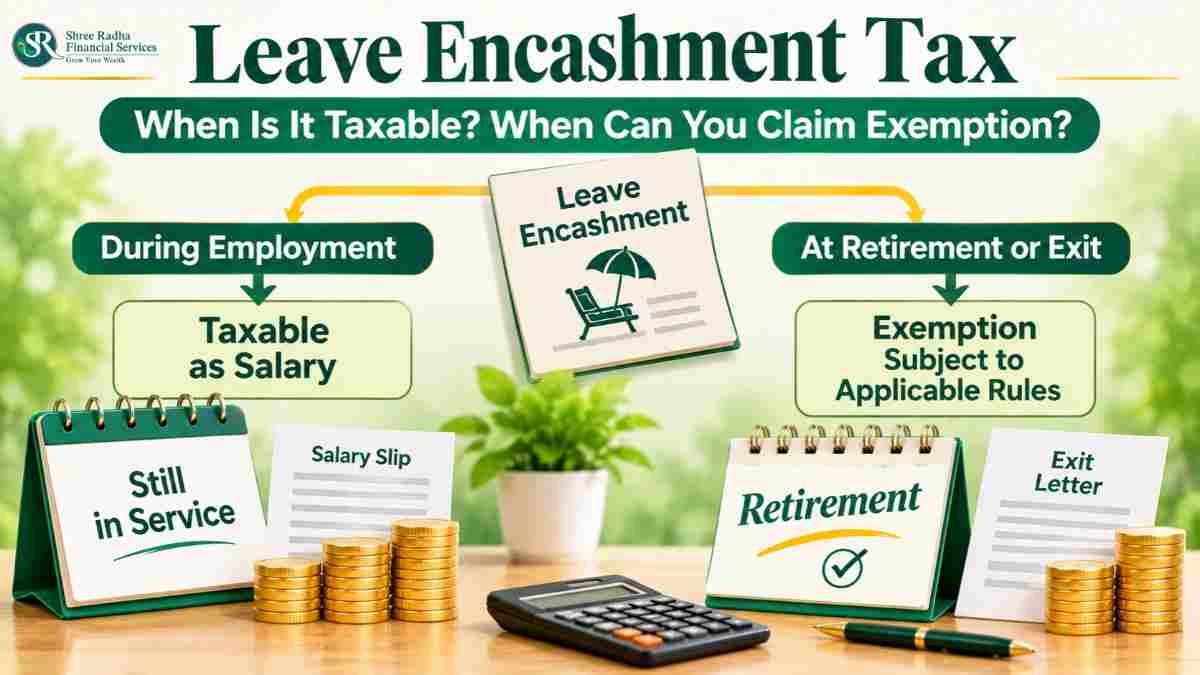
Leave encashment tax depends on one simple question: are you being paid for unused leave while you are still working, or because you are leaving? The answer changes everything. While you work, the money is taxed like salary. When you retire or leave, part of it, or all of it, can be tax-free.
This guide explains leave encashment tax in five easy rules. Each rule comes with a story from a different city. The people in the stories are fictional, and each one reads the rules and asks their own HR, accounts section or CA before deciding anything.
Reading time: about 12 minutes | Last verified: 6 November 2026
Quick answer: leave encashment tax in short
While in service: fully taxable as salary. At retirement or when you leave: Central and State Government employees get the entire amount exempt. Other employees get the lowest of four figures exempt. The rest is taxed as salary.
While in service: fully taxable as salary. At retirement or when you leave: Central and State Government employees get the entire amount exempt. Other employees get the lowest of four figures exempt. The rest is taxed as salary.
Who this guide is for: any employee who plans to encash leave this year, resign, or retire in the next few years, and anyone who wants to check the leave encashment tax on their own payslip.
“Most people think unused leave is their own money, so it must be tax-free. The law does not see it that way while you are still working. The tax-free part comes only at the end, and only up to a limit. A few minutes with the rules before you encash can change the amount you take home.”
— Paresh Chaudhary, Founder, Shree Radha Financial Services
Leave Encashment Tax: The 5 Rules at a Glance
| Rule | It affects | You will read it in |
|---|---|---|
| 1. Leave encashed while in service is taxable | Everyone | The Chennai story |
| 2. Government employees get the entire retirement amount exempt | Central and State Government employees | The Bhopal story |
| 3. Everyone else gets the lowest of four figures exempt | Private-sector, PSU and bank employees | The Pune story |
| 4. “Retirement or otherwise” includes leaving your job | People who resign | The Surat story |
| 5. The limit is shared across all your employers | People who change jobs | The Jaipur story |
Leave Encashment Tax Rule 1: Encashing While You Work Is Taxable
Arvind Krishnan works for a software company in Chennai. Every December his company lets staff encash up to 15 days of unused leave. This year, Arvind had a plan. His sister’s wedding was coming in February, and he needed some extra money for the shopping.
“It is my own unused leave,” he told his wife over dinner. “I earned it. Why would the government tax it?” He applied for 15 days. His basic + DA was ₹60,000 a month, and his company worked out one day at ₹2,000. So he expected ₹30,000.
January came. He opened his payslip and frowned. The ₹30,000 was there. But the tax line was bigger than usual. He walked to the payroll desk. The executive was polite. “Sir, leave encashment is added to the month’s salary. Tax is cut on the whole salary.”
Arvind was not convinced. That evening he called his friend Meenakshi, a chartered accountant in Coimbatore. “Is this right?” She laughed gently. “Arvind, it is right. While you are still working, anything paid for unused leave is salary. There is no tax-free part. The exemption you are thinking of comes only when you retire or leave.”
Arvind did not argue. He read the rule himself that night. Then he did the sum he should have done before applying: how much of ₹30,000 would reach his hand after tax at his slab rate. The wedding budget changed. He encashed 5 days instead of 15, and used the rest of his leave to travel with his family.
In simple words: encashing leave while you are in service is the same as getting extra salary. It is added to your income for the year, and tax is cut at source on it. This is true for private and government employees. For example, a Central Government employee who encashes up to 10 days of earned leave with Leave Travel Concession (Rule 38-A of the CCS Leave Rules) also gets taxed on it as salary.
Law reference: Income-tax Act 2025, Section 17(1)(h) (any payment received for leave not availed is salary) and Section 392 (tax deducted on salary). CCS (Leave) Rules, 1972, Rule 38-A.
Leave Encashment Tax Rule 2: Government Employees Get the Entire Amount Exempt
Kavita Joshi was two months from retirement. She worked in a central government office in Bhopal and had spent 36 years there. Her office had sent every retiring staff member a leave statement, and hers showed 340 days of earned leave and half-pay leave together.
She was worried about two things, and she told her colleague Deepak at lunch. “Will they pay all 340 days? And will the tax office take half of it?” Deepak had retired friends in private companies. “They always say a big part is taxed. Better keep a CA ready.”
Kavita did not guess. She went to the accounts section and asked. The accounts officer opened the CCS (Leave) Rules and showed her Rule 39(2). On retirement at the normal age, the authority grants the cash equivalent of leave salary for earned leave and half-pay leave together, with a maximum of 300 days. So 40 days of her balance would simply lapse. The sum was (pay + DA on the date of retirement) ÷ 30 × the number of days.
With pay + DA of ₹1,00,000, Kavita learned that she would get ₹1,00,000 ÷ 30 × 300 = ₹10,00,000. Then she asked about tax. The accounts officer said that was a question for the Income-tax Act, and she should check it herself. She read Section 19 of the Income-tax Act 2025. For a Central or State Government employee, the entire amount is exempt.
Kavita relaxed about the tax. She was sad about the 40 days. She told the new joiners in her office the one lesson she had learned: “Plan your leave early. The 300-day limit does not wait for you.”
In simple words: for Central and State Government employees, the cash equivalent of earned leave at retirement is fully exempt. The rule says “whether on superannuation or otherwise”. The 300-day limit is a leave rule of the Central Government. State Government employees follow their own state leave rules, so ask your accounts office.
Law reference: Income-tax Act 2025, Section 19(1) Table, Sl. 13 (earlier Section 10(10AA)(i)). CCS (Leave) Rules, 1972, Rule 39(2).
Leave Encashment Tax Rule 3: Everyone Else Gets the Lowest of Four Figures Exempt
Rahul Deshmukh retired from a manufacturing company in Pune after 20 years. His leave account had 270 days of privilege leave, and the company policy allowed him to encash all of them. HR calculated one day at ₹3,000 and handed him a letter for ₹8,10,000.
Rahul was happy. “Retirement benefit,” he told his wife Anjali. “It will go straight to the new flat.” He had read somewhere that retirement benefits are tax-free, and he did not think twice.
Two weeks later, he met his CA, Prasad, to plan the year. Prasad opened a notebook. “Rahul, before we plan, let me check the exempt part.” He wrote four numbers. Rahul watched the page fill up and felt his stomach drop.
The first number was the actual payment, ₹8,10,000. The second was the leave the law lets you count. For private-sector employees, earned leave counts at no more than 30 days for each year of actual service, and leave you already took is deducted. Twenty years × 30 days = 600 days. Rahul had taken 400 days in his career. So 200 days were counted, which Prasad worked out as 200 ÷ 30 × ₹90,000 = ₹6,00,000. The third number was 10 times the average monthly salary of the last ten months: 10 × ₹90,000 = ₹9,00,000. The fourth was the limit notified by the Central Government.
“The exempt part is the lowest of the four,” said Prasad. Rahul looked at the page. The lowest was ₹6,00,000. The other ₹2,10,000 would be taxed as salary. Rahul was quiet for a minute. Then he asked Prasad to show him how leave already taken is deducted, so he could explain it to Anjali. He also asked his old HR to confirm his leave history in writing. The new flat plan stayed. The tax on ₹2,10,000 went into the budget.
Exempt amount = the lowest of (a), (b), (c) and (d)
(a) the cash equivalent of the earned leave at your credit, counting no more than 30 days for each year of actual service
(b) 10 × the average monthly salary of the last 10 months
(c) the limit notified by the Central Government
(d) the actual payment received
(a) the cash equivalent of the earned leave at your credit, counting no more than 30 days for each year of actual service
(b) 10 × the average monthly salary of the last 10 months
(c) the limit notified by the Central Government
(d) the actual payment received
| Figure | Rahul’s working | Amount |
|---|---|---|
| (a) Cash equivalent of leave counted | (600 days − 400 days taken) = 200 days, 200 ÷ 30 × ₹90,000 | ₹6,00,000 |
| (b) 10 months’ average salary | 10 × ₹90,000 | ₹9,00,000 |
| (c) Notified limit | Assumed ₹25 lakh for this example. Check the current notification. | ₹25,00,000 (assumed) |
| (d) Actual payment | 270 days × ₹3,000 | ₹8,10,000 |
| Exempt (lowest) | ₹6,00,000 | |
| Taxable (added to salary) | ₹8,10,000 − ₹6,00,000 | ₹2,10,000 |
In simple words: a private-sector employee, a PSU employee and a bank employee are all “not Central or State Government employees” for this rule. Salary here means basic pay, and DA only if your terms of employment include DA in pay. Other allowances and perquisites are left out. The method of working out leave already taken can differ from case to case, so ask your CA to check yours.
Law reference: Income-tax Act 2025, Section 19(1) Table, Sl. 14 and Section 19(2)(b) (earlier Section 10(10AA)(ii)).
Leave Encashment Tax Rule 4: Resigning Counts Too
Hardik Patel worked for a chemical company in Sachin, near Surat. After 12 years, a friend invited him to join a start-up. The new job could start in October, but Hardik wanted to wait until December. His reason surprised his wife Nisha.
“I read that leave encashment is tax-free only at retirement,” he said. “If I resign in October, the company will tax my leave payment. If I stay until my 60th birthday, it will not.” Nisha stared. “Hardik, your 60th birthday is 22 years away.” He laughed, but he still thought the two months mattered for tax.
He decided to ask. At the office he met the HR manager, Mrs. Trivedi. “Is leave encashment on resignation treated differently?” She pulled out the policy and said the company pays leave for resignation exactly as for retirement. Hardik still wanted proof for the tax side, so he booked an hour with a CA in Surat, Mr. Dave.
Mr. Dave opened the Act. The words in the rule are “at the time of his retirement, whether on superannuation or otherwise”. He said, “The words ‘or otherwise’ are widely read to cover leaving the job. I will confirm it for your exact case, but you do not need to wait.”
Hardik’s own sum was simple. He had 12 years of service, so the counted leave was 12 × 30 = 360 days, less the 270 days he had already taken, leaving 90 days. His average salary was ₹60,000 a month, so the cash equivalent was 90 ÷ 30 × ₹60,000 = ₹1,80,000. The company would pay him for 150 days, ₹3,00,000. So ₹1,80,000 would be exempt and ₹1,20,000 taxed. Hardik had worried about the wrong thing. He resigned on his planned date, and he started the new job in October.
In simple words: the exemption is not only for people who retire at 60. The rule covers retirement “on superannuation or otherwise”, and leaving a job is commonly read as “otherwise”. The same four-figure test applies to you.
Law reference: Income-tax Act 2025, Section 19(1) Table, Sl. 13-14.
Leave Encashment Tax Rule 5: The Limit Is Shared Across Employers
Neha Sharma lives in Jaipur and has worked in two companies in 25 years. When she left her first company in 2024, her leave encashment was large. Her CA, Mr. Bhatia, worked out that ₹20 lakh of it was exempt.
Two years later she was leaving her second company. The HR team told her she would get ₹7 lakh for her unused leave. Neha did a quick sum in her head. “New employer, new limit. So the ₹7 lakh will be tax-free.”
She mentioned it to Mr. Bhatia when she went to file her papers. He shook his head. “Neha, the limit does not reset with each employer. The Income-tax Act says the limit for the year is the notified amount, minus whatever exemption you were allowed in earlier years, from any employer.” He picked up his pen. “Let us assume the notified limit is ₹25 lakh, just for this example. You used ₹20 lakh in 2024. So ₹5 lakh is left.”
The other three figures were higher than ₹7 lakh, so the limit decided. Neha’s exempt amount was ₹5 lakh, and ₹2 lakh would be taxed. She asked Mr. Bhatia to note her 2024 exemption in a letter, and she asked her new HR to keep a copy. “Next time,” she said, “I will tell my team before they change jobs.”
Limit left = notified limit (A) − exemptions already allowed in earlier years (B)
Neha’s example: ₹25,00,000 (assumed) − ₹20,00,000 = ₹5,00,000
Neha’s example: ₹25,00,000 (assumed) − ₹20,00,000 = ₹5,00,000
In simple words: keep a record of every leave encashment exemption you have claimed, from every employer. When you change jobs, tell your new HR and your CA.
Law reference: Income-tax Act 2025, Section 19(2)(f).
Leave Encashment Tax: Myth vs Fact
| Myth | Fact |
|---|---|
| Unused leave is my own money, so it is tax-free | While you are in service, it is taxable salary |
| Retirement benefits are always tax-free | Private-sector employees get only the lowest of four figures exempt |
| Government employees pay tax on leave encashment | Central and State Government employees get the entire retirement amount exempt |
| The exemption is only for retirement at 60 | The rule covers retirement “on superannuation or otherwise” |
| Each employer has its own limit | The limit is shared across all employers and earlier years |
| The exemption is lost in the new regime | It still applies. Only the professional tax deduction in the same Table is disallowed (Section 202(2)) |
Leave Encashment Tax Checklist: What to Ask Before You Encash
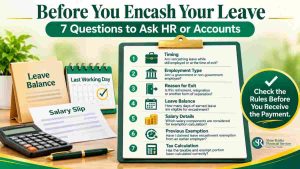
- Ask if the payment is in service or at exit, because in-service payments are always taxable.
- Ask which rule covers you: Central or State Government, or others.
- Get your leave history in writing: leave at credit, leave taken and leave already encashed.
- Know your average salary of the last 10 months (basic + DA, as your terms provide).
- Keep a record of earlier exemptions from every employer.
- Ask your CA to work out the exempt part before the payment is made.
- Check the current notified limit with your CA.
Leave encashment is one part of your exit. For the rest, read our retirement schemes guide and the NPS withdrawal rules guide. To compare tax regimes with numbers, see the old vs new tax regime guide. For planning in Surat, read the retirement planning guide for Surat, and for withdrawals after retirement the retirement SIP and SWP guide. Rules and rates change from time to time. Please confirm with your tax consultant / CA. Last verified on 6 November 2026 against the Income-tax Act 2025 and the CCS (Leave) Rules on the DoPT website. Notifications are published in the e-Gazette.
Leave Encashment Tax: Frequently Asked Questions
Is leave encashment taxable while I am still in service?
Yes. A payment for unused leave while you are working is salary. It is added to your income and tax is cut at source.
Leave encashment par kitna tax lagta hai?
In service, the whole amount is taxed at your slab rate. At retirement or when you leave, Central and State Government employees get the entire amount exempt. Other employees get the lowest of four figures exempt, and the rest is taxed as salary.
Is leave encashment taxable on resignation?
The exemption covers retirement “on superannuation or otherwise”, which is commonly read to include resignation. Confirm with your CA for your case. The four-figure test decides the exempt part.
How is leave encashment calculated for central government employees?
On retirement at the normal age, the cash equivalent is (pay + DA on the date of retirement) ÷ 30 × days of earned leave and half-pay leave together, up to 300 days (CCS Leave Rules, Rule 39).
What are the four figures for private-sector employees?
The cash equivalent of leave at credit (counted at no more than 30 days for each year of actual service), 10 × the average monthly salary of the last 10 months, the limit notified by the Central Government, and the actual payment.
Which salary is used in the calculation?
Basic pay, and DA if your terms of employment include DA in pay. Other allowances and perquisites are left out.
Is the leave encashment limit per employer?
No. It is the notified limit minus the exemption already allowed in earlier years, from any employer.
Is the leave encashment exemption available in the new tax regime?
Yes. Only the professional tax deduction in the same Table is not allowed in the new regime.
Can I encash leave and still plan for retirement?
Yes, but check the tax first. If you encash in service, the money is taxed as salary. Planning before you encash can leave more leave for the end, where the exemption applies.
This article is also available on Medium for wider reading:
Want a Clear Picture of Your Leave Encashment Tax?
Connect with Shree Radha Financial Services for a personalized discussion on the investment side of your retirement plan. For your own leave encashment and tax case, please ask your employer, your accounts section or your CA.
📞 Call/WhatsApp: +91 98791 13255
📧 Email: shreeradha.services@gmail.com
🌐 Visit: www.srwealth.co.in
📍 Shop 33, Mira Nagar 2, Dindoli Road, Surat 394210
Paresh Chaudhary
Founder, Shree Radha Financial Services, Surat
AMFI Registered Mutual Fund & SIF Distributor — ARN: 268390
APMI Registered PMS Distributor — APRN05763
Investing since 2012 | BE Mechanical, SVNIT Surat | Ex-L&T (15+ Years)
Educational Disclaimer: This article is published by Shree Radha Financial Services — an AMFI Registered Mutual Fund & SIF Distributor (ARN: 268390) and APMI Registered PMS Distributor (APRN05763). All content is strictly for educational purposes only and does not constitute individualized investment advice. We do not advise on individual leave encashment, pension or tax cases. Please confirm your own case with your employer, your office accounts section and a qualified tax professional. Mutual fund investments are subject to market risks — read all scheme-related documents carefully before investing. Rules and rates change from time to time. Tax treatment is based on the Income-tax Act 2025 as verified on 6 November 2026 and is subject to change. The characters in this article are fictional.