NPS Withdrawal Rules in India: Why Everyone Is Asking in 2026
NPS withdrawal rules changed in December 2025, and many employees are still not sure what the new rules mean for them. Government offices are circulating notes about NPS and UPS. Colleagues who joined before 2004 talk about the old pension. And private employees keep asking one question: “How much of my NPS money can I actually take out?”
This guide answers that in plain words and covers every NPS withdrawal rule that matters. You will meet four families from Ahmedabad, Surat, Vadodara and Rajkot. Each one believed something about NPS that was only half true. You will see what they thought, where the mistake was, and how it was corrected.
We have checked every NPS withdrawal rule against the PFRDA Exit Regulations as last amended on 20 July 2026, PFRDA’s own UPS page and the Income-tax Act, 2025 reference. For wider planning, read our retirement schemes guide and our PPF rules guide.
“When a government employee asks me about NPS, the real question is not ‘which scheme is best’. It is ‘what will I actually get, and what are my choices’. Most people have never been shown that in simple words, with real numbers.”
— Paresh Chaudhary, Founder, Shree Radha Financial Services

NPS Withdrawal Story 1: Rakesh in Ahmedabad and the Office Circular
Rakesh is 46. He works in a central government office in Ahmedabad and joined in 2009, so he is under NPS. One morning a circular about the Unified Pension Scheme (UPS) landed on his desk. At tea time, his senior Vinod, who joined in 2001 and is under the old pension scheme, said, “Rakesh, my pension is fixed. Yours is a gamble.”
Rakesh went home worried. In his head, three beliefs were running. First: “Vinod gets a fixed pension, and I get nothing fixed.” Second: “If I do nothing about this circular, I lose my pension.” Third: “At 60, NPS withdrawal will force me to buy a pension with all my money and I will have nothing in hand.”
He called us for a phone conversation (we have no office in Ahmedabad). Here is how each belief was tested.
“I get nothing fixed.” Under NPS, the pension depends on the corpus and the annuity rate, so it is not fixed. But UPS is built differently for central government employees. As per PFRDA’s page, UPS assures a payout of 50% of the average basic pay of the last 12 months, after at least 25 years of qualifying service. If the service is shorter, the payout is proportionate, and a minimum ₹10,000 a month applies after 10 years. For him, that is a real option to look at, not a gamble.
“If I do nothing, I lose everything.” No. PFRDA says that if no option is exercised, the employee continues under NPS. The time window to choose UPS was 30 November 2025, or such extended timelines as the government allowed. Please check with your office what applies to you today. There is also a one-time, one-way switch from UPS back to NPS.
“NPS forces me to buy a pension with everything.” Also no. A government employee exiting at retirement must put at least 40% into an annuity, and can take up to 60% as a lump sum. If the corpus is ₹8 lakh or less, the full amount can be taken. The money can also stay invested up to age 85, so NPS withdrawal can wait.
Rakesh’s mistake was making an NPS withdrawal and pension decision from a tea-time comment. A better way is to put three numbers on paper: years of service left, expected basic pay at retirement, and how much he wants to be assured versus flexible. We will come back to Rakesh at the end, with a clear OPS vs NPS vs UPS table.
What Is NPS? The Simple Picture
The National Pension System is a retirement account regulated by PFRDA. You have a PRAN (account number), and your money is invested in a mix of equity, corporate bonds, government securities and alternative assets. You can see the details on the NPS Trust website and the PFRDA website.
There are three main types of subscribers, and the NPS withdrawal rules depend on which one you are:
- Government sector: central and state government employees (and their autonomous bodies).
- Non-government sector: All Citizen model (you opened it yourself) and corporate model (your employer offers it).
- NPS-Lite and Swavalamban: a scheme for the unorganised sector.
UPS, introduced from 1 April 2025, is an option inside the NPS framework for central government employees only.
NPS Tier I vs Tier II: What Each One Is For
This matters because NPS withdrawal rules apply differently to each tier.
| Point | Tier I | Tier II |
|---|---|---|
| Purpose | The retirement account | A voluntary, flexible savings account linked to Tier I |
| Access to money | Restricted: partial NPS withdrawal for set reasons, full exit as per the exit rules | You can withdraw in full or part at any time |
| Tax deduction on deposit | Yes, as per the tax rules below | No. The exception is the Tier II Tax Saver Scheme for central government employees, with a 3-year lock-in |
| When Tier I exits | As per the exit rules | Tier II is closed at the same time, and the money is paid out |
NPS Withdrawal Story 2: Ankit in Surat and the Tier II Mix-up
Ankit is 36. He runs a small marketing consultancy from Adajan, Surat. He opened an NPS account at his bank and was asked if he also wanted Tier II. A friend told him, “Take both. Two accounts, double the tax saving.”
Ankit believed three things. First, both tiers save tax. Second, the money in NPS is locked completely till 60, so he should not put in too much. Third, at 60 the government pays him a pension, “like a salary”.
Here is the correction on NPS withdrawal and tax, in the order he asked.
Tier II and tax. For someone like Ankit, Tier II does not give a tax deduction. It is a flexible account where he can invest and take money out whenever he wants. Gains are taxed as per the rules for that kind of income, so please confirm with your CA. Only central government employees under the Tier II Tax Saver Scheme get a deduction, with a 3-year lock-in.
“Completely locked till 60.” Not completely. The NPS withdrawal rules allow a partial withdrawal from Tier I of up to 25% of your own contributions, after 3 years in NPS. It is allowed for specified reasons: higher education of children, marriage of children, a one-time house purchase or construction, medical treatment or hospitalisation, expenses arising from disability, or settling a loan taken against the NPS lien. You can do it up to four times before 60, with a gap of at least four years between withdrawals.
“The government pays me a pension.” NPS is not a government pension. It is your own money, invested in the market. At exit, an annuity has to be bought from a life insurer for at least a part. The monthly pension depends on that amount and on the annuity rate at that time.
Ankit’s good news: as a self-employed person, his own contribution can earn a deduction of up to 20% of gross income in the old regime, within the overall limit. His mistake was treating a product label as a tax rule.
How NPS Money Is Invested
- Auto choice: the mix changes with your age, with less equity as you grow older.
- Active choice: you decide how much goes to equity, corporate bonds and government securities. PFRDA sets the upper limits, and they differ for different subscribers and schemes.
- Multiple Scheme Framework: for non-government subscribers, schemes with different equity levels can sit under one PRAN. Check the current options on the NPS Trust site.
Returns are not fixed. NPS is market-linked, so the corpus can go up and down. None of this changes the NPS withdrawal rules, but it changes how big the corpus is when you reach them.
NPS Tax Benefits and NPS Withdrawal Tax: The EEE Check
The Income-tax Act, 2025 came into effect on 1 April 2026. NPS now sits in Section 124. Earlier this was Section 80CCD under the 1961 Act. The final lump-sum exemption is now in Schedule II. Earlier this was Section 10(12A) and 10(12B). You can see the law on the Income Tax Department website.
EEE means Exempt when you invest, Exempt while it grows, Exempt when you withdraw. NPS is exempt in the first two stages. At the exit stage, it is only partly exempt. That is the heart of NPS withdrawal tax.
| Stage | Old tax regime | New tax regime |
|---|---|---|
| Your own contribution | Counts within the overall ₹1.5 lakh limit (earlier 80CCD(1)). Self-employed: up to 20% of gross income, within that limit | No deduction |
| Extra ₹50,000 | Section 124(3) (earlier 80CCD(1B)). Not claimed again under Section 123 | No deduction |
| Employer’s contribution | Section 124(1)-(2) (earlier 80CCD(2)): up to 10% of salary for private employers, 14% for government employers | Same section, up to 14% for everyone. This is the one NPS benefit that survives in the new regime |
| While it grows | No tax inside NPS | No tax inside NPS |
| Partial withdrawal (up to 25% of own contributions) | Tax-free (earlier 10(12B)). Please confirm with your CA | Tax-free. Please confirm with your CA |
| Final lump sum | Up to 60% of the corpus is tax-free (Schedule II). The part above 60% is treated as taxable at your slab rate, as per current information. Confirm with your CA | Same |
| Annuity pension | Not taxed when you buy the annuity. The monthly pension is taxable as income | Same |
For UPS: PFRDA’s page says the NPS tax provisions apply to UPS in the same way, and the new Act lists the UPS lump sum and 60% of the corpus in Schedule II.
Tax on NPS withdrawal depends on your regime, income and employer policy. Please confirm the exact position for your case with your tax consultant or CA.
NPS Withdrawal Story 3: Sneha in Vadodara and the Employer’s NPS
Sneha is 45. She works in finance at a manufacturing company in Vadodara. Her company has a corporate NPS facility. In April she tore up the form. “EPF is already there, why one more?” she said, and her HR did not push further.
A few months later she told us, on a WhatsApp video call, that she dreams of leaving the job at 50 and starting a small business. She also assumed that her NPS, if she had it, could simply be withdrawn at 50.
Here is what she learned. First, the employer’s NPS. If her employer contributes to her NPS, that contribution is deductible in both tax regimes, up to 10% of salary in the old regime and up to 14% in the new regime for a private employee. It is one of the few tax benefits that works even when the new regime has taken most others away. Whether the company offers it, and in what form, depends on the company’s policy.
Second, leaving at 50. An exit before the normal exit age or before superannuation is treated as a premature exit. At least 80% of the corpus has to buy an annuity. Only up to 20% can be taken as a lump sum. If the corpus is ₹5 lakh or less, the whole amount can be taken. For an All Citizen account, an exit after 15 years of subscription is treated as a normal exit, but this 15-year route does not apply to accounts subscribed through employment.
Sneha’s mistake was treating NPS withdrawal like EPF withdrawal. EPF can be withdrawn on leaving a job. NPS is built for retirement, and the NPS withdrawal rules reflect that. She did not need to act in a hurry, but she needed to know the rule before planning an early exit.
NPS Withdrawal Rules: Where, When and How Much
This is the section most people search for when they type NPS withdrawal. All figures are from the PFRDA Exit Regulations as last amended on 20 July 2026.
NPS withdrawal at retirement or normal exit
| Corpus at exit | Government sector | Non-government sector |
|---|---|---|
| Up to ₹8 lakh | Up to 100% lump sum (or staggered payouts) | Up to 100% lump sum (or staggered payouts) |
| ₹8 lakh to ₹12 lakh | Up to ₹6 lakh lump sum. The balance as staggered payouts for at least 6 years, or annuity | Up to ₹6 lakh lump sum. The balance as staggered payouts for at least 6 years, or annuity |
| Above ₹12 lakh | Up to 60% lump sum. At least 40% annuity | Up to 80% lump sum. At least 20% annuity |
| Stay invested | Up to age 85 | Up to age 85 |
The lump-sum part can also be taken as periodic payouts: a systematic lump sum withdrawal (SLW), where you take the lump-sum portion in instalments, or a systematic unit redemption (SUR), where units are redeemed regularly. Tax on staggered payouts may differ, so please confirm with your CA.
NPS withdrawal before retirement (premature exit)
| Situation | What the rules allow |
|---|---|
| Voluntary exit or resignation (before normal exit) | At least 80% must buy an annuity. Up to 20% lump sum. If the corpus is ₹5 lakh or less, 100% can be taken |
| Non-government, All Citizen, after 15 years of subscription | Treated as normal exit (80:20 rule). Does not apply to accounts subscribed through employment |
| Government employee discharged for specified reasons | Treated as retirement (60:40) in listed cases, such as invalidation or 20 years of regular service for central government employees under CCS NPS Rules |
Partial NPS withdrawal before exit
- How much: up to 25% of your own contributions (not the employer’s), as on the date of application.
- When: only after 3 years in NPS.
- How often: up to 4 times before age 60 or retirement, with at least 4 years between withdrawals. If you stay beyond 60, the gap is 3 years.
- Why: higher education or marriage of children, one-time house purchase or construction, medical treatment or hospitalisation of self, spouse, children or parents, expenses from disability, or settling a financial obligation against the NPS lien.
Skill development and starting a venture were permitted reasons earlier, but have been removed from the regulations.
Loan against NPS
The regulations allow a subscriber to take financial assistance from a regulated financial institution, with a lien or charge on the NPS account up to the limit in the rules. PFRDA’s December 2025 press release mentions up to 25% of your own contributions. Availability depends on PFRDA’s operating circulars and on lenders, so please check the current status with your bank or NPS Trust.
NPS withdrawal on death of the subscriber
- Non-government: the whole corpus is paid to the nominee or legal heir. They can also choose staggered payouts or an annuity.
- Government: up to ₹8 lakh can be taken fully. Above that, at least 80% goes to an annuity for the family, and up to 20% is a lump sum. Please check your service rules too.
- Nomination is important. The rules also say NPS wealth is generally not open to seizure by court order for creditors, except for the lien allowed under the rules.
The NPS Annuity Requirement in Plain Words
An annuity is a contract with a life insurer. You give a sum, and the insurer pays you a pension, often for life. For NPS, the insurers are those empanelled by PFRDA. Once the free-look period is over, an annuity cannot be cancelled and reinvested elsewhere.
The default annuity gives a pension for the subscriber and the spouse for life. On the demise of both, the purchase price goes back to the family members, in the order set by the regulations. Other annuity types are available, and the payout depends on the type, your age and the insurer.
The pension from an annuity is taxable as income. This is why many families look at the exact split between lump sum and annuity before exit, and compare written quotes from different insurers. This is why the annuity part of an NPS withdrawal needs a little homework.
NPS Withdrawal Story 4: Mahendrabhai in Rajkot and the ₹50 Lakh Question
Mahendrabhai is 60. He retired from a private company in Rajkot. His All Citizen NPS corpus is about ₹50 lakh. A neighbour told him, “Take all 80% in cash, it’s all tax-free, and keep just 20% for the pension.”
Mahendrabhai believed two things. First, that the whole 80% lump sum is tax-free. Second, that taking less annuity is always better because “a pension is only a small amount anyway”.
On a phone call, we put two NPS withdrawal options side by side. These numbers are examples. The monthly pension uses an assumed annuity rate of 6% a year, which is not a quote. Real annuity rates vary by insurer, type and age.
| On a ₹50 lakh corpus | Option A: 60% lump sum, 40% annuity | Option B: 80% lump sum, 20% annuity |
|---|---|---|
| Lump sum | ₹30 lakh | ₹40 lakh |
| Tax-free part | ₹30 lakh | ₹30 lakh |
| Part treated as taxable income | Nil | ₹10 lakh (added to income in that year) |
| Annuity amount | ₹20 lakh | ₹10 lakh |
| Monthly pension at an assumed 6% | About ₹10,000 (taxable) | About ₹5,000 (taxable) |
Illustrative only. Option A is the rule that applies to government employees. For non-government subscribers it is a choice within the rules. No annuity quote is implied.
Mahendrabhai learned that tax-free NPS withdrawal stopped at 60%. The extra ₹10 lakh would be added to his income that year, and the tax would depend on his slab. He also saw that a smaller annuity means a smaller fixed income, which matters if his other income is limited. He did not rush. He asked his CA to estimate the tax on Option B, and asked three insurers for written annuity quotes. He also learned that he could defer both the lump sum and the annuity till 85 and keep the money invested.
NPS Withdrawal: A Worked Example with Numbers
Let us look at ₹10,000 a month for 25 years. You put in ₹30 lakh in total. What it grows to depends on the yearly growth rate. These rates are examples, not promises. NPS is market-linked.
| Example yearly growth | Total invested | Corpus after 25 years (approx.) |
|---|---|---|
| 8% | ₹30 lakh | ₹95.7 lakh |
| 10% | ₹30 lakh | ₹133.8 lakh |
| 12% | ₹30 lakh | ₹189.8 lakh |
Illustrative only. Monthly investing and monthly compounding. Charges and tax are not included.
Now take the 10% case (₹133.8 lakh) and see how the exit differs for a government and a non-government subscriber. The pension uses the same assumed 6% annuity rate, which is not a quote.
| At exit on ₹133.8 lakh | Government (60:40) | Non-government, maximum lump sum (80:20) |
|---|---|---|
| Lump sum | ₹80.3 lakh | ₹107.0 lakh |
| Tax-free part | ₹80.3 lakh | ₹80.3 lakh |
| Taxable part of lump sum | Nil | ₹26.8 lakh |
| Annuity amount | ₹53.5 lakh | ₹26.8 lakh |
| Monthly pension at an assumed 6% | About ₹26,800 | About ₹13,400 |
Illustrative only. Not an annuity quote and not a promise of returns. Tax on the taxable portion depends on your slab. Confirm with your CA.
This is why the NPS withdrawal rules are worth understanding early. The same corpus gives a different mix of cash, tax and monthly pension depending on who you are and what you choose.
OPS vs NPS vs UPS: What Is Good and What to Watch Out For
Many employees ask for the old pension scheme, and the government is pushing UPS. Both change how you think about NPS withdrawal. We will not take a side. Policies are decided by governments, and they differ for central and state employees. Here are the facts from the sources we could check, plus what each option is good for.
| Point | Old pension (OPS) | NPS | UPS (central government) |
|---|---|---|---|
| Who is covered | Mainly central government employees recruited before 1 January 2004. State rules differ | Government recruits after 2004, and any citizen | Central government employees (serving, new recruits, and certain retirees) |
| Who pays | Government. No employee contribution | Employee 10% and government 14% (central government) | Employee 10%, government 10% matching and about 8.5% to a pool corpus |
| Pension amount | About 50% of last pay (or average of last 10 months, whichever is more beneficial). Full pension needs 33 years of qualifying service | Not fixed. Depends on corpus and annuity rate | Assured payout of 50% of average basic pay of last 12 months, after 25 years. Proportionate between 10 and 25 years. Minimum ₹10,000 a month after 10 years |
| Lump sum | Commutation up to 40% of pension, plus gratuity | Up to 60% (government) at exit | Final withdrawal up to 60% of corpus (reduces the assured payout), and a lump sum of one-tenth of monthly pay for every 6 months of service |
| Family | Family pension as per rules | Depends on annuity type, and the corpus can go to the nominee | 60% of the payout to the spouse |
| Inflation | Dearness relief as notified | Not built in. Annuity is fixed unless the type has escalation | Dearness relief as notified |
| Good for | Predictability linked to your last pay, with no contribution from you | Flexibility, choice of investments, a corpus you can leave to family, tax benefits | A defined payout inside the NPS system, with a one-time switch back to NPS |
| Watch out for | Only for those covered. Future policy is a government decision | Market risk, annuity rates, no assured amount | Only central government. Needs long service for full benefit. Taking the 60% withdrawal reduces the payout |
Taxes: UPS gets the same tax treatment as NPS. For OPS, the monthly pension is taxed as income. The commuted portion and gratuity have their own exemptions (Section 19(1) table of the new Act, earlier 10(10A) and 10(10)). Please confirm with your CA.
For state government employees: UPS is a central government scheme. State rules differ from state to state and can change, so check the latest order from your own department.
Back to Rakesh: Questions to Ask Before He Decides
Rakesh did not need a verdict. He needed a list. Here is what we gave him, and it works for any government employee:
- How many years of qualifying service will I complete by retirement?
- What is my likely basic pay then?
- How important is an assured amount compared with flexibility and a corpus I can leave to my family?
- What is my current option status, and is there a deadline or a window still open? Ask your DDO.
- What does my spouse’s family pension look like under each choice?
With ₹80,000 as an example last basic pay and 25 years of service, the UPS assured payout would be 50%, which is ₹40,000 a month before dearness relief. Rakesh compared that with a rough NPS projection and spoke to his family before deciding. The right answer was different for him than for his neighbour.
NPS Withdrawal Rules: Which Situation Suits What
- Central government employee: check OPS eligibility, NPS and UPS status with your office. Use the questions above.
- State government employee: follow your state’s latest rules, which differ and can change.
- Private salaried employee: look at the employer’s NPS contribution first, since it works in both tax regimes.
- Self-employed or business owner: NPS can add a long-term, disciplined bucket next to PPF and mutual funds. Read our retirement planning guide for Surat investors.
- Senior executives: corporate NPS and tax planning go together. Our CXO guide covers more.
- NRIs: eligibility and tax rules differ. Start with our NRI retirement planning guide.
NPS Withdrawal Rules: Where NPS Helps Most
- Long-term discipline. The structure makes it hard to spend the money early.
- Low-cost, regulated and flexible. You choose the mix, and it moves with you when you change jobs.
- Employer contribution benefit that works in both tax regimes.
- A corpus for family. On death, a non-government subscriber’s nominee gets the whole corpus.
- Protection from creditors, as per the regulations, except for the lien the rules allow.
- You can stay invested up to 85 and defer the lump sum and annuity, so NPS withdrawal can wait.
NPS Withdrawal Rules: Where NPS Has Limits
A balanced view matters. These are the real limits of NPS:
- Market risk. The corpus can fall as well as rise.
- Annuity is mandatory for at least part of the money (20% or 40%, or 80% in a premature exit). Annuity rates can be modest, and the pension is taxable.
- The tax-free part stops at 60% of the lump sum, as per current information.
- NPS withdrawal is restricted before exit age. Partial withdrawals are limited to 25% of your own contributions, 4 times, for set reasons.
- Rules change often. PFRDA amended the exit rules in December 2025 and again in July 2026. Always check the latest.
- No tax deduction in the new regime except the employer’s contribution.
Many families use NPS as one part of the plan, next to a safe bucket and a flexible bucket. Our guide to whether ₹2 crore is enough to retire shows how to think about the full corpus. You can try your own numbers on our calculator.
A Short Note for Parents: NPS Vatsalya
Priya, a mother in Surat, asked whether she could start an NPS account for her 8-year-old son. NPS Vatsalya is a separate scheme where a parent or guardian opens an account for a minor, and it moves to the regular NPS when the child turns 18. Its withdrawal and tax rules are different, so please check the current PFRDA details. If you are planning for a child, also read Child Education and Retirement Fund: 5 Costly Mistakes to Avoid.
Seven NPS Withdrawal Mistakes to Avoid
- Assuming the whole 80% lump sum is tax-free.
- Opening Tier II for a tax deduction it does not give.
- Ignoring the employer’s NPS contribution benefit.
- Planning an early exit without knowing the 80% annuity rule.
- Taking a partial NPS withdrawal without checking the 3-year, 25% and 4-year gap limits.
- Deciding on UPS or NPS from office gossip, not from your own numbers.
- Not registering a nominee.
NPS Withdrawal Checklist: Seven Questions Before You Decide
Use this list to apply the NPS withdrawal rules to your own account.
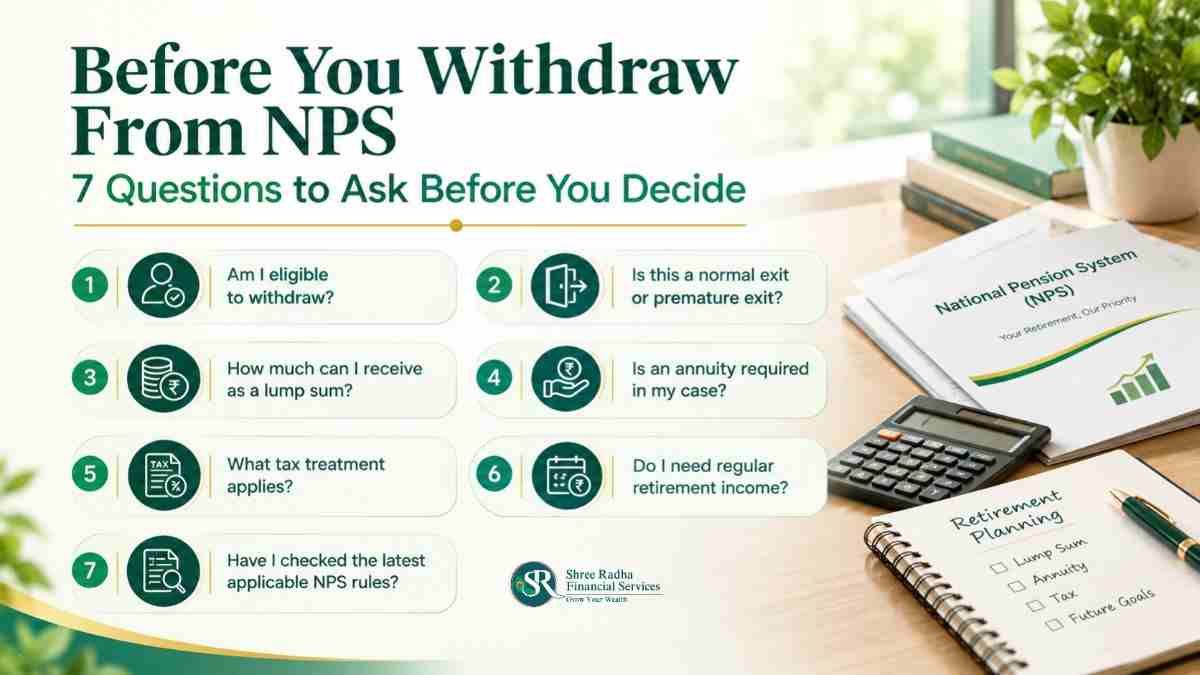
- Am I a government or non-government subscriber? The NPS withdrawal rules differ.
- Which tax regime am I in? Only the employer’s contribution deduction works in both.
- Does my employer contribute to my NPS?
- How much do I want as lump sum, and what will be taxable? Check the 60% limit.
- Have I compared written annuity quotes?
- Do I know the partial withdrawal limits? 3 years, 25% of own contributions, up to 4 times.
- Is my nominee registered and my PRAN details updated?
Rules and regulations change from time to time. Please connect with your tax consultant / CA for details specific to your situation. Figures in this article were last verified on 27 October 2026.
NPS Withdrawal Rules: Frequently Asked Questions
How much NPS withdrawal is allowed at 60?
For non-government subscribers with a corpus above ₹12 lakh, up to 80% can be taken as a lump sum, and at least 20% must buy an annuity. For government subscribers, up to 60% lump sum and at least 40% annuity. Smaller corpus amounts have more flexibility: up to ₹8 lakh can be taken in full.
Is the NPS withdrawal amount fully tax-free?
No. Up to 60% of the corpus is tax-free. Under current information, the part above 60% in a non-government exit is taxable at your slab rate. The annuity pension is also taxable. Please confirm with your CA.
Can I make a partial NPS withdrawal before 60?
Yes, after 3 years in NPS, up to 25% of your own contributions, for specified reasons, up to 4 times, with at least 4 years between withdrawals.
What is the difference between NPS Tier I and Tier II?
Tier I is the retirement account with restricted access and tax benefits. Tier II is a flexible account with no lock-in and no tax deduction, except for central government employees under the Tier II Tax Saver Scheme.
Can I continue my NPS after 60?
Yes. You can stay invested up to age 85 and defer both the lump sum and the annuity purchase, which means you can delay your NPS withdrawal.
What is the annuity requirement in NPS withdrawal?
At least 20% for non-government and 40% for government subscribers at normal exit, and at least 80% in a premature exit. Smaller corpus amounts are exempt from the annuity requirement, up to the limits in the table above.
What happens to my NPS if I die?
For non-government subscribers, the whole corpus goes to the nominee or legal heir. For government subscribers, a larger part goes into an annuity for the family, as per the regulations.
Is UPS better than NPS?
It depends on your service length, pay and priorities. UPS is available only to central government employees and gives an assured payout under conditions. Please compare with your own numbers and confirm your status with your office.
This article is also available on Medium for wider reading:https://medium.com/@shreeradha.services/nps-withdrawal-rules-in-india-lump-sum-annuity-tax-and-ops-vs-nps-vs-ups-explained-f6a057f3ad1f
Want to See How the NPS Withdrawal Rules Fit Your Retirement Plan?
Connect with Shree Radha Financial Services for a personalized discussion.
📞 Call/WhatsApp: +91 98791 13255
📧 Email: shreeradha.services@gmail.com
🌐 Visit: www.srwealth.co.in
📍 Shop 33, Mira Nagar 2, Dindoli Road, Surat 394210
Paresh Chaudhary
Founder, Shree Radha Financial Services, Surat
AMFI Registered Mutual Fund & SIF Distributor — ARN: 268390
APMI Registered PMS Distributor — APRN05763
Investing since 2012 | BE Mechanical, SVNIT Surat | Ex-L&T (15+ Years)
Educational Disclaimer: This article is published by Shree Radha Financial Services — an AMFI Registered Mutual Fund & SIF Distributor (ARN: 268390) and APMI Registered PMS Distributor (APRN05763). NPS and UPS are regulated by PFRDA and are not products of this firm. All content is strictly for educational purposes only and does not constitute individualized investment advice. Mutual fund investments are subject to market risks — read all scheme-related documents carefully before investing. Tax treatment is based on current laws and subject to change. Please consult a qualified tax professional before investing. The characters in this article (Rakesh, Vinod, Ankit, Sneha, Mahendrabhai and Priya) are fictional and used only to explain situations. Numbers in the worked examples are illustrative, use an assumed annuity rate that is not a quote, and are not a promise of returns.