EPF Withdrawal Tax: Why One Click Can Cost You
EPF withdrawal tax is the part most people learn about only after the money has been paid out. The rule looks simple: wait five years and your EPF is tax-free. But the real rule has more steps. It depends on how you count those five years, why you leave your job, and whether you withdraw or transfer.
This guide explains EPF withdrawal tax and the timing rules in plain words. It follows five people from five cities, and each one makes a different mistake. They are fictional, and each one reads the rules and asks their own HR, EPFO office or CA before the next step.
Reading time: about 12 minutes | Last verified: 6 November 2026
Quick answer: EPF withdrawal tax in short
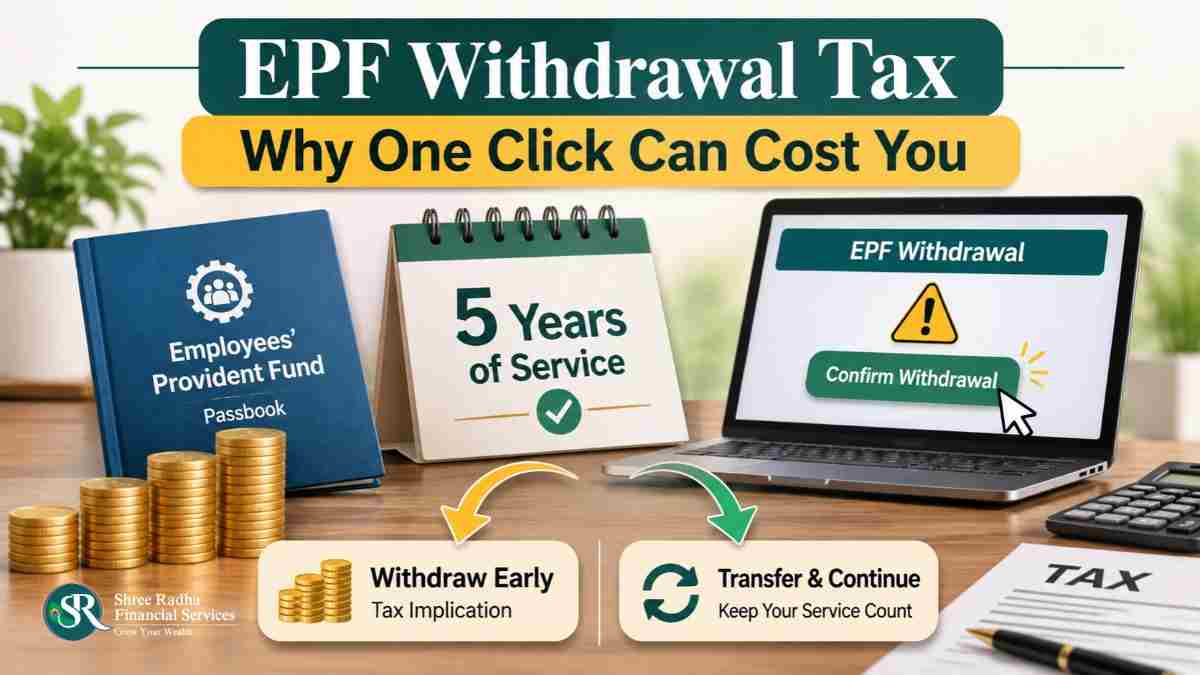
If you have five years of continuous service (including earlier jobs whose balance was transferred), your EPF balance is excluded from your income. If you have less, the balance may be taxed, and tax of 10% is cut at source when the payment is ₹50,000 or more. Transferring your account, instead of withdrawing, can keep your service count and your tax-free status.
If you have five years of continuous service (including earlier jobs whose balance was transferred), your EPF balance is excluded from your income. If you have less, the balance may be taxed, and tax of 10% is cut at source when the payment is ₹50,000 or more. Transferring your account, instead of withdrawing, can keep your service count and your tax-free status.
Who this guide is for: any salaried person who is changing jobs, has lost a job, or wants to know what happens to the EPF balance before they click “withdraw”.
“Changing jobs is the most common time to make an EPF withdrawal tax mistake. People are busy, a new salary is coming, and the old PF looks like free cash. A withdrawal takes a minute. Fixing its tax effect can take much longer. EPF withdrawal tax is easier to plan than to repair.”
— Paresh Chaudhary, Founder, Shree Radha Financial Services
How EPF Withdrawal Tax Works: Three Steps
Before the stories, here is the EPF withdrawal tax rule in one place. Read it once, and the stories will make more sense.
Step 1: Count your continuous service. Service with earlier employers counts only for the balance that was transferred to your new account.
Step 2: If you have five years or more, the balance is excluded from your income. The balance is also excluded if you have less than five years but your service ended because of ill-health, closure or contraction of the employer’s business, or another cause beyond your control.
Step 3: If neither applies, the balance is included in your income. Tax of 10% is cut at source when the payment is ₹50,000 or more.
Step 2: If you have five years or more, the balance is excluded from your income. The balance is also excluded if you have less than five years but your service ended because of ill-health, closure or contraction of the employer’s business, or another cause beyond your control.
Step 3: If neither applies, the balance is included in your income. Tax of 10% is cut at source when the payment is ₹50,000 or more.
Law reference: Income-tax Act 2025, Schedule XI Part A, para 8(1) and (2) (earlier Section 10(12) read with the Fourth Schedule); Section 392(7) (tax deducted at source).
The exclusion also applies if, on leaving a job, you take up employment with another employer and the balance is transferred to your new account. That is why transfer matters so much for EPF withdrawal tax. When the balance is not excluded, the tax is worked out under paragraph 9 of the same Part. A small point for ₹50,000 or less: no tax is cut at source, but the balance can still be part of your income.
If your tax for the year is nil, you can give a declaration in Form 121 (earlier Forms 15G and 15H) so that tax is not cut at source (Section 393(6)). Your CA can tell you if it applies to you.
EPF Withdrawal Tax Mistake 1: Vikash Withdrew After Three Years
Vikash Reddy was 29 and worked for a pharma company in Hyderabad. After three years, a start-up offered him a better role. On his last day, his EPF balance stood at about ₹2,40,000. He had a plan for it: the down payment for a new bike.
“It is my money,” he told his friend Rohan over lunch. “I will just withdraw it. Why would anyone move it to the new company?” That evening he opened the EPFO portal, filled in the claim, and clicked submit. Ten days later, the money arrived.
But it was not ₹2,40,000. His bank account showed ₹2,16,000. He called Rohan, who works as a tax assistant in Secunderabad. “That is tax at source,” said Rohan. “You had less than five years of service, and you did not move the balance to your new account. So the balance was treated as income, and 10% was cut because the payment was above ₹50,000.”
Vikash felt foolish. He had never heard of EPF withdrawal tax. He read the rule himself. He saw that the tax cut at source is not the final tax. When he filed his return, the CA he consulted told him the amount would be adjusted against his total tax. But he still lost the use of ₹24,000 for months, and the balance was taxed in a way he had not planned. At his next job change, he asked the new HR to guide him through the transfer. He did not withdraw again.
In simple words: EPF withdrawal tax applies when you have less than five years and you take the money out. The simple fix is to transfer the balance to your new account. Paragraph 43 of the EPF Scheme 2026 allows a member who takes up a job in another covered establishment to apply on the designated portal for transfer.
Law reference: EPF Scheme 2026, Para 43; Income-tax Act 2025, Schedule XI Part A para 8(1)(c) and Section 392(7).
Closing the Old Account: How Pooja in Pune Lost Her Service Count
Pooja Kulkarni, 34, had worked for six years in two companies in Pune. At her first company she worked for four years. When she moved to the second one two years ago, she withdrew the old balance to pay a loan EMI. She thought nothing of it.
Now she was planning to leave her second company. A colleague, Ankita, had said, “After five years in jobs you pay no tax on PF. You have six years, so you are safe.” Pooja nodded, and she planned to withdraw her second company balance of ₹3,10,000 for her sister’s wedding.
Before she applied, she asked her CA, Mr. Joshi, to confirm the EPF withdrawal tax. He asked one question first: “Did you transfer your first company balance or withdraw it?” Pooja said she withdrew it. Mr. Joshi shook his head. “Then only your two years at the second company count. Earlier service counts only for the balance that was transferred.”
Pooja did not withdraw. She asked Mr. Joshi what her options were. He showed her that, if she moved to another employer, she could transfer the balance and keep the count growing from there. She also learned a harder rule. After a full withdrawal for leaving a job, a member who takes up covered employment again is treated as a fresh member (EPF Scheme 2026, Para 49(3)). She decided to look for the next job first, and to transfer the balance when she joined.
In simple words: for EPF withdrawal tax, your five years are not a total of all your jobs. The service with earlier employers counts only for the balance that was transferred. If you withdrew it, that service no longer counts.
Law reference: Income-tax Act 2025, Schedule XI Part A para 8(2); EPF Scheme 2026, Para 47 and Para 49(3).
EPF Withdrawal Rules and Timing: Imran in Kolkata Waited Only Two Months
Imran Sheikh was a 38-year-old contract supervisor at a logistics firm in Kolkata. When his contract ended in July, he was not worried. A friend had told him, “After two months without a job, you can withdraw your full PF.” Imran counted: September.
His mother’s treatment had started, and the bills were growing. In September he applied for full withdrawal. The claim was rejected. He rang the EPFO office. The officer was patient: “Sir, for a full withdrawal on leaving a job, the rule is now twelve months out of covered employment, not two.”
Imran sat on the office steps, worried. Then the officer added something. “Your mother’s illness is a different case. There is a partial withdrawal for illness. Your balance must remain above a minimum, but you can take most of it.” He filled the form properly that day, asked HR for the papers, and kept a copy. The partial withdrawal came through, and the rest of the balance stayed in his account.
In simple words: the wait rule comes before EPF withdrawal tax even applies. For a full EPF withdrawal after leaving a job, the EPF Scheme 2026 requires you to stay out of covered employment for a continuous period of twelve months. Women who resign to get married are exempt from the wait. A member can also withdraw in full on retirement after the age of 55, on retrenchment, or on permanent incapacity. For illness, housing, education, marriage or special circumstances, partial withdrawal is possible while the balance stays in the account.
Law reference: EPF Scheme 2026, Para 49(1), 49(2) and Para 46.
| Partial withdrawal under Para 46 | Rule |
|---|---|
| Minimum membership | 12 months |
| Minimum balance | 25% of total contributions and interest must stay in the account |
| Education | Up to 10 times |
| Marriage | Up to 5 times |
| Housing | Up to 5 times |
| Special circumstances | Up to 2 times in a year |
EPF Transfer and Claim Timing: Lakshmi in Chennai Applied at the Last Minute
Lakshmi Narayanan was an accountant in Chennai. School fees for her two children were due on the 30th. On the 25th, she remembered her old EPF balance, applied for the claim online, and felt calm. “Twenty days is the rule,” she told her husband. “It will be fine.”
EPF withdrawal tax was not her worry, because her service was long. Timing was. But the claim was not complete. Her name on her records had one spelling, and her bank had another. The claim sat for eighteen days. Then a note came: there was a deficiency. She called her old HR, who also found that her last employer had not yet recorded her leaving date.
The fees were paid from a loan from her brother. A few weeks later she corrected the details, and the claim went through. She read the paragraph on claims herself. The EPF Scheme 2026 says that a claim that is complete in all respects is to be settled within twenty days of receipt. A deficiency has to be communicated within twenty days. And if the Commissioner fails without sufficient cause to settle a complete claim in time, penal interest of 12% a year may be charged, and it is deducted from the salary of the Commissioner. It is not a payment to the claimant.
In simple words: the twenty-day period starts only when the claim is complete. Check that your name, date of birth, bank details and exit date are right, and apply well before you need the money.
Law reference: EPF Scheme 2026, Para 54(7), (8) and (9).
EPF Withdrawal Tax on Interest: Bharat in Surat Added Too Much
Bharat Shah was an operations head at a diamond unit in Katargam, Surat. He liked the idea of safe savings. Every year he added a big voluntary deposit to his EPF, on top of the regular share. “Safe, steady, and tax-free,” he told his wife Hetal.
At the time of filing his return, his CA, Mr. Mehta, asked for the EPF passbook. He looked at the total of Bharat’s own deposits for the year and paused. It was ₹3,60,000. “Bharat, do you know that interest on your own deposits above ₹2.5 lakh a year is not tax-free?”
Bharat had not known. Mr. Mehta explained that the limit is ₹5 lakh if the employer makes no contribution, but Bharat’s employer did. He also explained that the voluntary route, on salary above the wage ceiling, is allowed by the Scheme (Para 19) but does not remove the tax rule. Bharat checked with his HR how much he was depositing in all. He cut the voluntary amount for the next year to stay under the limit.
In simple words: on EPF withdrawal tax and interest, the rule is this: interest on the part of your own yearly deposit above ₹2.5 lakh (₹5 lakh if the employer does not contribute) is not excluded from your income. The old regime also gives a deduction for your own contribution under Section 123 (earlier Section 80C). The new regime does not.
Law reference: Income-tax Act 2025, Schedule II Sl. 3-4 (earlier Section 10(11)/(12)); EPF Scheme 2026, Para 19; Section 123.
The EPF Withdrawal Tax Cheat Sheet: Five Situations
Use this table to see EPF withdrawal tax at a glance.
| Situation | Is the balance in your income? | Tax cut at source? |
|---|---|---|
| Five years or more of continuous service | No, it is excluded | No |
| Less than five years, balance transferred to the new employer’s account | No, to the extent transferred | No |
| Less than five years, service ended due to ill-health, closure or contraction of the business, or another cause beyond your control | No, it is excluded | No |
| Less than five years, withdrawn, payment ₹50,000 or more | Yes | Yes, 10% (Form 121 if your tax is nil) |
| Less than five years, withdrawn, payment below ₹50,000 | Yes | No, but it is still part of your income |
EPF Withdrawal Tax: Myth vs Fact
Most EPF withdrawal tax mistakes come from half-known rules.
| Myth | Fact |
|---|---|
| Five years means five years in total across all jobs | Earlier service counts only for the balance that was transferred |
| I can take my full PF two months after leaving a job | The Scheme requires twelve months out of covered employment, with exceptions |
| The 20-day period starts when I click submit | It runs for claims that are complete in all respects |
| EPF interest is always tax-free | Interest on your own yearly deposit above ₹2.5 lakh (₹5 lakh if there is no employer share) is not excluded |
| A partial withdrawal can empty my account | 25% of contributions and interest must stay as Minimum Balance |
| Tax at source is the final tax | It is an advance. The actual tax is settled in your return |
EPF Withdrawal Tax Checklist: Before You Click
Use this EPF withdrawal tax checklist before you withdraw or transfer.

- Count your service: continuous years, and which balances were transferred.
- Ask if transfer is possible before you choose withdrawal.
- Check why you left: the exceptions for ill-health, closure and causes beyond your control.
- Know the 12-month rule for full withdrawal, and the partial withdrawal options.
- Check your details: name, date of birth, bank and exit date, and apply early.
- Check your yearly deposit against the ₹2.5 lakh interest limit.
- Ask your CA about the tax on your balance before you apply.
EPF withdrawal tax is one part of your retirement plan. For the rest, read our retirement schemes guide and the PPF rules guide. To compare the two tax regimes, see the old vs new tax regime guide. For the NPS side, see the NPS withdrawal rules guide, and for planning in Surat, the retirement planning guide for Surat. Rules and rates change from time to time. Please confirm with your tax consultant / CA. Last verified on 6 November 2026 against the Income-tax Act 2025 and the EPF Scheme 2026 on the EPFO website. The Scheme is published in the e-Gazette.
EPF Withdrawal Tax: Frequently Asked Questions
Is EPF withdrawal taxable if I change jobs before five years?
EPF withdrawal tax can apply. If you have less than five years of continuous service and you withdraw, the balance is included in your income, and 10% tax is cut at source if the payment is ₹50,000 or more. If you transfer the balance to your new account, it is not included to the extent transferred.
PF nikalne par kitna tax lagta hai?
After five years of continuous service, no tax. Before that, the balance is included in your income, and 10% is cut at source when the payment is ₹50,000 or more. The actual tax is settled in your return.
Does transferring my PF reset the five-year count?
No. For EPF withdrawal tax, service with earlier employers counts for the balance that was transferred. If you withdraw it instead, that service does not count.
Can I withdraw my full PF right after resigning?
Generally no. The EPF Scheme 2026 requires twelve months out of covered employment for a full withdrawal on leaving a job. Exceptions include retirement after 55, retrenchment, permanent incapacity and women resigning to marry.
How much can I withdraw as a partial withdrawal?
Up to the eligible balance for listed purposes, while 25% of contributions and interest stays as Minimum Balance. You need at least 12 months of membership.
How long does a claim take?
A claim complete in all respects is to be settled within 20 days of receipt, and any deficiency is to be communicated within 20 days.
Is the interest on my EPF always tax-free?
No. Interest on your own yearly deposit above ₹2.5 lakh (₹5 lakh if the employer does not contribute) is not excluded.
What if I get a pension from EPS?
The pension scheme has its own rules. For the withdrawal benefit on leaving before ten years of service, the EPS 2026 requires waiting thirty-six months from the date the last contribution was due.
Does tax at source settle my tax?
No. It is an advance against your tax for the year. You settle the final amount when you file your return, and your CA can help.
This article is also available on Medium for wider reading:
Want a Clear Picture of Your EPF Withdrawal Tax?
Connect with Shree Radha Financial Services for a personalized discussion on the investment side of your retirement plan. For your own EPF withdrawal tax or transfer case, please ask your employer, your EPFO office or your CA.
📞 Call/WhatsApp: +91 98791 13255
📧 Email: shreeradha.services@gmail.com
🌐 Visit: www.srwealth.co.in
📍 Shop 33, Mira Nagar 2, Dindoli Road, Surat 394210
Paresh Chaudhary
Founder, Shree Radha Financial Services, Surat
AMFI Registered Mutual Fund & SIF Distributor — ARN: 268390
APMI Registered PMS Distributor — APRN05763
Investing since 2012 | BE Mechanical, SVNIT Surat | Ex-L&T (15+ Years)
Educational Disclaimer: This article is published by Shree Radha Financial Services — an AMFI Registered Mutual Fund & SIF Distributor (ARN: 268390) and APMI Registered PMS Distributor (APRN05763). All content is strictly for educational purposes only and does not constitute individualized investment advice. We do not advise on individual EPF, pension or tax cases. Please confirm your own case with your employer, your EPFO office and a qualified tax professional. Mutual fund investments are subject to market risks — read all scheme-related documents carefully before investing. Rules and rates change from time to time. Tax treatment is based on the Income-tax Act 2025 as verified on 6 November 2026 and is subject to change. The characters in this article are fictional.