Introduction
Old vs new tax regime 2026-27 is a choice most salaried people and business owners make once a year, often by habit. The new regime is the default under Section 202 of the Income-tax Act 2025, and the old regime is still there as an option. The right pick comes down to one thing: how large your deductions are.
This guide shows the numbers. We use the same slabs for FY 2025-26 (filed under the 1961 Act) and Tax Year 2026-27 (the 2025 Act), because the slab rates did not change. If you have not read it yet, our income tax computation guide explains the 8 steps behind every figure here.
“Every March, many Surat families buy tax-saving products just to claim a deduction, without checking whether the old regime even suits them. The deduction should be a by-product, not the reason. Check the regime first, then decide what to invest in for your own goals.”
— Paresh Chaudhary, Founder, Shree Radha Financial Services
Old vs New Tax Regime: Why Mehul Paid ₹89,000 More Than Needed
Mehul is a 38-year-old manager at a chemical company in Vadodara. His gross salary is ₹18 lakh. Last April his HR team sent a link: “Declare your tax regime for TDS.”
He ticked the old regime, because a friend had said it saves tax. His employer then deducted TDS as per the old regime for the whole year.
When we ran his numbers, the picture was different. His real deductions were modest: ₹1.8 lakh HRA exemption (assumed), ₹1.5 lakh under Section 123 and ₹25,000 under Section 126.
| Mehul, ₹18 lakh salary | New regime | Old regime |
|---|---|---|
| Taxable income | ₹17,25,000 | ₹13,95,000 |
| Tax on slabs | ₹1,45,000 | ₹2,31,000 |
| Cess at 4% | ₹5,800 | ₹9,240 |
| Total tax | ₹1,50,800 | ₹2,40,240 |
The new regime would have cost about ₹89,000 less. The good news is that the regime you tell your employer is for TDS only. A salaried person with no business income can choose again when filing the return, so Mehul can still correct it.
Old vs New Tax Regime 2026-27: Both Regimes Side by Side
The slabs and the main rules sit in Section 202 and Section 156 of the Income-tax Act 2025. Use this table to see what each regime gives and takes away.
| Feature | New regime (Section 202) | Old regime (optional) |
|---|---|---|
| Status | Default | You choose it |
| Slabs | Nil up to ₹4 lakh, then 5%, 10%, 15%, 20%, 25%, 30% above ₹24 lakh | Nil up to ₹2.5 lakh, then 5%, 20%, 30% above ₹10 lakh |
| Rebate (Section 156) | Up to ₹60,000 if income is up to ₹12 lakh | Up to ₹12,500 if income is up to ₹5 lakh |
| Standard deduction (salaried) | ₹75,000 | ₹50,000 |
| Section 123 (earlier 80C) | Not allowed | Up to ₹1,50,000 |
| Section 126 (earlier 80D) | Not allowed | Allowed, with limits |
| NPS: employer contribution (Section 124) | Allowed, up to 14% of salary | Allowed, up to 10% of salary (14% for Government employers) |
| NPS: own contribution (Section 124(3)) | Not allowed | Up to ₹50,000 extra |
| HRA exemption | Not allowed | Allowed, as per Income-tax Rules |
| Home loan interest, self-occupied house (Section 22(2)(a)) | Not allowed | Up to ₹2,00,000 |
| House property loss set-off against other income | Not allowed | Up to ₹2,00,000 |
Notice what the new regime still allows: the higher standard deduction and the employer’s NPS contribution. These two items help most people who choose it. Everything else in the old column is where the old regime gets its power, and that is why the break-even matters.
Which Act Applies: FY 2025-26 or Tax Year 2026-27?
Income earned up to 31 March 2026 is taxed under the Income-tax Act 1961, and its return is for Assessment Year 2026-27. The regime there is Section 115BAC. Income from 1 April 2026 is under the Income-tax Act 2025 as Tax Year 2026-27, and the regime is Section 202.
The Income Tax Department explains the move in its FAQs on the transition. Here is where the old and new sections match.
| Item | 1961 Act | 2025 Act |
|---|---|---|
| New tax regime | Section 115BAC | Section 202 |
| Rebate | Section 87A | Section 156 |
| Standard deduction | Section 16 | Section 19 |
| Investments deduction | Section 80C | Section 123 (with Schedule XV) |
| NPS deductions | Section 80CCD | Section 124 |
| Health insurance deduction | Section 80D | Section 126 |
| Home loan interest | Section 24(b) | Section 22 |
| Interest on savings | Sections 80TTA / 80TTB | Section 153 |
| Return of income | Section 139 | Section 263 |
| Option form for business owners | Form 10-IEA (up to AY 2026-27) | Option made in the return (confirm the form or rule with your CA) |
Old vs New Tax Regime Break-Even: How Many Deductions Do You Need?
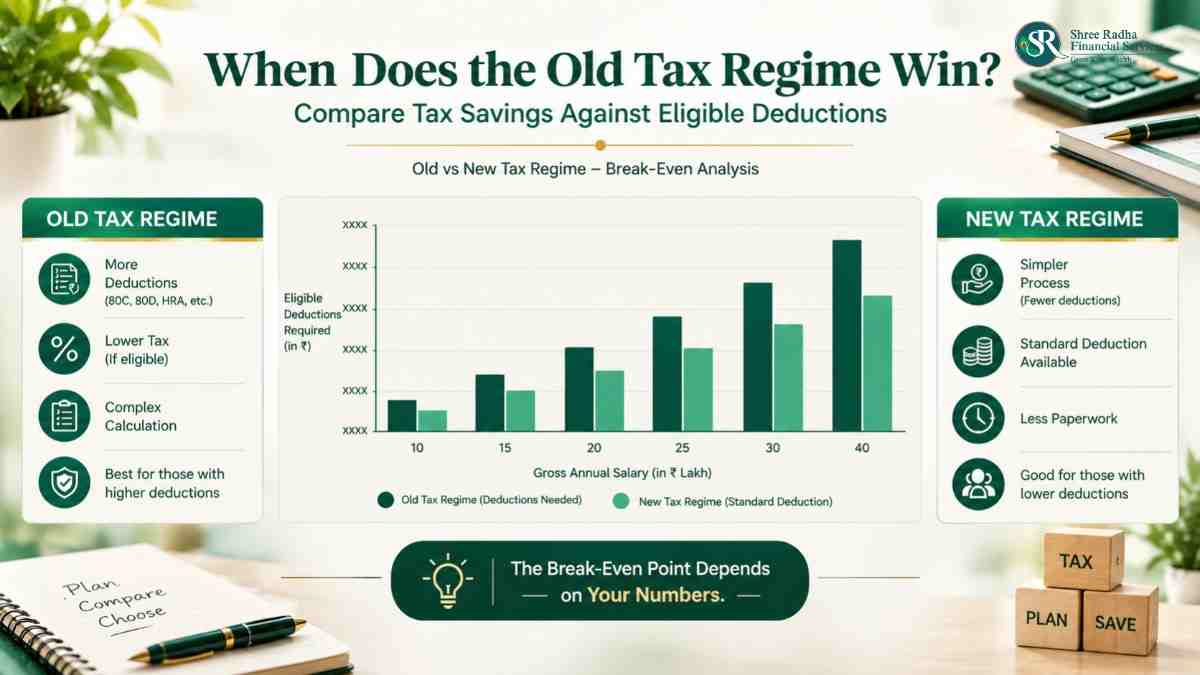
The break-even is the amount of old-regime deductions at which both regimes cost the same tax. Below it, the new regime wins. Above it, the old regime wins. The table below is for salaried people, and the deductions are on top of the ₹50,000 standard deduction.
| Salary | New regime tax (with cess) | Old regime deductions needed to match (above the ₹50,000 standard deduction) |
|---|---|---|
| ₹10 lakh | ₹0 (rebate) | The old regime cannot beat nil tax |
| ₹12 lakh | ₹0 (rebate) | The old regime cannot beat nil tax |
| ₹13 lakh | ₹26,000 | About ₹6.9 lakh |
| ₹15 lakh | ₹97,500 | About ₹5.4 lakh |
| ₹18 lakh | ₹1,50,800 | About ₹6.4 lakh |
| ₹25 lakh | ₹3,19,800 | About ₹8.0 lakh |
| ₹40 lakh | ₹7,87,800 | About ₹8.0 lakh |
| ₹40 lakh, with employer NPS used in the new regime | ₹7,00,440 | About ₹10.8 lakh |
Two things stand out. First, up to a salary of about ₹12.75 lakh, the new regime tax is nil because of the Section 156 rebate and the ₹75,000 standard deduction. Second, from ₹15 lakh upwards, you need roughly ₹5 to ₹8 lakh of deductions to make the old regime worthwhile.
For a business owner, there is no standard deduction in either regime. At ₹30 lakh of profit, the old regime needs about ₹7.7 lakh of deductions to match the new regime.
The slabs of the old regime are set by the Finance Act each year and are not written in the Act itself, so please check the current figures with your CA.
Old vs New Tax Regime: The One Case Where the Old Regime Wins
Dipen and Nisha live in Ahmedabad. Dipen earns ₹18 lakh, the same as Mehul. But their deductions are very different.
They pay rent in Ahmedabad. They also repay a home loan on a flat in Surat where Dipen’s parents live. Dipen puts ₹1.5 lakh into Section 123 products, ₹50,000 into his own NPS, and pays health insurance for himself and his senior parents.
| Item (Dipen and Nisha, ₹18 lakh salary) | Old regime | New regime |
|---|---|---|
| Gross salary | ₹18,00,000 | ₹18,00,000 |
| Standard deduction | ₹50,000 | ₹75,000 |
| HRA exemption (assumed) | ₹3,00,000 | Not allowed |
| Section 123 (earlier 80C) | ₹1,50,000 | Not allowed |
| Section 124(3) own NPS | ₹50,000 | Not allowed |
| Home loan interest, Section 22(2)(a) | ₹2,00,000 | Not allowed |
| Section 126: self ₹25,000 + senior parents ₹50,000 | ₹75,000 | Not allowed |
| Taxable income | ₹9,75,000 | ₹17,25,000 |
| Total tax with cess | ₹1,11,800 | ₹1,50,800 |
The old regime saves them about ₹39,000. Their total deductions of ₹7.75 lakh are higher than the break-even of about ₹6.4 lakh at this salary.
Three conditions must hold before they claim this. The home loan must be for buying or building the flat, with construction done within five years, and the lender must give an interest certificate (Section 22(2)(a)). The HRA exemption depends on rent, basic salary and the city, as per the Income-tax Rules. And they can only claim what they can prove.
Very few families reach ₹7.75 lakh of deductions. That is why this case is the exception, not the rule. If you want to see how products such as EPF, PPF and NPS fit, our retirement schemes guide compares them.
Old vs New Tax Regime at ₹40 Lakh: Legal Ways to Reduce Tax
Rakesh is a senior executive in Surat with a salary of ₹40 lakh, of which ₹20 lakh is basic. He assumed that a high income means the old regime. We ran the numbers.
| Option (Rakesh, ₹40 lakh salary, basic ₹20 lakh) | Total tax with cess |
|---|---|
| New regime, no planning | ₹7,87,800 |
| New regime, employer NPS at 14% of basic (₹2,80,000) | ₹7,00,440 |
| Old regime, very heavy deductions (₹9,75,000 including employer NPS at 10%) | ₹7,33,200 |
Even with a very heavy set of old-regime deductions, the old regime costs about ₹32,760 more than the new regime with employer NPS. At the 30% slab, each extra ₹1 lakh of allowed deduction saves about ₹31,200.
Here are the legal ways high earners can lower tax. They are general information, so please discuss them with your CA.
- Employer NPS (Section 124(2)). It is allowed in both regimes, at up to 14% of salary in the new regime. It works only if your employer offers it through your salary structure.
- The annual capital gains exemption. The first ₹1.25 lakh of listed equity gains in a year is exempt under Section 198, and every taxpayer in the family has their own limit. The rate and limit come from the Finance Act, so check them each year.
- Clubbing rules. Income of a spouse or a minor child can be added to yours (Section 99), so moving assets inside the family needs care.
- Using the old regime only when the totals justify it. Count Sections 123, 124(3), 126 and 22(2)(a) together before you decide.
- Keeping documents ready. Fake rent receipts, dummy donations and aggressive schemes can lead to notices and penalties.
Our executive wealth guide covers more on tax efficiency for high-income earners.
Old vs New Tax Regime for Business Owners: Jignesh bhai’s Story
Jignesh bhai runs an embroidery manufacturing unit in Surat. His profit is ₹30 lakh. He uses Section 123 for ₹1.5 lakh, pays ₹25,000 for health insurance and puts ₹50,000 into his own NPS. That is ₹2.25 lakh of deductions in all.
The new regime tax is ₹4,99,200. The old regime tax is ₹6,70,800. The new regime saves him about ₹1,71,600.
The rule that matters most for him is in Section 202(4)(a). A person with business income who wants the old regime must opt for it on or before the due date for the return. Once he opts, it applies to later years. He can withdraw it only once. After that withdrawal, he can never go back to the old regime unless his business income stops.
Under the 1961 Act, business owners used Form 10-IEA for this option up to AY 2026-27. For Tax Year 2026-27 the option is made in the return itself, so please ask your CA which form or rule applies to you.
How and When to Choose Your Tax Regime
- Salaried people without business income: The Act says to choose along with the return furnished under Section 263(1). You can pick a different regime each year.
- Employer declaration: It only decides how much TDS your employer deducts. You can correct it when you file the return.
- Business owners: Opt on or before the return due date, and remember the one-time withdrawal rule.
- Late filers: The Act links the option to the return filed by the due date under Section 263(1). A late return is filed under a different sub-section, so a late filer should check with a CA whether the old regime is still open.
You can check your income and TDS entries on the e-Filing portal before you decide.
5 Common Mistakes in Choosing a Tax Regime
- Choosing by habit. Mehul picked the old regime because a friend did. Always compare both numbers.
- Buying tax-saving products only to claim a deduction. Choose investments for your goals first.
- Counting deductions you cannot prove. Keep the rent receipts, the lender’s certificate and the premium receipts.
- Forgetting the business owner rule. Missing the option date or withdrawing too early can lock you into one regime.
- Filing late. A late return can change which regime is open to you.
Who Fits Which Regime?
This table gives a general picture. It is not advice for your case.
| Profile | The regime that often fits |
|---|---|
| Salary up to about ₹12.75 lakh, few deductions | New regime (tax can be nil) |
| Salary ₹15 to ₹40 lakh, deductions below about ₹5 to ₹8 lakh | New regime |
| Salary of ₹18 lakh or more, with rent, home loan, Section 123, NPS and health cover adding up to more than the break-even | Old regime can win |
| Business owner with modest deductions | New regime, and the option rules matter |
| Senior citizen with mostly interest and pension income | Compare both; the new regime often wins on simple income |
Regime Decision Checklist
- Write down your gross income and your standard deduction.
- List every old-regime deduction you can prove: rent, loan interest, Sections 123, 124(3) and 126.
- Add them up and compare the total with the break-even in the table above.
- Check whether your employer offers NPS in your salary structure.
- Run the tax under both regimes, including 4% cess.
- If you have business income, read Section 202(4)(a) before choosing.
- Match your employer’s TDS declaration with your plan.
- File your return on time, and ask your CA to confirm the final choice.
Who Can Use This Guide, and Who Should Take Extra Help
This guide works well for:
- Salaried people choosing a regime for TDS or while filing
- Business owners and traders deciding on the old regime option
- Senior citizens with pension and interest income
You should take extra help from a CA if:
- You have foreign income or NRI status. Our NRI investment guide covers SIF, PMS and AIF rules, and your CA should confirm how the regime applies.
- You have a business with audit or loss carry-forward
- You are not sure whether to claim HRA and home loan interest together
- You are filing after the due date
How SR Wealth Can Help
Shree Radha Financial Services (SR Wealth) is an AMFI Registered Mutual Fund and SIF Distributor and an APMI Registered PMS Distributor. We are distributors, not tax consultants. Your CA or tax consultant should confirm your regime choice and your return.
What we can do for you:
- Explain how products such as ELSS mutual funds and NPS work, so you can discuss with your CA whether the old regime justifies them
- Show how tax on investment income may work, using our SIF taxation guide as a starting point
- Connect you with a competent CA or tax consultant if you need one for your regime choice or return
Never buy a product only for the deduction. A deduction is worth having only when the investment suits your goals.
Old vs New Tax Regime FAQ
Is the new tax regime mandatory for 2026-27?
No. It is the default under Section 202, but you can choose the old regime. Salaried people without business income do this along with the return. Business owners must follow Section 202(4)(a).
What is the standard deduction in the new tax regime?
It is ₹75,000 for salaried people and pensioners (Section 19). In the old regime, it is ₹50,000.
How much deduction do I need in the old regime to beat the new regime?
It depends on your salary. At ₹18 lakh it is about ₹6.4 lakh above the standard deduction, and at ₹25 to ₹40 lakh it is about ₹8 lakh. See the break-even table above.
Can I change my tax regime while filing my ITR?
A salaried person without business income can choose a regime each year along with the return. The regime told to the employer is only for TDS.
Can business owners switch between regimes every year?
No. The old regime option continues in later years and can be withdrawn only once (Section 202(4)(a)).
Is Section 80C available in the new tax regime?
No. Section 80C is now Section 123, and it works only in the old regime.
What is the income limit for zero tax in the new regime?
Income up to ₹12 lakh is tax-free through the rebate in Section 156. A salaried person gets there with a gross salary of about ₹12.75 lakh, because of the ₹75,000 standard deduction. The rebate covers tax at slab rates only, so tax on special-rate income such as mutual fund gains can still be payable.
Is HRA or home loan interest allowed in the new regime?
HRA exemption is not allowed. Interest on a self-occupied house is also not allowed, and loss from house property cannot be set off against other income. Interest on a let-out property can still reduce rental income.
Which regime suits senior citizens?
The new regime uses one slab table for every age. The old regime gives higher basic exemption limits to senior citizens, set by the Finance Act. A senior with simple pension and interest income should compare both, and our retirement planning guide for Surat is a good next read.
This article is also available on Medium for wider reading: https://medium.com/@shreeradha.services/old-vs-new-tax-regime-2026-27-which-one-saves-more-a-break-even-guide-for-india-29630ba230dc
Choose Your Regime With Numbers, Not Habit
One tick on a payroll form can cost or save you tens of thousands of rupees. Before you decide, sit down with your own numbers and your CA. If you want to see how your investments fit around that decision, talk to us first. No CA yet? We can connect you with a competent one.
📞 Call / WhatsApp: +91 98791 13255
📧 Email: shreeradha.services@gmail.com
🌐 Visit: www.srwealth.co.in
📍 Shop 33, Mira Nagar 2, Dindoli Road, Surat 394210
Paresh Chaudhary
Founder, Shree Radha Financial Services (SR Wealth), Surat
AMFI Registered Mutual Fund & SIF Distributor — ARN: 268390
APMI Registered PMS Distributor — APRN: 05763
IRDAI Licensed Insurance Distributor
BE Mechanical, SVNIT Surat | Ex-L&T (15+ Years)
Last verified on 27 October 2026 against the Income-tax Act 2025 (as amended by Finance Act 2026) and the Income-tax Act 1961. Official sources: Income Tax Department and the e-Filing portal.
Educational Disclaimer: This article is published by Shree Radha Financial Services — an AMFI Registered Mutual Fund & SIF Distributor (ARN: 268390) and APMI Registered PMS Distributor (APRN: 05763). It is for education only and is not tax, legal or investment advice. Tax rules, rates and section numbers change from time to time. Please connect with your tax consultant or CA for details specific to your situation. The people in the stories are fictional and the numbers are illustrations only. Mutual fund investments are subject to market risks. Please read all scheme-related documents carefully.