DB Vs DC in Simpleway
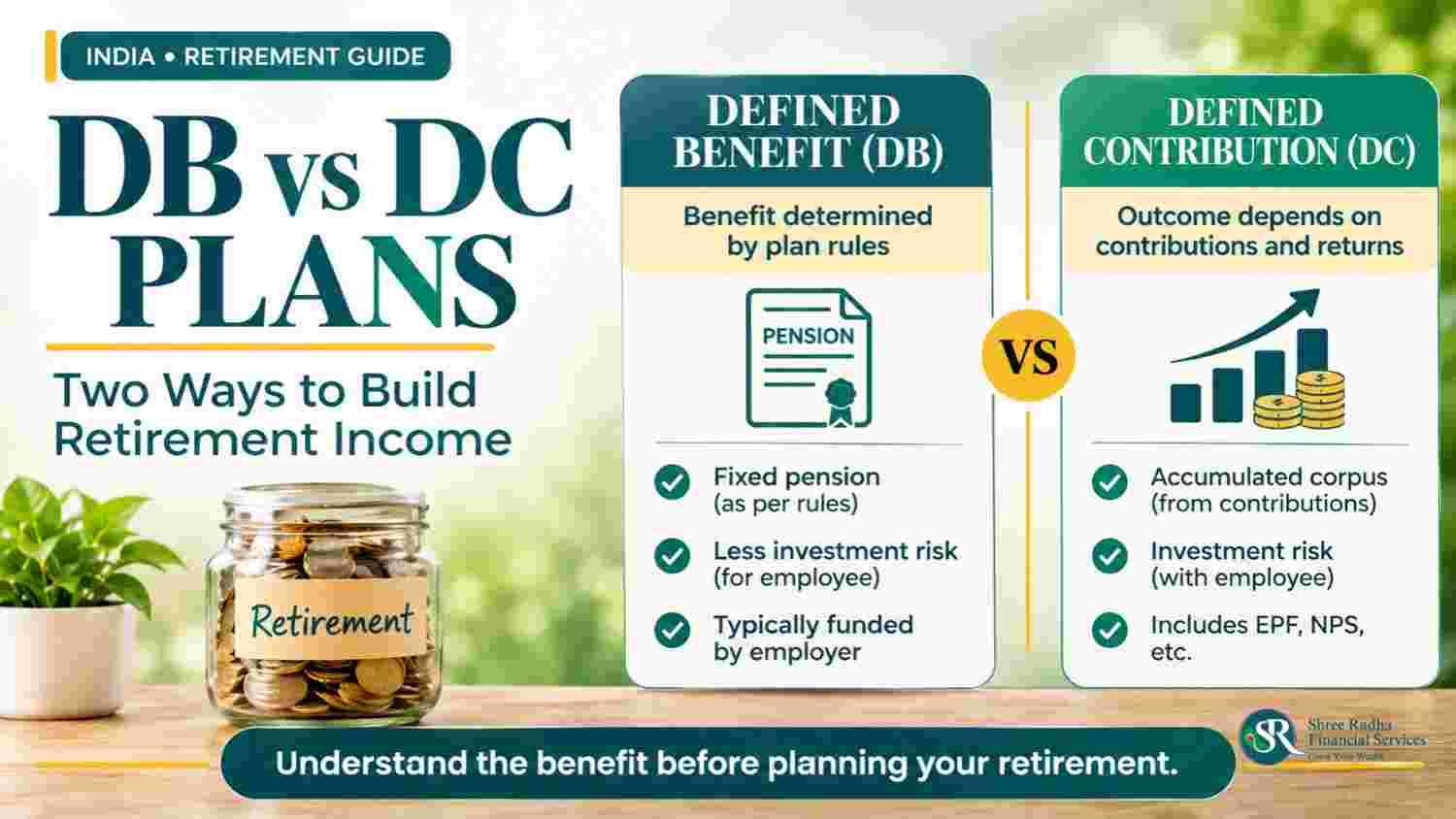
DB vs DC is the simplest way to understand every retirement scheme in India. DB means defined benefit: the payout is promised by a formula. DC means defined contribution: only the deposit is fixed, and the final amount depends on how the money grows.
Most people compare EPF, NPS and PPF by return or tax saving. The first question is different. Who carries the risk if markets fall, or if you live longer than your money? That is what DB vs DC answers.
This DB vs DC guide uses the Income-tax Act 2025 (Tax Year 2026-27), with the earlier section numbers noted. It is written for salaried people, government employees and business owners across India.
“I often hear, ‘I have EPF, so I have a pension.’ EPF is a balance you can withdraw. A pension is a monthly payment for life. Before you compare any scheme, ask one thing: which part of my retirement is promised, and which part depends on me?”
— Paresh Chaudhary, Founder, Shree Radha Financial Services
DB vs DC: What the Two Words Really Mean
DB: Retirement income = formula (salary × years of service × a fixed factor). The payer carries the risk.
DC: Retirement money = your deposits + employer deposits + growth. You carry the risk.
DC: Retirement money = your deposits + employer deposits + growth. You carry the risk.
| Question | DB (defined benefit) | DC (defined contribution) |
|---|---|---|
| Who decides the final amount? | The scheme formula | Your deposits and how they grow |
| Investment risk | Employer, government or fund | You |
| Longevity risk (living longer than the money) | Pension is paid for life | You must plan withdrawals or buy an annuity |
| Inflation risk | Depends on the scheme (some pensions get dearness relief, some do not) | You |
| Examples in India | Old pension rules, EPS, gratuity | EPF, NPS, PPF |
In DB vs DC, a DB promise is only as strong as the payer. A DC balance is only as strong as your deposits, your choices and the market.
DB vs DC in India: Where Each Scheme Sits
Here is how every common Indian scheme falls under DB vs DC.
| Scheme | Type | What is fixed | Who carries the risk |
|---|---|---|---|
| Old pension (CCS Pension Rules 2021) | DB | Pension by formula | Government |
| EPS (Employees’ Pension Scheme 2026) | DB | Pension by formula | The Pension Fund (with a government contribution) |
| Gratuity | DB | Lump sum by formula | Employer |
| Superannuation fund | DB or DC | Depends on the fund rules | Employer (DB type) or you (DC type) |
| EPF | DC | The deposit rate | You (interest rate is set by the Central Government) |
| NPS | DC | The deposit | You |
| PPF | DC | The deposit | You (interest rate is set by the Government) |
| UPS | Hybrid | An assured payout, with deposits held in NPS accounts | Shared |
For scheme-by-scheme rules, read our retirement schemes guide, the PPF rules guide and the NPS withdrawal rules guide.
DB vs DC in Numbers: Same Deposit, Different Results
The DB vs DC difference is easiest to see with numbers.
DC corpus = monthly deposit × growth factor for the years invested
DB pension = pensionable salary × service ÷ 70 (EPS formula)
DB pension = pensionable salary × service ÷ 70 (EPS formula)
DC example. Deposit ₹10,000 a month for 20 years. You put in ₹24 lakh. The result changes with the rate you earn. The rates below are assumed for learning only. They are not forecasts or expected returns.
| Assumed yearly rate | Corpus after 20 years (approx.) |
|---|---|
| 6% | ₹46.2 lakh |
| 8% | ₹58.9 lakh |
| 10% | ₹75.9 lakh |
DB example. Assume a pensionable salary of ₹15,000 and 30 years of service. EPS pension = 15,000 × 30 ÷ 70 = about ₹6,429 a month. With the 2-year weightage for 20 years or more of service, it becomes 15,000 × 32 ÷ 70 = about ₹6,857. The ₹15,000 is an assumed figure. The real ceiling is notified by the government.
In DB vs DC terms, the DC result moves with the market. The DB formula does not.
DB vs DC Inside Your Salary Slip: EPF, EPS and EDLI
For private-sector employees covered by the EPF Scheme 2026 (see the official EPFO website), one employer deposit feeds both sides of DB vs DC.
Employee: 12% of salary (basic + DA) → EPF
Employer: 12% of salary (basic + DA) → 8.33% to EPS + the balance to EPF
Both are calculated on salary up to the notified wage ceiling. The rate is 10% for classes of establishments notified by the government. The Central Government adds 1.16% of pay to EPS.
Employer: 12% of salary (basic + DA) → 8.33% to EPS + the balance to EPF
Both are calculated on salary up to the notified wage ceiling. The rate is 10% for classes of establishments notified by the government. The Central Government adds 1.16% of pay to EPS.
EPF: the DC side of DB vs DC
| Stage | Rule (EPF Scheme 2026) |
|---|---|
| Contribution | Employee and employer pay equal amounts (Para 18) |
| Interest | Rate is set by the Central Government with the Central Board and credited on the monthly running balance (Para 42) |
| Partial withdrawal | After 12 months of membership; 25% of total contributions and interest must stay as Minimum Balance; education up to 10 times, marriage 5 times, housing 5 times, special cases 2 times a year (Para 46) |
| Full withdrawal | On retirement after age 55 and in other listed cases (Para 49) |
EPS: the DB side of DB vs DC
Monthly pension = (pensionable salary × pensionable service) ÷ 70
Pensionable salary = average of the last 60 months, capped at the notified ceiling.
Pensionable salary = average of the last 60 months, capped at the notified ceiling.
| Stage | Rule (EPS 2026) |
|---|---|
| Contribution | 8.33% of salary from the employer share, plus 1.16% from the Central Government (Para 4) |
| Eligibility | At least 10 years of eligible service (Para 12) |
| Early or later start | Early pension from age 50, reduced 4% for every year before the age of superannuation. Deferral up to age 60 adds 4% for every year (Para 12) |
| Minimum pension | ₹1,000 a month (Para 12) |
| Leaving before 10 years | Withdrawal benefit only after 36 months from the date the last contribution was due, or at the age of superannuation, whichever is earlier (Para 13) |
EDLI: a death cover, not a pension
Benefit = 35 × average salary (capped) + 50% of average PF balance (capped at ₹1.75 lakh)
Minimum ₹2.5 lakh and maximum ₹7 lakh (EDLI Scheme 2026, Para 21).
Minimum ₹2.5 lakh and maximum ₹7 lakh (EDLI Scheme 2026, Para 21).
It is paid to the nominee if the member dies in service. It does not give retirement income, so it sits outside DB vs DC.
Story 1: Vikram in Pune thought EPF was his pension
Vikram works for an IT services company in Pune. For 11 years he has seen “EPF 12%” on his payslip. He thinks, “This is my pension fund. At retirement I will get a monthly pension from it.”
The mistake: He treated one balance as two different things. His passbook shows a lump sum. It does not show a pension.
The correction: Vikram reads the EPS 2026 Scheme and asks his company HR how his employer share is split. He learns that 8.33% goes to EPS and the rest to EPF. The EPF balance is a lump sum. The pension is a separate EPS right, paid by formula after 10 years of eligible service. He now plans for the two parts of DB vs DC separately.
DB vs DC for Government Employees: OPS, NPS and UPS
Old pension: 50% of emoluments or the average emoluments of the last 10 months, whichever is more beneficial. Needs 10 years of qualifying service. Minimum ₹9,000 and maximum ₹1,25,000 a month (CCS Pension Rules 2021).
NPS: Account value at retirement = deposits + growth. The payout depends on the fund value.
UPS: Assured payout = 50% of the average basic pay of the last 12 months, for 25 years of qualifying service.
NPS: Account value at retirement = deposits + growth. The payout depends on the fund value.
UPS: Assured payout = 50% of the average basic pay of the last 12 months, for 25 years of qualifying service.
UPS is the one scheme that blends DB vs DC. Under UPS, service of 10 to 25 years gets a proportionate payout. A minimum of ₹10,000 a month applies after 10 years of qualifying service. A lump sum of 1/10th of (basic pay + DA) is paid for every completed six months of qualifying service. These details are from the official PFRDA UPS page.
We compare these three side by side in our NPS withdrawal rules guide. This article only shows where each one sits in DB vs DC.
Story 2: Anita in Lucknow assumed UPS meant her last salary
Anita works in a central government office in Lucknow. She joined under NPS and has just heard about UPS. She thinks, “UPS means half of my last drawn salary, guaranteed.”
The mistake: She assumed “last drawn”. She also assumed the full amount comes with any length of service.
The correction: Anita reads the PFRDA page and asks her office accounts section. The assured payout uses the average basic pay of the last 12 months. The full 50% needs 25 years of qualifying service. With 10 to 25 years it is proportionate. She now builds her estimate on the average, not the last salary.
DB vs DC at Work: Gratuity and Superannuation Funds
Gratuity = formula (salary × years of service × a factor set by the gratuity law). Paid once by the employer when you leave or retire.
Government employees: 1/4 of emoluments for every six-month period, up to 16.5 times emoluments and ₹20 lakh (CCS Pension Rules 2021).
Government employees: 1/4 of emoluments for every six-month period, up to 16.5 times emoluments and ₹20 lakh (CCS Pension Rules 2021).
In DB vs DC terms, gratuity is DB, but it is a lump sum, not a pension.
A superannuation fund is different. Your company’s fund rules decide whether it is DB type or DC type. The Income-tax Rules 2026 set the limits: the employer deposit can be up to 27% of salary less the employer’s PF contribution (Rule 305). The pension must be bought through an insurer (Rule 307). Commutation is 1/3 if you received gratuity and 1/2 if you did not (Rule 308).
Story 3: Ramesh in Coimbatore never read his superannuation letter
Ramesh is an engineer at a manufacturing company in Coimbatore. His appointment letter lists provident fund, gratuity and superannuation. He thinks, “All three are PF-type savings. Superannuation is my guaranteed pension.”
The mistake: He never read the fund rules.
The correction: Ramesh asks his HR department for the superannuation fund rules. His fund is DC type. The employer deposits go into a fund, and an annuity is bought from an insurer at retirement. Gratuity is the DB part, paid by formula. He now places the three on the DB vs DC map as three different promises.
DB vs DC Tax Rules: The EEE Angle in the Old and New Regime
Tax at the end = amount you receive − the part the law exempts
| Scheme | Deposit | Growth | Payout |
|---|---|---|---|
| EPF | Section 123 (earlier Section 80C): old regime only, up to ₹1.5 lakh together with other eligible items | Interest is not exempt where your own yearly deposit is above ₹2.5 lakh (₹5 lakh if the employer does not contribute). Schedule II Sl. 3-4 (earlier Section 10(11)/(12)) | Balance is excluded after 5 years of continuous service and in other listed cases (Schedule XI Part A, para 8). TDS may apply on taxable payouts (Section 392(7)) |
| NPS | Employer deposit: Section 124(1)-(2). Up to 10% of salary (14% for government employers, and 14% for everyone under the new regime). Own extra ₹50,000: Section 124(3) (earlier Section 80CCD(1B)), old regime only | See the NPS withdrawal rules guide | Up to 60% on closure is exempt (Schedule II Sl. 6). The annuity pension is income (Section 124(6)) |
| UPS | Same Section 124 deductions apply | See the NPS withdrawal rules guide | Up to 60% of the individual corpus at superannuation is exempt (Schedule II Sl. 15). The lump sum is exempt (Sl. 16). Moving money from individual corpus to pool corpus is not treated as receipt (Section 124(12)) |
| Gratuity | Paid by the employer | Not applicable | Section 19(1) Sl. 3-6 (earlier Section 10(10)): government death-cum-retirement gratuity is fully exempt. Other cases are exempt up to the limits in that table |
| Superannuation fund | Employer deposit counts in the ₹7.5 lakh yearly limit (Section 17(1)(h)-(i)) | Not applicable | Exempt only in the cases listed in Schedule II Sl. 8 (earlier Section 10(13)) |
| Commuted pension | Not applicable | Not applicable | Section 19(1) Sl. 7-8 (earlier Section 10(10A)): fully exempt for listed government schemes. For other employers 1/3 of the pension value if you received gratuity, 1/2 if not |
Whether a scheme is DB or DC does not decide its tax. The section that applies does. A monthly pension (EPS, old pension, UPS or an NPS annuity) is counted as income under “Salaries” and taxed at your slab rate. The new regime has no Section 123 benefit, so EPF and PPF deposits give no deduction there.
Compare regimes with numbers in our old vs new tax regime guide. Rules and rates change from time to time. Please confirm with your tax consultant / CA. Last verified on 4 November 2026 against the Income-tax Act 2025.
DB vs DC by Career: What to Read and Whom to Ask
Your DB vs DC mix depends on your job. Find yours below.
| Your situation | DB part you may have | DC part you control | Whom to ask |
|---|---|---|---|
| Central Government employee | Old pension rules or UPS assured payout | NPS account | Your office accounts section |
| Private employee, EPF-covered company | EPS pension and gratuity | EPF balance | Company HR and your EPFO passbook |
| Employee with a company superannuation fund | Depends on the fund rules | Depends on the fund rules | HR and the fund trustees |
| Self-employed or business owner | None by default | NPS own account, PPF | Your CA |
Story 4: Bharatbhai in Surat believed his business was his pension
Bharatbhai runs a small textile trading unit in Pandesara, Surat. He thinks, “Pension is for job people. My business is my pension.”
The mistake: In DB vs DC terms, he has no DB scheme at all. Every risk sits with him: his business income, his investments and how long he lives.
The correction: Bharatbhai reads our PPF rules guide and the NPS guide, then asks his CA how the ₹50,000 NPS deduction works. It is old regime only. He decides to build a DC pot with fixed yearly deposits and to plan his withdrawals in advance. For more on the numbers, see our retirement planning guide for Surat.
Planning with systematic investments? Our retirement SIP and SWP guide and how much SIP is enough explain the DC side in detail. If you are wondering about a target corpus, read is ₹2 crore enough to retire.
DB vs DC Checklist

- List every scheme you are in and mark each one DB, DC or hybrid using DB vs DC.
- Ask HR how your employer share is split between EPF and EPS.
- Check your service years against the 10-year (EPS, old pension) and 25-year (UPS) conditions.
- Read your superannuation fund rules to see whether it is DB type or DC type.
- Find the DC risks you carry: market risk, longevity risk and inflation risk.
- Check the tax on every payout under your regime with your CA.
- Ask your office, HR or EPFO about your own case before you decide anything.
DB vs DC: Frequently Asked Questions
What is DB vs DC in simple words?
DB (defined benefit) promises a payout by a formula, and the payer carries the risk. DC (defined contribution) fixes only the deposit, and you carry the risk of how the money grows.
Is EPF a defined benefit or defined contribution plan?
EPF is DC. The balance depends on deposits and the interest rate set by the Central Government. The pension part of your employer share goes to EPS, which is DB.
Is EPS a DB plan?
Yes. EPS pays a monthly pension by the formula pensionable salary × pensionable service ÷ 70, with at least 10 years of eligible service. The minimum pension is ₹1,000 a month.
Is NPS DB or DC?
NPS is DC. The final amount depends on your deposits and the fund value. Up to 60% on closure is exempt under Schedule II Sl. 6, and the rest goes into an annuity.
Is UPS DB, DC or hybrid?
UPS is a hybrid. It gives an assured payout of 50% of the average basic pay of the last 12 months for 25 years of qualifying service, while deposits are held in NPS accounts.
Is gratuity a defined benefit plan?
Yes. Gratuity is paid by a formula based on salary and years of service. It is a lump sum, not a monthly pension.
Can private-sector employees get a lifelong pension?
Employees covered by EPS can, after 10 years of eligible service. The amount follows the EPS formula and is not linked to market returns. Check your own record with your HR or EPFO office.
Which is better in DB vs DC?
Neither is better for everyone. DB shifts risk to the payer but the amount is fixed by rules. DC gives you control but you carry market, longevity and inflation risk. Most employees have a mix of both.
Can a self-employed person join EPS or UPS?
EPS runs through an employer’s EPF, and UPS is for Central Government employees covered under NPS. A self-employed person can use DC options such as NPS and PPF. Confirm the details with your CA.
This article is also available on Medium for wider reading:https://medium.com/@shreeradha.services/db-vs-dc-in-india-who-carries-your-retirement-risk-f4ebba2efc66
Want a Clear Picture of Your DB vs DC Mix?
Connect with Shree Radha Financial Services for a personalized discussion on the investment side of your retirement plan. For your own pension case, please ask your employer, EPFO or CA.
📞 Call/WhatsApp: +91 98791 13255
📧 Email: shreeradha.services@gmail.com
🌐 Visit: www.srwealth.co.in
📍 Shop 33, Mira Nagar 2, Dindoli Road, Surat 394210
Paresh Chaudhary
Founder, Shree Radha Financial Services, Surat
AMFI Registered Mutual Fund & SIF Distributor — ARN: 268390
APMI Registered PMS Distributor — APRN05763
Investing since 2012 | BE Mechanical, SVNIT Surat | Ex-L&T (15+ Years)
Educational Disclaimer: This article is published by Shree Radha Financial Services — an AMFI Registered Mutual Fund & SIF Distributor (ARN: 268390) and APMI Registered PMS Distributor (APRN05763). All content is strictly for educational purposes only and does not constitute individualized investment advice. We do not advise on individual pension, EPF, EPS, gratuity or tax cases. Please confirm your own case with your employer, EPFO, PFRDA or CRA, and a qualified tax professional. Mutual fund investments are subject to market risks — read all scheme-related documents carefully before investing. Rules and rates change from time to time. Tax treatment is based on the Income-tax Act 2025 as verified on 4 November 2026 and is subject to change. The characters in this article are fictional.