MSME Payment Mistakes: Do You See Yourself in These 4 Stories?
MSME payment rules catch many business owners by surprise at year-end. A bill that is booked as an expense can still lose its tax deduction if it is paid at the wrong time or in the wrong way.
Here are four business owners from four cities. Read their stories and ask yourself: “Am I doing the same?”
These stories are illustrative, based on common situations. Names, amounts and details are changed, and they are not individual tax advice. The tax effects are simple examples. Your actual tax depends on your income, your tax regime and your rate.
“Most business owners track what they owe their suppliers. Very few track by which date they must pay it for the tax deduction to stay safe. That one habit can change your year-end.” — Paresh Chaudhary
Story 1: Murali in Coimbatore – “I Will Pay Before I File My Return”
Murali makes industrial pumps in Coimbatore. He buys packaging boxes from a small unit nearby. The owner is a registered micro enterprise.
On 10 February, Murali accepted a delivery of packaging worth ₹8 lakh. There was no written agreement on the payment date. The bill was booked as a business expense in the books.
The year ended on 31 March, and the bill was still unpaid. Murali thought, “No problem. I will pay it before I file my return.” He paid it on 20 April.
What went wrong. For most year-end dues, the law lets you pay up to the return due date. But an MSME payment is the exception. The grace period does not apply to dues to micro and small enterprises.
Murali’s MSME payment was late as per the time limit. So the ₹8 lakh deduction moved to the year in which he actually paid. In simple terms, for this year his taxable profit was ₹8 lakh higher than he expected. At a 30% tax rate, that is about ₹2.4 lakh more tax in that year, plus cess.
The right way.
- A sum owed to a micro or small enterprise beyond the time limit in Section 15 of the MSMED Act is allowed only in the year it is actually paid (Section 37(2)(g), earlier Section 43B(h)).
- The grace till the return due date does not apply to this item (Section 37(3)).
- Ask every supplier for a Udyam certificate, mark the MSME vendors in your books, and track the payment date for each bill.
- Under Section 15 of the MSMED Act, a written agreement cannot set a payment date more than 45 days from acceptance. Without a written agreement, payment is due within 15 days. The Finance Ministry has also told Parliament that the rule is linked to this 45-day limit.
- A written objection to the goods can change the dates. Please ask your CA whether this supplier is covered and how the days are counted for your bill.
Story 2: Rajesh in Jaipur – “The Bank Said It Counts as Paid”
Rajesh runs a small jewellery manufacturing unit in Jaipur. At year-end he owed three things: ₹1.5 lakh as the employer’s share to the provident fund, a ₹2 lakh bonus to his staff, and ₹1 lakh as interest on his bank loan.
He paid the provident fund and the bonus before the return due date. The bank interest was another matter. He did not have the cash, so the bank offered to add the unpaid interest to his loan. He agreed and thought, “It is settled.”
What went wrong. Interest that is added to a loan is not treated as paid. The deduction for that ₹1 lakh was not allowed in that year.
The right way.
- Interest on loans from banks and other specified financial entities is allowed only when paid (Section 37(2)(e)).
- If the interest is converted into a loan, a new instrument or any other deferred liability, it is not treated as paid (Section 37(4)).
- The provident fund contribution, the bonus and the interest, when actually paid by the return due date, are allowed in the earlier year (Section 37(3)). That is why Rajesh’s other two items were safe.
- Once a deduction is allowed in one year, it is not allowed again in the year of payment (Section 37(5)).
Story 3: Tejas in Pune – “TDS Is the Landlord’s Problem”
Tejas is a civil contractor in Pune. He pays ₹6 lakh a year as rent for his office. He also paid ₹3 lakh in fees to an architect for a project.
He paid both in full, and did not deduct any TDS. He thought the tax was the landlord’s and the architect’s problem, since they would pay tax on their own income.
What went wrong. When tax should be deducted and is not, a part of the expense is lost for the payer. Here the total was ₹9 lakh. A 30% disallowance means ₹2.7 lakh of expense could not be claimed.
The right way.
- 30% of a payment to a resident is not allowed if TDS was required but was not deducted, or was deducted but not paid by the return due date (Section 35(b)(i), earlier Section 40(a)(ia)).
- If the tax is deducted later, or paid late, the 30% is allowed in the year the tax is paid (Section 35(b)(i)(A)).
- Section 35(b)(i)(B) gives a relief in some cases where the receiver has filed a return and paid tax on that income. The conditions are detailed, so please ask your CA before relying on it.
- Check with your CA which of your payments need TDS, and set up a monthly deposit routine.
Story 4: Anil in Lucknow – “Cash Discount, Cash Payment”
Anil runs a hardware shop in Lucknow. One supplier offered him a good discount if he paid in cash the same day.
Anil paid ₹45,000 in cash in one day and booked it as a purchase. He felt he had saved money on both the price and the paperwork.
What went wrong. For tax, a cash payment above the limit to one person in one day is not allowed as a business expense. Anil saved on the price, but lost the deduction on the whole ₹45,000.
The right way.
- If you pay more than ₹10,000 in a day to a person, other than by a specified banking or online mode, the expense is not allowed (Section 36(4), earlier Section 40A(3)).
- Payments to the same person on the same day are added up.
- For hiring or leasing goods carriages the limit is ₹35,000 (Section 36(6)).
- Some cases are exempt, such as payments to a bank, payments to cultivators for farm produce, or places with no bank (Rule 26, Income-tax Rules 2026, earlier Rule 6DD).
- Pay by UPI, NEFT, RTGS or an account payee cheque. These are accepted modes (Rule 48).
- Please ask your CA before you rely on any exception in Rule 26 for your own payments.
Business Expenses in Simple Words: What Is Allowed and What Is Not
The general rule is in Section 34 (earlier Section 37). An expense is allowed if it is spent wholly and exclusively for the business or profession. It must not be a capital expense or a personal expense.
Specific expenses have their own sections. Here is a simple table.
| Expense | Allowed? | Section in the 2025 Act |
|---|---|---|
| Shop or factory rent, municipal taxes, current repairs, insurance on machinery | Yes | Section 28 (earlier Section 30) |
| Employer’s contribution to provident fund, gratuity fund | Yes, on actual payment | Sections 29 and 37 |
| Insurance premium on stock | Yes | Section 30 |
| Bonus or commission paid to employees | Yes, on actual payment | Sections 32(a) and 37 |
| Interest on money borrowed for the business | Yes, with conditions | Section 32(b) |
| Depreciation on assets | Yes, as per rates | Section 33 (earlier Section 32) |
| Personal expenses or capital expenses | No | Section 34(1) |
| Expenses that are an offence or prohibited by law | No | Section 34(2)(a) |
| Corporate social responsibility spending | No | Section 34(2)(b) |
| Income tax paid on income | No | Section 35(a) (earlier Section 40) |
| 30% of payments where TDS was not deducted or paid | No (until tax is paid) | Section 35(b) |
| Cash payments above ₹10,000 a day to one person | No | Section 36(4) |
| Partner remuneration and interest above the limits (firms) | Only up to the limits | Section 35(e) |
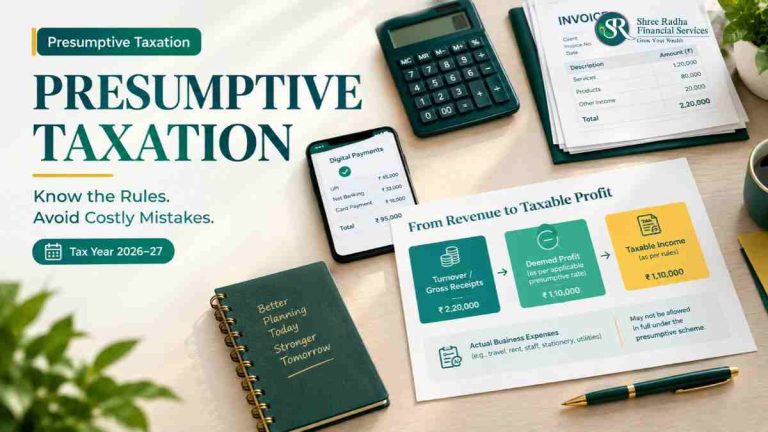
If you use presumptive taxation, you do not claim separate expenses at all (Section 58(4)). These rules matter mainly when you keep regular books. Our guide on presumptive taxation explains the two routes.
Section 37: Business Expenses Allowed Only When Actually Paid (Earlier 43B)
Most businesses book an expense when it is due, not when it is paid. This is called the accrual method. But for some items the law says: no payment, no deduction.
Section 37 applies “irrespective of” your method of accounting. Here is the full list, and where the grace period works. Only the MSME payment line has no grace period.
| Item payable at year-end | Section 37(2) | Paid by the return due date, safe in the earlier year? |
|---|---|---|
| Tax, duty, cess, surcharge or fee under any law | Clause (a) | Yes |
| Employer’s contribution to provident, superannuation, gratuity or welfare fund | Clause (b) | Yes |
| Leave encashment payable to employees | Clause (c) | Yes |
| Bonus or commission to employees (Section 32(a)) | Clause (d) | Yes |
| Interest on loans from banks and specified financial entities | Clause (e) | Yes (not if converted into a loan) |
| Dues to Indian Railways for railway assets | Clause (f) | Yes |
| Amount owed to a micro or small enterprise beyond the MSME time limit | Clause (g) | No. No grace period. |
The return due date is the date in Section 263(1). For business income without audit, it is 31 August. With a tax audit, it is 31 October. Please confirm the final dates with your CA, as dates can change, and ask which of your year-end items fall in this list.
A Year-End Example in Numbers
Take a manufacturer with a profit of ₹40 lakh as per the books. The books already include these year-end unpaid items:
- ₹8 lakh owed to a micro-enterprise supplier, beyond the MSME time limit
- ₹3 lakh of GST and other taxes
- ₹2 lakh of employer’s provident fund share
The business pays the ₹3 lakh and ₹2 lakh by the return due date. It pays the ₹8 lakh only after that date.
- The ₹3 lakh and ₹2 lakh stay allowed in the earlier year.
- The ₹8 lakh is not allowed in the earlier year. It is allowed in the year it is actually paid.
- So the taxable profit for the earlier year is about ₹48 lakh, not ₹40 lakh.
The deduction is not lost forever. It moves to the later year. But the tax is paid early, and that can strain cash flow. Interest on delayed advance tax can also follow, so please ask your CA.
MSME Payment Rule Explained: Who, When and How to Check
The MSME payment rule is in Section 37(2)(g) of the Income-tax Act 2025 (earlier Section 43B(h)). It links to Section 15 of the MSMED Act, 2006. Here are the main points in plain words.
Which Suppliers Are Covered
- The Act names micro and small enterprises. It does not name medium enterprises. In July 2026 the Finance Ministry told the Rajya Sabha that the rule applies to amounts payable to micro or small enterprises, as classified under the MSMED Act notification.
- Check each supplier’s Udyam certificate, and look at the enterprise type on it. Verify the number on the Udyam portal. You can read more on the Ministry of MSME website. The size limits have been revised from time to time, so old vendor records may be out of date.
- Many experts say the supplier should hold Udyam registration on the date of supply. The Act does not say this in so many words, so please ask your CA.
- Traders. A Ministry of MSME memorandum of 2 July 2021 allowed wholesale and retail traders to register on Udyam for priority sector lending only. Many professionals therefore treat a pure trader as outside this rule. But the Act and the Finance Ministry’s reply do not say this directly, so please ask your CA about each such supplier.
The Time Limit
- With a written agreement: the date agreed, but not more than 45 days from the day of acceptance of the goods or services.
- Without a written agreement: within 15 days from the day of acceptance.
- If you object in writing: if you raise a written objection to the goods within 15 days, the day of acceptance can shift. Please ask your CA how this affects your bill.
A simple timeline. Suppose you accept goods on 1 March.
- With no agreement, the limit ends around 16 March. If you pay after that, even by 20 March, the sum may be treated as late.
- With a 45-day agreement, the limit ends around 15 April. As we read it, a bill paid inside the limit is not affected, even if it is paid after 31 March.
This matches what the Government has said in Parliament: the deduction can be allowed on an accrual basis if the payment is made within the time set by Section 15. You can read that in a Government reply in Parliament. Please still confirm the exact dates for your bills with your CA.
Interest on Late Payments to MSME Suppliers
A late payment to a micro or small supplier can also bring compound interest under Section 16 of the MSMED Act. That interest is not allowed as a tax deduction (Section 23 of the MSMED Act). The rate and the way it is worked out are outside this article, so please ask your CA.
A Simple Process for Business Owners
- Mark every MSME vendor in your books or accounting software, so each MSME payment is tracked.
- Collect the Udyam certificate from each vendor.
- Sign a short written payment agreement with a payment date of up to 45 days.
- Run an ageing report every month. Flag bills nearing 15 days and 45 days.
- Before 31 March, pay or plan every overdue MSME bill.
If you also have idle cash in the business account during the year, you can read our guide on investment for business owners and idle cash.
TDS and the 30% Disallowance in Simple Words
When you pay rent, professional fees, contractor bills and other listed payments, the law may ask you to deduct tax first. You deposit that tax with the government, and the receiver gets credit for it.
If you do not deduct it, or deduct it and do not deposit it on time, you lose a part of your expense. The part is 30% of the payment.
| Situation | Example on a ₹9 lakh payment | Result |
|---|---|---|
| TDS deducted and deposited by the due date | Full ₹9 lakh claimed | All allowed |
| TDS required but not deducted | 30% of ₹9 lakh = ₹2.7 lakh | ₹2.7 lakh not allowed that year |
| TDS deducted, but deposited after the due date | 30% of ₹9 lakh = ₹2.7 lakh | ₹2.7 lakh allowed in the year the tax is deposited |
Please note that TDS rules, rates and limits are different for each type of payment. Ask your CA for the list that applies to your business.
Cash Payment Limits for Business Expenses: Examples
The cash rule is about the mode of payment. The limit is counted for each person, for each day.
| Payment on a day | Allowed as an expense? |
|---|---|
| ₹9,500 in cash to a supplier | Yes. It is within ₹10,000. |
| ₹12,000 in cash to a supplier | No. The whole ₹12,000 is not allowed. |
| ₹6,000 and ₹7,000 in cash to the same person on the same day | No. They add up to ₹13,000. |
| ₹30,000 in cash for hiring a goods carriage | Yes. The limit for this is ₹35,000. |
| ₹40,000 in cash to a farmer for farm produce | Can be allowed. Rule 26 has an exception for payments to cultivators, growers and producers. |
| ₹2 lakh by UPI, NEFT, RTGS or account payee cheque | Yes. These are accepted modes. |
If you paid an earlier liability in cash above the limit, the payment itself can be treated as business income in the year you pay (Section 36(5)). Please ask your CA before settling old dues in cash, and before you rely on any exception in Rule 26.
Business Losses in Simple Words: Set-Off and Carry Forward
Sometimes the books show a loss instead of a profit. The Act has clear rules on what you can do with it.
- Set off in the same year: a business loss can be set off against income under other heads, but not against salary (Section 109(1)(a)).
- Carry forward: a loss not set off is carried forward to the next year, against business profits only. It can be carried forward for up to eight tax years (Section 112, earlier Section 72).
- Speculation loss: it can be set off only against speculation profits, and carried forward for four tax years (Section 113, earlier Section 73).
- The return must be filed on time. A loss that is not determined in a return filed under Section 263(1) cannot be carried forward (Section 121, earlier Section 80).
A simple example. A trader has a business loss of ₹5 lakh in Tax Year 2026-27, with no other income. In the next year, the business earns a profit of ₹3 lakh. The trader sets off ₹3 lakh against that profit and carries ₹2 lakh forward again, for the years that remain.
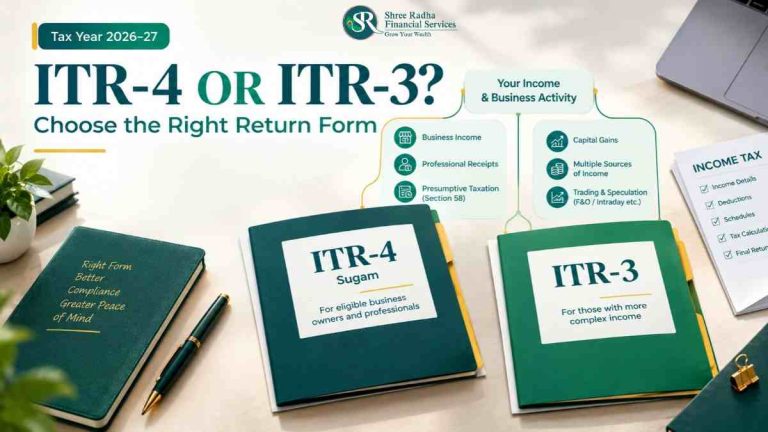
If you have a loss, you also need the right return form. Read our guide on ITR 4 or ITR 3.
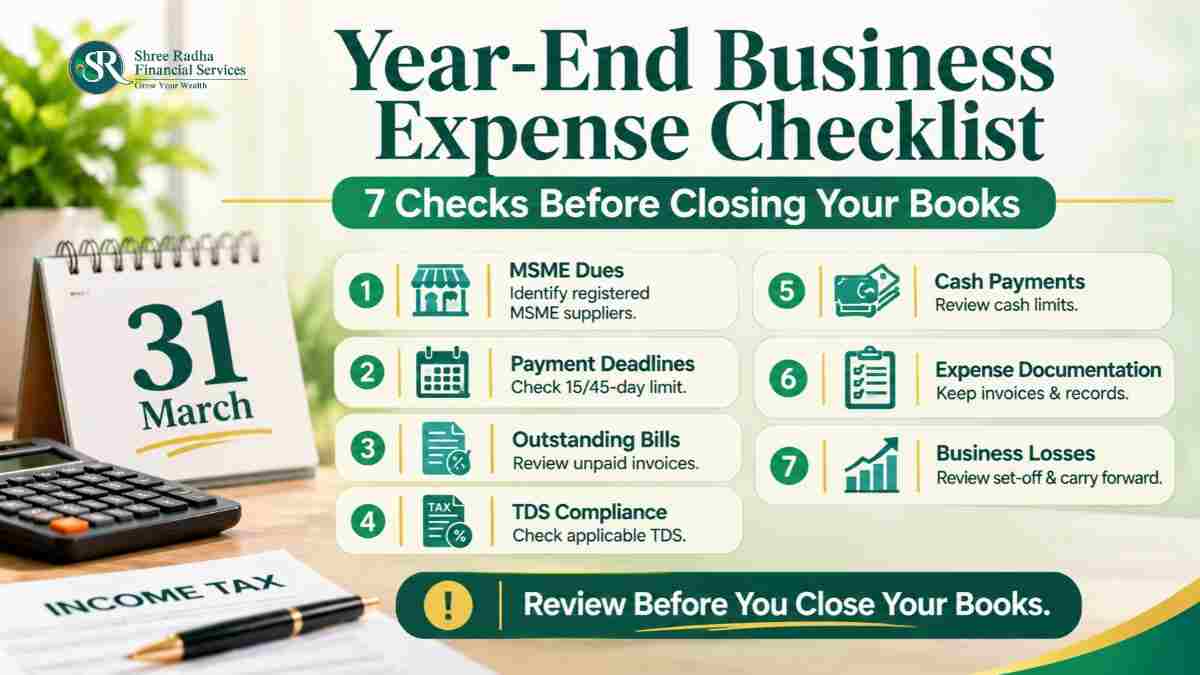
Year-End Business Expenses Checklist
| When | What to do |
|---|---|
| February to March | List all MSME vendors and their unpaid bills. Pay anything that is overdue. |
| Before 31 March | Deduct and deposit TDS on pending payments. Check cash payments above ₹10,000 in a day. Do not convert loan interest into a loan. |
| April to the return due date | Pay taxes, employer provident fund, bonus and bank interest that are still due. These get the grace period. An MSME payment does not. |
| Before you file | Give your CA the payment dates, the Udyam certificates and the TDS challans. |
Common Mistakes and Myths About Business Expenses
| What people believe | What the Act says |
|---|---|
| “Paying before I file my return saves every year-end bill.” | Not for MSME dues beyond the time limit (Section 37(3)). |
| “Interest added to my loan counts as paid.” | It does not (Section 37(4)). |
| “TDS is the receiver’s problem.” | 30% of the payment can be disallowed for the payer (Section 35(b)). |
| “Cash is fine if it is for business.” | Above ₹10,000 a day to one person, it is not allowed (Section 36(4)). |
| “A business loss reduces my salary tax.” | It cannot be set off against salary (Section 109(1)(a)). |
| “I can carry my loss forward even if I file late.” | The return must be filed on time (Section 121). |
Already Made a Mistake? Steps You Can Take
- Stay calm. In most cases the deduction is moved, not lost forever.
- List the bills, payment dates and the supplier or receiver details.
- Meet your CA and ask whether a revised return (Section 263(5)) or an updated return (Section 263(6)) is suitable.
- Do not change your books or dates on your own. Keep the proof of every payment.
For official text, you can read the Act on the Income Tax Department website. This is general education. For your own case, please talk to a competent CA or tax consultant before you decide.
Official Sources to Read
- Sections 28 to 37 of the Income-tax Act 2025 on the Income Tax Department website, with Rules 26 and 48 of the Income-tax Rules 2026.
- Section 15 of the MSMED Act, 2006, on the Ministry of MSME website.
- The Udyam portal, to check a supplier’s certificate.
This topic mixes tax law and MSME law, and the views of professionals can differ. Whenever you are in doubt, please check with your CA before you decide.
How SR Wealth Can Help
We are an AMFI Registered Mutual Fund & SIF Distributor and an APMI Registered PMS Distributor. We do not give tax advice. Please keep your CA or tax consultant for all tax decisions and filing.
Many business owners find that cash is tight at year-end. We help you plan the money you hold in the business and at home, based on your goals and your comfort with risk. We can:
- Help you plan an emergency fund, so a payment due date does not force you to borrow
- Set up mutual fund SIPs for long-term goals
- Explain SIF, PMS and AIF solutions, where they are suitable for you
- Arrange insurance solutions that protect family and business risk
- Connect you with a competent CA or tax consultant if you need one for your salary tax, return or notice
You can read more in our guides on mutual funds for business owners, MWPA insurance for business owners and income tax computation in simple language.
Mutual fund investments are subject to market risks. Please read all scheme-related documents carefully before investing.
Rules and rates change from time to time. Please confirm with your tax consultant / CA. Last verified on 1 November 2026.
Frequently Asked Questions
1. What is the MSME payment rule in the Income-tax Act 2025?
If you owe money to a micro or small enterprise beyond the time limit in Section 15 of the MSMED Act, the expense is allowed only in the year you actually pay it (Section 37(2)(g), earlier Section 43B(h)).
2. What is the time limit for paying an MSME supplier?
The MSMED Act says up to 45 days with a written agreement, and 15 days without one, from the day of acceptance. Please confirm the details of your case with your CA.
3. Does the 45-day rule apply to traders?
The Act says “micro or small enterprise”. Whether traders are covered is debated and depends on how the supplier is registered. Please ask your CA about your specific suppliers.
4. If I pay an MSME supplier before the return due date, is the deduction safe?
Not if the payment was beyond the MSME time limit. The grace till the return due date does not apply to this item (Section 37(3)).
5. Which year-end dues get the grace till the return due date?
Taxes and duties, employer’s contribution to provident and gratuity funds, leave encashment, bonus and commission to employees, interest on loans from specified financial entities, and railway dues. They must be paid by the return due date (Section 37(3)).
6. Is the deduction lost forever if I pay an MSME bill late?
No. It is allowed in the year of actual payment. But you pay more tax in the earlier year.
7. What is the 30% TDS disallowance?
If TDS was required on a payment to a resident but was not deducted, or was not deposited on time, 30% of that payment is not allowed. It is allowed in the year the tax is paid (Section 35(b)).
8. What is the cash payment limit for business expenses?
₹10,000 a day to one person, other than by a specified banking or online mode. For goods carriages it is ₹35,000 (Section 36(4) and (6)).
9. Do these rules apply under presumptive taxation?
Under presumptive taxation, no separate expenses are claimed (Section 58(4)). So these rules matter mainly if you keep regular books. Please confirm with your CA.
10. Can a business loss be set off against salary, and for how long can it be carried forward?
No, a business loss cannot be set off against salary (Section 109(1)(a)). It can be carried forward for eight tax years (Section 112), and a speculation loss for four (Section 113). The return must be filed on time (Section 121).
This article is also available on Medium for wider reading:https://medium.com/@shreeradha.services/msme-payment-rule-4-costly-year-end-mistakes-business-owners-make-tax-year-2026-27-d41fdc23bfc6
Plan Your Business Cash Flow With Shree Radha Financial Services
Connect with Shree Radha Financial Services for a personalized discussion on investments and financial planning.
📞 Call/WhatsApp: +91 98791 13255
📧 Email: shreeradha.services@gmail.com
🌐 Visit: www.srwealth.co.in
📍 Shop 33, Mira Nagar 2, Dindoli Road, Surat 394210
Paresh Chaudhary
Founder, Shree Radha Financial Services, Surat
AMFI Registered Mutual Fund & SIF Distributor — ARN: 268390
APMI Registered PMS Distributor — APRN05763
Investing since 2012 | BE Mechanical, SVNIT Surat | Ex-L&T (15+ Years)
Educational Disclaimer: This article is published by Shree Radha Financial Services — an AMFI Registered Mutual Fund & SIF Distributor (ARN: 268390) and APMI Registered PMS Distributor (APRN05763). All content is strictly for educational purposes only and does not constitute individualized investment advice. Mutual fund investments are subject to market risks — read all scheme-related documents carefully before investing. Tax treatment is based on current laws and subject to change. Please consult a qualified tax professional before investing.