ITR 4 Mistakes: Do You See Yourself in These 4 Stories?
ITR 4 looks like the easy form. It is short, simple and made for small business owners. But picking it by mistake can cost you more than the time you saved.
Here are four people from four cities. Read their stories and ask yourself: “Am I doing the same?”
These stories are illustrative, based on common situations. Names and details are changed, and they are not individual tax advice.
“Many people choose a return form because a friend said it was easy. The form should follow your income and your assets, not the other way round.” — Paresh Chaudhary
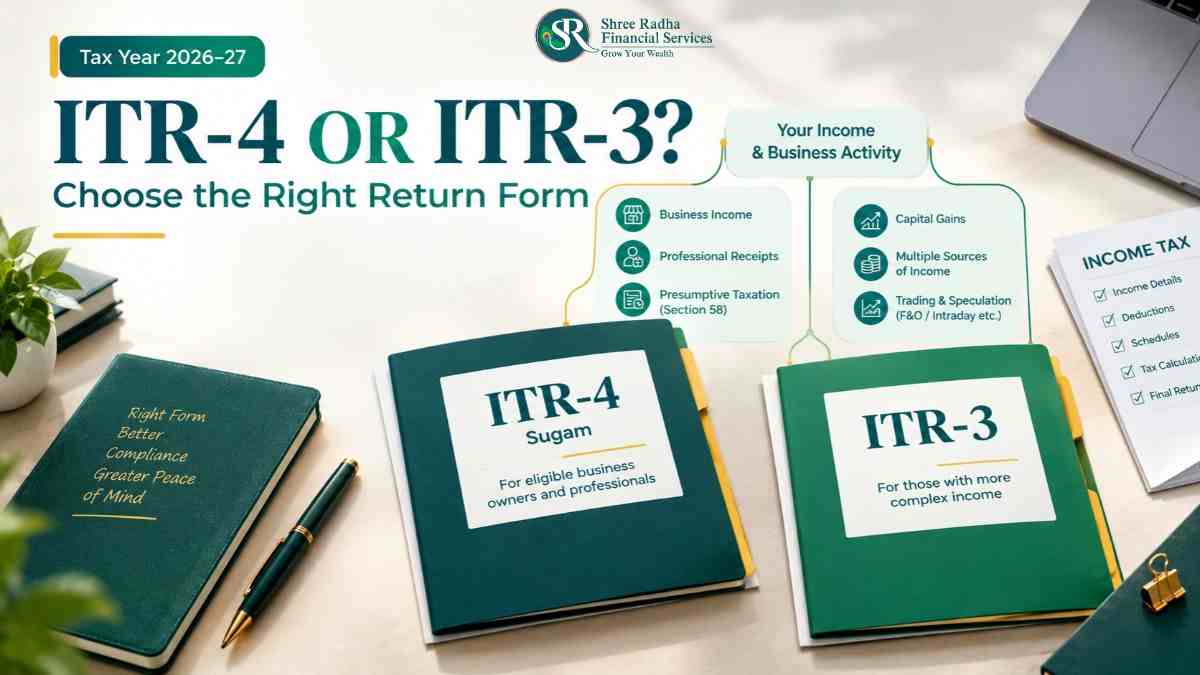
ITR 4 eligibility checklist for shop owners, freelancers and traders under Rule 164
Story 1: Vikram in Hyderabad – “My Client Is in the US, So What?”
Vikram is a freelance software developer in Hyderabad. His main client is a US company, and the money comes into his Indian bank account. This year his receipts were ₹30 lakh.
He used the 50% profession scheme and filed ITR 4. A friend had told him, “Same as every freelancer, no problem.”
What went wrong. The US company also gave Vikram some shares, which he holds in a foreign brokerage account. These are assets outside India, and he did not think they mattered for his return form.
The right way.
- You cannot file ITR-4 if you have assets, including financial interest in any entity, located outside India (Rule 164(6)(a)).
- The same bar applies if you have signing authority in an account outside India (Rule 164(6)(b)).
- It also applies if you have claimed tax relief for foreign tax under Section 159 (Rule 164(6)(l)).
- Vikram needed ITR-3. Ask your CA how to report foreign shares and foreign tax.
Story 2: Nikhil in Mumbai – “A Loss Is a Loss, Right?”
Nikhil trades in futures and options from his home in Mumbai. This year he lost ₹6 lakh.
He thought, “No profit, no tax, so I will file the simple form.” He filed ITR 4 and forgot about it.
What went wrong. Next year Nikhil made a profit. He wanted to set off last year’s loss, but that loss was never properly recorded in his return. It was gone.
The right way.
- You cannot file ITR-4 if you have any brought forward loss or any loss to be carried forward (Rule 164(6)(j)).
- A loss can be carried forward only if it is determined in a return filed on time (Section 121, earlier Section 80).
- So a trader with a loss files ITR-3, on time, with proper records.
- Ask your CA about books, turnover and audit for your trading income.
Story 3: Lakshmi in Chennai – “I Only Sold a Few Shares”
Lakshmi runs a stationery shop in Chennai. Her turnover is ₹80 lakh, and she uses the presumptive scheme every year. She files ITR 4 and it has always been smooth.
This year she also sold some shares at a short-term gain of ₹90,000. She thought it was a small amount and added it under “other income”.
What went wrong. ITR 4 allows only one type of capital gain.
The right way.
- ITR-4 allows capital gains only if they are long-term gains under Section 198 and not more than ₹1,25,000 (Rule 164(5)(b)).
- Short-term gains, or long-term gains above ₹1.25 lakh, mean you need ITR-3.
- Keep your contract notes and capital gains statements ready before you file.
- Check your form again every year, because one transaction can change the answer.
Story 4: Soumen in Kolkata – “I Am Only a Director on Paper”
Soumen runs a garment shop in Kolkata with a turnover of ₹1.2 crore. He uses the presumptive scheme and files ITR-4.
Two years ago his family started a private limited company. To help them, Soumen became a director and took some of its shares. He gets no salary from it, so he never mentioned it to his tax filer.
What went wrong. A directorship and unlisted shares both count, even if no money is earned.
The right way.
- You cannot file ITR-4 if you are a director in any company (Rule 164(6)(f)).
- You also cannot file it if you held any unlisted equity share at any time in the tax year (Rule 164(6)(g)).
- Soumen still can use the presumptive scheme for his shop, but his form is ITR-3.
- Tell your CA about every directorship and every unlisted share you hold.
ITR 4 and the Other Forms in Simple Words (Rule 164, Tax Year 2026-27)
Rule 164 of the Income-tax Rules 2026 decides which form you file for Tax Year 2026-27. The names are the same as before, but the rule numbers are new. Here is the simple version.
| Form | Who files it | Business income? |
|---|---|---|
| ITR-1 (SAHAJ) | Resident individual with salary, pension, up to two house properties or other sources, and total income up to ₹50 lakh | No |
| ITR-2 | Individual or HUF who does not fit ITR-1 and has no business or professional income | No |
| ITR-3 | Individual or HUF with business or professional income who does not fit ITR-4 | Yes |
| ITR-4 (SUGAM) | Resident individual or HUF (other than not ordinarily resident), or a resident firm (other than an LLP), whose business income is computed under Section 58 | Yes, under the Section 58 scheme only |
| ITR-5 | Firms and LLPs not covered by ITR-4, and similar entities (not individuals, HUFs or companies) | Yes |
Section 58 is the presumptive taxation scheme (earlier Sections 44AD, 44ADA and 44AE). We explain it in our guide on presumptive taxation for business and professional income.
Who Cannot File ITR 4? A One-Minute Check
This is the list that trips up most people. You cannot file ITR-4 if any one of these is true for you (Rule 164(6)):
- Foreign link. You have assets outside India, signing authority in a foreign account, or income from any source outside India.
- Company link. You are a director in a company, or you held any unlisted equity share during the year.
- High income. Your total income is above ₹50 lakh.
- Many properties. You own more than two house properties.
- A loss. You have a brought forward loss, or a loss to be carried forward, under any head.
- Agricultural income above ₹5,000.
- Foreign tax relief. You claimed relief under Section 159.
- Residency. You are not a resident, or you are a resident but not ordinarily resident (for an individual or HUF).
- Capital gains. You have short-term gains, or long-term gains other than those under Section 198, or long-term gains above ₹1.25 lakh.
- Not on Section 58. Your business income is not computed under Section 58. For example, you keep regular books or you declare less than the deemed profit.
- You are an LLP. LLPs file ITR-5.
If you see yourself in even one point, ITR-3 or ITR-5 is likely your form. Please check with your CA before you file.
Which Form Fits You? A Simple Decision Table
| Your situation | Likely form | Why |
|---|---|---|
| Shop owner or specified professional on Section 58, none of the bars above | ITR-4 | Rule 164(5) |
| Salary plus a small business on Section 58, none of the bars above | ITR-4 | Salary is not on the bar list. Please confirm with your CA. |
| Business income with regular books, or declaring less than the deemed profit | ITR-3 | Not computed under Section 58 |
| Foreign shares, foreign account or foreign tax relief | ITR-3 | Rule 164(6)(a), (b), (l) |
| Short-term gains, or long-term gains above ₹1.25 lakh | ITR-3 | Rule 164(5)(b) |
| Director in a company, or unlisted shares | ITR-3 | Rule 164(6)(f), (g) |
| A loss to carry forward | ITR-3 | Rule 164(6)(j) and Section 121 |
| Total income above ₹50 lakh | ITR-3 | Rule 164(6)(h) |
| Resident partnership firm (not an LLP) on Section 58 | ITR-4 | Rule 164(5) |
| Other firms, and all LLPs | ITR-5 | Rule 164(8) |
| Salaried only, no business income | ITR-1 or ITR-2 | Rule 164(2), (4) |
If you are salaried, you can read how salary is taxed in our guide on salary income under the new Income-tax Act.
F&O and Intraday Traders: ITR 4 or ITR 3?
This is the question we hear most from traders. The Rule does not name F&O or intraday trading in the form list. What it does say is clear and useful.
- ITR-4 is only for business income computed under Section 58.
- Any brought forward loss or loss to be carried forward bars ITR-4.
- A loss can be carried forward only through a return filed on time (Section 121).
Many traders have losses in some years, and so most of them file ITR-3. Whether trading income can be computed under Section 58 at all, and how trading turnover is counted, is something your CA should confirm for your case.
Freelancers With Foreign Clients: What the Rule Says
Freelancers often ask, “Can I file ITR-4 if my client is abroad?” The honest answer has two parts.
- The Rule bars ITR-4 if you have income from any source outside India, assets outside India, signing authority in a foreign account, or foreign tax relief under Section 159.
- Whether fees from a foreign client for work done from India count as income from a source outside India is not explained in the Rule itself.
So please do not assume. If you hold foreign shares, keep a foreign wallet or account, or claim foreign tax relief, ITR-3 is the safer route. Ask your CA before you choose.
What If You Filed the Wrong Form?
Do not panic. Many people file the wrong form, and it can often be fixed. But it is better to act early.
- A return that is not in line with the prescribed conditions can be treated as defective (Section 263(7)).
- The Assessing Officer can send you a notice to correct the defect, usually within 15 days.
- If the defect is not corrected in time, the return can be treated as invalid, as if you never filed (Section 263(7)).
- Your CA can tell you whether a revised return (Section 263(5)) or an updated return (Section 263(6)) is suitable.
Please do not file a new return on guesswork. Time limits and extra tax can apply.
Switching Between ITR-4 and ITR-3
Moving from ITR-4 to ITR-3 is not always just a form change. If you leave the Section 58 scheme by declaring a lower profit, a five-year bar can follow (Section 58(7)). Books and a tax audit may apply (Section 58(8)).
The reverse is simpler. Many people file ITR-3 because of one special year, such as a share sale, and go back to ITR-4 the next year. Check your facts each year.
Our guide on presumptive taxation explains the five-year rule with stories. If you file on more than one platform, read why ITR filing on multiple platforms gets messy.
Common Mistakes and Myths About ITR 4
| What people believe | What the Rule says |
|---|---|
| “ITR-4 is for every small business owner.” | Only for business income computed under Section 58. |
| “A small share sale does not matter.” | Short-term gains bar ITR-4. Long-term gains are allowed only up to ₹1.25 lakh. |
| “I earn nothing from the company, so my directorship does not count.” | Any directorship bars ITR-4. |
| “A loss means a simple return.” | A loss to carry forward bars ITR-4, and it needs a timely return. |
| “Foreign shares are not my business income, so they do not matter.” | Assets outside India bar ITR-4, whatever their source. |
| “An LLP can use ITR-4 like a firm.” | LLPs file ITR-5. |
| “Three house properties are fine.” | More than two house properties bars ITR-4. |
Quick Checklist Before You File
- Is my business income computed under Section 58?
- Do I have any foreign asset, account or foreign income?
- Am I a director, or do I hold unlisted shares?
- Did I sell shares, property or mutual funds this year?
- Do I have a loss to carry forward?
- Is my total income within ₹50 lakh?
- Am I a firm, or an LLP?
Download the latest form instructions from the e-filing portal and read the rule on the Income Tax Department website. This is general education about ITR-4. For your own case, please talk to a competent CA or tax consultant before you decide.
How SR Wealth Can Help
We are an AMFI Registered Mutual Fund & SIF Distributor and an APMI Registered PMS Distributor. We do not give tax advice. Please keep your CA or tax consultant for all tax decisions and filing.
Business owners, traders and freelancers often have money spread across bank accounts, shares and mutual funds. We help you plan where your surplus can go, based on your goals and your comfort with risk. We can:
- Help you organise your mutual fund holdings and statements, so your records are ready when your CA asks for them
- Set up mutual fund SIPs for long-term goals
- Explain SIF, PMS and AIF solutions, where they are suitable for you
- Arrange insurance solutions that protect family and business risk
- Connect you with a competent CA or tax consultant if you need one for your salary tax, return or notice
You can read more in our guides on mutual funds for business owners and the old vs new tax regime for 2026-27.
Mutual fund investments are subject to market risks. Please read all scheme-related documents carefully before investing.
Rules and rates change from time to time. Please confirm with your tax consultant / CA. Last verified on 29 October 2026.
Frequently Asked Questions
1. What is the difference between ITR-4 and ITR-3?
ITR-4 (SUGAM) is for business income computed under Section 58 (presumptive taxation), with several bars such as foreign assets or a loss to carry forward. ITR-3 is for individuals and HUFs with business or professional income who do not fit ITR-4.
2. Who can file ITR-4 for Tax Year 2026-27?
A resident individual or HUF (other than not ordinarily resident), or a resident firm other than an LLP, whose business income is computed under Section 58, and who has none of the bars in Rule 164(6).
3. Can I file ITR-4 if I have capital gains?
Only if you have long-term gains under Section 198 of not more than ₹1.25 lakh. Short-term gains, or larger long-term gains, mean you need ITR-3.
4. Can a salaried person with freelance income file ITR-4?
Salary is not on the list of bars, so it can be possible if the freelance income is computed under Section 58 and no other bar applies. Please confirm with your CA.
5. Which form should F&O or intraday traders file?
A loss to carry forward bars ITR-4, and many traders file ITR-3. Whether trading income can be computed under Section 58 needs a careful check for your case.
6. Can a freelancer with foreign clients file ITR-4?
The Rule bars ITR-4 for foreign assets, a foreign signing authority, income from any source outside India, or foreign tax relief. How foreign client fees are treated should be checked with your CA.
7. Can a partnership firm or an LLP file ITR-4?
A resident partnership firm (not an LLP) can file ITR-4 if its income is computed under Section 58. An LLP files ITR-5 (Rule 164(8)).
8. Can a partner in a firm file ITR-4?
This depends on how the partner’s income from the firm is taxed and on the other bars in Rule 164(6). Please ask your CA before you choose the form.
9. What happens if I file the wrong form?
The return can be treated as defective, and you may get a chance to correct it within a set time. If it is not corrected, it can be treated as invalid (Section 263(7)). Please see your CA early.
10. Can I go from ITR-4 back to ITR-3?
Yes, if your facts change. But if you leave the Section 58 scheme by declaring a lower profit, a five-year bar and an audit can follow (Section 58(7) and (8)).
This article is also available on Medium for wider reading:https://medium.com/@shreeradha.services/itr-4-or-itr-3-4-costly-form-mistakes-business-owners-and-freelancers-make-tax-year-2026-27-7ce0e69ff24c
Plan Your Surplus With Shree Radha Financial Services
Connect with Shree Radha Financial Services for a personalized discussion on investments and financial planning.
📞 Call/WhatsApp: +91 98791 13255
📧 Email: shreeradha.services@gmail.com
🌐 Visit: www.srwealth.co.in
📍 Shop 33, Mira Nagar 2, Dindoli Road, Surat 394210
Paresh Chaudhary
Founder, Shree Radha Financial Services, Surat
AMFI Registered Mutual Fund & SIF Distributor — ARN: 268390
APMI Registered PMS Distributor — APRN05763
Investing since 2012 | BE Mechanical, SVNIT Surat | Ex-L&T (15+ Years)
Educational Disclaimer: This article is published by Shree Radha Financial Services — an AMFI Registered Mutual Fund & SIF Distributor (ARN: 268390) and APMI Registered PMS Distributor (APRN05763). All content is strictly for educational purposes only and does not constitute individualized investment advice. Mutual fund investments are subject to market risks — read all scheme-related documents carefully before investing. Tax treatment is based on current laws and subject to change. Please consult a qualified tax professional before investing.