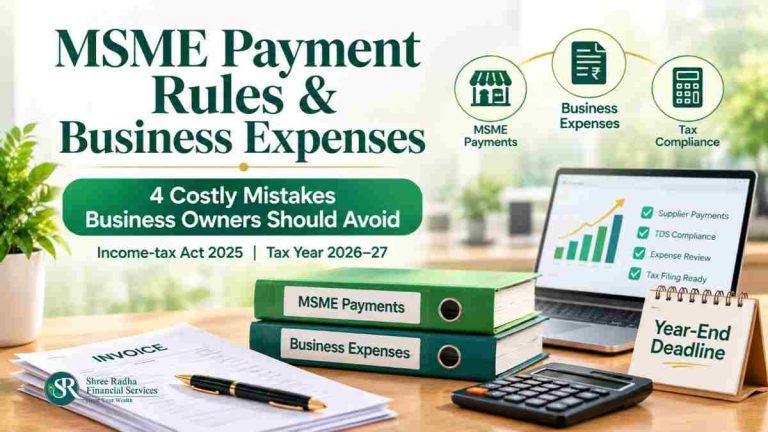
Presumptive Taxation Mistakes: Do You See Yourself in These 4 Stories?
Presumptive taxation looks simple. You pay tax on a fixed percentage of your sales or receipts, and you skip most of the paperwork. But one small missed condition can change everything.
Here are four people from four cities. Read their stories and ask yourself one thing: “Am I doing the same?”
These stories are illustrative, based on common situations. Names and details are changed, and they are not individual tax advice.
“Many business owners choose this scheme for peace of mind, and later find that one small condition was missed. A short yearly check of the rules saves a lot of worry.” — Paresh Chaudhary
Story 1: Rakesh in Indore – “My Limit Is ₹3 Crore”
Rakesh runs a cloth wholesale shop in Indore. Business was good, and this year his sales touched ₹2.6 crore.
A friend told him, “Use the presumptive scheme. No books, no audit, and the limit is ₹3 crore.” Rakesh liked what he heard. He filed his return in ITR-4 and felt relaxed.
What went wrong. About 8% of his sales came in cash. Some customers also paid by cheques that were not account payee. Those cheques count as cash too.
The ₹3 crore limit works only when cash is 5% or less. For Rakesh the limit was ₹2 crore, and he had crossed it.
The right way.
- The higher limit of ₹3 crore needs cash receipts of 5% or less of turnover. A cheque or draft that is not account payee counts as cash (Section 58(9)).
- Track cash and digital receipts every month.
- Ask customers to pay by UPI, NEFT or account payee cheque.
- Check the limit with your CA before the year closes, not after filing.
Outside the scheme, regular books apply, and a tax audit can follow above ₹1 crore of turnover. The higher ₹10 crore audit limit needs both cash receipts and cash payments to be 5% or less (Section 63).
Story 2: Meera in Bengaluru – “I Took 50%, Now I Will Claim My Costs Too”
Meera is a freelance software consultant in Bengaluru. Her receipts for the year were ₹40 lakh.
She chose the profession scheme and declared 50% of her receipts as profit, which is ₹20 lakh. Then she remembered her costs: desk rent in a co-working space, a new laptop, internet and software subscriptions. She deducted all of them as well.
What went wrong. The 50% is already after all costs. She counted her expenses twice.
Some of her clients are also outside India. That raises a second question about her return form.
The right way.
- After you declare the deemed profit, no further deduction is allowed (Section 58(4)).
- Choose one method. Either keep the 50% and claim nothing more, or keep regular books if your real costs are much higher.
- If you claim a profit lower than 50% and your income is above the basic exemption limit, books and tax audit apply (Section 58(3)).
- ITR-4 is not allowed for a person who has income from any source outside India (Rule 164(6), Income-tax Rules 2026). Ask your CA which form fits clients abroad.
Story 3: Sanjay in Pune – “Margins Fell, So I Left”
Sanjay runs a pharma distribution business in Pune. He used the scheme for two years and found it easy.
In the third year his margins fell. His real profit was lower than the deemed profit, so he decided to leave the scheme, declare the lower profit and file ITR-3.
What went wrong. Nobody told him about the five-year rule. Once you leave, the door closes for a long time.
The right way.
- If you declare a lower profit within the five years after joining, you cannot use the business scheme for the next five tax years (Section 58(7)).
- If your income is above the basic exemption limit in those years, you must keep books and get a tax audit (Section 58(8)).
- Decide with a five-year view, not just this year’s margin.
- Keep a simple record of your real margins and review the choice with your CA before you file.
Story 4: Mahesh in Jaipur – “We Became an LLP, Nothing Else Changed”
Mahesh and his brother run a gems trading firm in Jaipur. As a partnership firm, they had used the scheme for years.
Last year they converted the firm into an LLP to look stronger to banks. They kept filing the same way as before.
What went wrong. They changed the structure, but not their filing habit. An LLP cannot use the scheme.
The right way.
- LLPs are excluded from the scheme (Section 58(11)).
- An LLP keeps regular books, follows the audit rules in Section 63 and files ITR-5 (Rule 164(8)).
- Check the tax effect before you change the business structure.
- Ask your CA what changes after conversion, including books and the return form.
What Is Presumptive Taxation? Section 58 in Simple Words (Earlier 44AD, 44ADA, 44AE)
Presumptive taxation means the law presumes a fixed share of your turnover or receipts as profit. You pay tax on that profit and do not work out every expense.
In the Income-tax Act 2025, this scheme is in Section 58 (earlier Sections 44AD, 44ADA and 44AE of the 1961 Act). It applies from Tax Year 2026-27, which covers the same period as FY 2026-27 (earlier called Assessment Year 2027-28).
Income from a business or profession is taxed under Section 26 (earlier Section 28). You can work out this income in two ways: regular books, or the Section 58 scheme. If you also have salary income, you can read our guide on salary income under the new Income-tax Act.
You can read the Act on the Income Tax Department website. Please check the latest text there before you decide anything.
Who Cannot Use Presumptive Taxation? A One-Minute Check
This is where most mistakes start, so please read it slowly. You cannot use the business scheme if any one of these is true for you:
- You earn commission or brokerage. For example, a commission agent in a mandi or cloth market, a real estate broker, or an insurance agent.
- You run an agency business. For example, you sell on behalf of a company and earn a fee or commission for it.
- You are an LLP or a company. Only resident individuals, HUFs and firms (other than LLPs) can use the business scheme.
- You are not a resident. The scheme is for residents only.
- You are a specified professional. Doctors, lawyers, engineers, architects, accountants, technical consultants, interior designers, IT professionals and company secretaries use the profession scheme, not the business scheme.
- You claimed a Chapter VIII-C deduction.
- Your sales are above the limit, or your cash receipts are above 5% when your turnover is above ₹2 crore.
- You left the scheme in the last five years by declaring a lower profit.
The list of specified professions is in Section 62(4). The Board can also notify more professions.
If you see yourself in any point above, regular books are the route for you. Please talk to your CA before you file.
Presumptive Taxation Limits and Rates for Tax Year 2026-27
Section 58(2) has one Table with three schemes. Here are the key points in simple form.
| Scheme | Who can use it | Turnover or receipt limit | Deemed profit |
|---|---|---|---|
| Business (earlier 44AD) | Resident individual, HUF or firm (not an LLP) | Up to ₹2 crore. Up to ₹3 crore if cash receipts are 5% or less of turnover. | 6% of receipts by banking or online mode, 8% of the rest. Or the actual profit, if higher. |
| Profession (earlier 44ADA) | Resident individual or firm (not an LLP) in a specified profession | Up to ₹50 lakh. Up to ₹75 lakh if cash receipts are 5% or less of gross receipts. | 50% of gross receipts. Or the actual profit, if higher. |
| Goods carriage (earlier 44AE) | Any assessee who owns not more than ten goods carriages at any time in the tax year | Based on vehicles, not turnover | ₹1,000 per ton per month for heavy goods vehicles, ₹7,500 per month for other goods carriages. Or the actual profit, if higher. |
These figures are from the Act text as amended by Finance Act 2026. Limits and rates can change in future Finance Acts, so please check before you file.
What Counts as Digital and What Counts as Cash
The 6% rate applies to money received by a “specified banking or online mode”. This means an account payee cheque, an account payee bank draft, or electronic clearing through a bank account (Section 66(32)).
The Income-tax Rules 2026 (Rule 48) add other electronic modes. These include credit card, debit card, net banking, IMPS, UPI, RTGS, NEFT and BHIM Aadhaar Pay. The money must be received during the tax year or before the return due date.
Why “Whichever Is Higher” Matters
The Act says your profit under the scheme is the deemed amount or the profit you actually earned, whichever is higher. If your real profit is higher, you show the higher figure.
How Section 58 Profit Is Calculated: A Simple Example
Business example. Take a trader like Rakesh, but with turnover of ₹1.5 crore. Of this, ₹1.4 crore came by UPI and bank transfer, and ₹10 lakh came in cash.
- 6% of ₹1.4 crore = ₹8.4 lakh
- 8% of ₹10 lakh = ₹0.8 lakh
- Deemed profit = ₹9.2 lakh
Profession example. A consultant like Meera, with gross receipts of ₹40 lakh, has deemed profit of 50%, which is ₹20 lakh.
These examples only show the deemed profit. Tax is then worked out on your total income as per the slab you are under. You can read how this works in our guide on income tax computation in simple language.
What You Cannot Claim
- No further deduction, allowance or loss against the deemed profit (Section 58(4)). This includes rent, salary, depreciation, phone and internet bills.
- The written down value of your assets is treated as if depreciation was claimed every year (Section 58(6)).
- Firms: the rules on partners’ salary and interest are in Section 58(5). Please ask your CA how this applies to your firm.
Regular Books vs Section 58: Tax Audit and Due Dates
The main difference between presumptive taxation and regular books is in record keeping, audit and advance tax. This table shows both routes side by side.
| Point | Section 58 scheme | Regular books |
|---|---|---|
| Profit | Fixed percentage, or actual if higher | Income minus allowed expenses |
| Extra expenses | Not allowed (Section 58(4)) | Allowed as per Sections 28 to 37 |
| Books (Section 62) | Needed if you claim a lower profit than the deemed profit | Needed above the limits in Section 62(2). For individuals and HUFs these are ₹2.5 lakh income and ₹25 lakh turnover. |
| Tax audit (Section 63) | Not needed if you declare the deemed profit. Needed if you claim lower profit and your income is above the basic exemption limit. | Business: turnover above ₹1 crore (₹10 crore if cash receipts and cash payments are each 5% or less). Profession: receipts above ₹50 lakh. |
| Advance tax | One payment on or before 15 March (Section 408(2)) | Four instalments: 15 June, 15 September, 15 December, 15 March |
| Return due date | 31 August (accounts not audited) | 31 August without audit, 31 October with audit |
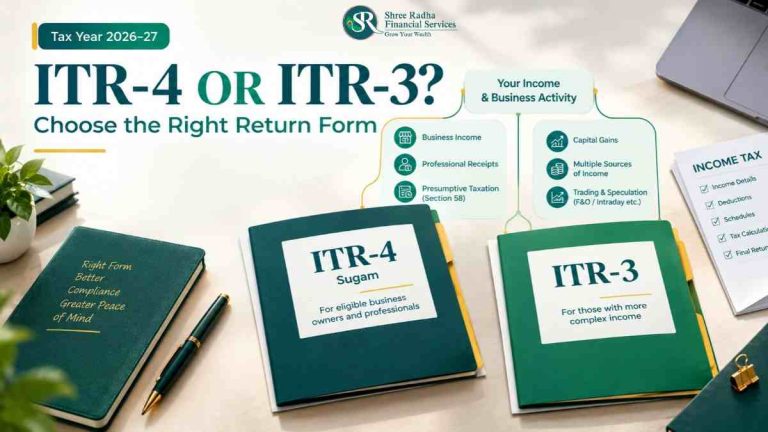
| Return form | ITR-4 (SUGAM), if eligible | ITR-3 |
A tax audit report is due one month before the return due date (Section 63(5)(a)). Rules and due dates change from time to time, so please confirm with your CA before you rely on any date.
Which Return Form: ITR-4 or ITR-3?
Rule 164 of the Income-tax Rules 2026 sets the form for Tax Year 2026-27. In simple words:
- ITR-4 (SUGAM) is for a resident individual, HUF or a firm (not an LLP) whose business income is computed under Section 58. Capital gains are allowed only if they are long-term gains under Section 198 and not more than ₹1.25 lakh.
- ITR-3 is for an individual or HUF with business or professional income who does not fit ITR-4.
- ITR-5 is for firms and LLPs that are not covered by ITR-4.
You cannot file ITR-4 if you have any of these:
- assets or a signing authority outside India, or income from any source outside India
- a directorship in a company, or unlisted equity shares at any time in the year
- total income above ₹50 lakh
- more than two house properties
- any brought forward loss or loss to be carried forward
- agricultural income above ₹5,000
Form names and rules can change. Please download the latest form from the e-filing portal. If you use more than one platform to file, our guide on ITR filing on multiple platforms may help.
Presumptive Taxation and the New Tax Regime
The new tax regime in Section 202 is the default. A person with business or professional income can opt for the old regime, but the choice has strict rules (Section 202(4)(a)):
- You must opt by the return due date.
- Once you opt, it continues in later years.
- You can withdraw only once.
- After you withdraw, you can never opt again, unless your business income stops.
Under the new regime, income up to ₹4,00,000 is nil, and the next slabs are 5%, 10%, 15%, 20%, 25% and 30% (Section 202(1)). Surcharge and cess apply as per the Finance Act. We have a full comparison in our guide on old vs new tax regime 2026-27.
Advance Tax, Return Due Dates and Business Losses
If you declare profit under Section 58, you pay the whole advance tax on or before 15 March (Section 408(2)). The return due date for business income without audit is 31 August, and with audit it is 31 October (Section 263(1)(c)). A late return can bring a fee under Section 428 and interest under Sections 423 to 425.
Losses work differently. No loss is allowed against income computed under Section 58 (Section 58(4)). With regular books, a business loss can be carried forward under Section 112 (earlier Section 72), and a speculation loss follows Section 113 (earlier Section 73). To carry forward a loss, you must file the return on time (Section 121, earlier Section 80).
Common Mistakes and Myths
| What people believe | What the Act says |
|---|---|
| “I can claim rent and salary on top of 6% or 50%.” | No further deduction is allowed (Section 58(4)). |
| “The ₹3 crore limit is automatic.” | It works only if cash receipts are 5% or less. |
| “Any cheque counts as digital.” | A cheque that is not account payee counts as cash (Section 58(9)). |
| “An LLP can use it.” | LLPs are excluded (Section 58(11)). |
| “Commission agents can file under 44AD.” | Commission, brokerage and agency income are barred. |
| “I can leave the scheme any year I like.” | A five-year bar can follow (Section 58(7) and (8)). |
| “There is never an audit under this scheme.” | Audit applies if you claim lower profit and your income is above the basic exemption limit. |
Already Made a Mistake? Steps You Can Take
- Stay calm. Many filing issues can be corrected.
- Collect your return copy, bank statements, bills and your AIS.
- Meet your CA and ask whether a revised return (Section 263(5)) or an updated return (Section 263(6)) is suitable for you.
- Do not file a new return on guesswork. Time limits and extra tax can apply, so act early.
Quick Checklist Before You Choose
- Is my turnover or receipt within the limit?
- Is my cash share 5% or less?
- Do I earn any commission, brokerage or agency income?
- Am I an LLP or a company?
- Are my real costs likely to be higher than the deemed profit?
- Am I ready for the five-year rule?
- Which return form fits me, ITR-4 or ITR-3?
This is general education about presumptive taxation. For your own case, please talk to a competent CA or tax consultant before you decide.
How SR Wealth Can Help
We are an AMFI Registered Mutual Fund & SIF Distributor and an APMI Registered PMS Distributor. We do not give tax advice. Please keep your CA or tax consultant for all tax decisions and filing.
Business owners and professionals often keep a lot of money in current accounts. We help you plan where your surplus can go, based on your goals and your comfort with risk. We can:
- Help you plan an emergency fund for slow months in the business
- Set up mutual fund SIPs for long-term goals
- Explain SIF, PMS and AIF solutions, where they are suitable for you
- Arrange insurance solutions that protect family and business risk
- Connect you with a competent CA or tax consultant if you need one for your salary tax, return or notice
You can read more in our guides on mutual funds for business owners and MWPA insurance for business owners.
Mutual fund investments are subject to market risks. Please read all scheme-related documents carefully before investing.
Rules and rates change from time to time. Please confirm with your tax consultant / CA. Last verified on 29 October 2026.
Frequently Asked Questions
1. What is presumptive taxation in simple words?
It is a scheme where the law fixes your profit as a percentage of turnover or receipts. You do not work out profit from every expense. It is in Section 58 of the Income-tax Act 2025.
2. What are the limits for Tax Year 2026-27?
For business, the limit is ₹2 crore, or ₹3 crore if cash receipts are 5% or less. For specified professions, it is ₹50 lakh, or ₹75 lakh if cash receipts are 5% or less. Limits can change with future Finance Acts.
3. Can I claim expenses on top of the deemed profit?
No. After you declare the deemed profit, no further deduction, allowance or loss is allowed against it (Section 58(4)).
4. Is a tax audit needed if I use the scheme?
Not if you declare the deemed profit. If you claim a lower profit and your income is above the basic exemption limit, you must keep books and get a tax audit (Section 58(3)).
5. Should I file ITR-3 or ITR-4?
ITR-4 is for eligible persons whose business income is under Section 58. ITR-3 is for other individuals and HUFs with business income. Please check Rule 164 and the latest form instructions.
6. What is the five-year rule?
If you use the business scheme and later declare a lower profit within the next five tax years, you cannot use the scheme for five tax years after that (Section 58(7)). Books and audit may then apply (Section 58(8)).
7. Can an LLP, a commission agent or a broker use the scheme?
No. LLPs and persons with commission, brokerage or agency income are excluded from the business scheme (Section 58(11)). They keep regular books.
8. Can a freelancer use the profession scheme?
Yes, if the work falls in a specified profession in Section 62(4), such as information technology or technical consultancy, and the person is a resident individual or firm within the limits. Freelancers with clients abroad should check ITR-4 eligibility with their CA.
9. Can F&O or intraday traders use the scheme?
This needs a careful check of the Act, the form instructions and how turnover is counted. Please speak to your CA before choosing a route.
10. Does MAT or AMT apply to someone under this scheme?
MAT (Section 206, earlier Section 115JB) applies to companies. AMT applies to non-companies that claim certain deductions in Chapter VIII-C or Section 46. A person using the business scheme cannot claim Chapter VIII-C deductions, and AMT does not apply to a person taxed under Section 202(1).
This article is also available on Medium for wider reading:https://medium.com/@shreeradha.services/presumptive-taxation-under-the-income-tax-act-2025-4-costly-mistakes-business-owners-make-a30c2ea06a6d
Plan Your Business Surplus With Shree Radha Financial Services
Connect with Shree Radha Financial Services for a personalized discussion on investments and financial planning.
📞 Call/WhatsApp: +91 98791 13255
📧 Email: shreeradha.services@gmail.com
🌐 Visit: www.srwealth.co.in
📍 Shop 33, Mira Nagar 2, Dindoli Road, Surat 394210
Paresh Chaudhary
Founder, Shree Radha Financial Services, Surat
AMFI Registered Mutual Fund & SIF Distributor — ARN: 268390
APMI Registered PMS Distributor — APRN05763
Investing since 2012 | BE Mechanical, SVNIT Surat | Ex-L&T (15+ Years)
Educational Disclaimer: This article is published by Shree Radha Financial Services — an AMFI Registered Mutual Fund & SIF Distributor (ARN: 268390) and APMI Registered PMS Distributor (APRN05763). All content is strictly for educational purposes only and does not constitute individualized investment advice. Mutual fund investments are subject to market risks — read all scheme-related documents carefully before investing. Tax treatment is based on current laws and subject to change. Please consult a qualified tax professional before investing.