APY Eligibility in 2026: Who Can Join Atal Pension Yojana and Who Should Think Twice
APY eligibility looks simple: join between 18 and 40, pay a small amount regularly, and get a guaranteed minimum pension from 60. Over 9 crore people have enrolled. But many join without asking two questions: Am I really eligible? and Is a guaranteed pension of at most ₹5,000 right for me?
This guide answers both, starting with APY eligibility, in plain words. You will meet families from Surat, Lucknow, Pune and Ludhiana. Each one held a belief about Atal Pension Yojana that was only half true. You will see what they thought, what went wrong, and how it was put right.
For the wider picture, read our retirement schemes guide. APY is a government scheme run through banks and post offices, not a product of ours. We explain it so you can decide with open eyes.
“APY is a good idea for the right person. It gives people who have no pension a simple, disciplined start. But I see two problems: people who join without checking APY eligibility, and people who think ₹5,000 a month will be enough in 2056. Both can be avoided with a few facts.”
— Paresh Chaudhary, Founder, Shree Radha Financial Services

APY Eligibility at a Glance
Last verified on 28 October 2026. Rules can change. These APY eligibility rules apply to new joiners. Please also check with your bank or post office, and on the PFRDA website the Jan Suraksha portal and the NPS Trust website.
| Point | APY rule |
|---|---|
| Age to join | 18 to 40 years |
| Who can join | Indian citizens with a savings bank or post office account and KYC |
| Income-tax payers | Not eligible to join, from 1 October 2022. Check your own status with your bank |
| Pension | ₹1,000, ₹2,000, ₹3,000, ₹4,000 or ₹5,000 a month from age 60. The Central Government guarantees this minimum pension. The notification says a higher pension is possible depending on investment returns, but do not count on it |
| Contribution period | Until age 60. At least 20 years of contributions |
| Payment | Auto-debit from your savings bank account, monthly, quarterly or half-yearly. Your bank also lets you change your pension slab, usually once a year |
| After you | Spouse gets the same pension. After both, the nominee gets the corpus (₹8.5 lakh for the ₹5,000 slab) |
| Exit before 60 | Only in exceptional cases: death, or specified illnesses under the NPS exit regulations (per the Government notification) |
APY Eligibility Story 1: Ramesh in Surat and the “Enough” Pension
Ramesh is 28. He works in an embroidery unit in Surat and earns about ₹22,000 a month. At a camp at his bank, he met the APY eligibility rules and joined APY for the ₹5,000 slab, paying ₹485 a month (the official chart rate for age 28). He was proud. “From 60, ₹5,000 every month, guaranteed by the government. My retirement is sorted,” he told his wife.
His belief was that ₹5,000 would be enough. His second belief was that “guaranteed” means “safe from everything”.
A friend who works as an accountant asked him one question: “Ramesh, what does ₹5,000 buy today? And what will it buy in 2058?” Ramesh did not have an answer.
Here is the answer. The guaranteed minimum pension is paid for life, and it does not rise with prices. The Government notification says a higher pension is possible depending on investment returns, but that is not guaranteed. If prices rise 6% a year, then ₹5,000 after 30 years buys only what about ₹870 buys today. Ramesh joined at 28, so his pension starts in 32 years, and the picture is even sharper.
The guarantee is real: the Government of India stands behind the pension amount. But it protects the number of rupees, not their buying power. Ramesh did not need to leave APY. He needed to see it as one small layer, not the whole building. He kept his APY, and also started a small separate monthly savings habit for the years in between. APY eligibility had helped him start. What he needed next was a second layer.
How Much You Pay: A Sample Contribution Chart
The monthly payment depends on your age when you join and the pension slab you choose. For the ₹5,000 pension, here is a sample:
| Join at age | Monthly payment (approx.) | Years of payment | Total you pay (approx.) |
|---|---|---|---|
| 18 | ₹210 | 42 | ₹1.06 lakh |
| 30 | ₹577 | 30 | ₹2.08 lakh |
| 40 | ₹1,454 | 20 | ₹3.49 lakh |
Amounts are from the official chart (Annex-1 of the Government notification of 16 October 2015). Quarterly and half-yearly amounts are also prescribed. Please check the current chart with your bank or on the Jan Suraksha portal.
You can see the trade-off in APY eligibility by age. Joining earlier costs far less each month. Joining at 40 costs about seven times more per month than joining at 18 for the same pension.
APY Eligibility Story 2: Meena in Lucknow and Her Husband’s Tax
Meena is 38. She lives in Lucknow, stitches blouses at home, and runs the household. Her husband works in a private bank and pays income tax.
At her neighbour’s urging, Meena went to the bank to join APY. The clerk hesitated. “Madam, your husband is a taxpayer.” Meena came home upset and called us on a phone call.
She believed that if the husband pays tax, the wife cannot join. That was her APY eligibility mistake. APY is an individual scheme. The tax rule looks at the person who is joining, not the spouse. If Meena herself is not an income-tax payer, and she is between 18 and 40 with a bank account and KYC, she can join. Her husband’s status does not decide it. The clerk’s hesitation was a misunderstanding.
But a second problem showed up when she ran the numbers. At 38, the ₹5,000 slab costs ₹1,196 a month, or ₹3,564 a quarter, as per the official chart. For a household budget like hers, that could be a stretch. We explained what happens when a payment is missed: the auto-debit fails, a small late-payment amount is added (₹1 to ₹10 a month, based on the contribution size), and the bank may also charge for the failed debit. After 6 months of no payment, the account is frozen. After 12 months, it is deactivated. After 24 months, it is closed.
Meena chose a lower slab that she could pay every month without worry. The lesson is that APY works for people who can keep paying for years. A lower slab paid regularly is better than a higher slab paid for six months. Our guide on SIP for homemakers shows another way to start small, and the guide on financial planning for working women covers the wider picture.
APY Eligibility Rules After You Join: Penalty, Freeze, Exit and Death
Late payment penalty under the APY eligibility rules
| Your monthly contribution | Penalty per month of delay |
|---|---|
| Up to ₹100 | ₹1 |
| ₹101 to ₹500 | ₹2 |
| ₹501 to ₹1,000 | ₹5 |
| Above ₹1,000 | ₹10 |
The penalty stays as part of your pension corpus. Banks may also charge for a failed auto-debit, which can be higher than the APY penalty itself, so please check your bank’s charges.
What happens if payments stop
- After 6 months: the account is frozen.
- After 12 months: the account is deactivated.
- After 24 months: the account is closed.
Exit before 60
As per the Government of India notification, exit before 60 is allowed only in exceptional circumstances: death, or specified illnesses under the NPS exit regulations. In those cases, the accumulated pension wealth goes to the nominee or the subscriber. The notification also says that a subscriber who received the Government co-contribution and exits voluntarily before 60 gets back only their own contributions and net interest, and the co-contribution is not returned. Because rules can be updated, please confirm the current position with your bank before relying on it. Treat APY as money you will not touch until 60.
Death of the subscriber
- After 60, the pension continues to the spouse for life.
- After both are gone, the nominee receives the corpus (₹8.5 lakh for the ₹5,000 slab).
- If the subscriber dies before 60, the spouse can continue the account in his or her name.
Husband and wife can each join APY, if each is eligible on their own. That can build a combined family pension of up to ₹10,000 a month.
APY Eligibility Story 3: Jayesh in Pune and the Tax Return Surprise
Jayesh is 35 and works as a supervisor in an auto-parts company in Pune. His salary is modest, but his employer asked him to file an income tax return, and he does. A colleague told him, “Join APY, ₹5,000 pension is the best deal.”
At the bank, he was told he could not join. He believed APY was for everyone with a bank account. He also thought that since his tax came to zero, the rule could not apply to him.
On a video call (we have no office in Pune), we explained the rule. APY is meant for people outside the tax net. Since 1 October 2022, anyone who is or has been an income-tax payer cannot join. How the rule treats a person who files a return but pays no tax is something banks check on their end, and we could not confirm a single answer for every case. The simple advice for such cases is: ask your bank in writing, and do not assume.
The more useful conversation was about what else could work for Jayesh. As a salaried person, he may already have EPF. He may be able to use NPS through his employer, where the employer’s contribution deduction works in both tax regimes. He can also start a small monthly SIP, or open a PPF. Our guides on NPS withdrawal rules and PPF rules show how each works.
Jayesh’s mistake was assuming APY eligibility from a colleague’s advice. APY eligibility is checked by the bank, at the time of joining.
APY Eligibility and Tax: The “Taxpayer Paradox”
APY contributions have been eligible for a tax deduction under Section 80CCD in the old tax regime. Earlier this was Section 80CCD under the 1961 Act. For how the old and new tax regimes compare in 2026-27, read our old vs new tax regime guide, and for the basics of the new law, our income tax computation guide. In the Income-tax Act, 2025, NPS deductions sit in Section 124. You can see the law on the Income Tax Department website. Please confirm with your CA the exact section that now applies to APY. The new tax regime gives no deduction on your own contribution.
Here is the paradox most articles miss. Since only non-taxpayers can join, the deduction mainly helps someone who joined earlier and later became a taxpayer. Most new joiners do not pay tax, so a deduction has no value for them. This means APY should be judged on the pension, not the tax saving.
Please confirm the tax treatment of the pension and of the corpus paid to the nominee, which sit outside APY eligibility, with your tax consultant or CA.
APY Eligibility Story 4: Dilipbhai in Surat and His Staff
Dilipbhai runs a diamond polishing unit in Varachha, Surat. He has five workers and a driver. At a family function he said, “I can’t join APY myself, I pay tax. But my people have no pension. How can I help?”
He believed he could open APY accounts for them and pay everything himself. Here is what we explained.
Each person must join in their own name, through their own bank account, if they meet APY eligibility: age 18 to 40, not an income-tax payer, with KYC. Auto-debit comes from that person’s account. So Dilipbhai cannot “own” the accounts. What he can do is help each worker understand the scheme, help them fill the form, and, if he wishes, add a small amount to their wages with a note to keep that balance in the account. That keeps the auto-debit from failing.
He also learned to be careful about promises. APY gives a guaranteed minimum pension, so he should not tell staff it will “be enough”. We suggested that he show them the contribution chart and the inflation example, and that older workers above 40 are not eligible for APY, so they need other options.
Dilipbhai’s good intention needed three things: each worker’s own APY eligibility, their own account and their own commitment. As a business owner, his own retirement needs are different, and our retirement planning guide for Surat investors is the place to start.
A Short Story from Ludhiana: Hardeep and the Frozen Account
Hardeep, 33, drives a truck out of Ludhiana. His income comes in bursts. He joined APY with the ₹1,000 slab, which costs ₹151 a month at his age (33), but after a slow season his bank balance was empty on the debit date for several months. He worried that the whole account was gone. Not yet. After 6 months of missed payments, an account is frozen, and after 12 months it is deactivated. He caught up in time. The lesson for people with irregular income: choose a slab you can pay even in a slow month, and keep a small buffer in the account on the debit date.
APY Eligibility: Who Should Take APY and Who Should Not
| APY may suit you if | Think again if |
|---|---|
| You are 18 to 40 and not an income-tax payer | You pay income tax (you are not eligible), or you are above 40 |
| You have no pension from a job, EPF or NPS | You already have EPF, NPS or a government pension and surplus money |
| You want a Central Government-guaranteed minimum pension, whatever the market does | You expect ₹5,000 to cover your whole retirement |
| You find it hard to save, and an auto-debit helps you stay disciplined | Your income is irregular and you cannot keep the debit date balance |
| You can commit for 20 years or more | You may need the money before 60 |
| You want your spouse covered after you | You want your money to grow with the market or to be inflation-linked |
This table is a simple guide to APY eligibility and suitability, not a verdict. Your own situation decides.
APY Eligibility and Real Value: A Worked Example
APY eligibility is only the first step. The next is to know what the pension is worth.
The guaranteed pension is in rupees. Its buying power falls with inflation. Here is what a ₹5,000 monthly pension looks like in today’s money, at 6% yearly inflation. This is an example, not a forecast.
| Years until the pension starts | Joined at age | ₹5,000 in today’s money (approx.) |
|---|---|---|
| 20 years | 40 | ₹1,560 |
| 30 years | 30 | ₹870 |
| 42 years | 18 | ₹430 |
Illustrative only, at an assumed 6% yearly inflation.
Now a fair comparison. If the same monthly amount had been invested elsewhere, what might it become? For someone who joins at 30 and pays ₹577 a month for 30 years (₹2.08 lakh in total):
| Example yearly growth on ₹577 a month | Value after 30 years (approx.) |
|---|---|
| 6% | ₹5.8 lakh |
| 8% | ₹8.7 lakh |
| 10% | ₹13.2 lakh |
| 12% | ₹20.4 lakh |
Illustrative only. These rates are examples, not promises, and no APY return is implied. Market investments can fall as well as rise, and they do not carry a government guarantee. APY gives a guaranteed minimum pension and, on the ₹5,000 slab, a ₹8.5 lakh corpus for the nominee.
The point is not that one is “better”. APY gives certainty. Other options give growth with risk. Many families use APY as a small, certain base and add other layers. For the full picture, see Is ₹2 crore enough to retire, and test your own numbers on our calculator.
APY vs NPS vs PPF vs SIP: A Quick Comparison Beyond APY Eligibility
| Point | APY | NPS | PPF | Mutual fund SIP |
|---|---|---|---|---|
| Result | Guaranteed minimum pension of ₹1,000 to ₹5,000 | Corpus, with annuity for part | Tax-free lump sum at maturity | Flexible corpus |
| Risk | Government guarantee on the pension amount | Market-linked | Government-backed, low | Market risk |
| Access | Not before 60, except death or specified illness | Limited partial withdrawals | Loan and partial withdrawal rules | Usually no lock-in |
| Taxpayers can join? | No | Yes | Yes | Yes |
| Inflation | Guaranteed pension is not linked to inflation | Corpus can grow | Modest | Can grow |
Read more in our guides on NPS and PPF.
APY Eligibility: Where APY Helps Most
- People with no pension at all: domestic workers, drivers, shop staff, gig workers and small traders, in every city, who usually meet APY eligibility.
- Homemakers who are not taxpayers, like Meena in Lucknow.
- People who need a forced habit. The auto-debit does the saving for you.
- Families who want certainty: a pension that does not depend on markets, and a spouse who is covered.
APY Eligibility: Where APY Has Limits
- The guaranteed pension is not linked to inflation. Inflation will reduce what it buys, as Ramesh learned.
- The cap is ₹5,000 a month. There is no higher slab.
- Access is limited. Do not treat it as an emergency fund.
- You must keep paying for 20 years or more. A good number of subscribers stop paying. A frozen account helps nobody.
- Eligibility is narrow: age 18 to 40, and not an income-tax payer.
- The tax benefit is limited for most new joiners, who do not pay tax.
As per the Government notification, a Central Government co-contribution (50% of the contribution, up to ₹1,000 a year) was offered only to eligible early joiners, for five years from FY 2015-16 to FY 2019-20. It does not apply to new subscribers today. As reported, the Union Cabinet extended APY up to FY 2030-31 in January 2026. Please check the latest on the PFRDA site.
Seven APY Eligibility Mistakes to Avoid
- Joining without checking APY eligibility and your own income-tax status.
- Thinking a taxpayer spouse blocks you. The test is your status, not your spouse’s.
- Choosing a slab you cannot pay every month.
- Letting the auto-debit fail without a buffer in the bank account.
- Treating ₹5,000 as enough for the whole retirement.
- Planning to exit before 60 without checking the rule with your bank.
- Forgetting to update the nominee and the spouse’s details.
APY Eligibility Checklist: Seven Questions Before You Join
Use this list to check APY eligibility before you join.
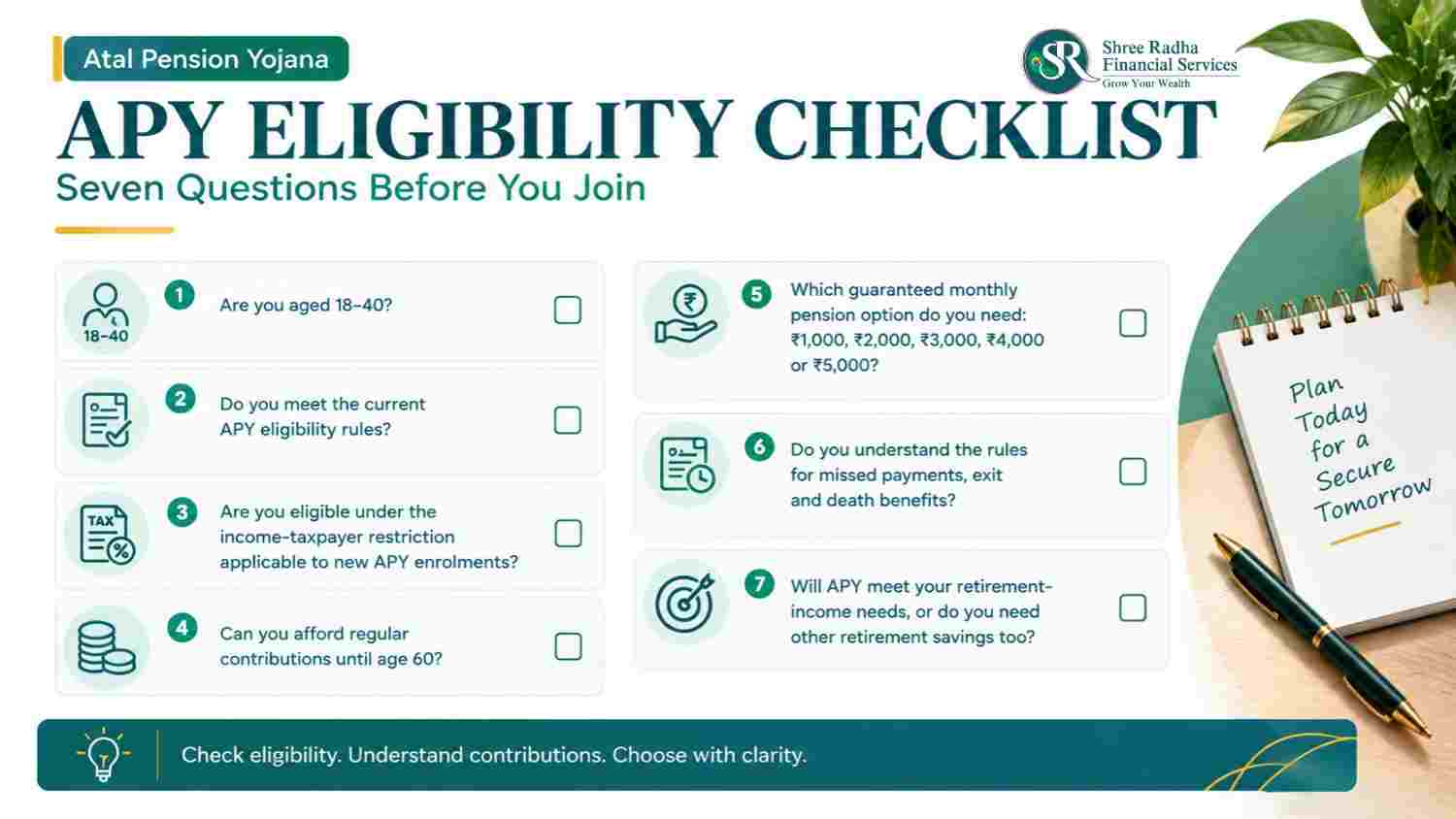
- Am I between 18 and 40? Check your age on the date of joining.
- Am I an income-tax payer? Ask your bank to confirm your eligibility.
- Can I pay the monthly amount for 20 years or more? Pick the slab you can manage.
- Will my account have the money on the debit date? Keep a small buffer.
- Do I understand the guaranteed pension does not rise with inflation? Plan for a second layer.
- Have I named my nominee and added spouse details?
- Do I know I cannot take the money out before 60? Keep an emergency fund separately.
Rules and regulations change from time to time. Please connect with your tax consultant / CA for details specific to your situation. Figures in this article were last verified on 28 October 2026.
APY Eligibility: Frequently Asked Questions
Who meets APY eligibility for Atal Pension Yojana?
Indian citizens aged 18 to 40 with a savings bank or post office account and KYC, who are not income-tax payers. Please confirm your own case with your bank.
Does APY eligibility allow an income-tax payer?
No. Since 1 October 2022, anyone who is or has been an income-tax payer cannot join APY. Accounts opened in breach can be closed.
Can a homemaker join if her husband pays tax?
Yes. APY eligibility depends on her own status: she must not be an income-tax payer and must meet the age and KYC rules. The test is her own status, not her husband’s.
Can both husband and wife join APY?
Yes, each in their own name, if each is eligible. A couple can build up to ₹10,000 a month between them.
Is the APY pension fixed or does it rise with inflation?
The guaranteed minimum pension is ₹1,000 to ₹5,000 a month for life. It is not linked to inflation. The Government notification says a higher pension is possible depending on investment returns, but this is not guaranteed.
What is the penalty if I delay an APY payment?
₹1 to ₹10 a month, depending on the contribution amount. The account is frozen after 6 months of non-payment, deactivated after 12 months and closed after 24 months. Banks may also charge for a failed auto-debit.
Can I exit APY before 60?
As per the Government notification, only in exceptional circumstances: death, or specified illnesses under the NPS exit regulations. Please confirm the current rule with your bank.
What happens to APY after the subscriber’s death?
The spouse gets the same pension for life. After both, the nominee receives the corpus (₹8.5 lakh for the ₹5,000 slab).
This article is also available on Medium for wider reading:https://medium.com/@shreeradha.services/atal-pension-yojana-apy-who-should-take-it-who-should-not-and-what-5-000-really-buys-9701f7963073
Want to Check Your APY Eligibility and Retirement Plan?
Connect with Shree Radha Financial Services for a personalized discussion.
📞 Call/WhatsApp: +91 98791 13255
📧 Email: shreeradha.services@gmail.com
🌐 Visit: www.srwealth.co.in
📍 Shop 33, Mira Nagar 2, Dindoli Road, Surat 394210
Paresh Chaudhary
Founder, Shree Radha Financial Services, Surat
AMFI Registered Mutual Fund & SIF Distributor — ARN: 268390
APMI Registered PMS Distributor — APRN05763
Investing since 2012 | BE Mechanical, SVNIT Surat | Ex-L&T (15+ Years)
Educational Disclaimer: This article is published by Shree Radha Financial Services — an AMFI Registered Mutual Fund & SIF Distributor (ARN: 268390) and APMI Registered PMS Distributor (APRN05763). Atal Pension Yojana is a scheme of the Government of India regulated by PFRDA and is not a product of this firm. All content is strictly for educational purposes only and does not constitute individualized investment advice. Mutual fund investments are subject to market risks — read all scheme-related documents carefully before investing. Tax treatment is based on current laws and subject to change. Please consult a qualified tax professional before investing. The characters in this article (Ramesh, Meena, Jayesh, Dilipbhai and Hardeep) are fictional and used only to explain situations. Numbers in the worked examples are illustrative and are not a promise of returns.