NPS Switch in 2026: Why Everyone Is Asking
NPS switch is a phrase people use for three very different things, and mixing them up costs time and sometimes money. Some mean a new job. Some mean changing the pension fund or scheme inside their account. Some mean the central government’s choice between NPS and UPS.
PFRDA issued a major circular on 28 August 2026 that changed how schemes are named and how often you can change them. The UPS option and its one-time switch back to NPS keep coming up in government offices. And every private employee who changes a job asks, “What happens to my NPS?”
This guide splits the NPS switch into three clear moves. Each NPS switch comes with a story, and you will meet four people from Pune, Surat, Bengaluru and Jaipur. Each one believed something that was only half true. You will see what they thought, where the mistake was, and how it was corrected. For exit rules, read our NPS withdrawal rules guide. For the wider picture, start with our retirement schemes guide.
“People ask me which NPS switch is the best one. The better question is which switch they are actually making. A job change, a fund change and a scheme-type change are three different decisions with three different rulebooks.”
— Paresh Chaudhary, Founder, Shree Radha Financial Services

The Three Moves Behind Every NPS Switch
Before any NPS switch, find your move in this table. Most confusion ends right here.
| Point | Move 1: Job change | Move 2: Inside NPS | Move 3: Scheme type |
|---|---|---|---|
| What it means | You leave one employer and join another, or move from corporate NPS to your own account | You change the pension fund, the scheme, or both, in the same account | You move between NPS and UPS (central government), or ask about the old pension scheme |
| Who is affected | Private and corporate employees, and anyone moving jobs | All Citizen and corporate subscribers. Government-sector accounts follow separate rules | Central government employees for UPS. State employees follow their own state’s order |
| What stays the same | Your PRAN and your money | Your PRAN, and the original account conditions on a scheme change | Your service record and your NPS account |
| Main rule to know | Employer’s contribution stops when you leave. Your own account continues | A maximum of two change requests per account in a financial year | UPS to NPS is a one-time, one-way switch with a last date |
NPS Switch Story 1: Neha in Pune and the New Job
Neha is 32. She is a software engineer at an IT company in Pune. Her company has corporate NPS and puts in a part of her basic pay. A Bengaluru company offered her a better role, and she wanted to accept.
She called us on a WhatsApp video call (we have no office in Pune). Three beliefs were worrying her. First: “If I leave, my NPS gets closed.” Second: “The new company means a new NPS account, and I start again.” Third: “The tax benefit on the employer’s NPS will carry on automatically.”
Here is how each belief about her NPS switch was tested.
“My NPS gets closed.” No. The NPS account is yours, not your employer’s. Your PRAN (the account number) stays with you. What stops is the employer’s contribution once your link with that employer ends. Your money stays invested. You can keep adding to the same account on your own, as an All Citizen subscriber. The exact steps and any charges are shown on the CRA website or by your point of presence, so please check them there.
“A new PRAN.” Not needed. Give your existing PRAN to the new HR team. If the new company does not offer NPS, you can continue on your own.
“The tax benefit carries on.” Only if the new employer contributes. The employer’s contribution deduction is in Section 124(1)-(2). Earlier this was Section 80CCD(2) under the 1961 Act. The limit is 10% of salary for a private employer in the old regime and 14% in the new regime. If no employer contributes, there is no employer deduction to claim. We cover the full tax picture below, and in our old vs new tax regime guide.
Neha’s mistake was treating NPS like an employer benefit that ends with the job. It is a personal account that an employer can add to. She joined the new company with the same PRAN and a clear idea of what would change. Her NPS switch needed no new account.
NPS Switch Move 1: Changing Jobs and Moving to All Citizen
What happens to your PRAN and your money
PFRDA’s scheme circular says a PRAN is unique to a Central Recordkeeping Agency (CRA), and one PRAN can hold more than one scheme. In plain words, you keep one account number for life, whichever job you are in. Your employer-linked status can change, but the account stays. So a job-linked NPS switch never means a new account.
What the corporate NPS circular says about choices
PFRDA’s circular of 7 November 2025 revised the corporate model. Where the employer contributes, the choice of pension fund and scheme is based on a formal mutual agreement between management and employees. The employer reviews that choice every year as per the agreement. An employer can also decide to hand the choice fully to the employee. This means your freedom for an NPS switch in corporate NPS depends on your company’s policy. Please ask your HR team what applies in your company.
If your old PF or superannuation balance moves to NPS
Some people ask whether an old provident fund balance can be moved into NPS. The Income-tax Act, 2025 says that a recognised provident fund balance is excluded from income if the entire balance is transferred to your account under the notified pension scheme. This is in Schedule XI, Part A, paragraph 8(1)(d). Earlier this was Rule 8 of Part A of the Fourth Schedule to the 1961 Act.
A payment from an approved superannuation fund that is transferred to your NPS account is also covered, in Schedule II, Sl. 8(e). Earlier this was Section 10(13). Whether your PF trust and your NPS account allow such a move in practice is a separate question. Please check with your employer and your tax consultant before acting.
For senior professionals, corporate NPS and tax planning often go together. Our CXO guide covers more.
NPS Switch Story 2: Hiren in Surat and the Two Change Requests
Hiren is 41. He runs a textile trading firm in Varachha, Surat. He opened an All Citizen NPS account in 2022 and chose Active Choice, with a high share in equity. When the market fell, he told us, “I want to move to the safest scheme today and move back when the market recovers.”
His friend had told him a few things, and Hiren believed all of them. First: “You can change the fund manager as many times as you like.” Second: “Changing scheme restarts the lock-in clock.” Third: “Merging two schemes is just tidying up.”
“As many times as you like.” No. PFRDA’s circular of 28 August 2026 allows a maximum of two requests per account in a financial year. A request to change the pension fund, the scheme, or both together counts as one request. So Hiren has two NPS switch requests in a year, not unlimited ones.
“The clock restarts.” Also no. A change from one scheme to another does not affect the vesting period or the other conditions of the account. The clock still runs from the original date of opening.
“Merging is tidying up.” This is where he was close to a costly mistake. If you merge one scheme into another, the merged money is governed by the target scheme’s rules, including vesting, charges, partial withdrawals and scheme changes. A merge is a different action from a change, and you cannot undo it casually.
Hiren also wanted to hold Lifecycle and Active Choice together. That is not allowed: one PRAN can hold only one of the two at a time. Holding several MSF schemes together is allowed. His mistake was planning an NPS switch out of market fear. He kept his plan and used one of his two requests later, on a planned date.
NPS Switch Move 2: Changing Fund or Scheme Inside Your Account
An NPS switch inside your account does not take money out of NPS. It changes how your money is invested. Please check on the CRA site whether a change applies to your existing corpus, your future contributions, or both. You can read more on the NPS Trust website and the PFRDA website.
The five types of scheme, as per PFRDA’s 28 August 2026 circular
| Type | What it is | Good to know |
|---|---|---|
| Lifecycle | Equity, corporate bond and government securities mix changes with your age | Four variants: Aggressive, 75 High, 50 Moderate and 25 Low |
| Active Choice | You decide the split among equity, corporate bonds and government securities | Equity up to 75%, and up to 100% in Tier II |
| NPS Sanchay | A composite scheme for the informal sector with a fixed pattern | Equity up to 25% |
| MSF | Schemes launched by pension funds, now sorted into categories A to E | You can hold more than one MSF scheme together |
| 4A schemes | Special schemes such as NPS Vatsalya, NPS Swasthya and NPS MSME | Follow their own guidelines |
The new A to E categories for MSF schemes
Every MSF scheme must now sit in one category based on its equity range, and the category code must be in the scheme’s name. For example, a name like “XYZ NPS A Retirement Scheme” tells you at once that it is a very high equity scheme.
| Category | Label | Equity range |
|---|---|---|
| A | Aggressive Growth, very high risk | 80% to 100% |
| B | High Growth, high risk | 60% to 80% |
| C | Balanced Growth, medium risk | 35% to 60% |
| D | Conservative | 10% to 35% |
| E | Debt, government and corporate bonds | 0% to 10% |
Reports say pension funds have been asked to rename their existing MSF schemes within 30 days, so you may see new names on the CRA website. If you hold Lifecycle or Active Choice, those reports say your account is not touched. Please read the notice from your own pension fund.
Rules for the NPS switch inside your account
- Limit: a maximum of two requests per account in a financial year. Fund, scheme or both together count as one request. Please check on the CRA site how your Tier I and Tier II accounts are counted.
- Clock: a scheme change does not affect the vesting period or other account conditions. They run from the original opening date.
- Merge: merging a scheme into a target scheme puts that money under the target scheme’s rules.
- Holding: only one of Lifecycle or Active Choice at a time under one PRAN, but more than one MSF scheme is allowed.
- Display: platforms must show type, then category, then pension fund, with historical returns, benchmark, charges, riskometer and AUM, so you can compare before choosing.
- Charges: they differ for direct subscribers and for those who come through a point of presence. The circular’s Annexure A has the ranges, so please read it before you pay anything.
- Government sector: the circular does not apply to accounts tagged to the Government sector.
Returns are not fixed. A good-looking past return does not promise a future one, and it does not make an NPS switch safe. If you want a long-term view, our guide on whether ₹2 crore is enough to retire helps you think about the whole corpus.
NPS Switch Worked Example 1: Hiren’s Year and the Clock
Let us put Hiren’s year on paper. These are examples, not advice.
| In one financial year | Counts as | Requests used |
|---|---|---|
| Change pension fund from X to Y | 1 request | 1 of 2 |
| Change scheme and pension fund together | 1 request | 2 of 2 |
| Any further change in the same year | Not allowed | Wait for the next financial year |
Now the clock. PFRDA’s own illustration uses a 15-year vesting period.
| Action on 1 April 2029 | Account opened 1 April 2026 in Scheme A | Which rules apply |
|---|---|---|
| Change from Scheme A to Scheme B | Vesting still counts from 1 April 2026 | Original account conditions, including the limit of four partial withdrawals |
| Merge Scheme A into Scheme B | The merged money moves to Scheme B’s rules | Scheme B’s vesting, charges, partial withdrawals and change rules |
Illustrative only, based on the example in PFRDA’s circular. Check the circular and your own account details before acting.
The lesson is simple. A change keeps your clock. A merge can change it. Know which NPS switch button you are pressing.
NPS Switch Story 3: Prakash in Bengaluru and the UPS Switch Back
Prakash is 48. He works in a central government establishment in Bengaluru. He joined in 2008 and is covered by NPS. In 2025, after the office circular, he opted for UPS. Now he is not sure that he made the right choice, and he called us on WhatsApp video (we have no office in Bengaluru).
He believed three things. First: “UPS is permanent, there is no way back.” Second: “UPS means a fixed pension, so I need to think no more.” Third: “If I ever switch back to NPS, I lose the government’s extra contribution.”
“No way back.” There is one way back, once. The Central Civil Services (Implementation of Unified Pension Scheme under the National Pension System) Rules, 2025, give a one-time, one-way switch from UPS to NPS. It must be exercised not later than one year before the date of superannuation, or three months before the deemed date of retirement in the case of voluntary retirement. After you switch to NPS, you cannot go back to UPS. If you do not switch within the time, you continue under UPS.
“A fixed pension, no more thinking.” Not quite. As per PFRDA’s page, the assured payout is 50% of the average basic pay of the last 12 months, after at least 25 years of qualifying service. For shorter service the payout is proportionate, and a minimum ₹10,000 a month applies after 10 years. If you take a final withdrawal of up to 60% of the corpus, the assured payout is reduced.
“I lose the extra contribution.” The government has said that its differential contribution for the UPS period, worked out at the default investment pattern, is credited to the NPS account when you exit after switching. The PIB release of 18 September 2025 mentions 4%. The exact method should be confirmed with your office.
Prakash’s mistake was leaving his NPS switch decision to the last minute. He started a simple list of questions and a date diary instead.
NPS Switch Move 3: UPS, NPS and the Old Pension
How UPS works in one paragraph
UPS started on 1 April 2025 as an option inside NPS for central government employees. The employee contributes 10%, and the government adds a matching 10% plus about 8.5% to a pool corpus. Family gets 60% of the payout to the spouse. We compare it with OPS and NPS in our NPS withdrawal rules guide.
Is the option to join UPS still open?
Our earlier guide noted 30 November 2025 as the date set for serving employees to opt for UPS, with the possibility of further extensions. New recruits get 30 days from joining. Please ask your office whether any window is open for you today. Do not rely on old news.
When can you switch from UPS to NPS? A date example
This is the rule that makes the central government NPS switch different from all the others.
| Case | Key date | Last date to switch |
|---|---|---|
| Superannuation | 30 June 2038 | Not later than 30 June 2037 (one year before) |
| Voluntary retirement | Deemed date 1 January 2034 | Not later than 1 October 2033 (three months before) |
Illustrative dates. How the dates are counted should be confirmed with your office and the rules.
NPS Switch Worked Example 2: UPS Payout vs an NPS Corpus
Suppose Prakash retires with an average basic pay of ₹90,000 over the last 12 months and 30 years of service. UPS assured payout is 50%, which is ₹45,000 a month before dearness relief. Now compare this with an NPS corpus. The monthly pension below uses an assumed annuity rate of 6% a year. It is not a quote.
| Illustration | UPS assured payout | NPS, corpus ₹1.5 crore | NPS, corpus ₹2.25 crore |
|---|---|---|---|
| Lump sum | Gratuity and a service-linked lump sum (not shown) | 60%, which is ₹90 lakh | 60%, which is ₹1.35 crore |
| Amount into annuity | Not applicable | 40%, which is ₹60 lakh | 40%, which is ₹90 lakh |
| Monthly pension | ₹45,000 before dearness relief (taxable) | About ₹30,000 (taxable) | About ₹45,000 (taxable) |
| Depends on | Years of service and last basic pay | Market returns and annuity rate | Market returns and annuity rate |
Illustrative only. Not an annuity quote and not a promise of returns. ₹60 lakh at 6% a year is ₹3.6 lakh a year, or ₹30,000 a month. ₹90 lakh gives ₹45,000 a month.
What does this show? At the assumed rate, an NPS corpus of about ₹2.25 crore would be needed for the annuity part alone to match ₹45,000 a month. That is one way to see what UPS promises. It is not a verdict. UPS needs long service, and taking the 60% withdrawal reduces the assured payout. NPS gives flexibility, market growth and a corpus that can pass to family. Dearness relief, tax and your own health and family needs also matter. So the right NPS switch depends on your numbers and your priorities, not on a headline.
NPS Switch Story 4: Kavita in Jaipur and the Old Pension Hope
Kavita is 44. She teaches in a state government school in Jaipur. News about the old pension scheme returning in some places has reached her staff room. She called us on a phone call (we have no office in Jaipur).
She believed three things. First: “OPS is coming back for everyone, so NPS details no longer matter.” Second: “UPS applies to me too.” Third: “I can change my NPS fund the way private employees do.”
“OPS is coming back for everyone.” The old pension scheme mainly covers central government employees recruited before 1 January 2004. For state employees, each state decides its own rules, and they can change. We do not take a side. Please follow your own department’s latest order, and keep copies of it.
“UPS applies to me.” UPS is a central government scheme. It does not automatically apply to state employees.
“I can change my fund like a private employee.” PFRDA’s circular of 28 August 2026 does not apply to accounts tagged to the Government sector. Her account follows the government-sector rules, so she should ask her office or nodal officer before planning any change.
Kavita’s mistake was waiting for policy news before any NPS switch decision and ignoring the basics. She updated her nominee and PRAN details first. Those steps help in every situation. For a wider view, read our retirement planning guide for Surat investors, which applies across India too.
NPS Switch: Who Can Do What
The rules for an NPS switch depend on your type of account.
| Point | All Citizen | Corporate NPS | Central government | State government |
|---|---|---|---|---|
| Change fund or scheme | Yes, up to two requests per account per financial year | Only as permitted by the 7 November 2025 circular and your employer’s agreement | Circular of 28 August 2026 does not apply. Ask your nodal office | Same as central: ask your department |
| Job change | Not linked to an employer | PRAN stays. Employer link and contribution end | Service rules decide | Service rules decide |
| UPS option | Not available | Not available | Yes, with a one-time switch back to NPS | Not a central scheme. The state decides |
| Old pension (OPS) | Not applicable | Not applicable | Mainly those recruited before 1 January 2004 | The state decides |
NPS Switch Tax: The EEE Check for Each Move
The Income-tax Act, 2025 came into effect on 1 April 2026. NPS now sits in Section 124. Earlier this was Section 80CCD under the 1961 Act. You can see the law on the Income Tax Department website. EEE means exempt when you invest, exempt while it grows, exempt when you withdraw. For NPS, the last stage is only partly exempt. Each NPS switch has its own tax angle, so the table goes move by move.
| Stage or move | Old tax regime | New tax regime |
|---|---|---|
| Employer’s contribution | Section 124(1)-(2) (earlier 80CCD(2)): up to 10% of salary for private employers, 14% for Central or State Government employers | Up to 14% for everyone. This is the one NPS benefit that survives in the new regime |
| Your own contribution | Counts within the overall ₹1.5 lakh limit. Extra ₹50,000 under Section 124(3) (earlier 80CCD(1B)). Not claimed again under Section 123 | No deduction |
| Job change, same PRAN | The account is not closed, so the closure rule in Section 124(6) is not triggered. Please confirm with your CA | Same |
| Change of fund or scheme inside NPS | No payment is made out. We did not find a provision that taxes a scheme change. Please confirm with your CA | Same |
| PF or superannuation balance moved into NPS | Excluded from income if the conditions are met (Schedule XI Part A para 8(1)(d); Schedule II Sl. 8(e)) | Same. Please confirm with your CA |
| NPS exit (closure) | Section 124(6) treats the amount as income, but Schedule II Sl. 6 (earlier 10(12A)/(12B)) exempts up to 60%. Money used to buy an annuity in the same tax year is not treated as received (Section 124(9)) | Same |
| UPS at retirement | Section 124(11) (earlier 80CCD(3A)) treats the amount as income. Transfer from individual corpus to pool corpus is not treated as received (Section 124(12), earlier 80CCD(6)). Schedule II Sl. 15 and 16 (earlier 10(12AA)) exempt up to 60% of individual corpus and the lump sum | Same |
| UPS to NPS switch | We could not confirm a specific rule. Please ask your CA before switching | Same |
| Annuity pension | Monthly pension is taxable as income | Same |
Tax on an NPS switch depends on your regime, income and employer policy. Rules and rates change. Please confirm the exact position for your case with your tax consultant or CA. Our tax computation guide explains the new Act in simple steps.
NPS Switch: When It Helps and When to Wait
- Helps: you changed jobs and want to continue the same account on your own. Your age has moved on and your scheme no longer fits your plan. You have a planned date, not a market scare.
- Helps: a central government employee has a clear timeline and has compared UPS and NPS with real numbers.
- Wait: you want an NPS switch only because the market fell this month. You have two requests a year, so use them with care.
- Wait: you plan to merge schemes but have not read the target scheme’s rules.
- Wait: you are a state employee and have not checked your department’s latest order.
- NRIs: eligibility and tax rules differ. Start with our NRI retirement planning guide.
NPS is one part of a plan, and an NPS switch is a small step inside it. Many families keep a safe bucket, such as PPF, and a flexible bucket next to it. You can try your own numbers on our calculator.
Seven NPS Switch Mistakes to Avoid
Most NPS switch mistakes come from mixing the three moves.
- Treating a job change as the end of your NPS account.
- Opening a new PRAN instead of using the one you have.
- Using both yearly change requests out of market fear.
- Merging schemes without reading the target scheme’s rules.
- Assuming the private subscriber rules apply to a government-sector account.
- Leaving the UPS to NPS decision to the last month.
- Waiting for old pension news while the nominee and PRAN details are out of date.
NPS Switch Checklist: Seven Questions Before You Act
Use this list to apply the NPS switch rules to your own account.
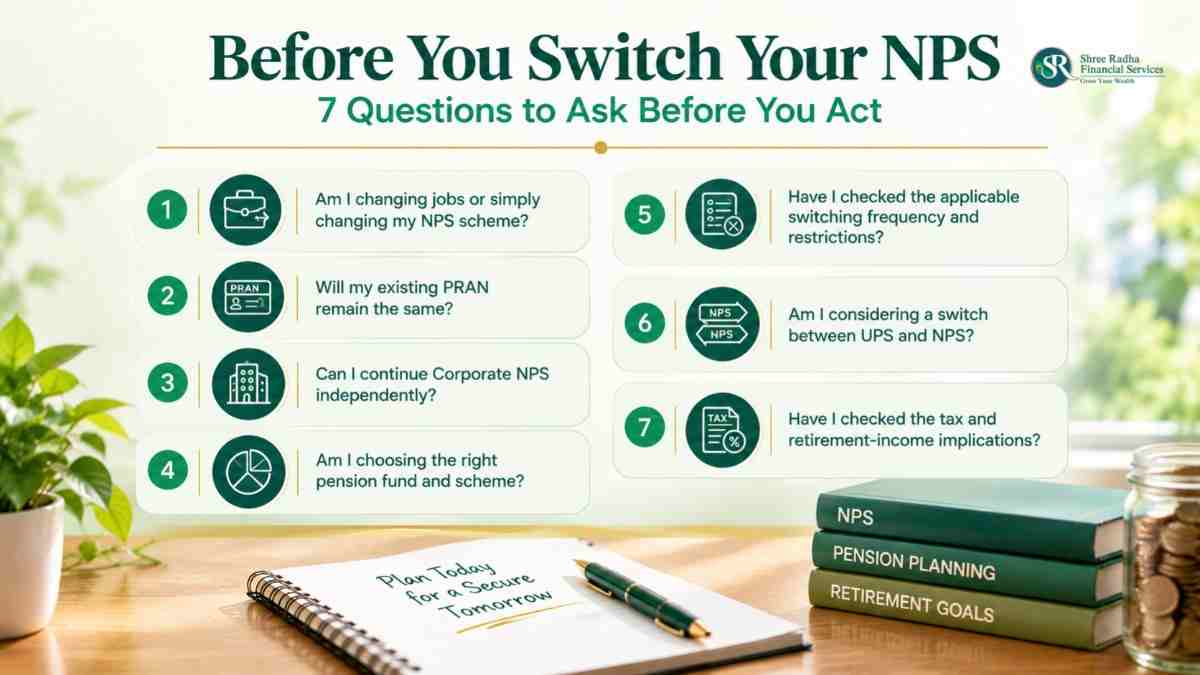
- Which move am I making? A job change, a change inside NPS, or a change of scheme type.
- What type of account do I hold? All Citizen, corporate or government sector. The NPS switch rules differ.
- Are my PRAN details and nominee updated?
- How many change requests have I used this financial year? The limit is two per account.
- If I merge schemes, do I know the target scheme’s rules?
- If I am a central government employee, do I know my last date to switch from UPS to NPS?
- Have I checked the tax effect for my case with my CA?
Rules and regulations change from time to time. Please connect with your tax consultant / CA for details specific to your situation. Figures in this article were last verified on 29 October 2026.
NPS Switch: Frequently Asked Questions
What exactly is an NPS switch?
An NPS switch can mean three things: a job change with the same PRAN, a change of pension fund or scheme inside your account, or the central government choice between NPS and UPS. Each has its own rules, so first decide which one you mean.
How many times can I change my pension fund or scheme in NPS?
For accounts covered by PFRDA’s circular of 28 August 2026, you can submit a maximum of two requests per account in a financial year. A change of fund, scheme or both together counts as one request. The circular does not apply to accounts tagged to the Government sector.
Does my PRAN change when I change jobs?
No. Your PRAN stays with you. What changes is the employer’s link and contribution. Please give your existing PRAN to the new employer.
Can I continue my corporate NPS on my own after leaving the job?
Yes, this NPS switch keeps the same account, and you continue as an All Citizen subscriber. The exact steps and any charges are shown on the CRA website or with your point of presence, so please check them there.
Is a change of NPS scheme taxable?
A scheme change inside your account is not a withdrawal. We did not find a provision that taxes it, but please confirm with your CA. Tax applies when money is received on closure or exit, as explained in the table above.
Can a UPS subscriber switch back to NPS?
Yes, once. It is a one-time, one-way switch. It must be done not later than one year before superannuation or three months before the deemed date of voluntary retirement. After switching, you cannot go back to UPS.
Is the UPS option still open?
That depends on your status. Serving employees were given a window that was extended, and new recruits get 30 days from joining. Please ask your office what applies to you today.
Can I choose the old pension scheme?
For central government employees, OPS mainly covers those recruited before 1 January 2004. For state employees, each state decides. Please check your department’s latest order.
My scheme has been renamed. Do I need to act?
PFRDA has asked pension funds to use a new naming format that shows the category code. Reports say a rename alone does not mean you must switch. Please read the notice from your pension fund and check the equity category, charges and benchmark.
This article is also available on Medium for wider reading:https://medium.com/@shreeradha.services/nps-switch-the-three-moves-most-people-mix-up-e7c8807c02b1
Want to See How an NPS Switch Fits Your Retirement Plan?
Connect with Shree Radha Financial Services for a personalized discussion.
📞 Call/WhatsApp: +91 98791 13255
📧 Email: shreeradha.services@gmail.com
🌐 Visit: www.srwealth.co.in
📍 Shop 33, Mira Nagar 2, Dindoli Road, Surat 394210
Paresh Chaudhary
Founder, Shree Radha Financial Services, Surat
AMFI Registered Mutual Fund & SIF Distributor — ARN: 268390
APMI Registered PMS Distributor — APRN05763
Investing since 2012 | BE Mechanical, SVNIT Surat | Ex-L&T (15+ Years)
Educational Disclaimer: This article is published by Shree Radha Financial Services — an AMFI Registered Mutual Fund & SIF Distributor (ARN: 268390) and APMI Registered PMS Distributor (APRN05763). NPS and UPS are regulated by PFRDA and are not products of this firm. All content is strictly for educational purposes only and does not constitute individualized investment advice. Mutual fund investments are subject to market risks — read all scheme-related documents carefully before investing. Tax treatment is based on current laws and subject to change. Please consult a qualified tax professional before investing. The characters in this article (Neha, Hiren, Prakash and Kavita) are fictional and used only to explain situations. Numbers in the worked examples are illustrative, use an assumed annuity rate that is not a quote, and are not a promise of returns.